Jimi Hendrix’s London (Part One)
Incredibly, it is almost fifty years since legendary musician, Jimi Hendrix’s sublime guitar skills became known to the world.

Jimi Hendrix
Born in Seattle, Washington on November 27th 1942, Jimi Hendrix obtained his first guitar- an acoustic model costing a mere $5- when he was fifteen years old.
In 1961 he enlisted in the army where he trained to be a paratrooper.

Jimi Hendrix during his army days
Military life wasn’t for Private Hendrix- perhaps most clearly demonstrated when he was caught dozing whilst on duty!
He was discharged in 1962 and, eager to forge a career in music, began touring clubs across the United States.
Over the next few years Jimi perfected his craft but despite his talent, he struggled to make a wage, remaining undiscovered and creatively stifled.
His luck changed in May 1966 whilst playing at the Cheetah club in New York.
Here he was spotted by Linda Keith– girlfriend of the Rolling Stones’ Keith Richards– who recommended the dazzling guitarist to Chas Chandler– former bassist for The Animals who was looking to establish himself as a manager.

Linda Keith and Chas Chandler
Like Linda, Chas Chandler could see that Jimi Hendrix was indeed a very rare talent… and so decided to whisk him to London which, during the swinging 60s, was the place where Jimi Hendrix would flourish and make his name.
Tragically, it was also the city in which he would lose his life.
*
In tribute to Jimi Hendrix and to celebrate the exciting announcement that one of his former London homes will soon be opening to the public as a museum, I have compiled a list of some of the most notable London locations associated with the late, great performer…

The Jimi Hendrix Experience posing on Westminster Bridge
*
11 Gunterstone Road, W14

Jimi Hendrix first arrived in London on 24th September 1966, flying into London Airport (which officially changed its name to ‘Heathrow’ that same year).

Jimi Hendrix pretending to thumb a lift at Heathrow, 1970
After several years as a struggling musician, Jimi Hendrix had very little to his name. When he boarded the plane in New York his only possessions were a change of clothes, a set of hair curlers, $40 (which he’d borrowed) and of course his beloved guitar.
Upon his arrival in London, Jimi was taken straight from the airport to 11 Gunterstone Road, West Kensington which was the home of British musician, Zoot Money, a major figure on the Soho scene at the time.

11 Gunterstone Road today (inset: Zoot Money)
Whilst at the house, Jimi took part in a jamming session with Zoot’s friend, Andy Summers– who would later go on to play with The Police.
*
Scotch of St James Club, 13 Mason’s Yard W1

On the evening of 24th September 1966, Jimi Hendrix played his first ever UK solo gig at the exclusive Scotch of St James club in Mason’s Yard; a peaceful courtyard which is now dominated by the White Cube modern art gallery.

Mason’s Yard today
A stone’s throw from Buckingham Palace, the club was popular with The Rolling Stones and The Beatles, both of whom enjoyed the luxury of their own private tables. The Who and Stevie Wonder also spent time here.
Immediately after his set, Jimi met Kathy Etchingham and the pair embarked upon a two year relationship.

Jimi Hendrix and Kathy Etchingham
The following month, Hendrix returned to Scotch of St James with musicians Mitch Mitchell and Noel Redding, who together formed The Jimi Hendrix Experience and thus it was here that the trio performed their UK debut.

Jimi, Mitch and Noel…The Jimi Hendrix Experience
*
Les Cousins Club (now Club 49), 49 Greek Street W1

Originally opened in the 1950s as the ‘Skiffle Cellar’, Les Cousins (tucked away beneath the Soho Grill) was at the heart of London’s folk scene by the 1960s

The Soho Grill, beneath which Les Cousins was located (image: John Martyn.com)
After just a few days in London, Jimi Hendrix and Chas Chandler paid a visit to the club as regular guests, paying their own entry fee.
Blues musician, Alexis Korner was on stage that night and Chas Chandler asked if Jimi could join him on stage for a jamming session… needless to say the crowd were gobsmacked by the young American’s flair!

The site today- now known as Club 49 (image: Google)
*
Westminster Polytechnic (now Westminster University, Regent Campus), Little Titchfield Street

On the evening of 1st October 1966, Cream were playing at this London Polytechnic campus when Jimi Hendrix rather audaciously asked if he could get up and jam with Eric Clapton, the UK’s undisputed guitar king.

The site today- now part of the University of Westminster
Jimi’s skill and flamboyant style knocked Eric Clapton for six and, once back stage the Cream guitarist had to ask Chas Chandler if the American was ‘always that good?’!
Despite their guitar duel, Eric Clapton and Jimi Hendrix became firm friends.

Jimi Hendrix and Eric Clapton, 1967
*
Cromwellian Club (now gone), 3 Cromwell Road, SW7

Situated directly opposite the Natural History Museum, the Cromwellian Club was rumoured to have started life as an illegal gambling den.

The Cromwellian Club
By the 1960s, ‘The Crom’ as it was nicknamed had established itself as a popular casino and music venue, witnessing performances from the likes of Georgie Fame, Eric Clapton and a very young Elton John.
Jimi Hendrix played one of his earliest gigs here in October 1966.

Site of the Cromwellian Club today
*
Bag O’ Nails Club, 9 Kingly Street W1

The Jimi Hendrix Experience played a gig at the Bag O’Nails club on 25th November 1966, after which, Jimi remarked, “Britain is really groovy”- not a surprising observation considering the club backs onto the ultra-hip Carnaby Street.

The Bag O’ Nails Club today
At another Bag O’Nails gig on 11th January 1967, Paul McCartney and Ringo Starr were in the audience… it was the first time they’d seen Jimi play live and, naturally, they were entranced.
Later that year, Paul McCartney met his future wife, Linda at the club.

Plaque commemorating the Jimi Hendrix Experience’s Bag O’Nails gig
*
Blaises Club (now gone) 121 Queen’s Gate SW7

Located in the basement of the now demolished Imperial Hotel, Blaises (named after the cartoon character, Modesty Blaise) was a cramped, sweaty club which, according to Melody Maker journalist, Chris Welch, was a venue, “where musicians, agents, managers and writers allowed themselves to be deafened whilst imbibing quantities of alcohol.”

The forlorn site of the former hotel and club in 2014
Jimi Hendrix appeared here on 21st December 1966 which led to one of first rave reviews: “Jimi has great stage presence and an exceptional guitar technique which involved playing with teeth on occasions and no hands at all on others!” (tricks which he’d learnt from old timers whilst on the US circuit).

Jimi Hendrix playing with his teeth
Pink Floyd were another big name to appear at Blaises and the club can be seen in the cult 1967 film, The Sorcerers (in which Boris Karloff uses hypnosis to seriously mess up one cool cat’s mind!)
Please click below to view a clip of the Blaises club in its heyday:
*
34 Montague Square, W1

During the 1960s, the basement of this rather grand address was leased by Ringo Starr.

34 Montagu Square today
Consequently, the home has numerous connections with The Beatles– the song, ‘Eleanor Rigby‘ was developed here for example and in 1968 the racy cover for John Lennon and Yoko Ono’s, Two Virgins album was snapped on the premises.
Jimi Hendrix rented the basement from Ringo between December 1966 and March 1967, moving in with his girlfriend, Kathy Etchingham. Whilst at the address, Jimi composed ‘The Wind Cries Mary’.

Unfortunately Ringo had no option but to evict Jimi Hendrix when the guitarist, whilst under the influence of LSD, splashed paint all over the walls…

Jimi Hendrix on the steps of 34 Montagu Square
One of the most iconic photographs of Jimi was taken just across the road on Montagu Place outside the Swedish embassy. Sadly, the original street sign has since been removed.

Jimi Hendrix posing on Montagu Place

The spot where Jimi stood. Montagu Place today… with Jimi’s sign sadly gone
*
Lime Grove Studios (now gone), W12

Between 1940 and 1991, Lime Grove in Shepherd’s bush was home to a BBC studio where many classic shows including Top of the Pops, Blue Peter, Doctor Who and a 1954 adaptation of George Orwell’s, 1984 (performed live and starring Peter Cushing) were filmed.

Lime Grove’s studio floor (image: BBC)
The Jimi Hendrix Experience filmed their first appearance for Top of the Pops here on 29th December 1966 with a performance of ‘Hey Joe’. Their next shoot took place on 30th March 1967– and can be viewed below.
Sadly, Lime Grove studios were demolished in 1993 and a modern housing development now occupies the site.

Site of the former Lime Grove studios today (image: Google)
*
The Upper Cut Club (now gone), 1-39 Woodgrange Road, E7

Out beyond Stratford and past the former 2012 Olympic Park, this is probably the furthest east Jimi Hendrix ever ventured whilst in London!

The former Upper Cut club as it appeared in 1991 (image: E7 Then and Now)
Based in Forest Gate, the Upper Cut Club was in business for just one year between 1966 and 1967. Despite its short span, the club shone bright playing host to such greats as The Who, Otis Redding, Sam and Dave, Prince Buster, Ben. E. King and Nina Simone.

Otis Redding at the Upper Cut club, 1967
The Jimi Hendrix Experience appeared at the Upper Cut on Boxing Day, 1966…and it was here, whilst resting in the club’s dressing room, that Jimi penned Purple Haze, one of his most definitive hits.

A simple plaque now marks the site.

Plaque installed by Newham Council (image: E7 Then and Now)
*
The Speakeasy Club (now gone), 48 Margaret Street, W1

Opened in 1966 a short distance from the bustle of Oxford Circus, the Speakeasy modelled itself on the illegal drinking dens which flourished during the era of American prohibition.
Visitors entered and signed in via a fake undertaker’s parlour… and were then permitted to enter the main club through a false wardrobe door! Inside, a menacing portrait of Al Capone loomed over the patrons.

Coffins and fake wardrobes… the Speakeasy’s unique entrance… (images: New Musical Express)
This was one of Jimi Hendrix’s favourite London clubs and he could often be spotted hanging out with friends here.

Site of the former Speakeasy club today
Jimi’s first Speakeasy gig took place in February 1967… and it was here that he cheekily tried to chat up Mick Jagger’s then girlfriend, Marianne Faithful!

Jimi Hendrix hanging out at the Speakeasy, 1967
To be continued
Tales from the Terminals: Waterloo Collection
Over the past few months, View From the Mirror has been taking a detailed look at the history of Waterloo station.
In case you missed any instalments, the full series can be accessed below- please click the boxes for each link.






First Train to Paris (Waterloo Station, Final Instalment)
In the 1990s, Waterloo station expanded further when it became home to London’s first Eurostar terminal, connecting the capital to Paris and Brussels via the Channel Tunnel (or Le tunnel sous la Manche as it is in French).

The former Waterloo International Eurostar terminal (image: Wikipedia)
The idea of linking Britain and France via an underwater route has a surprisingly long history, the first crossing being suggested by French mining engineer, Albert Mathieu way back in 1802.

The earliest Channel tunnel proposal from 1802
Very much ahead of its time, Monsieur Mathieu’s concept envisioned a tunnel lit by oil lamps (surely a serious affront to health and safety by today’s standards!) through which continental travellers would have been conveyed via horse drawn carriages. The proposal also included the creation of an artificial island in the middle of the Channel to provide an important rest stop.
One year later, Englishman Henry Mottray came up with a similar scheme to create a crossing by submerging and connecting a string of pre-fabricated iron tubes.
Sadly, these pioneering visions were cast aside by the onset of the Napoleonic Wars (which concluded in 1815 with the Battle of Waterloo… after which Waterloo Bridge and, consequently, Waterloo station are named).
*
The idea of building a railway beneath the Channel was first suggested in the 1830s by Aime Thome de Gamond who, like Albert Mathieu was a French mining expert.
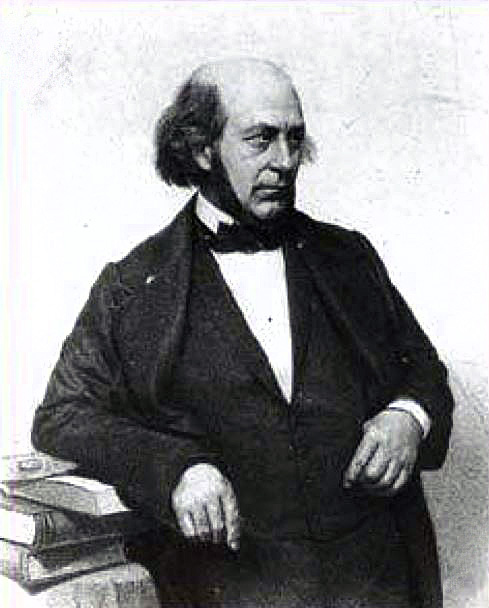
Aime Thome de Gamond
Thome de Gamond spent over 30 years and lost most of his wealth pursuing his idea (which, in the even grander scheme, aimed to extend the link all the way from London to Calcutta).
As testament to his determination, Thome de Gamond made a number of dives to the bottom of the Channel to collect geology samples… and he did so without a specialist suit, taking only a rope, 160lbs of pebbles to act as ballast and pig bladders to help him ascend. Whilst in the murky depths, Thome de Gamond gained some unwelcome attention from the Channel’s Conger Eels…

Thome de Gammond plunging beneath the Channel… (image: tunnel-sous-la-manche-skyrock.com)
During these terrifying expeditions, Thome de Gamond was rowed out into the channel by the person who believed in him the most- his daughter, Elizabeth.
In 1856, Thome de Gamond pitched his idea to Napoleon III, Queen Victoria and Prince Albert, informing them that “I have carried my studies to the limits of my personal powers…” The heads of state gave their blessing to his proposal and support was also voiced by esteemed engineers, Isambard Kingdom Brunel and Robert Stephenson.

Sketch of Thome de Gamond’s proposal which included a harbor in the middle of the Channel
Sadly, despite this encouragement the project was scuppered by the outbreak of yet another war- this time the Franco-Prussian conflict.
Exhausted and penniless, Aime Thome de Gamond died in 1876. Despite his tragic demise, he is now widely regarded as the ‘Father of the Tunnel’.

Cross section of Thome de Gamond’s vision
*
At around the time Thome de Gamond died, the Anglo-French Channel Tunnel Company was established, bringing together a collection of canal and railway engineers who carried out serious research into the creation of a tunnel. In 1880, test bores were dug at Shakespeare Cliff, Dover and at Sangatte in France.

The 1880s tunneling attempt
Unfortunately, with past wars still in mind, it was figured that such a connection would make it all too easy to mount a future invasion so the project was abandoned.

‘Hopes and Fears’; an 1882 cartoon from ‘Punch’ magazine, commenting on early Channel tunnel attempts
*
It wasn’t until 1974 that a further tunneling attempt was made. Initially quite promising, this endeavor was quickly ditched after just one year thanks to grave financial concerns triggered by the oil crisis.

The 1974 attempt… (image: kent-history.co.uk)
Despite this, the idea of forging a link between London and Paris remained a tempting concept.
In 1982 British Rail approached Lambeth Council with plans for a possible terminal at Waterloo should the idea be revived in the future… although in 1984 they also looked into the possibility of establishing a helicopter terminal on top of Waterloo in the hope that choppers capable of ferrying 200 people between the two capital cities would soon be developed!
This idea may not have sounded as far fetched as it seemed- for a brief period in the 1950s, a helicopter terminal was indeed based at Waterloo, acting as a shuttle service to and from London airport. The Shell Building now stands on the site.
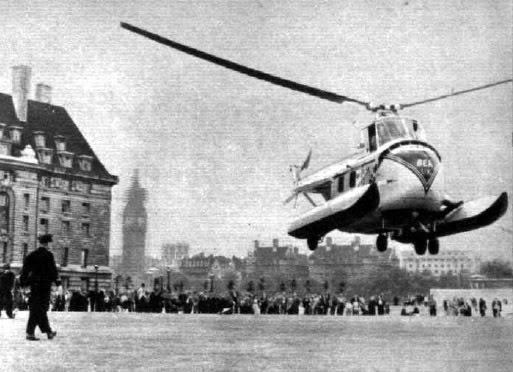
Waterloo Air Terminal, 1950s. In the 1980s, British Rail toyed with the idea of re-establishing a helicopter service.
A newsreel from 1953 featuring a helicopter test-run from Waterloo to Paris can be viewed below:
*
In 1985 things were once again set in motion when the governments of Britain and France invited private companies to come up with proposals for a channel crossing.
This resulted in four schemes being shortlisted:
Eurobridge: A vast suspension bridge for cars, with the traffic lanes contained in an enclosed tube suspended 70 meters above the Channel. The estimated cost of the bridge was £5.9 billion.

Cross-section of the tube containing road decks which would have hung from the proposed Eurobridge (image: London Illustrated News)
Euroroute: A £5 billion road built across a series of tunnels and bridges which would have been linked by artificial islands.

Euroroute… which would have linked Britain and France with a combination of bridges and tunnels (image: crd.co.uk)
Channel Expressway: A large tunnel for both cars and trains with ventilation shafts jutting out in the middle of the Channel. Cheaper at £2.1 billion, the tunnel would have seen road and rail sharing the same space- the idea being that traffic would alternate, with cars being halted ever hour to let trains through. One can only imagine the tailbacks such a set-up would have created!

Euroroute… road and rail combined (image: London Illustrated News)
Eurotunnel: A straight-forward railway tunnel… which, of course was the idea eventually chosen, mainly due to concerns that a road tunnel would pose too many problems with fumes and accidents. In 1985, the estimated cost for the Eurotunnel was £2.3 billion.

The Channel Tunnel as imagined in 1985 (image: London Illustrated News)
On July 29th 1987, Margaret Thatcher and Francois Mitterrand ratified the Treaty of Canterbury, granting Eurotunnel the green-light. Construction began in December of the same year and the two sides finally met deep beneath the Channel on the afternoon of December 1st 1990 (please click below to view):
Meanwhile back in London, construction of Waterloo International was underway.

Waterloo International construction site, 1991 (image: Chris Hogg)
Designed by Sir Nicholas Grimshaw (who also created the very modern looking branch of Sainsbury’s supermarket in Camden Town), the challenge was quite unique- to essentially squeeze an airport-style building with customs, security and other facilities into a relatively small, central London area.

The former Waterloo International Eurostar terminal, as seen from the junction of Addington Street and Westminster Bridge Road
With its curved roof reminiscent of the undulating waves beneath which the trains would run, the £120 million terminal bolted onto the existing Waterloo station was a resounding success and won numerous awards.
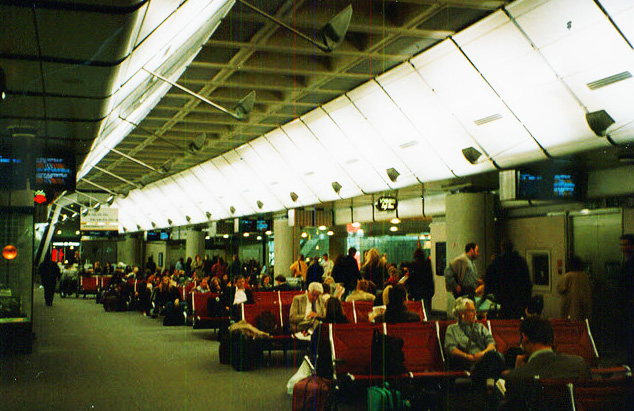
Waterloo International’s departure lounge (image: Geograph)
Waterloo International was completed on schedule in May 1993… but had to lie dormant for over a year whilst the rest of the Channel Tunnel works caught up!
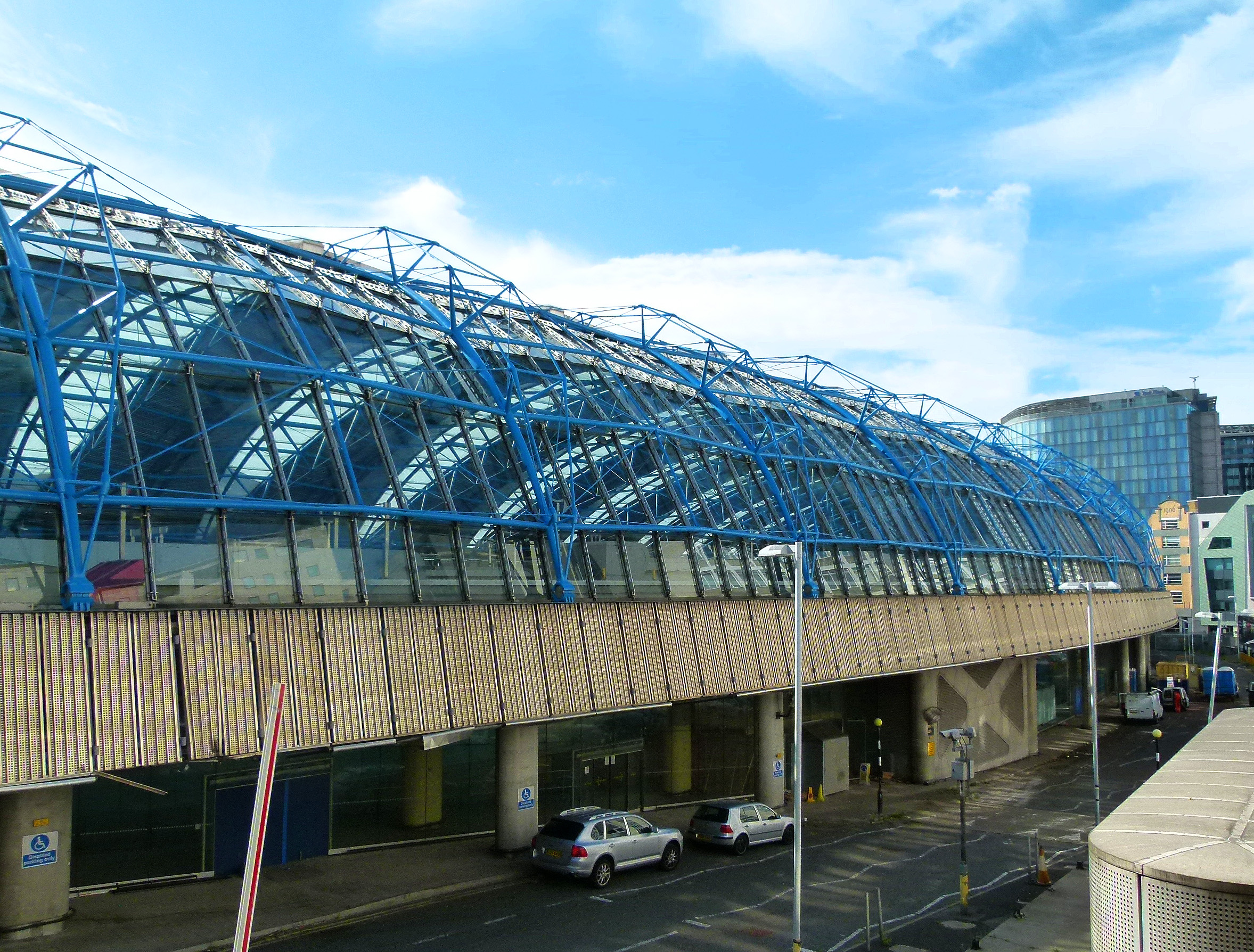
The northern end of the former Eurostar terminal
The first passenger train to the continent departed Waterloo on 11th November 1994.
When it first opened, the crossing was popularly known as the ‘Chunnel‘. Although seldom heard today, a reminder of this nickname can still be glimpsed on Lower Marsh, just outside Waterloo station:

The Chunnel Bar, Lower Marsh, Waterloo
Despite its popularity, the international terminal at Waterloo remained in use for just 13 years…
The main problem with the Eurostar operating out of Waterloo was that the fast, modern trains on the way to and from Folkestone had to use a route which had essentially been designed for steam engines many decades before.

Before transferring to St Pancras, Eurostar trains had to trundle through London’s southern suburbs. Here a Eurostar passes Brixton station (image: Wikipedia)
Because of this, Eurostar trains had to travel far slower on English soil than they did on the continent; an anomaly which impacted the efficiency of the service.
As early as 1996, plans were in place to construct HS1; the high speed line which would re-route the service to the present terminal at St Pancras. The switch was finally made in November 2007, leaving Waterloo International looking rather empty and forlorn…


In 2011 the former international station was used to stage a production of E Nesbit’s 1906 novel, The Railway Children.

Poster for ‘The Railway Children’, a unique production staged on Waterloo International’s former platforms
Thanks to the tracks and platforms, this meant that a fully working steam engine from York’s National Railway Museum, along with a carriage used in the 1970 film adaptation were able to be involved in the performance.

‘The Railway Children’ at Waterloo (image: Theatre Thoughts)
There are now plans (albeit very slow moving ones) to bring the redundant Eurostar terminal back into use, this time for commuter trains… which would be most beneficial as, despite losing its international role, Waterloo today remains the UK’s largest, busiest station.

Waterloo station… an integral part of London
* * *







 View from the Mirror