WW1 100: London’s Memorials… The Machine Gun Corps & the Man Who Mended Faces
2014 will mark the 100th anniversary of the outbreak of World War One.

Raging from July 28th 1914 to 11th November 1918, this hellish conflict was the world’s first truly modern war, characterized by the widespread use of tanks, aircraft, heavy artillery and poison gas.

A WWI Tank.
So intense was the fighting it is said that, during particularly heavy clashes, the thunder of guns could be heard echoing as far away as London.
Leaving Europe with deep physical and psychological scars, the Great War claimed a grand total of 16 million lives and left a further 21 million injured.
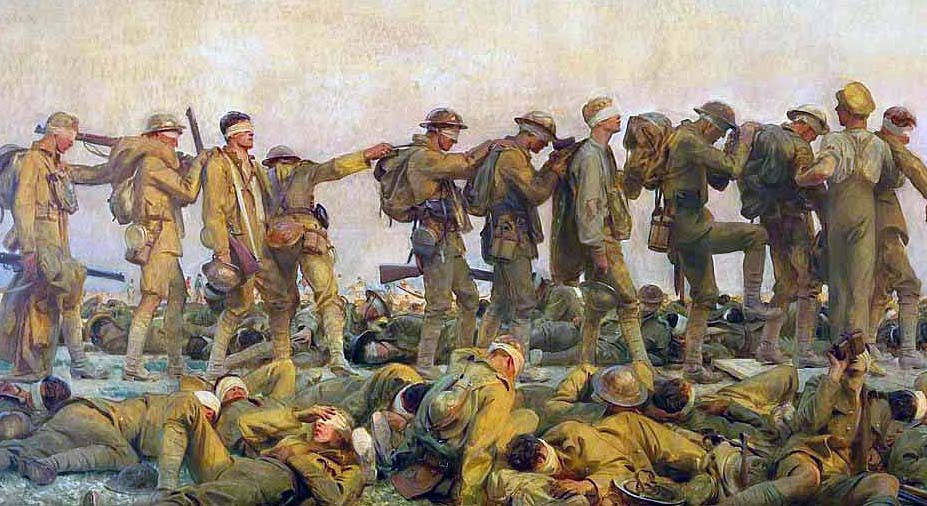
‘Gassed’ by John Singer Sargent, 1919. This painting is part of the Imperial War Museum’s collection.
On a personal level, my Great Great Grandfather- who was also named Robert- was shot at the Battle of Passchendaele in 1917.
Although he was lucky enough to survive (had he not, I would not be sitting here writing this now), the bullet he took remained in his body for the rest of his life.
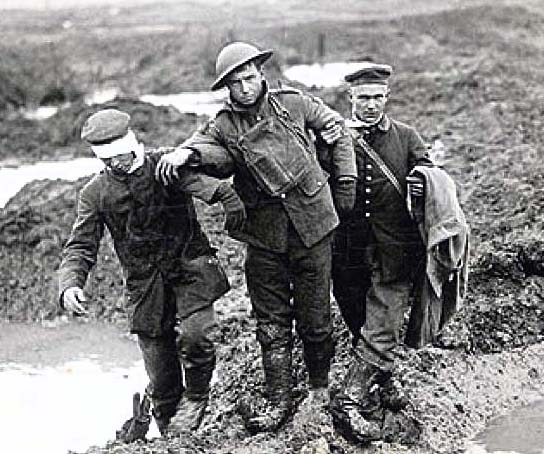
Wounded soldiers at Passchendaele, Belgium, 1917.
*
To mark this sombre landmark in our relatively recent history- and as my personal tribute to all of those who died, whatever their nationality- I have decided to start a new series which, over time, will take a look at London’s many World War One memorials and the stories behind them.
I shall begin with ‘The Machine Gun Corps’ memorial.
The Machine Gun Corps Memorial
Hyde Park Corner

Location of the Machine Gun Corps Memorial at Hyde Park Corner (image: Google).
When war first erupted in the summer of 1914, the British Military were still very much of a 19th century mind-set, confident that traditional infantry and cavalry based tactics would be sufficient enough force to seize victory… a tragically naïve assumption which was starkly portrayed in the 2011 film adaptation of Michael Morpurgo’s book, ‘Warhorse’ (please click below to view):
After a few bloody months on the Western Front, it soon became clear in which direction the conflict was heading, leading to the formation of the Machine Gun Corps in October 1915.
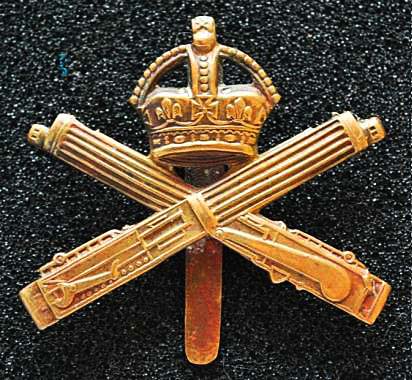
Machine Gun Corps badge (image: Wikipedia).
During WWI, the Machine Gun Corps were deployed in a wide range of theaters including France, Belgium, Palestine, Egypt, East Africa and Italy.
Because of the nature of their weaponry, troops from the MGC often fought well beyond the front line; a factor which earned the Corps both a high casualty rate and a darkly comic nickname… ‘The Suicide Club’.

Gas masked troops from the Machine Gun Corps at the Battle of the Somme, 1916.
Seven members of the Machine Gun Corps were awarded the Victoria Cross; the highest possible accolade for bravery.
The Memorial
Unveiled in 1925, the memorial to the fallen of the Machine Gun Corps is embodied by a statue known as the ‘Boy David’; the Biblical figure who proved his worth after slaying the fearsome giant, Goliath.

The ‘Boy David’ Machine Gun Corps Memorial.
Although we tend to associate David with heroism and triumph over adversity, his representation in this case is naked; something which suggests a sense of vulnerability.
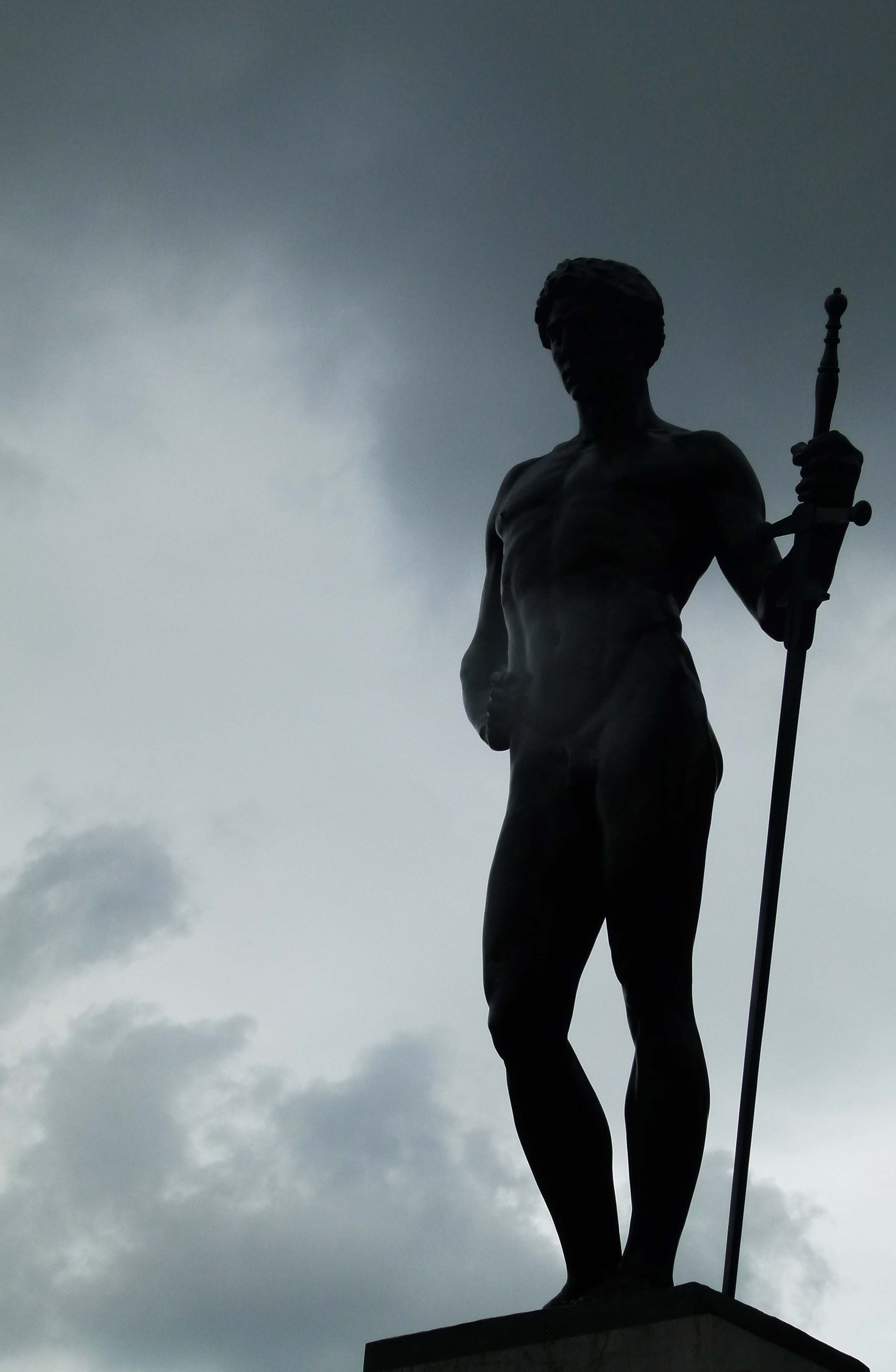
The statue’s plinth includes a quote from the Book of Samuel; “Saul hath slain his thousands but David his tens of thousands”; a grim nod to the impact which the Machine Gun Corps had on the course of the war.

On either side of the statue sit two ‘Vickers’ machine guns, each encircled with laurel wreaths. These fearsome weapons are actually real models… so it is some comfort that they are now encased in bronze.

The rear of the statue provides a brief history of the Corps:
“The Machine Gun Corps of which His Majesty King George V was Colonel in Chief, was formed by Royal Warrant dated the 14th day of October 1915.
The Corps served in France, Flanders, Russia, Italy, Egypt, Palestine, Mesopotamia, Salonica, India, Afghanistan and East Africa.
The last unit of the Corps to be disbanded was the Depot at Shorncliffe on the 15th day of July 1922.
The total number who served in the Corps was some 11,500 Officers and 159,000 other ranks of whom 1120 Officers and 12,671 other ranks killed and 2,881 Officers and 45,377 other ranks were wounded, missing or prisoners of war.”

Machine Gun Corps troops at Arras.
*
When first erected, the memorial stood on Grosvenor Place; just south of Hyde Park Corner.
This first site was short-lived, with major road works soon requiring the statue’s removal. It was placed in storage for many years, finally returning in 1963 when it was placed at its present site on the northern side of Hyde Park Corner, backing onto one of London’s busiest road junctions.

Looking towards the memorial at Hyde Park Corner (image: Google).
An annual observance is held at the statue on the 2nd Saturday of every May.
Francis Derwent Wood
Perhaps the most poignant factor about the Machine Gun Corps memorial is the story behind its sculptor; Francis Derwent Wood.

Francis Derwent Wood.
Francis Derwent Wood was born in the Lake District in 1871 and went onto teach sculpture at the Glasgow School of Art.
When war broke out in 1914, he was too old for military service, so volunteered to work in the bustling hospital wards, coming to be based at the 3rd London General Hospital in Wandsworth.
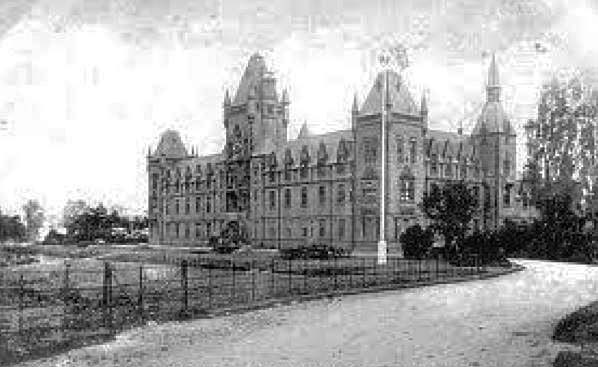
The 3rd London General Hospital.
Originally built in the 1850s as a home and school for orphans, this grand building was requisitioned in WW1 for use as a military hospital.
To cope with the sheer number of wounded troops being brought it, a temporary platform and station were built on the hospital’s western side (which backs onto one of the main lines into Clapham Junction).
A field behind the hospital (which is today a cricket ground) became an overflow area, lined with row after row of marquees standing in as temporary wards.

Postcard displaying the 3rd London General Hospital, Wandsworth. The railway lines which delivered wounded troops can be seen to the south, the overflow tent-wards towards the north.
Today, the former hospital is now known as the ‘Royal Victoria Patriotic Building’; a complex of apartments, workshops, studios, a drama school and a restaurant called ‘Le Gothique’.

The former 3rd London General Hospital today… now known as the Royal Victoria Patriotic Building (image: Google).
*
At the 3rd London General Hospital, Francis Derwent Wood encountered many young men who had suffered horrific injuries inflicted by the terrifying new weaponry.
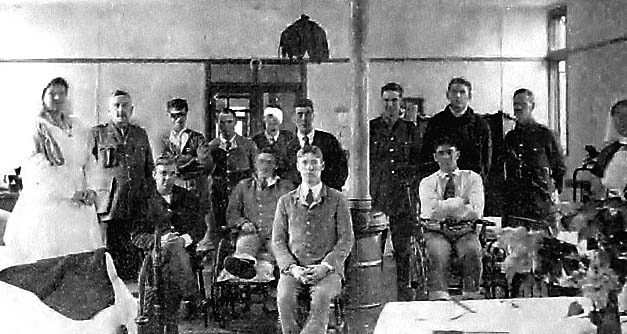
Canadian patients at the 3rd London General Hospital, Wandsworth.
Facial traumas were especially commonplace; if a squaddie quickly popped his head over the trench, an unexpected explosion or burst of enemy fire could have catastrophic results.
In one account, an American soldier, shot in the skull in 1918, described the experience; “It sounded to me like someone had dropped a glass bottle into a porcelain bathtub… a barrel of whitewash tipped over and it seemed that everything in the world turned white.”
In some cases, victims literally lost half their face… yet somehow managed to survive.
Although plastic surgery techniques were being pioneered at the time, there were some unfortunate souls who even this could not help.
Exposed to such tragedies, Francis Derwent Wood had a brain-wave.
Realising that his artistic skills may be able to help those with extensive facial scars, he took it upon himself to set up the ‘Masks for Facial Disfigurement Department’ within the hospital where, beginning in March 1916, he began to use his expertise to create custom masks for his patient’s shattered faces.

Francis Derwent Wood working on a patient’s mask (image: The Imperial War Museum).
Taking up to a month to create, each mask, which was made from ultra-lightweight metal and painted in enamel to match the wearer’s skin tone, was a work of art in itself, designed to fully disguise the affected area.
Where eyebrows and moustaches were required, slivers of tinfoil were used- rather like the technique used on ancient Greek statues.
Patients at the hospital quickly gave the department an affectionate nickname; ‘The Tin Nose Shop.’

Bits and bobs from Derwent Wood’s ‘Tin Nose Shop’ (image: The Imperial War Museum).
This creative solution did wonders for the morale of young men faced with a future of horrified stares and social exclusion- in Sidcup for example, which was also home to a facial hospital, certain park benches were designated for the use of patients…and were painted blue as a warning to passers-by of a more sensitive nature.
Interviewed in The Lancet in 1917, Francis said; “My work begins where the work of the surgeon is complete…The patient acquires his old self-respect, self-assurance, self-reliance… takes once more to a pride in his personal appearance. His presence is no longer a source of melancholy to himself nor the sadness of his relatives and friends.”

A wounded soldier examining the beginnings of his facial mask (image: The Imperial War Museum).
Derwent Wood’s work was soon noticed by the American sculptor, Anna Coleman.

Anna Coleman (image: Wikipedia).
After liaising with Derwent Wood and with support from the American Red Cross, Anna opened her own mask studio in Paris, where she continued the pioneering work on severely wounded French and American troops.
A video of this studio survives, which gives a good idea of the process involved at the hospitals in Paris and London (please click below to view):
Unsurprisingly, Anna Coleman and Francis Derwent Wood received many grateful letters from those they’d helped.
One particular response is heart-breaking in what it says;
“Thanks to you, I will have a home… the woman I love no longer finds me repulsive.”

Close up of the Boy David statue…
*
Francis Derwent Wood’s studio was wound down in 1919.
Although he was able to help several hundred men, this was a mere drop in a very sad ocean- over 20,000 would return from the continent with facial wounds.
After the war, Francis was commissioned to create memorials in honour of the men who never returned. These works include a statue for Liverpool’s Cotton Association, ‘Humanity Overcoming War’ in Bradford and work on the memorial plinth in his home town of Keswick.

Francis Derwent Wood’s sculpture for the Liverpool Cotton Exchange (image: Wikipedia).
He also created a controversial sculpture of a crucified soldier; ‘Canada’s Golgotha’ which can be seen in the Canadian War Museum, Ottawa.
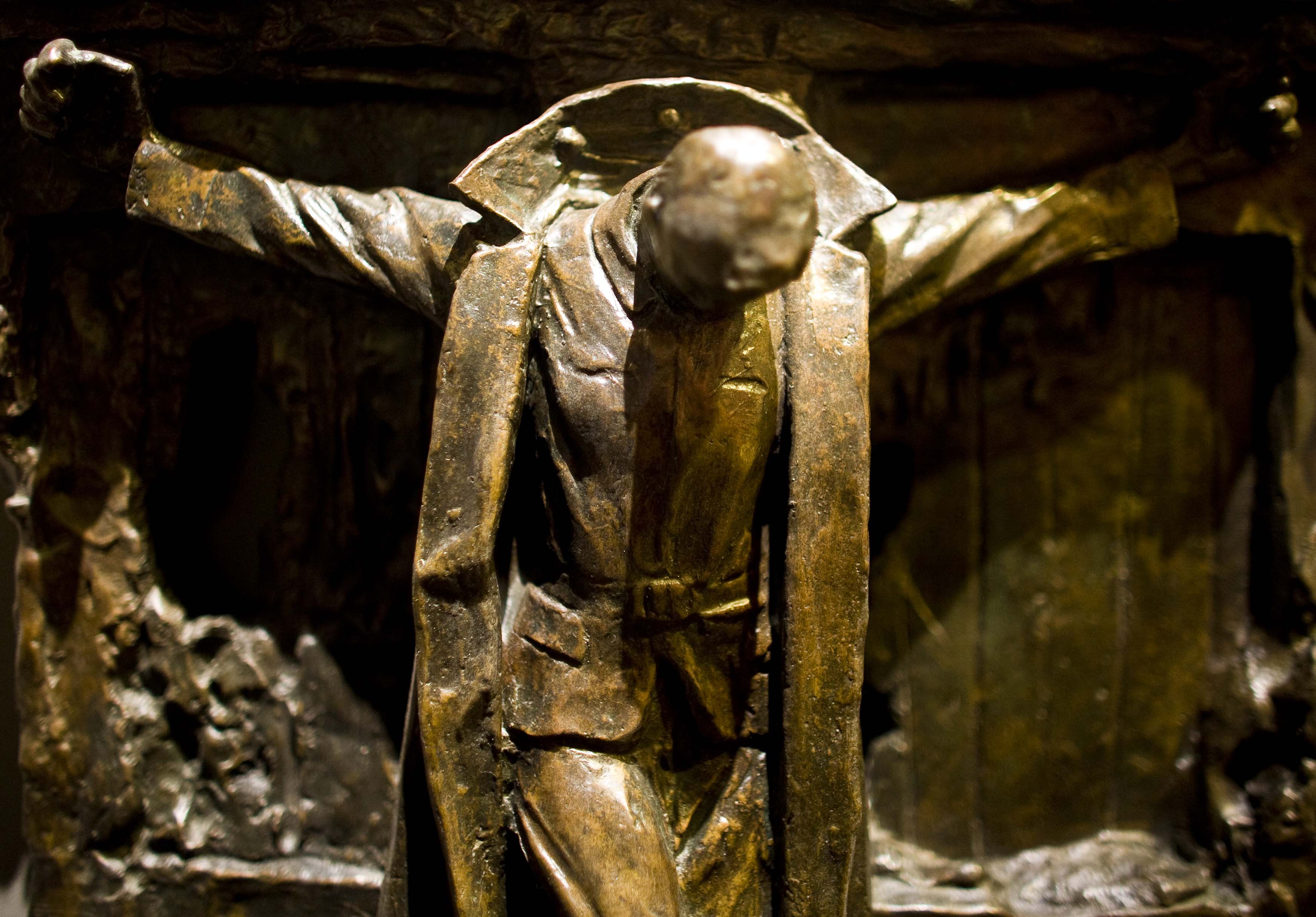
‘Canada’s Golgotha’… (image: Wikipedia).
London’s Machine Gun Corps memorial was one of Derwent Wood’s last pieces. He died just two years after its unveiling.
In 1929, a small, bronze copy of the Boy David was made by Edward Bainbridge Copnall as a memorial to Francis Derwent Wood.

The Boy David modello by Edward Bainbridge, 1929 (image: Copyright Paul Farmer, via Geograph).
Bequeathed by the Chelsea Arts Club, it can today be seen on the north side of Chelsea Embankment, overlooking Albert Bridge.

Van Gogh’s London
Despite being unappreciated during in his own lifetime, Vincent van Gogh is now considered to be one of the most brilliant artists of the 19th century.
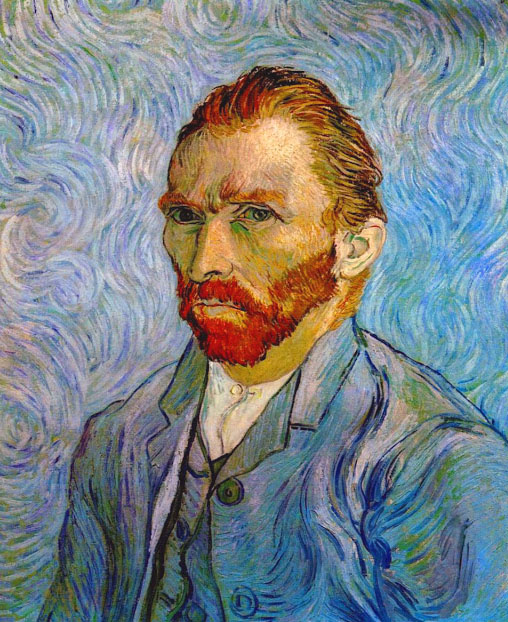
Vincent van Gogh, Self Portrait, 1888.
Early Life
Named after both his grandfather and a brother who had sadly been still-born exactly a year before, Vincent Willem van Gogh was born on the 30th March 1853 in Groot-Zundert; a small village in the southern Netherlands.
As a child, Vincent was noted for his talent in both languages and drawing.
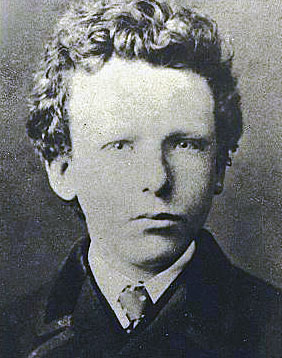
Vincent van Gogh, aged 13.
When he reached the age of 16, Vincent’s uncle, Cent helped the teenager secure employment with the art dealer, Goupil and Cie who were based in The Hague and had branches across Europe.
Van Gogh Comes to London
After a four year apprenticeship, the company posted the 20 year old Vincent to their London branch at 17 Southampton Street, Covent Garden in June 1873.
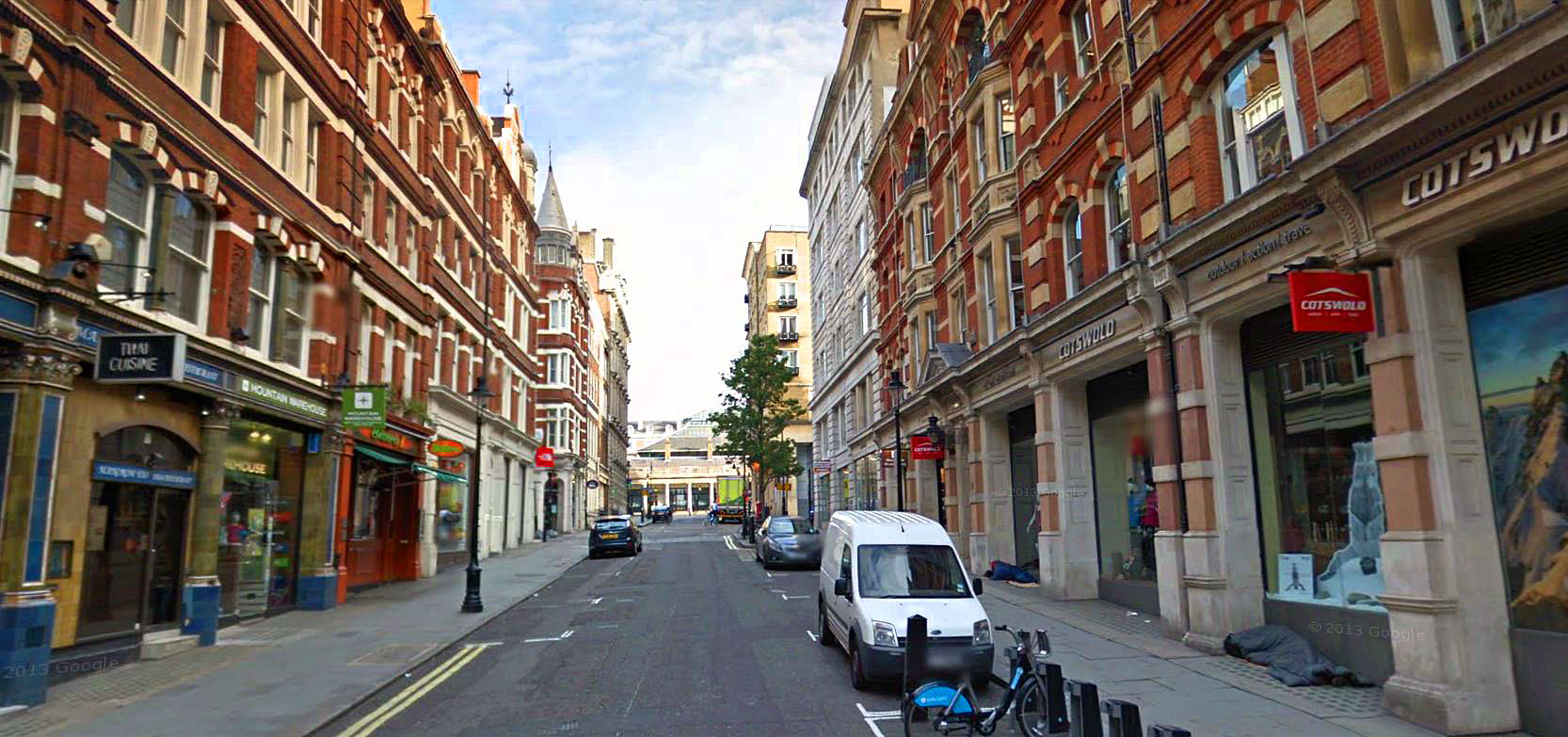
Southampton Street today (image: Google).
In 1875, whilst Van Gogh was still with the company, the dealership switched premises, moving to nearby Bedford Street, close to the junction with the Strand.

Bedford Street today (image: Google)
Upon receiving his new role, Vincent was full of energy and optimism and had high hopes for his new career.
Shortly before being sent to London, his mentor, Mr Tersteeg wrote to Vincent’s parents, happily informing them that their son was a popular young man whom both artists and buyers enjoyed working with.
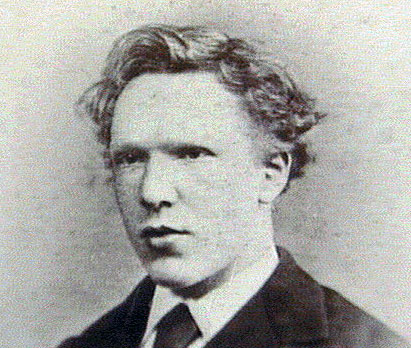
Vincent van Gogh, aged 19- shortly before his transfer to London.
Naturally, the first thing Vincent had to do upon arriving in London was to secure a roof over his head and in his first letter home he mentioned a problem which remains a bugbear for Londoners to his day; “Life here is very expensive…”
The location of Van Gogh’s first digs, where he stayed for two months, is unknown- although we do know that the young Dutchman lodged with two spinsters who kept parrots. No doubt memories of this period would have come to mind when he painted a parrot years later…
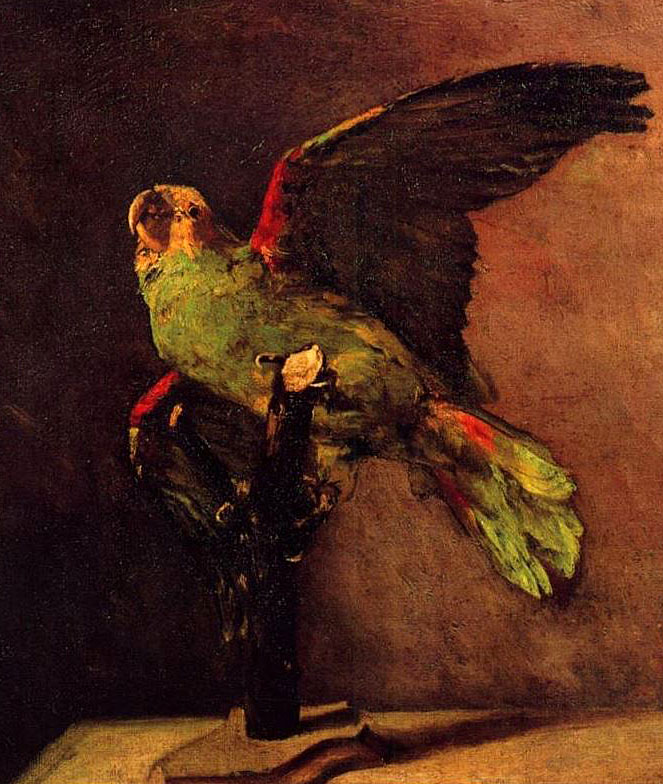
The Green Parrot by Van Gogh, 1886.
Also lodging in the house were three Germans, “Who really love music and play piano and sing, which makes the evenings very pleasant indeed.”
Vincent socialised with the German group but soon found it impossible to keep up due to their lavish spending habits!

The Night Cafe by Van Gogh, 1888.
During his first few weeks in England, Vincent travelled to Surrey to visit Box Hill, leading him to write, “The countryside here is magnificent.”
Although he could have made the trip by train, Vincent opted to go on foot… a journey which took him six hours.
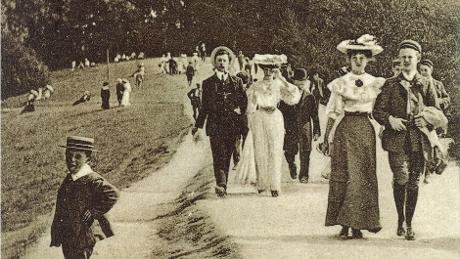
A day out at Box Hill, Surrey (image: National Trust).
In another early letter, Vincent also mentions his love of London’s green spaces; “One of the nicest things I’ve seen here is Rotten Row in Hyde Park, which is a long, broad avenue where hundreds of ladies and gentlemen go riding. In every part of the city there are splendid parks with a wealth of flowers, such as I’ve seen nowhere else.”

Rotten Row, Hyde Park during the late Victorian era.
*
Van Gogh’s second home in the capital- and the building which today provides London’s most noted link with the artist- was at 87 Hackford Road, Stockwell (close to Brixton) where he moved in August 1873.

87 Hackford Road today.
Thanks to the many letters he wrote to his younger brother, Theo, Vincent van Gogh’s time here is very well documented…and as we will soon see, it tells a sad story which has led to speculation that his time in London eventually came to have a detrimental impact on his mental health; the continuing poor state of which would come to plague the artist in later life.
*
Life in 1870s London
When he first secured lodgings at Hackford Road, Vincent couldn’t have been happier, writing to Theo, “Oh how I’d like to have you here, old chap, to see my new lodgings…I now have a room, as I’ve long been wishing…”

Map indicating the location of 87 Hackford Road (image: Google).
In the same letter, he also mentioned how he “Spent a Saturday rowing on the Thames with two Englishmen. It was glorious.”
“Things are going well for me here, I have a wonderful home and it’s a great pleasure for me to observe London and the English way of life and the English themselves, and I also have nature, art and poetry, and if that isn’t enough, what is?”
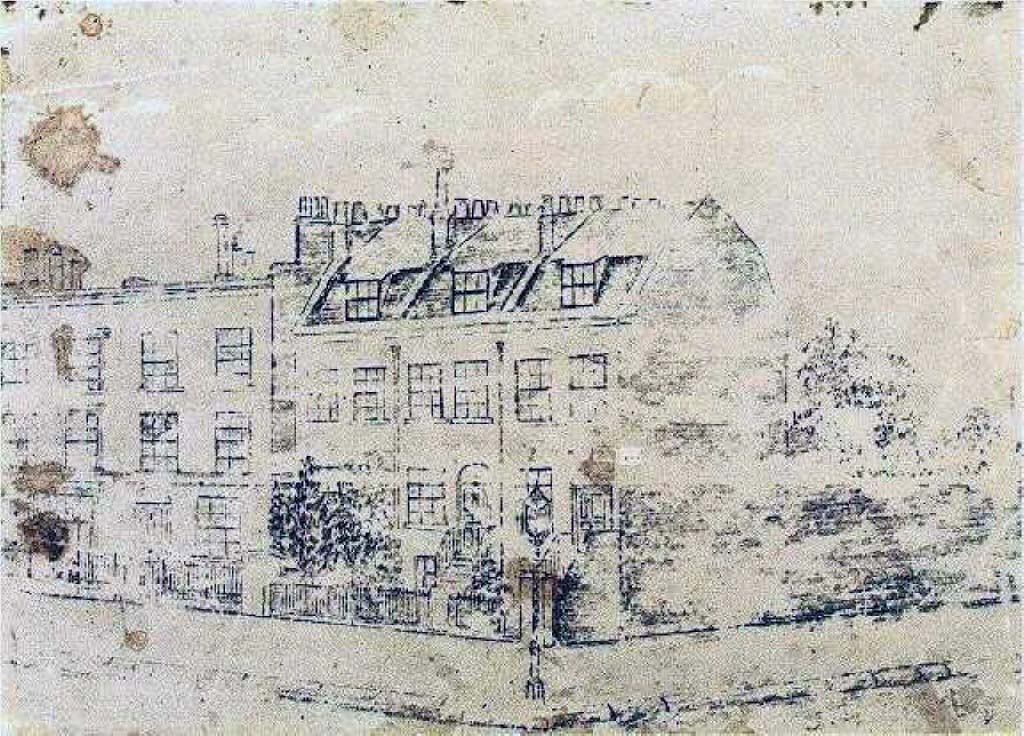
Sketch of 87 Hackford Road by Van Gogh. This drawing was lost for many years before being discovered in a box in an attic belonging to the Great Granddaughter of Ursula Loyer; Van Gogh’s former landlady.
In the early 1870s, Stockwell was still a relatively quiet, genteel suburb and the young Vincent took great pleasure in exploring the surrounding flora and fauna.
“I walk here as much as I can,” he wrote to Theo; “Always continue walking a lot and loving nature, for that’s the real way to learn to understand art better and better. Painters understand nature and love it, and teach us to see.”
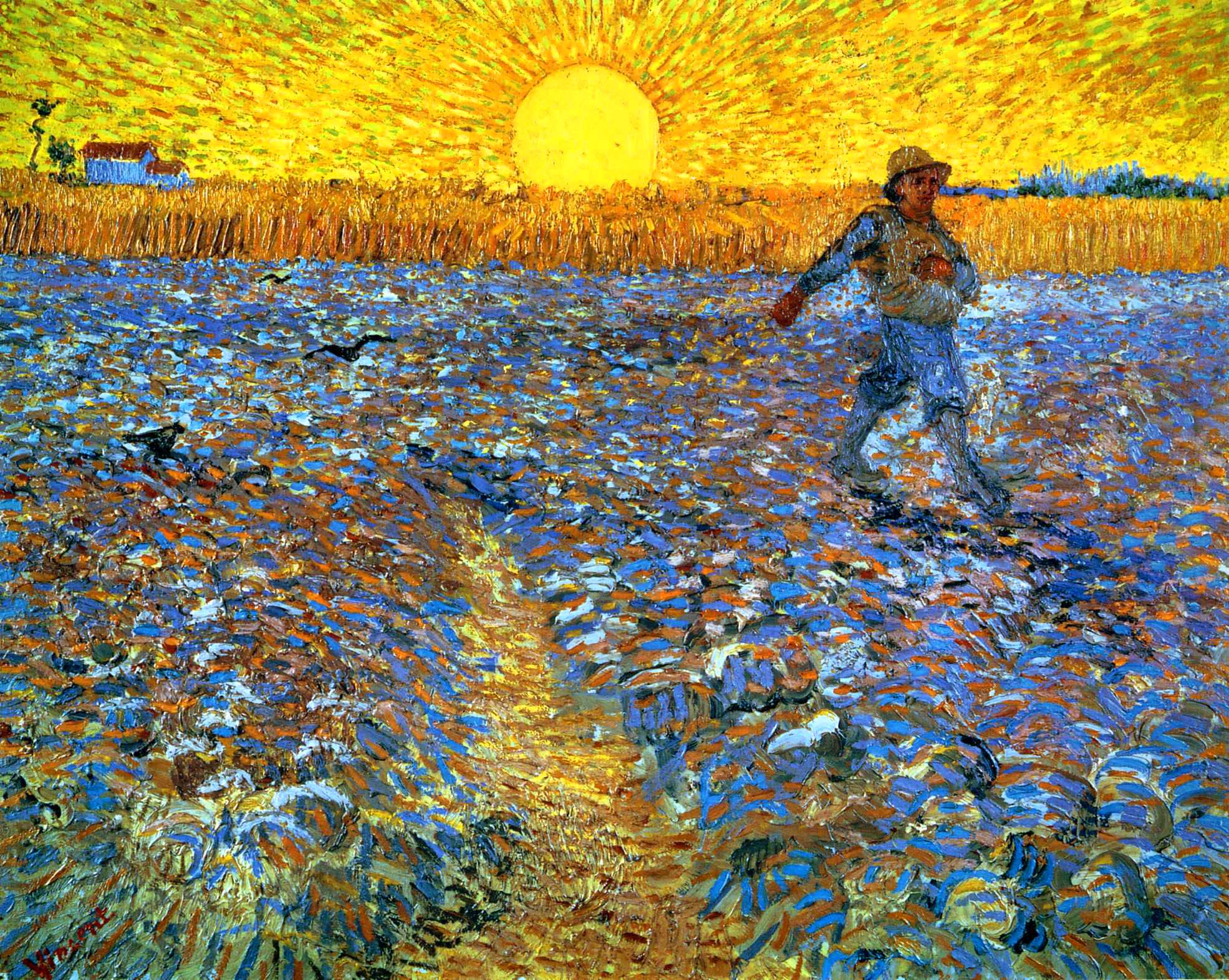
Sower with the Setting Son by Van Gogh, 1888.
*
Donning his specially purchased top hat (“You cannot be in London without one,” he told Theo), Vincent would walk to and from his Covent Garden workplace every day; a journey of some three miles in each direction; “I crossed Westminster Bridge every morning and evening and know what it looks like when the sun’s setting behind Westminster Abbey and the Houses of Parliament.”
On his evening return journey, Vincent would often pause to sketch various views of the Thames- although he was often frustrated in his efforts as he found the perspective tricky to grasp.

A tiny drawing of the view towards Westminster, sketched by Van Gogh on one of his business cards.
During his spare time, the young art-dealer delighted in exploring the city’s galleries and museums and was especially fond of the Royal Academy and Dulwich Gallery. He also visited the British Museum– where he signed the guest book on August 28th 1874.

As well as London’s attractions, Van Gogh also developed a taste for British art and literature; admiring the paintings of Gainsborough and Turner and the novels and poems of George Elliot, Charles Dickens (who had died just three years before Van Gogh’s arrival in England) and John Keats, of whom he wrote “He’s a favourite of the painters here, which is how I came to be reading him.”
He also became an avid reader of The Graphic, Punch and The London Illustrated News; magazines which documented news and topical issues with richly detailed illustrations.

Front page from a copy of the London Illustrated News, printed in August 1873- the month Van Gogh moved to Stockwell. Here, Scottish Black Watch troops are shown training on Dartmoor. Van Gogh was a great admirer of this style of social realism.
The offices of the London Illustrated News were based at 198 the Strand; close to Vincent’s workplace and he would often pop in to pore over the proofs for the latest issue which were available for public view. He even toyed with the idea of becoming a magazine illustrator, but sadly this dream never came to fruition.
Van Gogh was particularly interested in illustrations depicting Victorian Britain’s social ills and he later went onto become an avid collector of the magazines he’d first encountered in London, from which he cut and collected over 1,000 images.
These clippings would be displayed around his studio to inspire and motivate the artist as he worked. “For me,” Van Gogh wrote, “The English draughtsmen are what Dickens is in the sphere of literature. Noble and healthy, and something one always comes back to.”
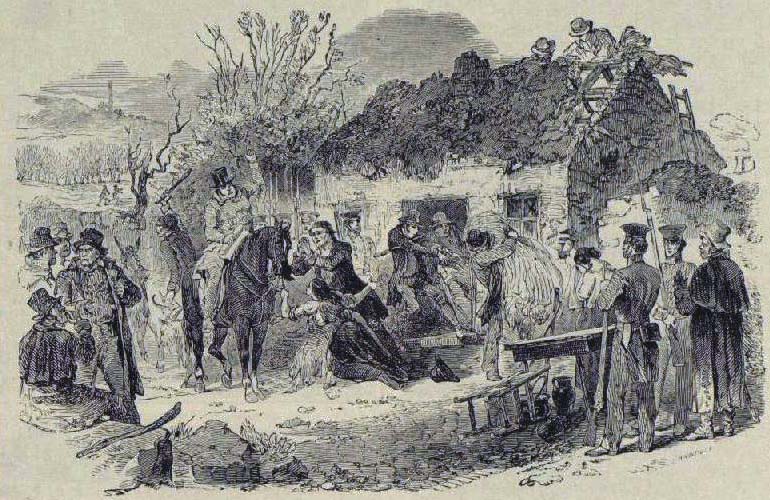
Scene depicting an Irish family being evicted from their home; one of the many prints in Van Gogh’s collection.
Of the many prints owned by Van Gogh, one in particular, snipped from an 1870 issue of The Graphic, depicted Charles Dickens’ empty seat; a melancholy illustration created shortly after the celebrated author died… and one which perhaps inspired Van Gogh’s own 1888 painting of a chair.

Another print which had an obvious impact on Van Gogh’s work was Gustave Dore’s depiction of convicts in Newgate Prison’s exercise yard, published in 1872’s London: a Pilgrimage.
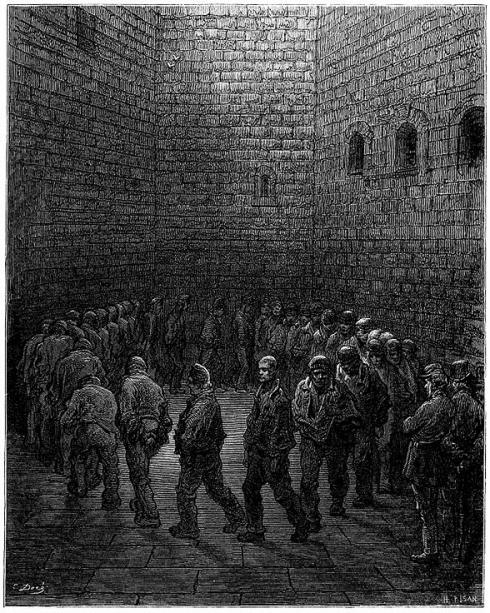
Newgate Prison exercise yard by Gustave Dore, 1872.
Van Gogh created his own version of this grim scene in 1890 whilst being held at an asylum in Saint-Remy.
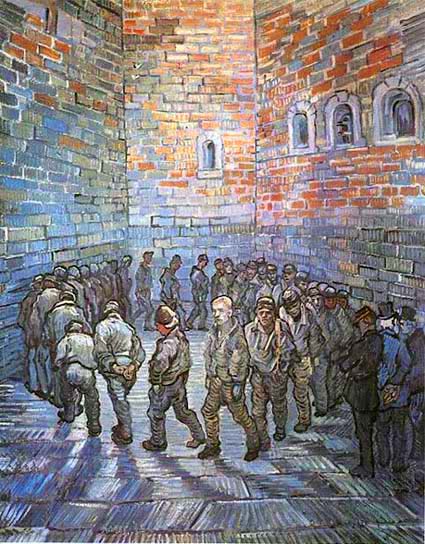
Van Gogh’s version of Dore’s Newgate yard, 1890.
*
The Dream Dwindles
Vincent appeared happy and settled in his new life in London, writing in early 1874 that “I have a rich life here, ‘having nothing, yet possessing all things.’ Sometimes I start to believe that I’m gradually beginning to turn into a true cosmopolitan, meaning not a Dutchman, Englishman or Frenchman, but simply a man. With the world as my mother country…”
Sadly, despite this positive outlook, his mood would soon turn to one of misery.
As the months at Hackford Road passed, Vincent had begun to fall hopelessly in love with his landlady’s 19 year old daughter, Eugenie Loyer.
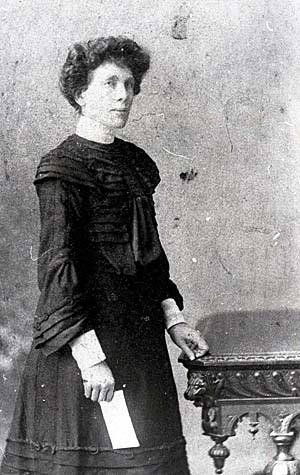
Eugenie Loyer pictured in her later life.
In the summer of 1874, Vincent finally plucked up the courage to declare his love for Eugenie… but he was told in no uncertain terms that the feeling wasn’t mutual- and that she was already engaged to a previous lodger.
This unrequited love was a huge knockback, sending the once optimistic young man into a spiral of depression and withdrawal.
By this point, Vincent’s younger sister, Anna had joined her brother in London and she too was lodging at Hackford Road. Despite Anna’s attempts to ease the embarrassing situation, the awkwardness between the Van Goghs and the Loyers soon became unbearable.

Vincent’s sister, Anna van Gogh (image: vangoghbiography.com).
In August 1874, Vincent and Anna had no choice but to move away from Stockwell, securing new lodgings at nearby 395 Kennington Road with a Mr and Mrs Parker who owned a house known as Ivy Cottage- which has long since vanished.
One Sunday, in April 1875, Van Gogh is known to have travelled to Streatham Common, which he sketched. Tragically, that very same morning, the Parker’s 13 year old daughter, Elizabeth died from pneumonia.
*
Shortly afterwards, Goupils transferred Vincent to Paris where his sadness and isolation continued to plunge further.

Goupil and Cie’s Parisian branch.
Whilst in London, Vincent’s exposure to the plight of the poor; through art, literature and what he himself witnessed on the streets of the metropolis, had led him to develop a deeply committed social conscience.
Now of the opinion that art should be for all, he began to grow jaded with his chosen profession, upset that he was expected to treat art as an expensive commodity.
Consequently, Goupil and Cie April terminated Van Gogh’s contract in April 1876.
Vincent Returns to London
After being sacked, Vincent headed back to England where he hoped to forge a new career in teaching, securing work at a boarding school in Ramsgate where he gave lessons in Bible studies.

Sketch of Ramsgate by Van Gogh.
Shortly after joining, the school moved to a new location- Holme Court House in the south-west London suburb of Isleworth. Vincent transferred to the new address… but was so poor he had to walk to get there; a journey of over 80 miles which took him three days.
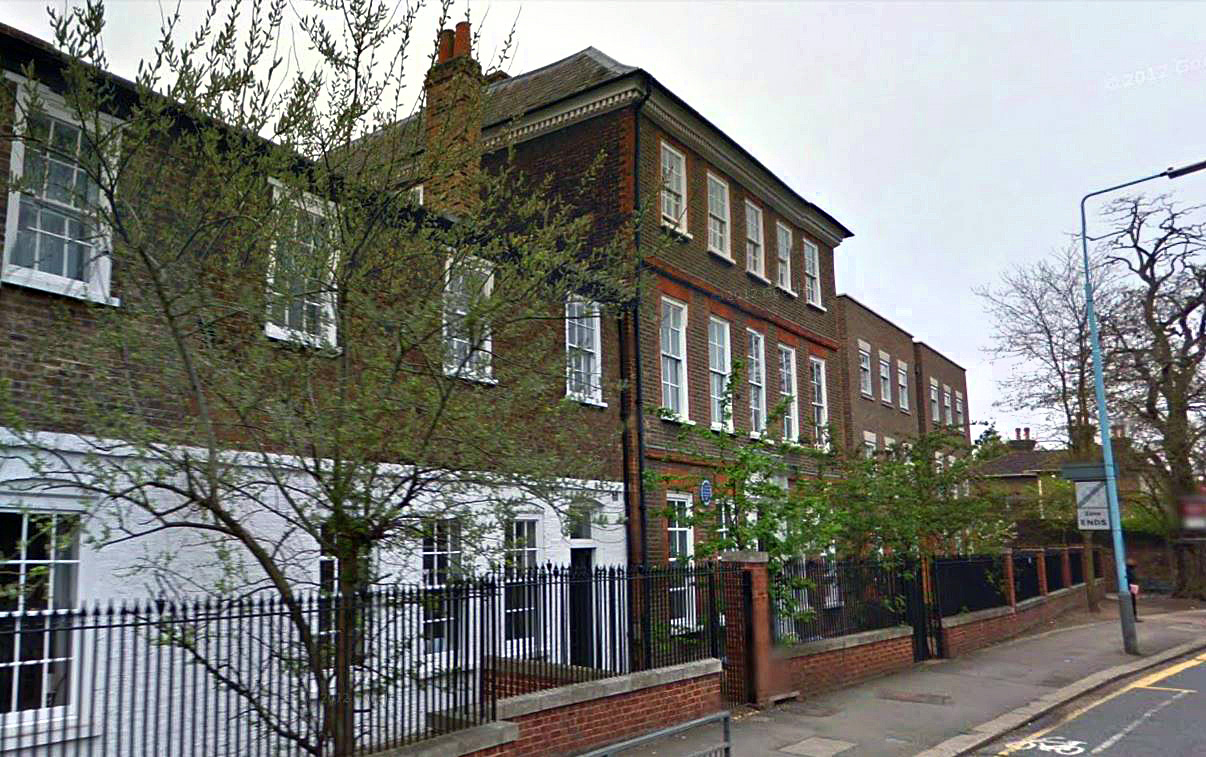
Holme Court House, Twickenham Road, Iselworth where Van Gogh taught and boarded (image: Google).
The school in Isleworth offered free bed and board but no salary. Van Gogh stayed until Christmas 1876 but with his prospects limited, he decided to return to the Netherlands, never to see England again.
14 years later, after a poverty-ridden life in which his mental health deteriorated and his art went unnoticed, Vincent van Gogh died aged just 37.
Although he is believed to have shot himself, the gun was never found.

Vincent van Gogh, 1853-1890 (self portrait painted 1888).
London’s Van Gogh Links Today
A blue plaque dedicated to Van Gogh was not installed at his former Hackford Road home until 1973; exactly 100 years after he moved in.

The house languished in a poor state until March 2012 when it was put up for auction, selling for just over half a million pounds- the buyer is reputed to be an admirer of the great artist.
A video of the interior of 87 Hackford Road, filmed for The Guardian shortly before the sale, can be viewed below.
Just across from the house, a short road formerly known as Isabel Street has been transformed into ‘Van Gogh Walk’.
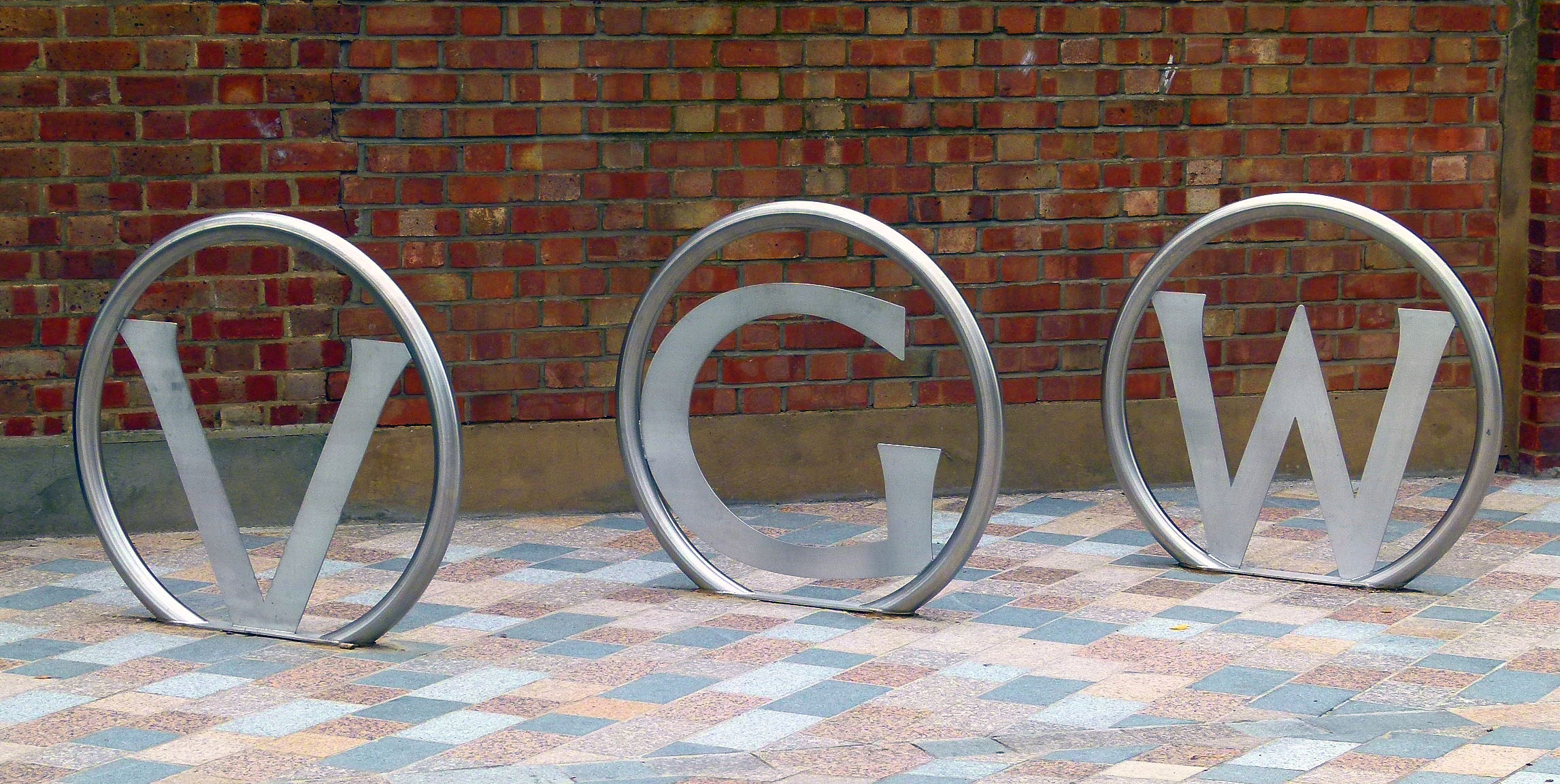
Unveiled in April 2013 to mark the 160th anniversary of the artist’s birth, Van Gogh Walk is a peaceful tribute which embraces Vincent’s love of nature with sunflower beds and quotes from the letters he wrote in happier times.

Van Gogh Walk
A short distance away, opposite Stockwell tube station Van Gogh can be glimpsed on a colourful mural, painted on the entrance to an old, deep-level air-raid shelter.

The young Vincent even appears on the back of the ‘Brixton Pound’; a currency designed to be spent at shops and businesses in the local area!

The Brixton Pound’s £20 note.
Where to see Van Gogh’s Paintings in London
The first major exhibition of Vincent van Gogh’s work came to London in 1947 and was unveiled at the Tate Gallery by the Dutch Ambassador.

The Dutch Ambassador opening London’s first major display of Van Gogh’s work, 1947 (image: The Times).
Today, the capital holds a number of important works by Van Gogh which can be viewed below (click the images to enlarge).
If you wish to see the real thing however, please scroll further down for details on where to find each piece.


The Courtauld Gallery, Somerset House:
* Self-portrait; Ear bandaged (1889)
* Peach Blossom in the Crau, (1889)
The National Gallery:
* A Wheatfield with Cypresses (1889)
* Head of a Peasant Woman (1884)
* Long Grass with Butterflies (1890)
* Sunflowers (1888)
* Two Crabs (1889)
* Van Gogh’s Chair (1888)
Tate Britain:
* Thatched Roofs (1884)
* A Corner of the Garden at St Paul’s Hospital at St Remy (1889)
* Farms near Auvers (1890)
* The Oise at Auvers (1890)
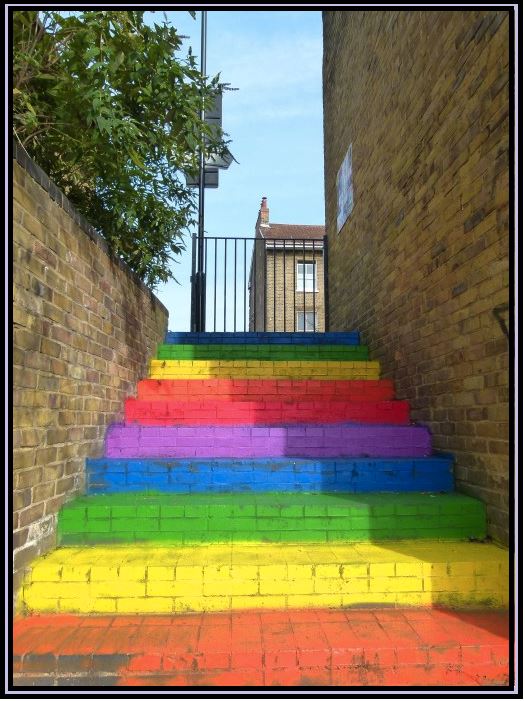
Candid Capital: Rainbow Stairway
Rainbow Stairway






 View from the Mirror