Cabbie’s Curios: A Victorian Thirst Quencher
If you ever find yourself feeling thirsty within London’s historic square mile then head for St Paul’s churchyard where, standing opposite the southern side of the magnificent cathedral, you’ll find this equally monumental structure:
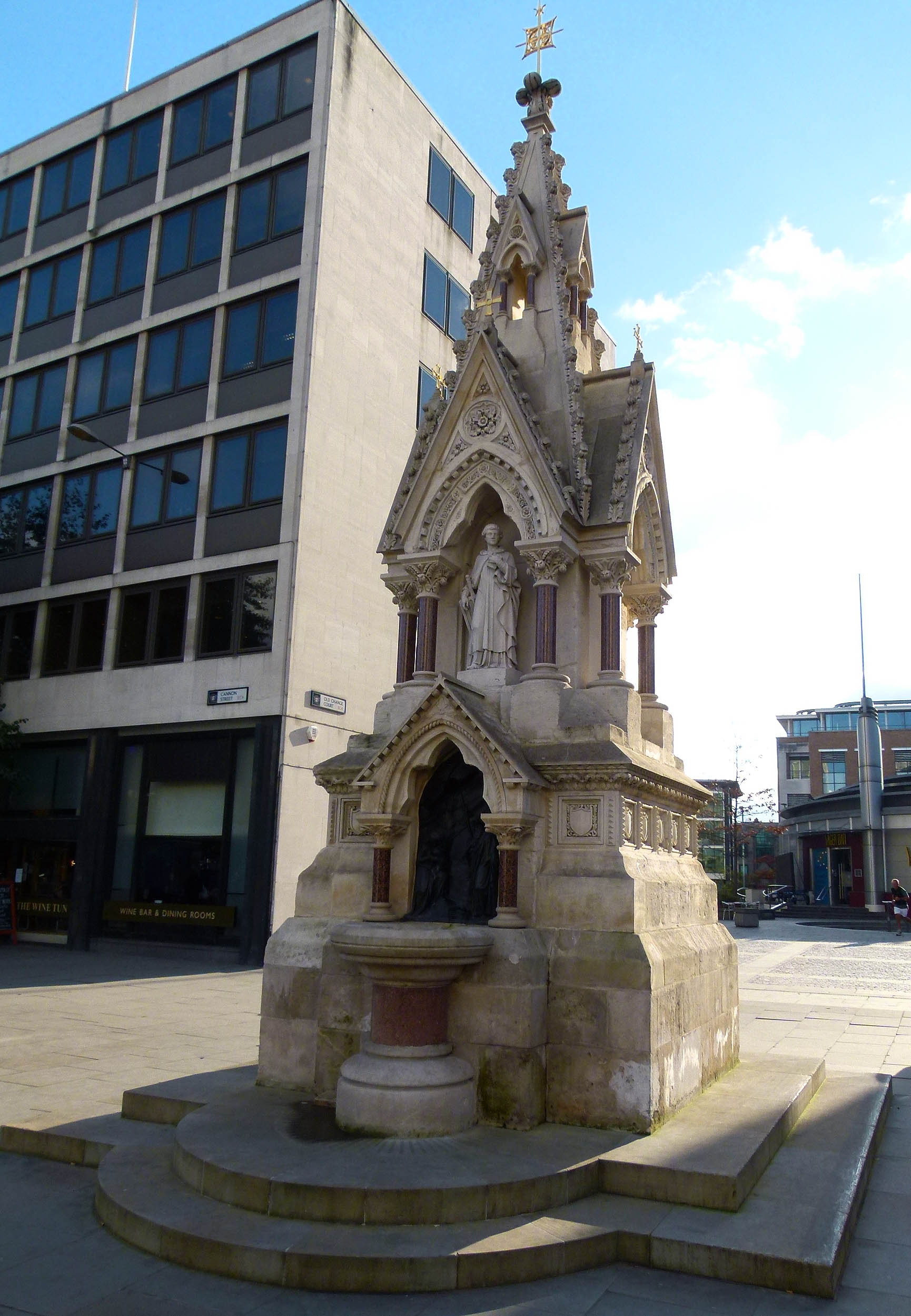
This is the St Lawrence Jewry Memorial Fountain which dates back to 1866. It has not always been at this site- its first home was a short distance away in the courtyard of St Lawrence Jewry church, Guildhall.

The fountain at its original location in the Guildhall courtyard.
The original St Lawrence Jewry church was one of many destroyed during the Great Fire of London in 1666.
It was rebuilt by Sir Christopher Wren and the fountain was installed 200 years later by the Victorians as a way of marking the bicentenary.

Close ups of the fountain’s religious detailing.
On the night of December 29th 1940 the church suffered appalling damage during what would turn out to be the heaviest night of the blitz.

The ruins of St Lawrence Jewry following the devastating December 1940 raid.
Amazingly the fountain survived, standing proud in the midst of the bombsite and holding the fort until the 1950s when St Lawrence Jewry was skilfully restored to Wren’s original design.

St Lawrence Jewry church today…. now thankfully fully restored (image: Wikipedia).
In the 1970s the Guildhall underwent extensive redevelopment which required the fountain to be dismantled.
Divided into 150 pieces, the Victorian masterpiece was reduced to a complex jigsaw, stashed away on pallets and stored at a barn in Epping where it would remain hidden for four decades.

The Guildhall Fountain in its original Victorian form…. (image: London Illustrated News).
The fountain finally returned to the streets of London in 2010 when it was lovingly pieced back together and installed at its new home opposite St Paul’s Cathedral; that other great survivor of the December 29th air-raid.

The iconic image of St Paul’s Cathedral, photographed on the night of December 29th 1940.
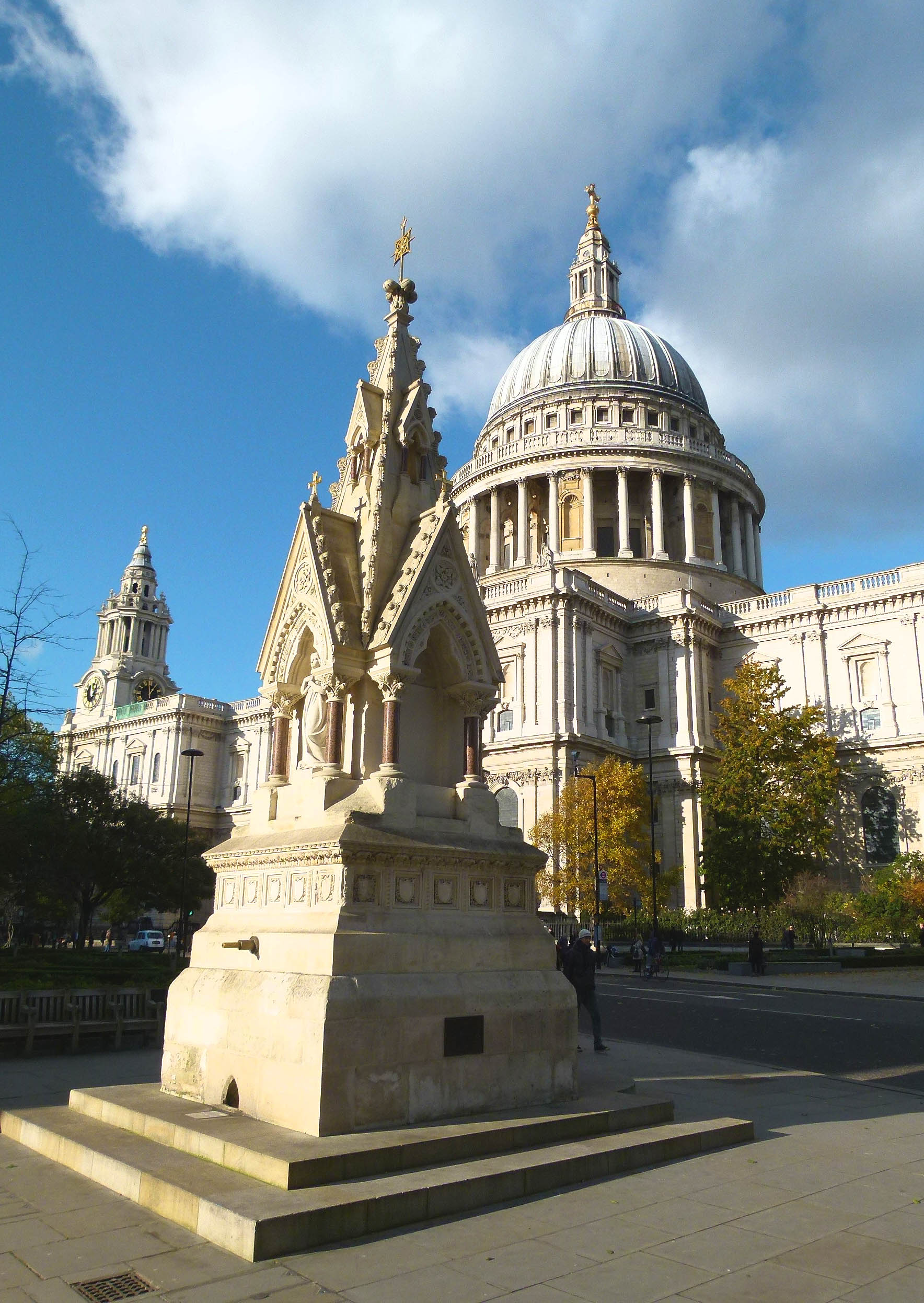
Two survivors together… St Paul’s Cathedral & the St Lawrence Jewry Fountain.
If you fancy a sip from the fountain, the pipe can be found around the back; on the south side which faces towards Distaff Lane and the Millennium Bridge.

A cyclist fills up from the Victorian fountain- the pipe is ideal for topping up water bottles.
Candid Capital: Hampstead Fog
Hampstead Fog
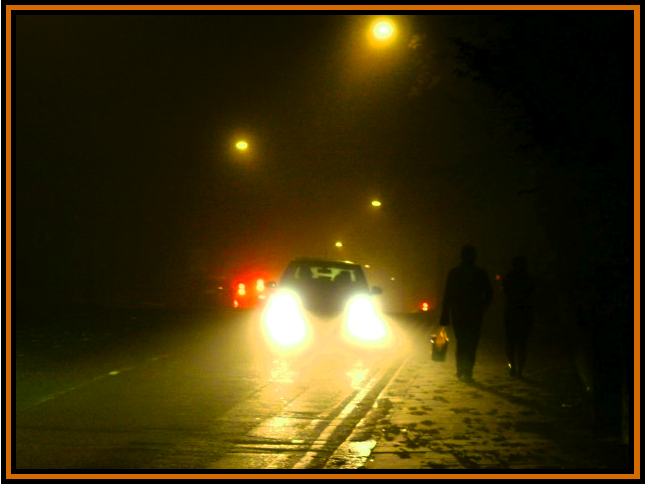 Fitzjohn’s Avenue on a murky, autumn night. November 2011.
Cabbie’s Curios : Covent Garden’s Cramped Alley
Pictured below is the London Coliseum (home to the English National Opera), which is located on St Martin’s Lane, Covent Garden.
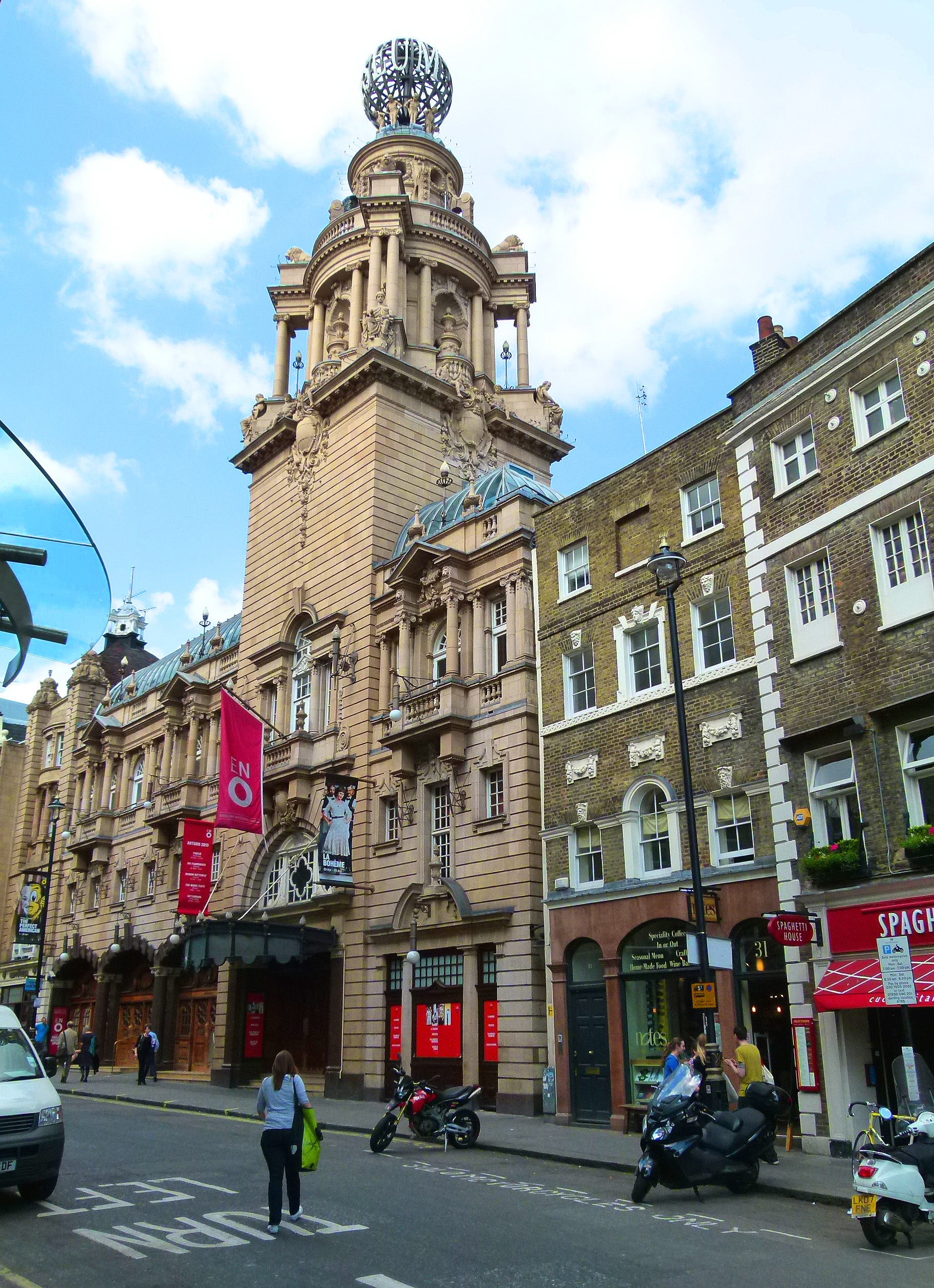
Did you notice the hidden alleyway?…

Location of the diminutive alleyway…
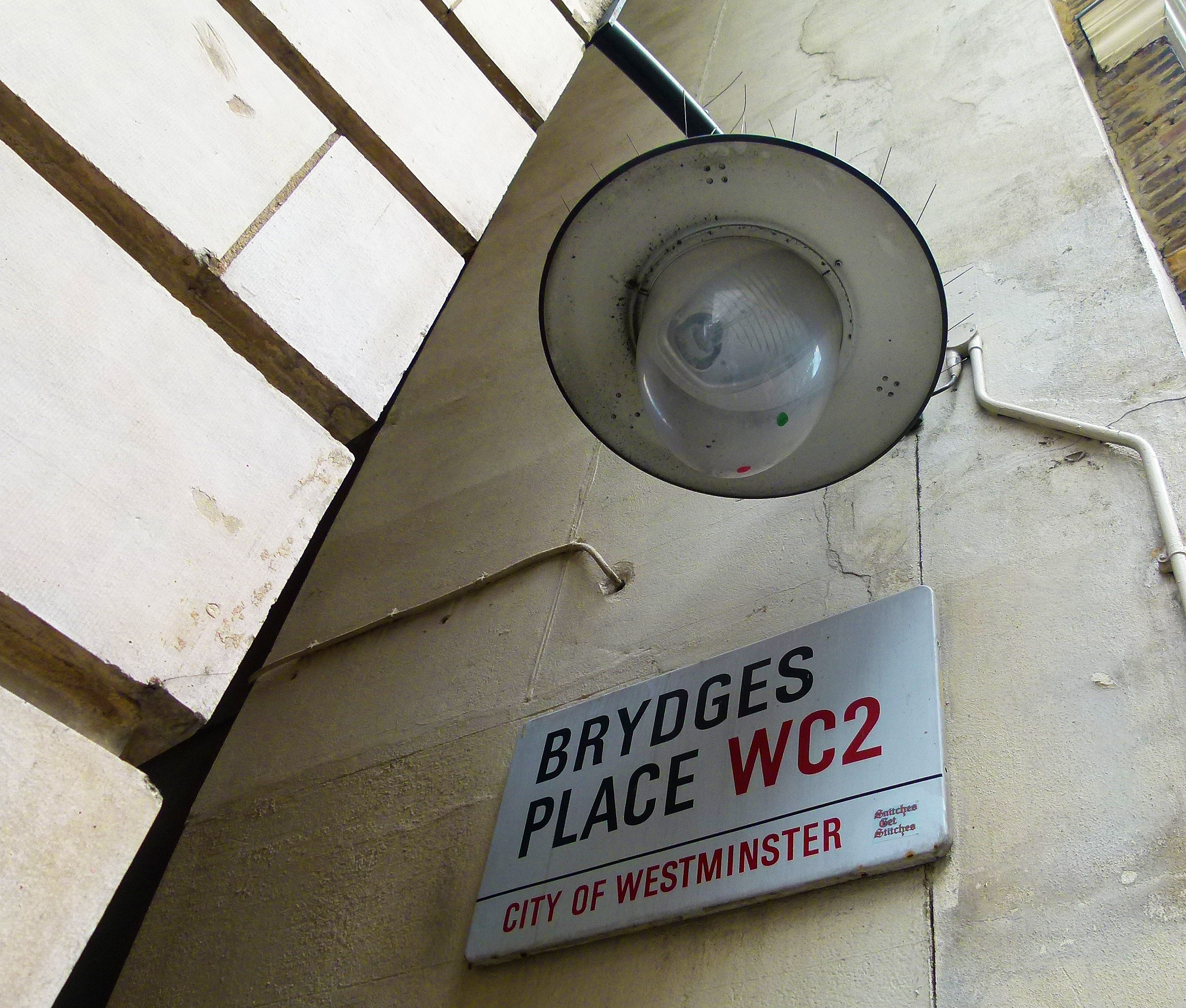
Running for approximately 250 ft. this secretive passageway is called ‘Brydges Place’ and provides pedestrians in the know with a quick link between St Martin’s Lane and Bedfordbury (just behind Charing Cross Police Station).

Brydges Place – St Martin’s Lane entrance.
At its tightest point, Brydges Place is just 15 inches wide, making it London’s narrowest alley- so is best avoided if you suffer from claustrophobia.
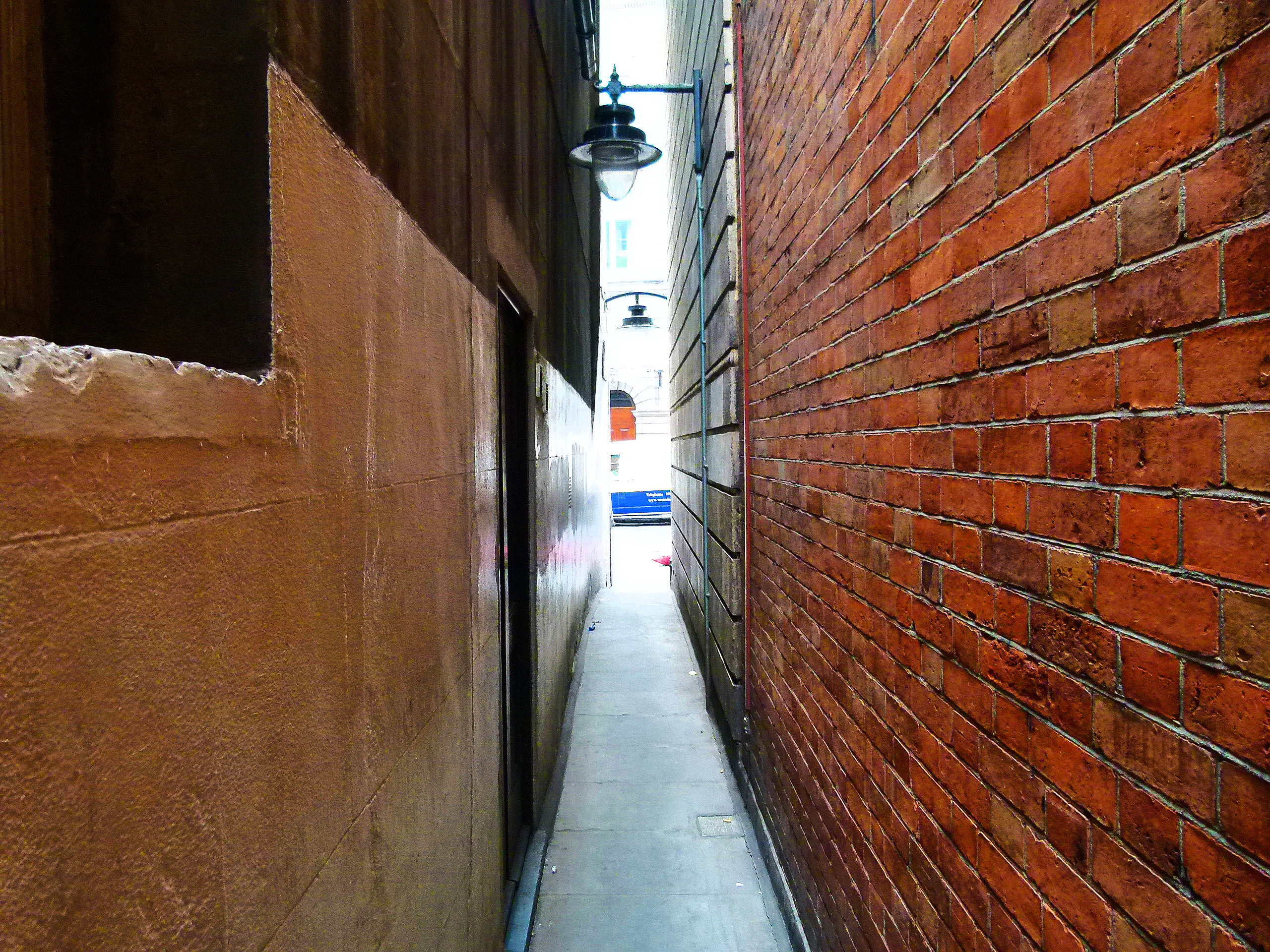
Brydges Place is named after Catherine Brydges of Chandos who married the fourth earl of the Bedford Family in 1608 (the Bedford family being the original owners of the land occupied by Covent Garden).
The Bedford dynasty gave their name to a number of streets in Covent Garden and, at one time, part of Catherine Street (home to the Duchess Theatre and the Theatre Royal) was known as Brydges Street.
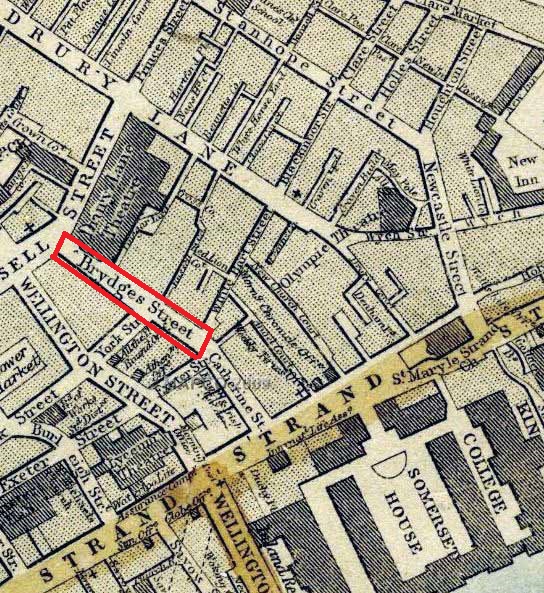
Brydges Street (now entirely named Catherine Street) on a map from 1868 (image: mapco.net)
Brydges Place as it stands today was created at the turn of the 20th century when the London Coliseum- which provides much of the alley’s northern wall- opened on Christmas Eve 1904.

However, a passageway covering this ground is nothing new- an alley had existed on the site long before its present incarnation and was known as ‘Turners Court’ before morphing into Brydges Place.
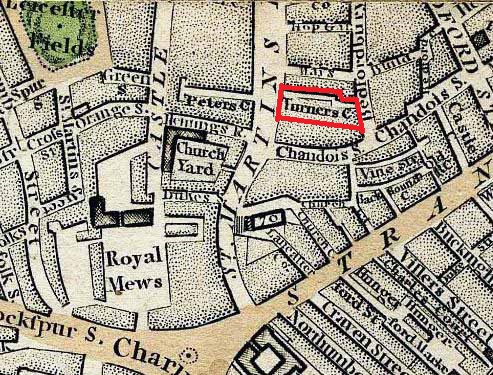
Turners Court…. note; the area labelled ‘Royal Mews’ in the bottom left hand corner of the map is now covered by the National Gallery.
On 15th August 1885, The Times carried a sad report on Mr Dennis O’Malley, a 73 year old sandwich-board man who lived and died in a tiny home on Turners Court.

A narrow window looking out on Brydges Place.
The flat- which Dennis O’Malley shared with his son- was described as a “front room in the basement” of a house into which another 14 people were crammed.
Mr O’Malley was “found lying dead on a kind of bed on the floor. The stench of the room was abominable.”

Dr Samuel Mills, who was called to the scene, stated that “he was not aware that such a place in Bedfordbury existed”…
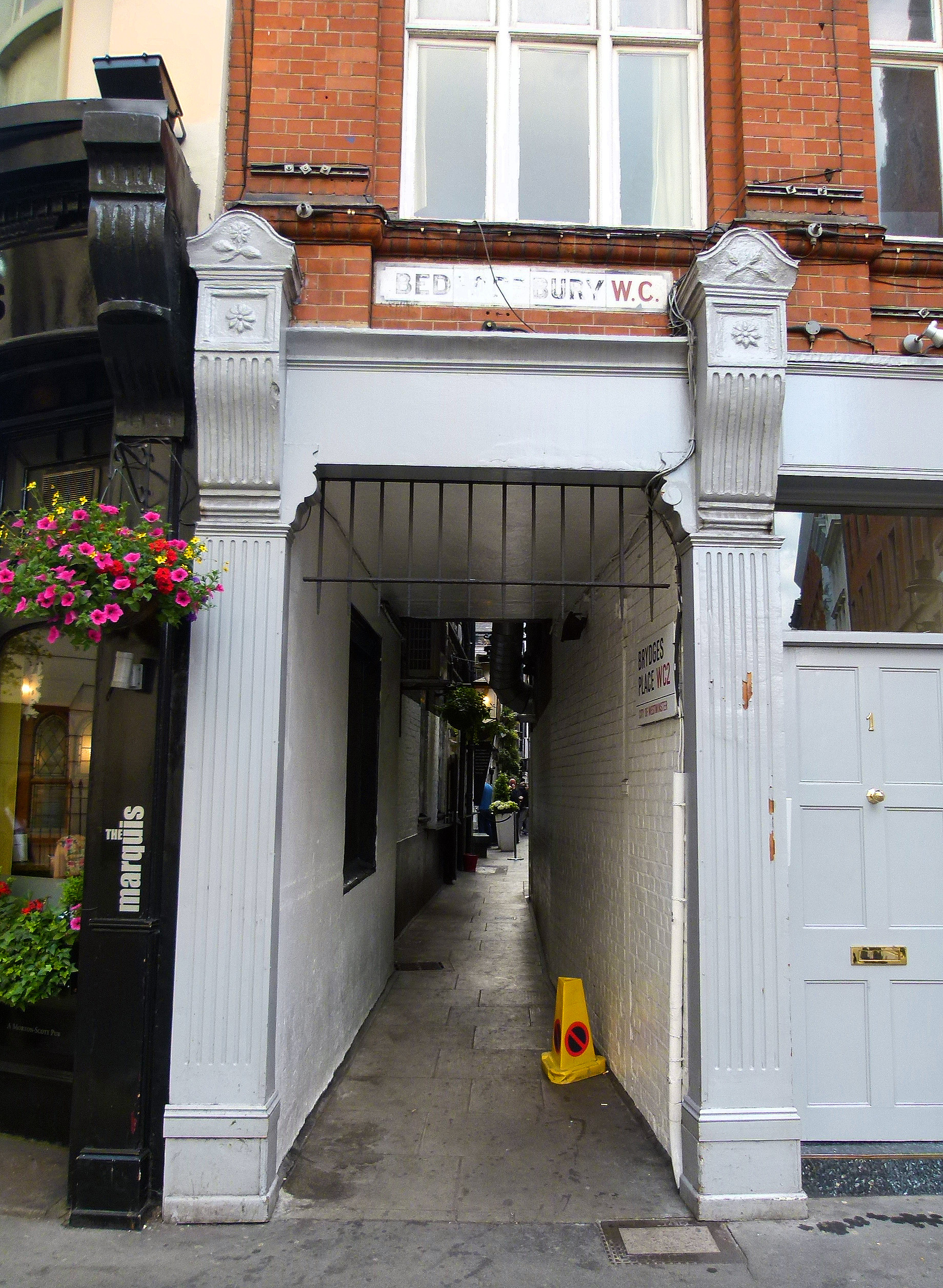
Brydges Place Bedfordbury exit.
*
Today, the only active premise to be found tucked away on Brydges Place is the aptly named ‘Two Brydges Place’; a discreetly private club popular with those who work in the theatre and media (Simon Callow is a noted member).

A group of drinkers gather outside Two Brydges Place.
Two Brydges Place was established in the early 1980s by Rod Lane, an entrepreneur who founded the club on “the basis that I didn’t like going to places where people clicked their fingers at the waiters.”
Sounds like my kind of place!






 View from the Mirror