Eerie Enfield… A Poltergeist Comes to North London
A Halloween Special
With Halloween upon us, I think now would be the ideal time to indulge in one of London’s most perplexing ghost stories…

What you are about to read is far removed from traditional tales of headless spooks and Victorian séances… this account is very much a modern-day haunting; a deeply disturbing series of events which occurred at a modest, north London council house during the late 1970s…
The Enfield Poltergeist
Green Street is an unassuming residential road in an area called Brimsdown; part of the London Borough of Enfield.

Map depicting location of Green Street, Enfield- please click to enlarge.
If you’ve ever ridden the Stanstead Express, you will have passed Brimsdown without even knowing it- at the eastern end of Green Street there is a level crossing, through which trains regularly whisk between Stanstead airport and Liverpool Street station.
Blink and you’d miss it…
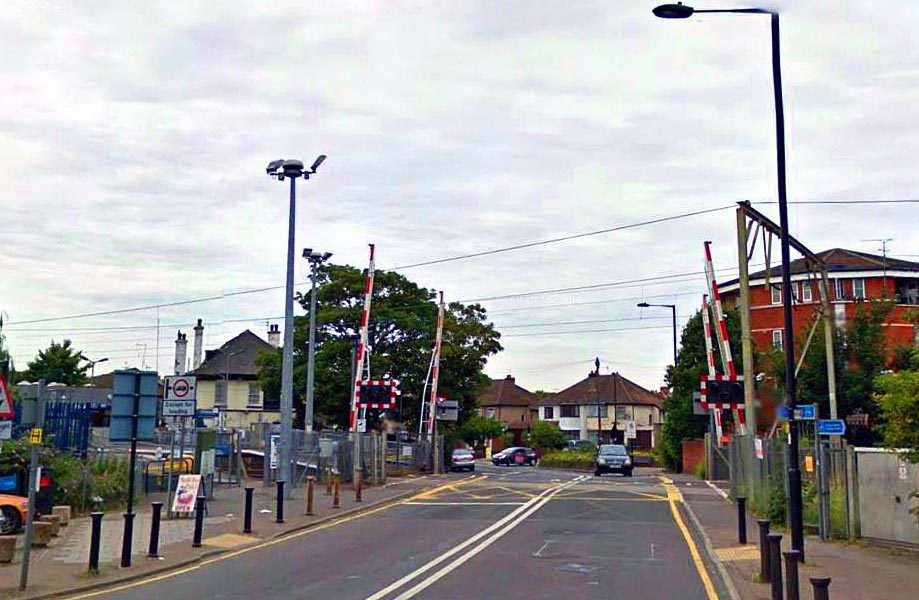
Green Street’s level crossing (image: Google).
In the 1970s, Green Street was home to Peggy Hodgson; a single mum with four children: Margaret (aged 12), Janet (11), Johnny (10) and Billy (7).
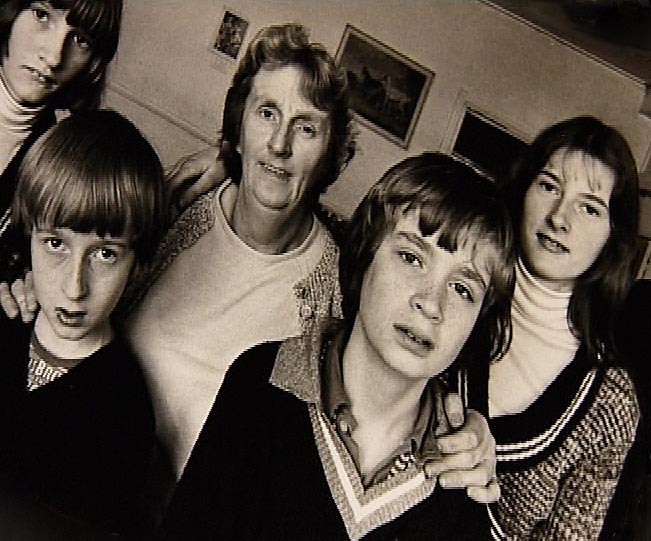
The Hodgson Family.
It was on the evening of August 30th 1977 that weird things began to happen in the Hodgson’s Enfield residence…
Upstairs, in one of the bedrooms, the children were alarmed to feel their beds wobbling.
Janet called down to her mum- but Peggy, understandably, suspected that her kids were mucking about and shouted back up at them to settle down and get to sleep.
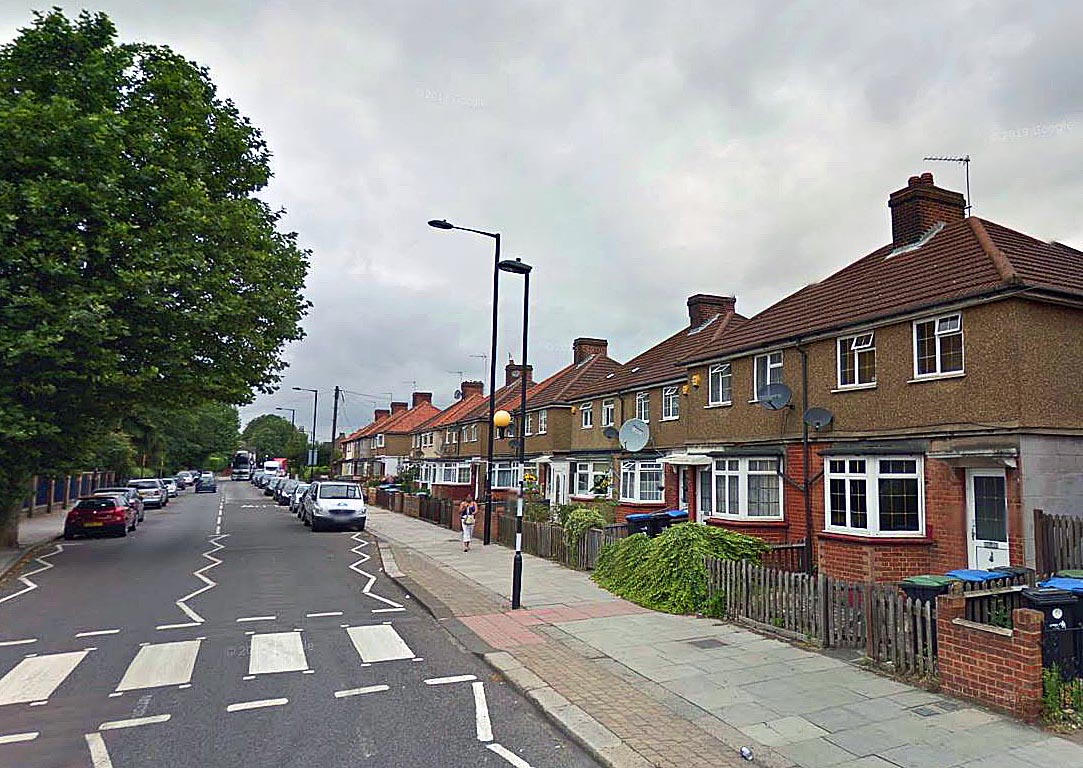
The section of Green Street which was home to Peggy Hodgson and her children (image: Google).
The following night at around 9.30pm, Peggy heard a loud crash.
Assuming her children were once again up to mischief, she stomped upstairs to administer a scolding.
As she entered the bedroom with orders to “pack it in”, Peggy spotted a chest of drawers being hauled forward by its own accord.
Instinctively, she attempted to force the furniture back- but was thwarted by an unseen force, which appeared to be pushing its might against her- rather like two opposing magnets.
Next came the noises; odd knocks and taps which started to rap around the house.
Scared witless, the family hastily donned their dressing gowns and slippers and fled, seeking refuge with their next door neighbours, the Nottinghams.
Head of the Nottingham household was Vic; a roofer by trade whose tough demeanour and practical nature made him the ideal candidate to inspect the strange goings on.
Hoping to calm his terrified neighbours, Vic ventured into the house- he later described his experience in a 1978 radio documentary:
“All I could here was this knocking… and I didn’t know what it was; no idea what it was; just a strange knock on the wall.
I went up the stairs and this knock followed me; three distinctive knocks on the wall. I carried on up the stairs into the front bedroom and there were three knocks on the wall again… strange I thought to myself. I’m beginning to shake.
I go into the back bedroom… same thing again; the knocks followed me.
Anyway, being in the building game I thought to myself, well I’ve got to have a look around the house; be brave like to try and find out what it is. So I go through all the pipes- no airlocks, nothing like that- and it wasn’t a knock like that anyway; it was a distinctive knock on the wall.”
Vic popped back next door and fetched his son and grandfather.
The three men positioned themselves at different rooms within the house- and each reported the distinctive knocks at their separate locations.
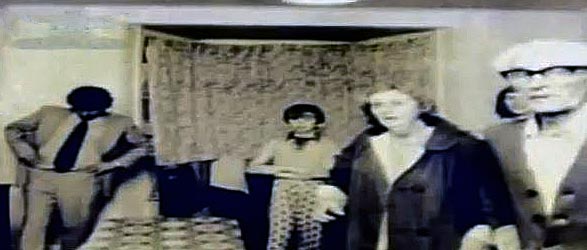
With even Vic spooked, the Green Street residents decided to phone the law- whose first question was “have you been drinking?”
Reluctantly, the police sent a squad car with two constables from nearby Ponders End.

The two police officers who visited 284 Green Street during the early hours of September 1st 1977.
The police too heard the distinctive knocking and, downstairs, WPC Carolyn Heaps witnessed a chair move unaided across the floor; something which she testified to in an official document- a brave move considering the possible ridicule from her friends and colleagues:
“On Thursday, 1st September 1977 at approximately 1am I was on duty in my capacity as a police woman when I received a radio message to Green Street, Enfield.
I heard the sound of knocking on the wall… there were four distinct taps on the wall and then silence.
Within a few minutes the eldest son pointed to a chair which was standing next to the sofa. I looked at the chair and noticed it was wobbling slightly from side to side. I then saw the chair slide across the floor towards the kitchen wall. It moved approximately 3-4 feet and then came to rest.”
Although sympathetic, the police had to inform the family that the ominous situation could not be classed as a police matter- after all, no crime had been committed…
*
The Poltergeist settles in…
Nervously, the Hodgsons returned to their home, but over the following months, the distressing activity would grow far worse… much of it witnessed by friends, neighbours, psychic investigators, council workers and news reporters.

The Hodgson children with a news reporter.
One phenomenon involved Lego bricks and marbles being hurled around the house at high speeds and odd angles- which, even more bizarrely, would stop dead still rather than bouncing when they landed. They were also hot to touch when picked up.
One journalist from The Daily Mirror was hit just above the eye by one of these small missiles- and received a small lump; a testament to the velocity at which the items were being hurled.

Soon, larger objects were being flung.
One reporter witnessed a t-shirt hop off of a table and fly across the room.
The living room sofa was seen to lift above the ground… and then spin around. The bulky television shuffled position and, in the children’s bedroom, a brick was wrenched away from the fireplace.

Aftermath of one of the Enfield Poltergeist’s many bouts of disruptive activity….
Puddles appeared and cups filled themselves with water.
Matches were scorched in their boxes and a pair of oven gloves self-combusted.
A mirror also caught fire… the charred remains of which were later collected by Turner-Prize nominee artist, Cornelia Parker, as part of her 1997 installation, ‘The Secret Life of Inanimate Objects’.
On one particular night, the BBC set up camp at 284 Green Street to capture audio evidence… only to later find that metal components in the machine had been bent and the recordings erased.
Terrified, Peggy and her children took to sleeping in the same room, where they would huddle together with the light kept on.

Billy, Janet and Margaret Hodgson.
*
Who ya’ gonna’ call?
In an attempt to garner some clarity, the editor of the Daily Mirror, George Fallows appealed to the Kensington based Society for Psychical Research to come and see if they could work out what was going on.

For the next 13 months, the Hodgsons and their haunted home were put under intense scrutiny.
The investigation was led by Maurice Grosse, a former military man and veteran of the Dunkirk evacuation.

Maurice Grosse (image: The Fortean Times).
After the war, Maurice had established himself as an inventor- his most successful patent being the rotating advertising board.
Tragically, in August 1976, his 22 year old daughter, Janet was killed in a motorbike accident. It was her death which led Maurice to join the Society for Psychical Research; no doubt as a way of helping to cope with his grief.
Although open to psychic phenomenon, Maurice’s background as an inventor meant that his mind worked in a scientific, methodical manner and as such he was considered the ideal analyst for the Enfield haunting.
He was soon joined by another experienced investigator; Guy Lyon Playfair who published an account of the haunting in 1980.
At first, Guy was reluctant to become involved; convinced that the whole thing was a hoax. However, when he arrived at the house, he soon changed his mind…

‘This House is Haunted’; Guy Lyon Playfair’s 1980 report on the Enfield Poltergeist.
By now, the events at Green Street had become even more intense.
As well as household objects being lobbed around, 11 year old Janet- who appeared to be the poltergeist’s main focus- was herself subjected to apparent levitations.
An example of this, which took place one morning at approximately 3am, was caught by an automatic camera which had been installed by the investigators:

Janet, apparently being hurled from her bed during the early hours of the morning. On a lighter note, a poster featuring David Soul (star of the 1970s cop show, ‘Starsky & Hutch) can be seen on the bedroom wall- he is one of the numerous celebrities I have met in the back of my cab!
On two occasions, two separate witnesses outside the house with a view towards the bedroom window, claimed they spotted Janet floating in the air.
The first sighting, which took place at around lunchtime on December 15th 1977, was attributed to Hazel Short; a lollipop lady who worked on the zebra crossing close to the Hodgson’s home:
“All of a sudden I heard a bang… and saw a book hit the front bedroom window and that was followed by a pillow, then the book, then the pillow again. All of a sudden, I saw Janet going up and down in front of the window- I thought she was jumping up and down on the bed, but when I looked she was horizontal going up and down with her arms and legs going everywhere; I suppose about half a dozen times. It was frightening… I didn’t think it would be, because to be truthful… I was a bit sceptical… well after that I wasn’t.”

Green Street’s zebra crossing, from which lollipop woman, Hazel Short claims to have spotted Janet Hodgson levitating (image: Google).
The second witness was John Rainbow, a baker delivering bread to the school opposite.
“Before that day I would never had believed anything about it although I had heard various rumours about what had been going on in the house.
The child appeared to float around the room- at the same time the curtains were blowing into the room as if there were a draught- although the windows were completely closed… articles and the child appeared to be revolving around the room in a clockwise direction.
The child’s arm banged against the window twice and I was frightened that the force she banged against it- that the window frame would’ve gone- I fully expected her to drop onto the road. I was frightened, there’s no doubt about it.”

Janet slumped over a cabinet following another supposed levitation.
*
Even more disturbingly, the poltergeist was supposedly beginning to talk through Janet…

The young girl, who also suffered from alarming seizures, would often adopt a deep, gruff voice which identified itself as belonging to a mysterious figure called ‘Bill.’
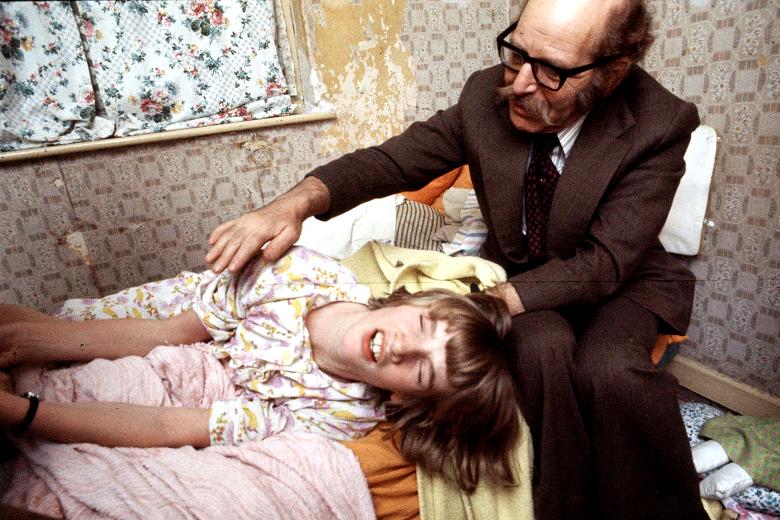
Maurice Grosse attempting to calm Janet as she suffers a seizure.
Janet would speak in the gravelly, menacing voice for hours at a time.
In one experiment, she was made to hold a quantity of water in her mouth… yet the voice still came through.
Further vocal tests were carried out by a Professor from Birckbeck College (now part of the University of London) who concluded that it was next to impossible to speak at length in such a way due to the damage such speech would cause to the vocal cords.
The academic also stated his belief that Janet was not producing the voice consciously.
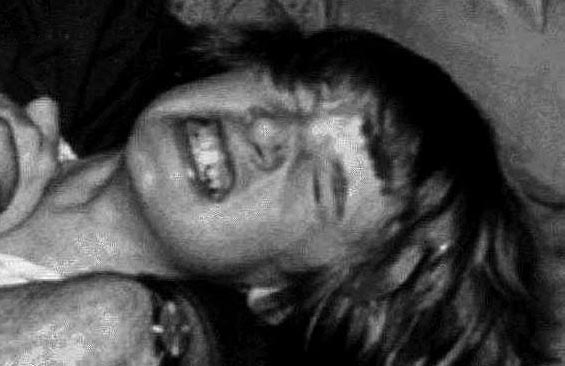
Janet in the depths of a trance…
Unsurprisingly, some sceptics accused the 11 year old of ventriloquism- which led Maurice Grosse to offer a £1,000 reward for anybody who could replicate a similar voice.
There were no takers.
*
With his often foul language and grumpy attitude ‘Bill’ made for a very sinister houseguest.
In one session- which, like many others, was caught on tape- Bill, speaking through Janet, stated that he had once lived and died at the Green Street home.
However you chose to look at it, the description of death which the supposed entity provides is most disturbing when you remember that it is being spoken by an 11 year old girl:
“Before I died I went blind…then I had a hemorrhage and I fell asleep and I died in a chair in a corner downstairs…”
This statement can be heard in the excerpt below… although please be warned, it is likely to send a chill down your spine…
Three years after the main events of the haunting, the Hodgson family were contacted by a man who claimed that his father- William (aka ‘Bill’) Wilkins had indeed lived in the house years before…and had died of a brain hemorrhage whilst resting in an armchair…
*
By the autumn of 1978 the hauntings began to die down.
However, the knocks and taps continued and there was a further burst of activity during the summer of 1980.
Following the haunting, the lives of the Hodgsons were far from blessed.
Johnny died of cancer aged just 14 and Janet lost a baby son to cot death when she was 18.
Speaking in 2007 Janet (then in her early 40s) said in a rare interview;
“I know from my own experience that it was real… it lived off me, off my energy. Call me mad or a prankster if you like. Those events did happen. The poltergeist was with me- and I feel in a sense that he always will be.”

Janet Hodgson today.
*
The presence remains…
In 2003, Peggy Hodgson died and the Green Street home was taken over by Clare Bennet who, like Peggy, was a single mum with four children- although in this case they were all boys.
Of her time at Green Street, Clare said that she frequently felt a presence; as if she were being watched- at first, she had no idea of the home’s dubious history.

284 Green Street…
Her boys would sometimes wake up in the middle of the night, saying that they could hear voices downstairs.
One of the lads; 15 year old Shaka, claimed he was woken up in the middle of one night and confronted by a ghostly vision of a man standing in the room.
The Bennets stuck Green Street for just two months…
*
Inspired Fear
In 1992, the case of the Enfield Poltergeist inspired a controversial BBC drama entitled Ghostwatch which was broadcast on Halloween night that year.

Starring Craig Charles, Sara Greene and Michael Parkinson, Ghostwatch bore many similarities to the Enfield case- it was set in an ordinary council home in suburban London (Northolt in this case) and centred on a single mum and her two daughters who were being tormented by a malevolent poltergeist- the evil spirit of a man who had died in the house years before.
Although a scripted, pre-filmed drama, Ghostwatch was made to appear as if it were an actual investigation, being broadcast live… and many people, thanks to the documentary nature of the show and the presence of the usually reassuring Michael Parkinson, tuned in half way through and believed the events depicted to be very real!

Michael Parkinson, pictured in the ‘live’ Ghostwatch studio, 1992.
The BBC switchboard was jammed with phone calls from petrified viewers… and people across Britain were reduced to nervous wrecks, unable to sleep soundly for many nights afterwards.
Ghostwatch has never been repeated on British television since.
***
Early Road Pricing: London’s Lost Turnpikes
Since 2003, the road network of central London has been subject to the ‘Congestion Charge’; a £10 fee which drivers must cough up if they wish to brave the capital’s chaotic streets (thankfully, as a London cabbie, my taxi is mercifully exempt from the charge).

The idea of making people pay to use London’s roads is far from new.
Between the 17th and 19th centuries, the capital operated an extensive system of toll gates known as ‘turnpikes’ which were responsible for monitoring horse-drawn traffic and imposing substantial charges upon any traveller wishing to make use of the route ahead.

A diagram of London’s turnpike network from 1790 (image: mapco.net) Please click to enlarge.
Just like today, certain lucky users were exempt from the charge- namely mail coaches, soldiers, funeral processions, parsons on parish business, prison carts and of course, members of the royal family.
Although the turnpikes were originally intended to fund the upkeep of London’s roads, they were subject to considerable corruption.
Over-charging was commonplace with scrupulous gate owners often more interested in lining their own pockets rather than ploughing the cash back into maintenance.

The former toll-keeper’s house (on right) at Hampstead turnpike, opposite the Spaniards Inn. Although long decommissioned, the former turnpike lives on in the narrow road which still forces drivers to slow down! (Image: Google)
Each turnpike was staffed by a lone toll-keeper, who was provided with a small cottage on site. The job was a tough one; the keeper expected to be on 24 hour duty for very little pay.
At night, toll-keepers were also easy-prey for robbers and highwaymen.

A rowdy group of travellers causing trouble at a turnpike, 1825.
In London, the busiest turnpikes were at Tyburn (the site famous for public executions, now known as Marble Arch), Hyde Park, Tottenham Court Road, Elephant and Castle and Mile End Road. Just like today, these were important roads and junctions and the requirement for all traffic to filter through the turnpike gates often resulted in frustrating jams.
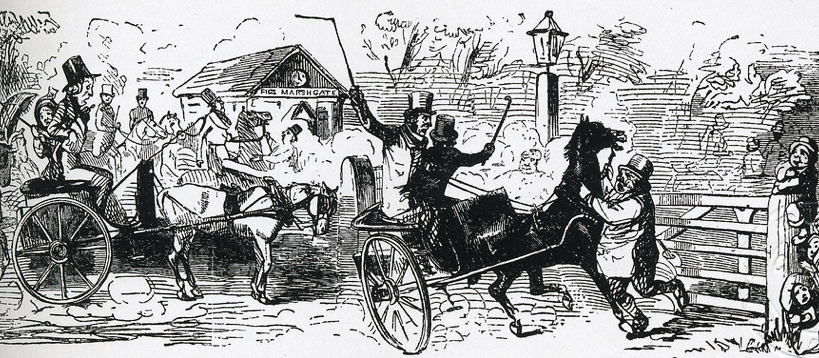
A scene depicting traffic chaos at a turnpike as race-goers return to London from Epsom (image by Mark Searle).
By the mid-19th century, the turnpikes were losing much business to the rapidly expanding rail network.
Consequently, the toll system was abolished in 1864 by the Metropolitan Turnpike Act. The last major gate to close was the Mile End turnpike which ceased collecting money in 1866.
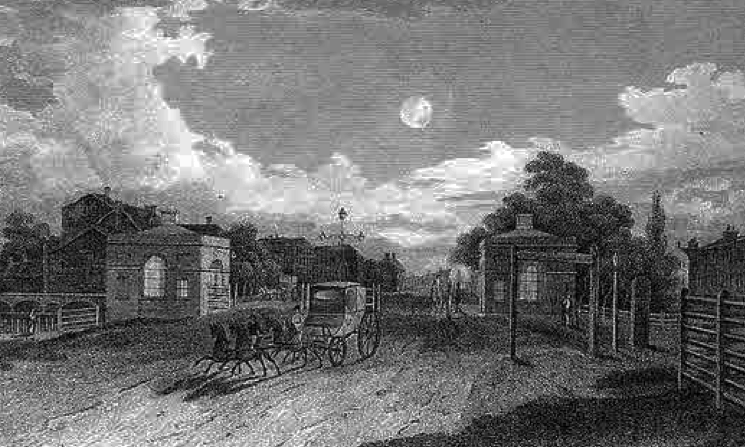
Mile End Gate; London’s last major turnpike.
Today, the names of London’s former gates live on in the names of streets such as Notting Hill Gate and Turnpike Lane.

Despite the 1864 act, toll gates in London haven’t died out completely.
Until fairly recently, on South Hill Drive in South Harrow, a toll gate was in operation just a stone’s throw away from the Piccadilly Line. The South Harrow charge is no longer enforced, although the gate remains firmly in place.

South Harrow toll gate (image: Google).
Today, London’s only active toll gate can be found on College Road in Dulwich which, for the price of £1, permits car owners to take a pleasant drive between Dulwich Common and Crystal Palace Parade.

College Road, Dulwich- London’s only remaining active toll gate (image: Google).
A gallery of images depicting a number of London’s now long lost turnpikes can be viewed below- please click on the pictures to learn more.


Secrets of the Viaducts: Walking the London Bridge to Greenwich Arches (Part Five)

* * *

After bridging the London Overground tracks, the arches of the London to Greenwich Railway cross Landmann Way; an isolated industrial road named after Thomas Landmann who first envisioned the pioneering viaduct in the 1830s.
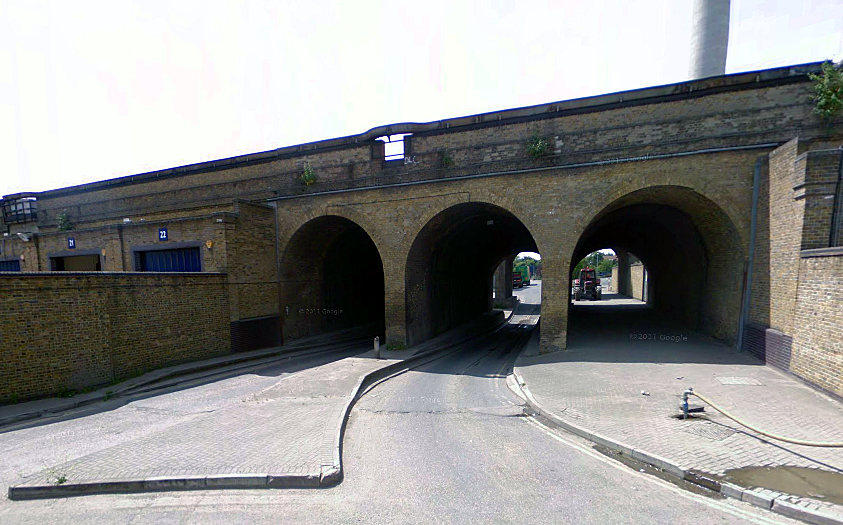
Landmann Way (image: Google).
The arches then approach the junction of Trundleys, Grinstead and Surrey Canal Road.
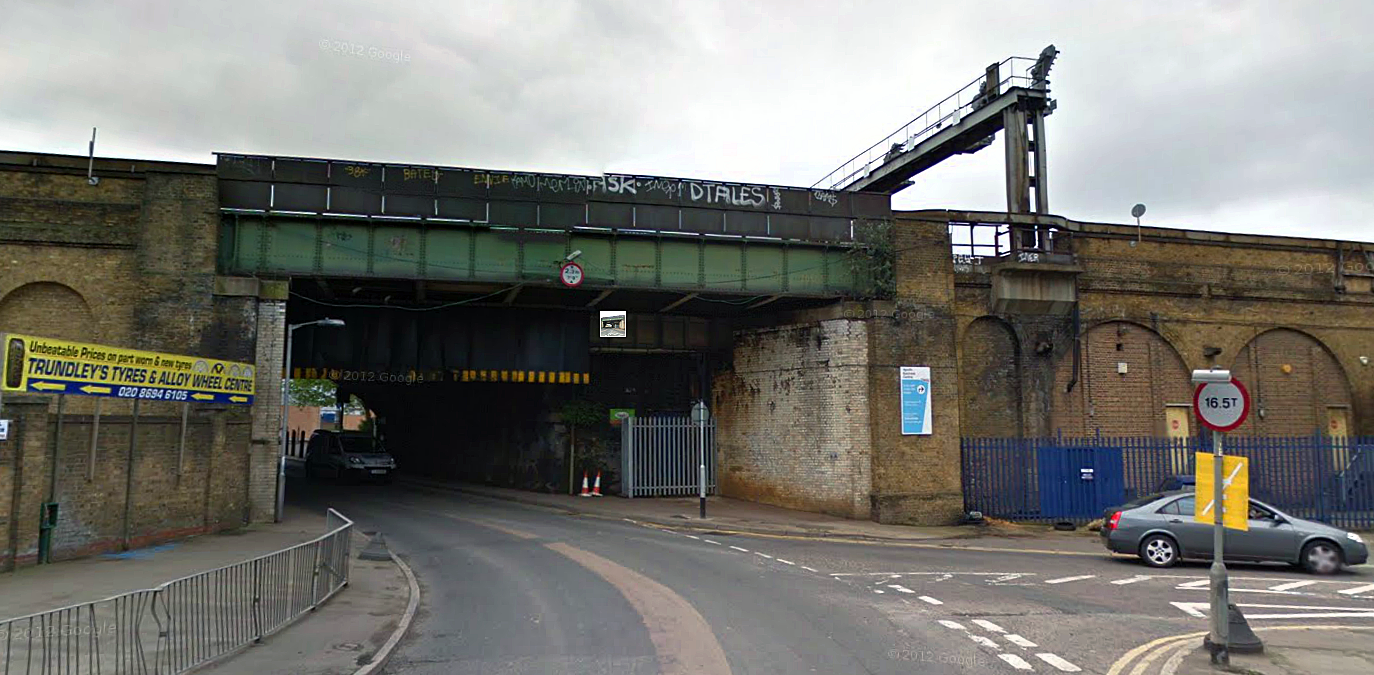
Trundleys/Grinstead Road junction (image: Google).
The Grand Surrey Canal
The route traced by Surrey Canal Road wasn’t originally a road at all- it was a waterway; part of the 2 ½ mile long Grand Surrey Canal which opened in 1810 for the purpose of transporting timber.
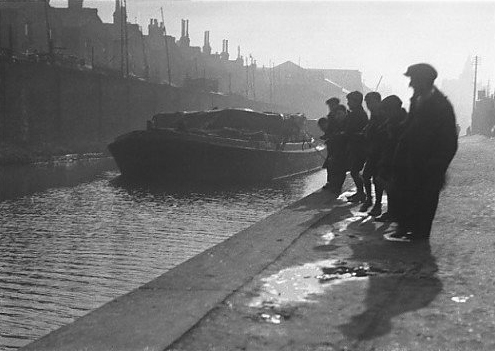
The Grand Surrey Canal (image: putitonmap.org)
Linked to the Thames at Rotherhithe’s Greenland Dock, the canal’s route headed directly south, passing beneath the London and Greenwich railway arches before turning onto the stretch covered by the now tarmacked over Surrey Canal Road.
The waterway then headed along the present day Verney Road, passed underneath the Old Kent Road and then on through the area now occupied by Burgess Park before terminating at a basin between Albany Road and Addington Square in Camberwell.
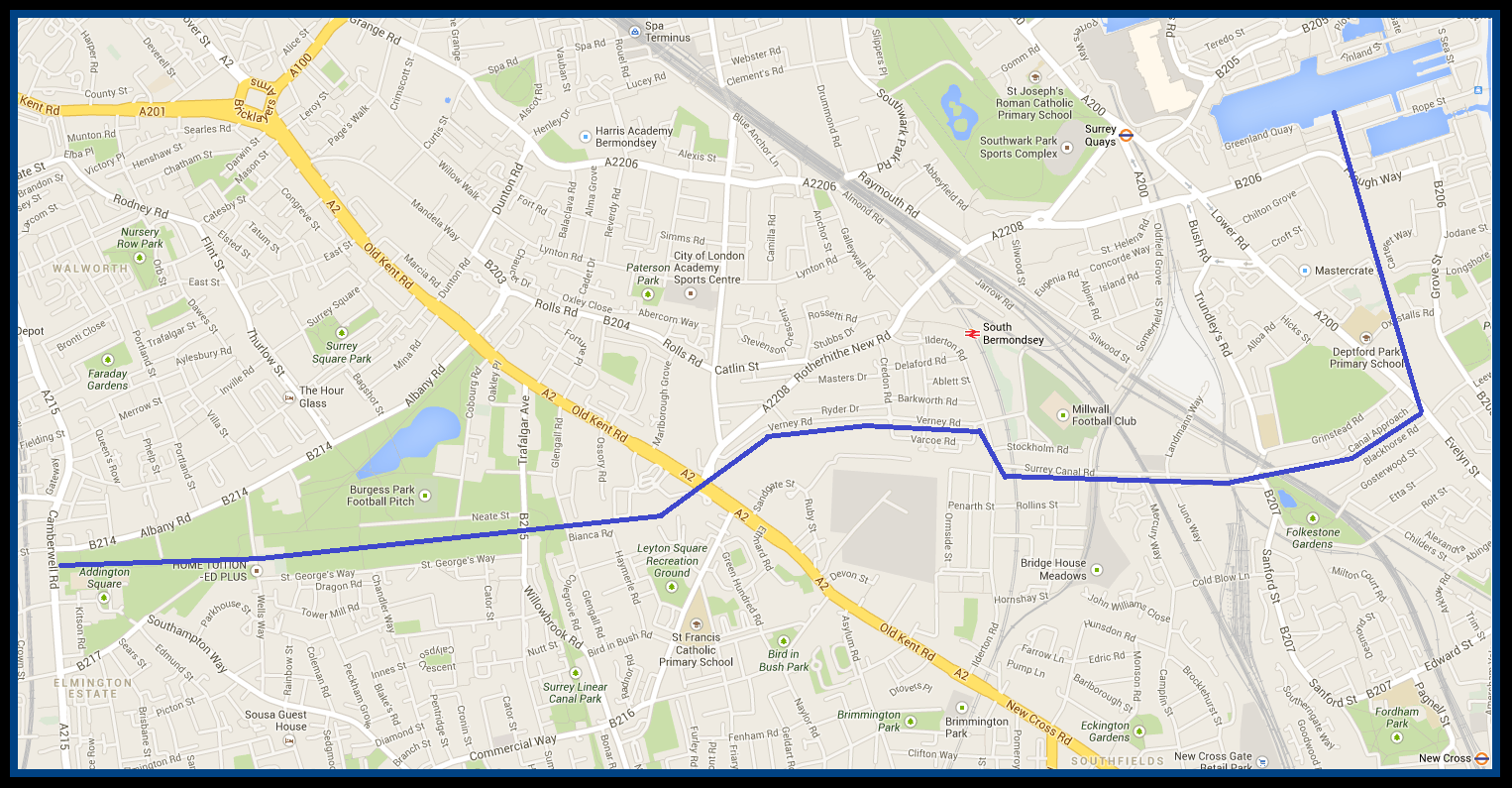
The approximate route of the former Grand Surrey Canal (please clink to enlarge).
The canal carried freight well into the 20th century but as the decades wore on, it began to receive increased competition from road transport.
Between the 1940s and 1970s, the canal was gradually closed down section by section, leaving a collection of muddy, rubbish-strewn troughs in its derelict wake.
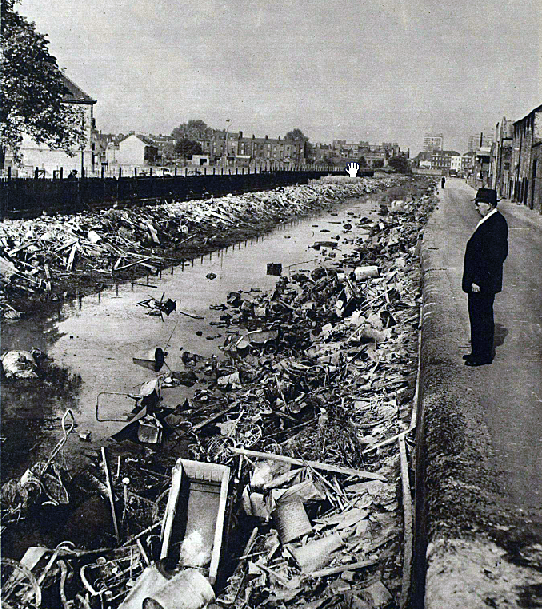
The state of the canal near Wells Way (Burgess Park) as it appeared in 1960. (Image: The London Illustrated News).
In the 1980s the obsolete trench was filled in; its route transformed into paths and roads which have pretty much erased all trace of the former canal.
However, if you know where to look there are a few clues here and there as the following images illustrate:

Former canal bridge on Evelyn Street. The filled in area below is now occupied by industrial units. (Image: Google).
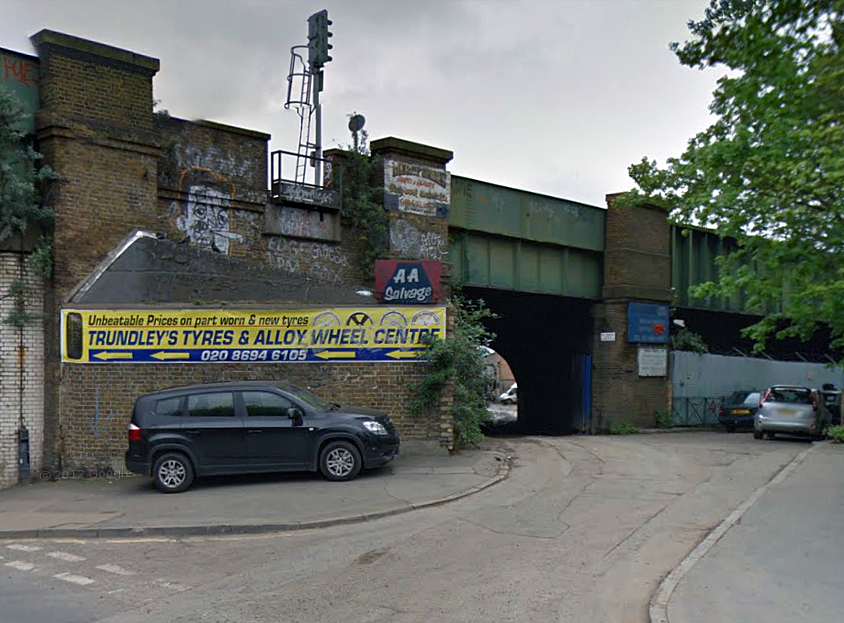
Canal Approach, off of Trundleys Road. The curved road here indicates the path once wound by the canal as it passed beneath the railway viaduct. On Canal Approach, it is still possible to spot the odd mooring ring buried in the dirt… (Image: Google).

Surrey Canal Road, a route which was once deep under water… (Image: Google).

Satellite view of the Canal’s old route through Burgess Park; now converted into a footpath (image: Google).
*
A Further V2 Catastrophe
After the Trundleys Road junction and close to where the canal once flowed, the London to Greenwich arches run past a small park called Folkestone Gardens.

Folkestone Gardens (Image: Google).
The land now covered by Folkestone Gardens once bustled with streets and housing.
However, at 3.20am on the 7th March 1945 the site was struck by a V2 rocket, the huge explosion destroying much of the housing stock and killing 53 people.
Most of the fatalities were railway employees and their families, housed in flats owned by the Southern Railway.
The bombsite remained until 1970 when the rubble was cleared away and the peaceful green spot laid out.
*
Cold Blow Lane’s Cold War Politics
Shortly after passing beneath the viaduct, Trundleys Road becomes Sanford Street, off of which branches Cold Blow Lane.
On the corner of Sanford Street and Cold Blow Lane, you’ll spot a bold mural entitled Riders of the Apocalypse, painted on the end terrace of the Sanford Housing Co-op.
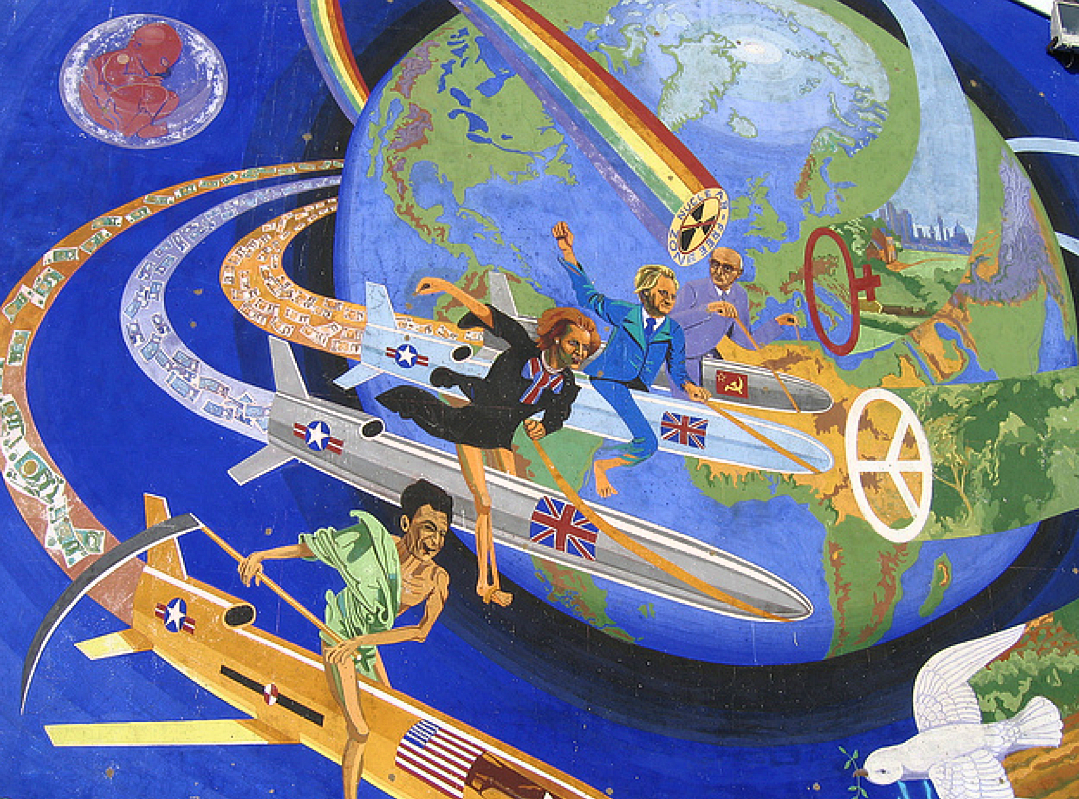
Riders of the Apocalypse (Image: London Murals website).
Created by Brian Barnes in 1983 when the cold war was decidedly chilly, the mural depicts Ronald Regan, Margaret Thatcher, Michael Heseltine (UK minister for defence at the time) and Soviet leader, Yuri Andropov, jockeying recklessly around the world on nuclear-tipped cruise missiles; a controversial weapon at the time due to its deployment on British soil at RAF/USAF bases Greenham Common and Molesworth.
The mural was a sequel to another of Brian Barnes’ south London murals… the terrifying Nuclear Dawn which was unveiled on Brixton’s Coldharbour Lane in 1981.

Nuclear Dawn; Brian Barnes’ other south London anti-war mural, pictured here in 1981 (Image: djfood.com).
Today, Nuclear Dawn can still be seen but is in a far sorrier state than its Deptford counterpart. There is currently a campaign to save it- please click here to learn more.
Deptford Station; Old Man of the Network
As we’ve seen in previous posts, in its first year the London and Greenwich Railway only ran a short distance between Spa Road and Deptford before being extended to London Bridge a year later; a quirk of history which granted Spa Road the accolade of being the capital’s first official railway terminal.
Spa Road has long since closed… but the Deptford stop is still very much in operation, essentially making it London’s oldest station to remain in service- and pretty much the world’s oldest working suburban station.

Deptford Station in the 1920s (Image: Old Deptford History).
For many years, the station was from salubrious, characterized by dingy stairwells and small, cramped brick buildings.

Deptford Station shortly before its recent redevelopment.
However, in the past two years Deptford Station has undergone a drastic re-development, with a brand new forecourt introducing much needed doses of light and air.

Deptford Station today.
*
The Deptford Project
On the high street, just over 100 yards south of the station, there sits The Deptford Project, based in the grounds of a former railway yard which was once annexed to Deptford Station.

The centrepiece of this refreshing community centre is a decommissioned 1960s train carriage which has been jazzed up and converted into a quirky café- I can safely vouch that the food and coffee served here is pretty marvellous!

The Deptford Project Carriage.
The 35 tonne carriage has held pride of place on Deptford High Street since 2008 after being carefully towed by road from Essex at the achingly slow speed of two miles per hour.
When the carriage passed beneath the Deptford Station arch, there were just a nail-biting two inches to spare…

The carriage arrives in Deptford (Image: The Deptford Project).
*
Rockin’ Out of Deptford

As the viaduct heads further south, the arches become neater and more diminutive.
After departing Deptford Station, trains on the London to Greenwich arches brush past the Crossfield Housing Estate which, despite appearing pretty run of the mill, actually boasts some surprising links with the history of British pop-music….

Looking towards the Crossfield Estate through the railway arches.
In the late 1970s, one of the estate’s blocks- Farrer House, which sits right beside the viaduct on a road known as Creekside, was deemed by the local council to be unsuitable for housing those with families.
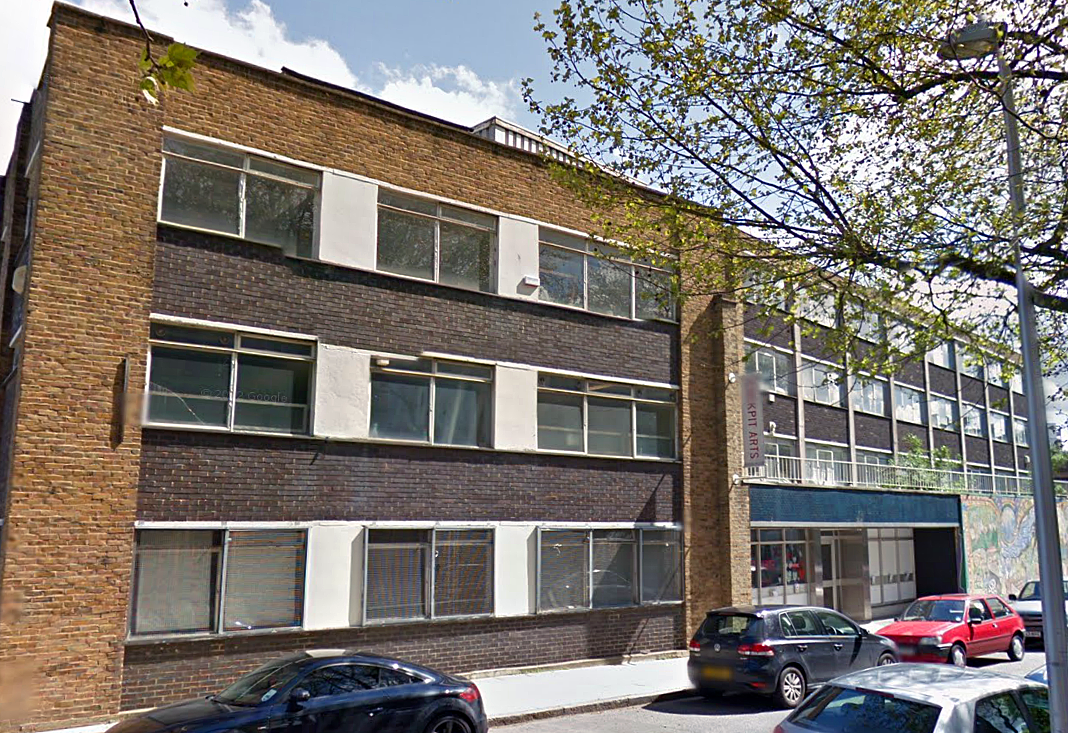
Farrer House (Image: Google).
Consequently, the accommodation was offered to young, single tenants; many of whom happened to be struggling artists and musicians.
Amongst these down-at-heel residents were a number of performers from Deptford based band Squeeze (for whom Jools Holland was famously the original keyboard player).

Squeeze single cover, 1980.
Very much a quintessentially London band, Squeeze went on to have success in both the UK and the USA with songs such as Cool for Cats, Tempted and the bittersweet classic, Up the Junction which can be heard below:
Around the same time, Farrer House was also occupied by the fledgling band, Dire Straits.

Dire Straits, 1978 (Image: Wikipedia).
In 1977, the Crossfield Estate provided the unlikely setting for Dire Straits’ first ever gig.
With the Deptford Music Festival in full swing outside, the band decided to plug their instruments into the flat’s electrics, trail the wires outside and preform an impromptu set on the lawn.
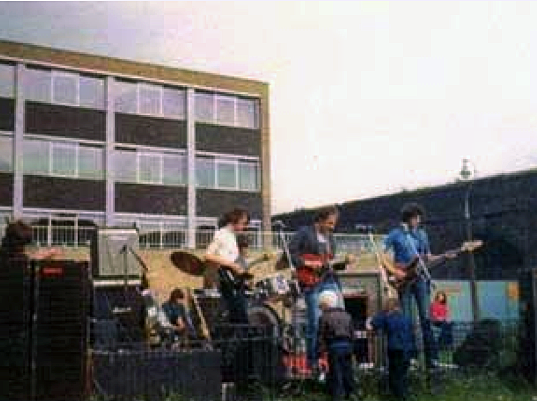
Dire Straits playing their first gig right beside the London to Greenwich arches, 1977. (Image: News Shopper).
Like Squeeze, Dire Straits were a regular act on Deptford’s club and pub scene, playing in venues such as The Duke and The Bird’s Nest before hitting the bit time.
The atmosphere of this south London pub scene was evoked in Dire Straits’ 1978 hit, The Sultans of Swing (please click below to listen):
In 2009 a plaque was unveiled on Farrer House by the Performing Rights Society to commemorate Dire Straits’ earliest gig.

Dire Straits Plaque (image: London Remembers).
The band is also linked to mural entitled Love Over Gold (the title of a Dire Straits album and single) which was painted outside Farrer House in 1989.

The Love Over Gold Mural.
Commissioned by the Inner London Education Authority and Dire Straits themselves, the mural was painted by local youngsters in support of Outset UK; a now sadly defunct charity which had been established to help disabled people.

A train crossing the London to Greenwich viaduct on the Love Over Gold mural.
Today, Farrer House maintains its artistic links thanks to the Cockpit Centre, to which it is now home.

Farrer House today… now the Cockpit Arts Centre (Image: Google).
*
Dancing in Deptford
Creekside is also home to the Laban Dance Centre; a major college of dance and arts named after its founder, Rudolf Laban.

The Laban Centre, Creekside (image: Google).
Born in Austria-Hungary in 1879, Rudolf Laban opened a number of schools across Europe, pushing dance towards the level of accepted art form.

Rudolf Laban
Following the rise of Nazism, Laban fled to Britain in 1938 and, ten years later, opened a dance school in Manchester; the genesis of the centre which now stands in Deptford.
Designed for a competition in 1997 and unveiled in 2002, the current Laban Centre on Creekside is the world’s largest purpose built dance school and one of London’s most intriguing examples of contemporary architecture.
It was designed by Swiss architects, Jacques Herzog and Pierre de Meuron- the team who also masterminded the conversion of the Tate Modern and the design of Beijing’s 2008 Olympic stadium.

The Laban Centre (Image: wikiarquitectura).
*
History in the Making
Creekside itself takes its name from Deptford Creek; the point at which the 11 mile long Ravensbourne River enters the Thames.
As it approaches Greenwich, the railway viaduct crosses this body of water.
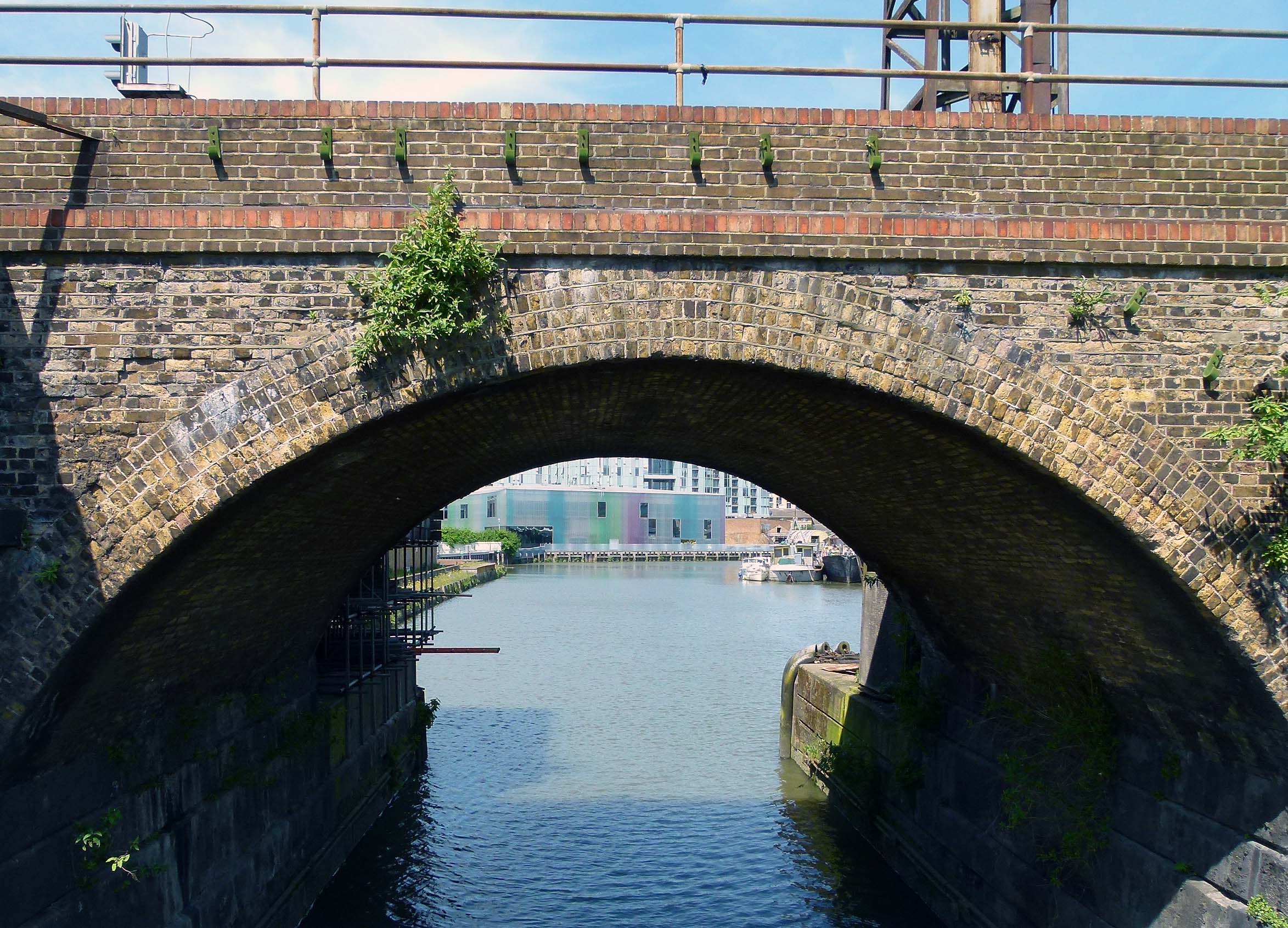
The arches cross Deptford Creek.
It was at Deptford Creek in 1580 that The Golden Hind finally came to rest after its monumental circumnavigation of the globe. Shortly after its arrival, Queen Elizabeth I boarded the ship to bestow a knighthood upon the captain, Francis Drake.

Francis Drake being knighted aboard the Golden Hind at Deptford (Image: reformation.org).
*
And now the end is near…
After crossing the Thames tributary the three and a half mile long viaduct finally begins its descent into Greenwich; our final destination on this tour.

Approaching Greenwich…
The arches reached Greenwich in December 1836 and the handsome station building, designed by architect George Smith, dates from 1840.

Greenwich Station.
As well as helping commuters travel back and forth between the city, Greenwich station was also instrumental in encouraging poorer Londoners to take daytrips away from the squalor of the city centre.
Today, the pleasant district remains a popular destination, noted for its seaside like atmosphere.
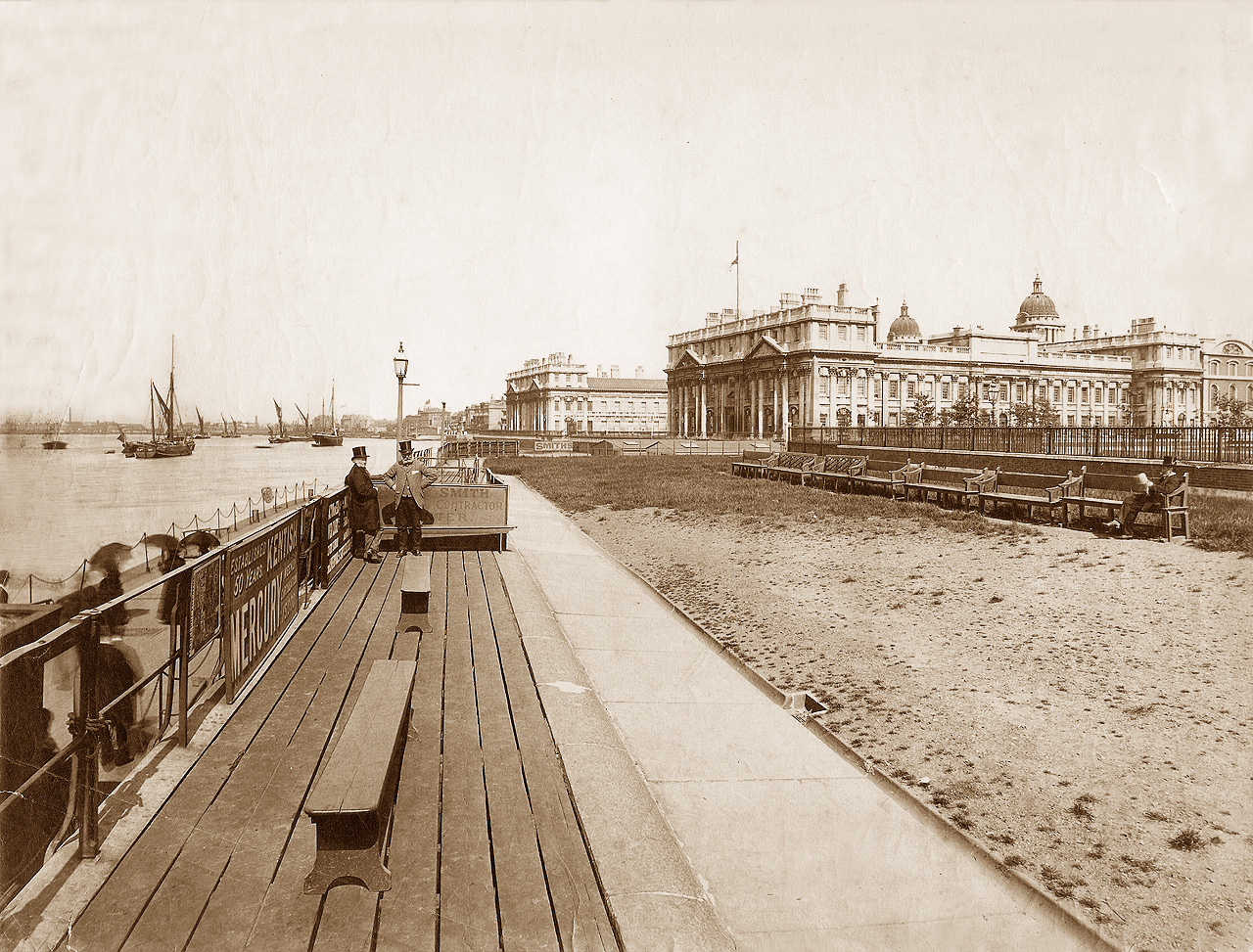
Greeniwich Pier, pictured in 1890 (image: oldukphotos).
Back in the ticket hall of the station, a small plaque hangs quietly on the wall, commemorating the railway’s place in the capital’s history.







 View from the Mirror