Cabbie’s Curios: A Quack in Hatton Garden
Back in the days when medicine was messy, painful and still in its infancy, ‘Quack Doctors’ were big business.

‘The Visit to the Quack Doctor’ by William Hogarth, 1743.
Exploiting the public’s medical naivety, these roguish characters promised a staggering array of seemingly miracle cures- all for a tidy sum of course.
In 18th century London, one of the more brazen quacks appears to have been a certain Doctor Sangrado who, in the summer of 1788, established a practice on Hatton Garden (home today to the capital’s jewellery quarter).

Hatton Garden today (image: Google)
Arriving from a spell in Jamaica where he claimed to have forged a lucrative career as a veterinary surgeon, Doctor Sangrado took out a lengthy advertisement in The Times, claiming that he had now “turned philosopher” and intended to “cure all kinds of disorders.”
In the marketing stunt, Doctor Sangrado listed his catalogue of apparent skills, including the supposed ability to “restore reason to a mad-man in three minutes”, “to make a new leg grow out of the stump from which the former had been amputated”, “to recover a person drowned after he had lain six weeks in the water” and, in a boast which was surprisingly ahead of its time, to “change the male into the female sex” and vice versa- a procedure which he stated would take a mere “one hour thirty three minutes and a half”!
*
Ludicrous as all this may sound, some gullible Londoners with more money than sense appear to have been willing to entrust their bodies to Doctor Sangrado.
On the 5th June 1789, another edition of The Times printed the contents of a mysterious medical bill which had been discovered abandoned on Hatton Garden.
Although the patient and practitioner were never identified, it is highly likely that, due to the location in which it was found, the bill was drawn up and accidently dropped by the Hatton Garden quack.
The baffling receipt detailed work conducted between 1788 and 1789 and read thus….
Aug 2nd. Taking your right arm off, repairing and fitting the bone below the shoulder.
Aug 6th. Three new fingers to your left hand.
Aug 10th. A new knee-pan to your left knee, replacing your thigh bone…and one new toe nail.
Aug 19th. A new foot to your left leg.
Oct 20th. Taking out three of your old ribs, and putting in three new ditto, and stitching your sides.
Oct 30th. Taking out your guts, untwisting them; turning, cleaning and putting in ditto.
Nov 1st. Filling your old bones with hog’s marrow.
Nov 12th. Filling your veins with goat’s blood.
Nov 20th. Mending your skull and putting in some…brains, altering your face and reparing the bridge of your nose.
Jan 20th. A new eye and brigtening the other.
Jan 31st. A new toungue, new lining for your mouth and widening ditto, the old parts being put repair.
March 10th. Cleaning and reparing the foul parts of your heart.
March 11th. Rubbing up your bad memory and sundry other repairs done to your person.
March 12th. A new cheek and mending your wind pipe.
March 13th A complete set of new lungs… and some repairs done to the stomach….

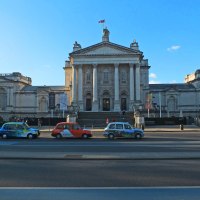
‘Hymn’ by Damien Hirst, exhibited outside the Tate Modern in 2012.
Melancholy Grace… The ‘Boy with a Dolphin’ Statue
Located on Chelsea’s Cheyne Walk opposite the approach to Albert Bridge, the Boy with a Dolphin sculpture is widely considered to be one of London’s most graceful public works of art.

The piece was created by Sir David Wynne; a self-taught artist who established his studio on Campden Hill, Holland Park in the early 1960s.

Sir David Wynne at work in the 1960s (image: BBC)
Shortly after setting up shop, Sir David was invited to sculpt the heads of all four Beatles; a task which required him to spend considerable time with the group and led to a lasting friendship.

Sir David Wynne with his Beatles busts (image via the Daily Mail).
It was in fact Sir David who introduced the Fab Four to Maharishi Mahesh Yogi; an association which led to the Beatles making a visit to the guru’s meditation school in India; a period which greatly influenced much of their later work.
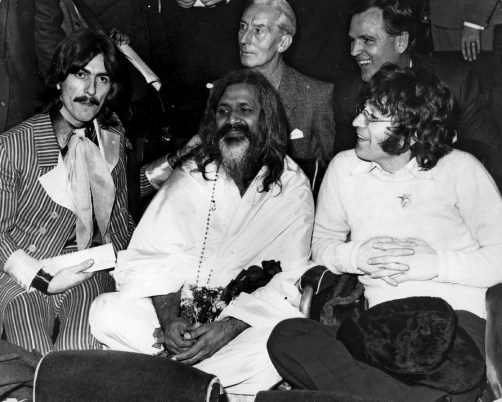
The Beatles with Maharishi Mahesh Yogi in 1967.
Other noted works by Sir David Wynne include a bust of a young Prince Charles, the Queen Mother Gates (which provide an entry point onto South Carriage Drive, Hyde Park) and a statue of ‘Guy’ the Gorilla; one of London Zoo’s most celebrated inmates.
Today, Wynne’s statue of Guy can be spotted in Crystal Palace Park.

Guy the Gorilla, Crystal Palace (image: Secret London)
Having read Zoology at Cambridge, it comes as no surprise that sculpting creatures is Sir David Wynne’s true passion, especially when they are shown to be interacting with humans.

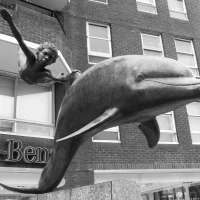
His famed Boy With a Dolphin creation (which is frustratingly situated in a very un-photogenic location), was first unveiled in October 1975 as a follow on from an earlier sculpture; the equally balletic Girl with a Dolphin which can be found outside the Guoman Tower Hotel near St Katherine’s Dock.
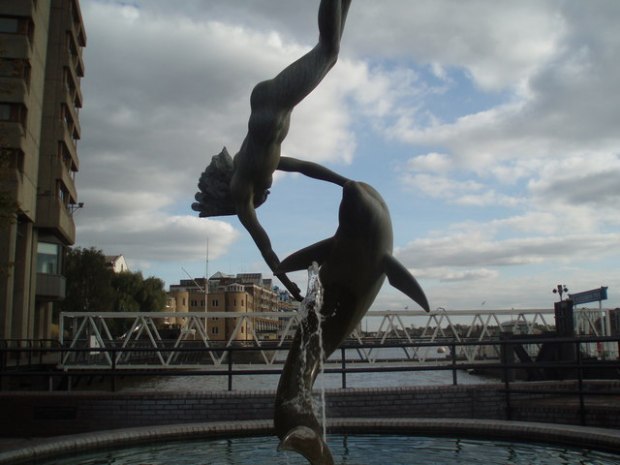
Girl With a Dolphin, sculpted by Sir David Wynne in 1973. (Image via Geograph; copyright Paul Gillett).
Of his Boy With a Dolphin statue, Sir David says that “the boy is being shown that if you trust the world, the thrills and great happiness are yours… if one meets a dolphin in the sea, he is the genial host, you the honoured guest.”
The pair’s delicate, gravity defying appearance is a great technical achievement, accomplished with the use of a double cantilever.

There are actually three casts of this statue… the other two can be found in America; one on Chestnut Place Plaza, Worcester, Massachusetts and the other outside the Mayo Clinic in Rochester Minnesota.

Boy With a Dolphin, Rochester, Minnesota (image: Gerrard Corporation).
The boy featured in the artwork was modelled upon Sir David’s son; Roland David Amadeus Wynne (Roly for short) who was 11 years old at the time and later went on to play bass in a rock band known as Ozric Tentacles.

Tragically, in 1999 at the age of 35, Roly committed suicide.
Today, the beautiful, sweeping statue depicting him in more innocent times has been dedicated to Roly as a memorial.

Droogs About Town: London Locations Featured in ‘A Clockwork Orange’
Released in 1971 and directed by Stanley Kubrick, A Clockwork Orange was by far one of the 20th century’s most controversial films.

Poster for A Clockwork Orange
Based on Anthony Burgess’ 1962 novel of the same name (the title being inspired by the old Cockney phrase “as queer as a clockwork orange’), the story is set in a dystopian London of the near future and centres on Alex DeLarge–a sadistic youth with a passion for Beethoven- who leads his gang of ‘droogs’ through the city on nightly sprees of ultra-violent mischief.
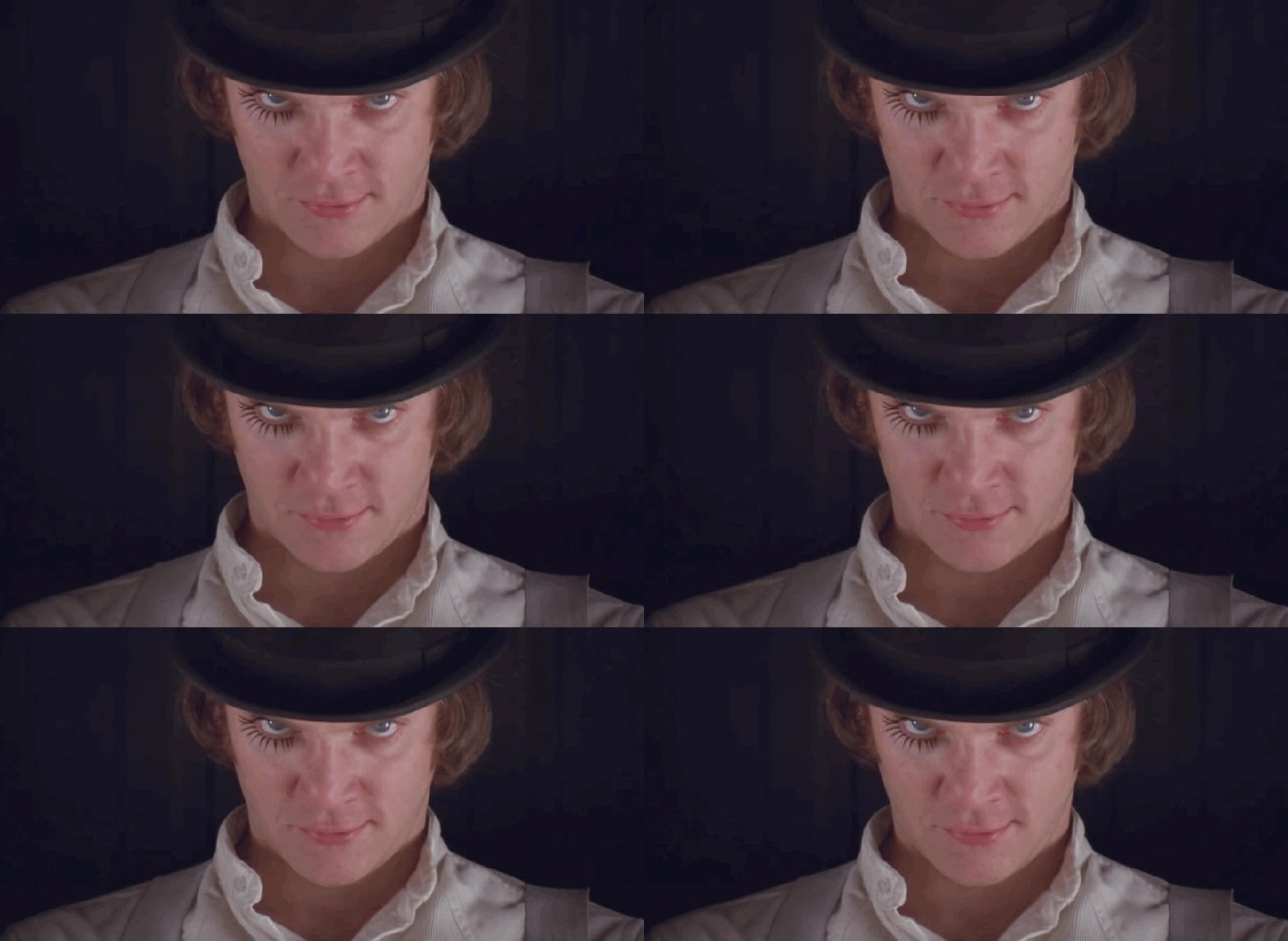
Alex De Large stares at the camera in the film’s iconic opening shot…
After committing murder, Alex is finally locked up… but is soon offered a quick way out when he agrees to act as a guinea pig for the Ludovico Technique; a controversial brain-washing programme designed to suppresses the desire for violence (and something which caused actor Malcolm McDowell great pain and discomfort when it came to portraying these disturbing scenes).

Alex undergoing the Ludovico Technique
In Britain, thanks to high levels of upset whipped up in the press, the film version of A Clockwork Orange gained such an intense notoriety that Stanley Kubrick himself withdrew his work from circulation; a self-imposed ban which remained right up until 2000.
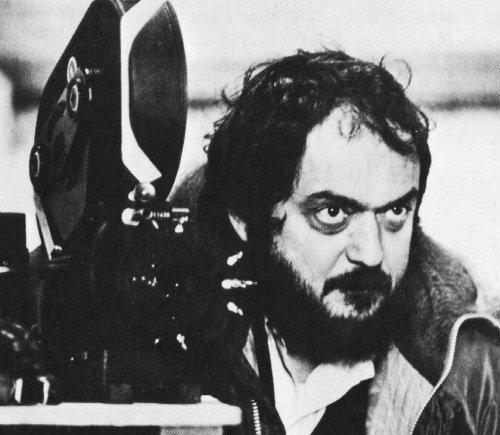
Stanley Kubrick
So strict was this embargo that, in 1993 when the Scala Cinema in Kings Cross attempted to screen the film, Warner Brothers took the owners to court; an action which led to the cinema going bust thanks to the immense legal costs involved.


Considering A Clockwork Orange was filmed entirely around London and the Home Counties (including areas such as Borehamwood, Kingston-Upon-Thames, Elstree, Radlett, Brunel University, Bricket Wood and Wandsworth prison) it’s rather ironic that British audiences were forbidden from viewing Kubrick’s film for so many years.
Here are some of the film’s most prominent London-based scenes:
The Chelsea Drugstore
Whilst Alex’s nights are spent committing all manner of horrific acts whilst tanked up on drug-laced milk, his days are rather more civil… devoted to indulging his love of classical music; especially that of the “lovely, lovely Ludwig Van” Beethoven.
In one of the film’s scenes, we follow Alex, decked out in his dandiest threads as he peruses his favourite record shop (click below to view):
This scene was filmed in the basement of the Chelsea Drugstore; a modern building fashioned from glass and aluminium which opened on the King’s Road in 1968.

The Chelsea Drugstore (Image: Royal Borough of Kensington and Chelsea)
Open 16 hours a day, 7 days a week, the Chelsea Drugstore was an avant-garde, mini shopping mall, its three floors boasting eateries, boutiques, a record shop, bar, newsagent and chemist.
It also boasted its own ‘Flying Squad’… an exclusive team of women clad in purple castsuits who were employed to make unconventional home deliveries on their fleet of motorbikes. Groovy!
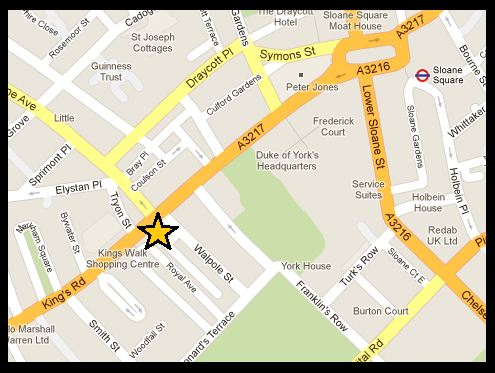
Map showing the location of the former Chelsea Drugstore.
The Chelsea Drugstore was also name checked in The Rolling Stone’s 1968 hit, You Can’t Always Get What You Want.” (Speaking of The Stones, Mick Jagger was once earmarked to play Alex DeLarge in an earlier proposed adaptation of Burgess’ novel which never came to fruition…)
Although the Chelsea Drugstore ceased trading in 1971, the shops in the basement (as featured in A Clockwork Orange) remained in place until the late 1980s whilst the rest of the building became a wine bar.
Today, the building is occupied by the Chelsea branch of McDonalds.
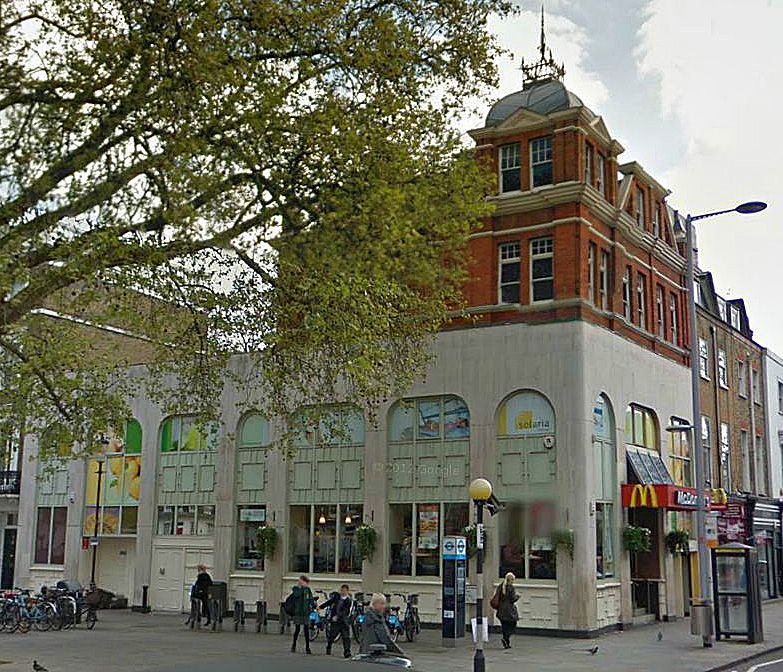
The building which once housed the Chelsea Drugstore… now a McDonalds. (Image: Google Streetview)
*
Thamesmead
Despite the inclusion of the psychedelic Chelsea Drugstore, A Clockwork Orange is mostly set against a cold, dystopian backdrop; a precedent set in Burgess’ original novel as the following excerpt, in which Alex and his gang are evading the police, atmospherically illustrates:
“Just round the next turning was an alley, dark and empty at both ends, and we rested there, panting fast then slower, then breathing like normal. It was like resting between the feet of two terrific and very enormous mountains, these being flatblocks, and in the windows of all the flats you could viddy like blue dancing light. This would be the telly. Tonight was what they called a worldcast, meaning that the same programme was being viddied by everyone in the world that wanted to… and it was all being bounced off the special telly satellites in outer space.”
In order to realise Burgess’ bleak, futuristic vision Stanley Kubrick turned to the modern, Brutalist architecture which was sprouting across London during the era in which the book and film were created; architecture which, as early as 1962, Anthony Burgess was already predicting would provide fertile ground for many unforeseen social ills.

1962 first edition for ‘A Clockwork Orange’ by Anthony Burgess
In Burgess’ novel, Alex lives in “Municipal Flatblock 18a”, a block daubed in obscene graffiti and plagued by vandalism.
To represent this domestic seediness, Kubrick took his film crew to the newly built Thamesmead Estate; a vast, sprawling development near Woolwich in South East London.
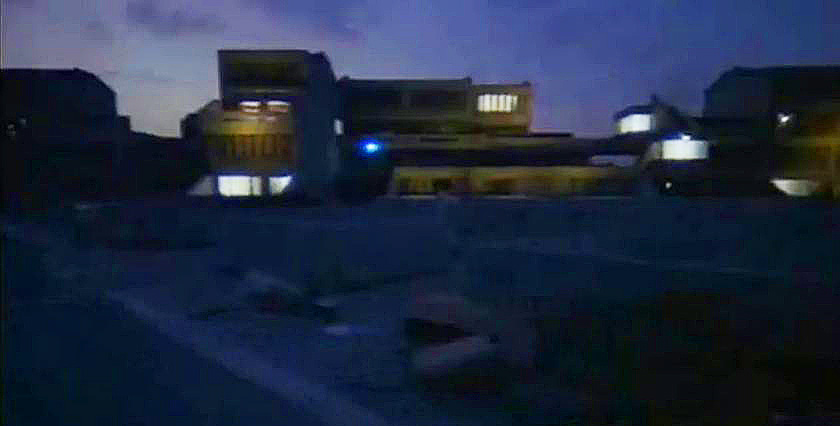
Screenshot of the Thamesmead as depicted in A Clockwork Orange…
Built on a former military site, the Thamesmead Estate, which was optimistically promoted as being the “town of the twenty-first century”, was built piecemeal between the 1960s and 1980s.

Thamesmead’s Binsey Walk, as featured in ‘A Clockwork Orange.’ (Image: Wikipedia)
One of the film’s most famous sequences takes place on Thamesmead’s Binsey Walk.
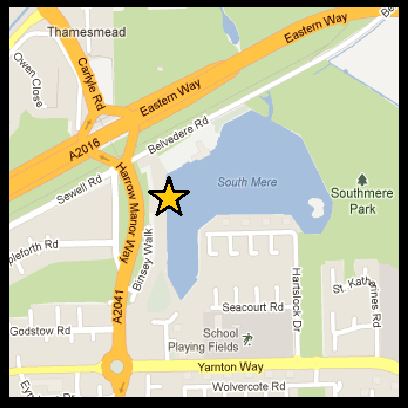
Map depicting location of Binsey Walk.
Walking alongside the man-made Southmere Lake Alex, whose leadership has just been challenged, decides to show his droogs whose really in charge (click below to view):
In recent years, the Thamesmead Estate has been used as a set for the E4 comedy, ‘Misfits‘.
*
York Road Roundabout, Wandsworth

Map depicting York Road Roundabout.
One of the most notorious scenes in Kubrick’s adaptation takes place at the very beginning of the film and involves a vicious assault on a hapless down and out as he lies drunkenly in a grimy, pedestrian subway.
The scene was filmed in the warren of walkways beneath York Road roundabout, which sits at the southern foot of Wandsworth Bridge.
Typical of the architecture of the time, York Road roundabout was laid out in 1969 and was pretty much brand new when Stanley Kubrick set up his cameras.
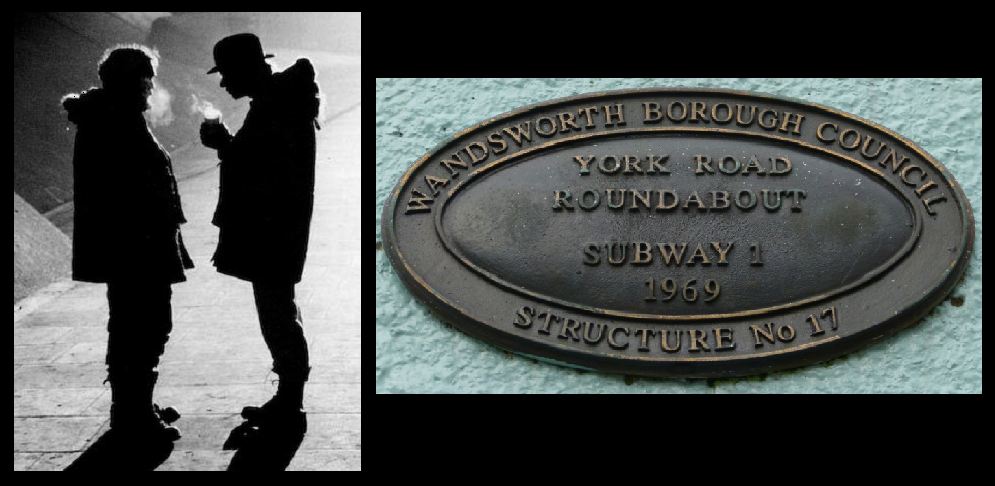
Stanley Kubrick with Malcolm McDowell on set below York Road roundabout, 1971 (image: Stanley Kubrick Archive).
Today, the labyrinth beneath the roundabout is just as bleak and unwelcoming as it was some 40 years ago…

The subway today…

Modern Droogs? York Road Roundabout subway, November 2012…
More recently, a large atom-esque sculpture of sorts has been plonked down on the roundabout, becoming something of a local landmark.
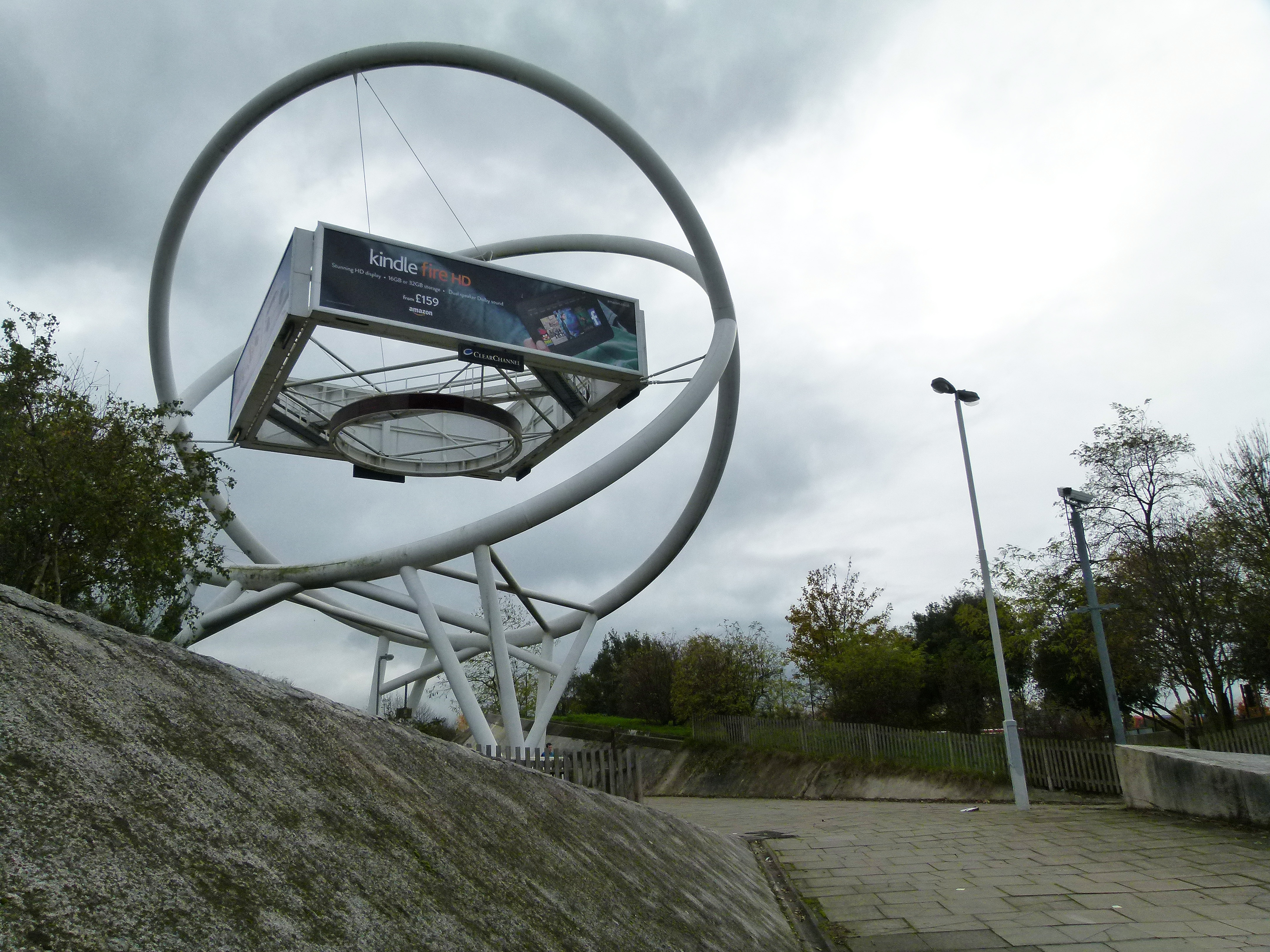
York Road roundabout’s atom sculpture.
Apparently inspired by the 1950’s Atomium sculpture in Brussels, but kitted out with a bulky and intrusive advertising gantry, the tangle of metal doesn’t really do much to beautify the 1960s concrete…
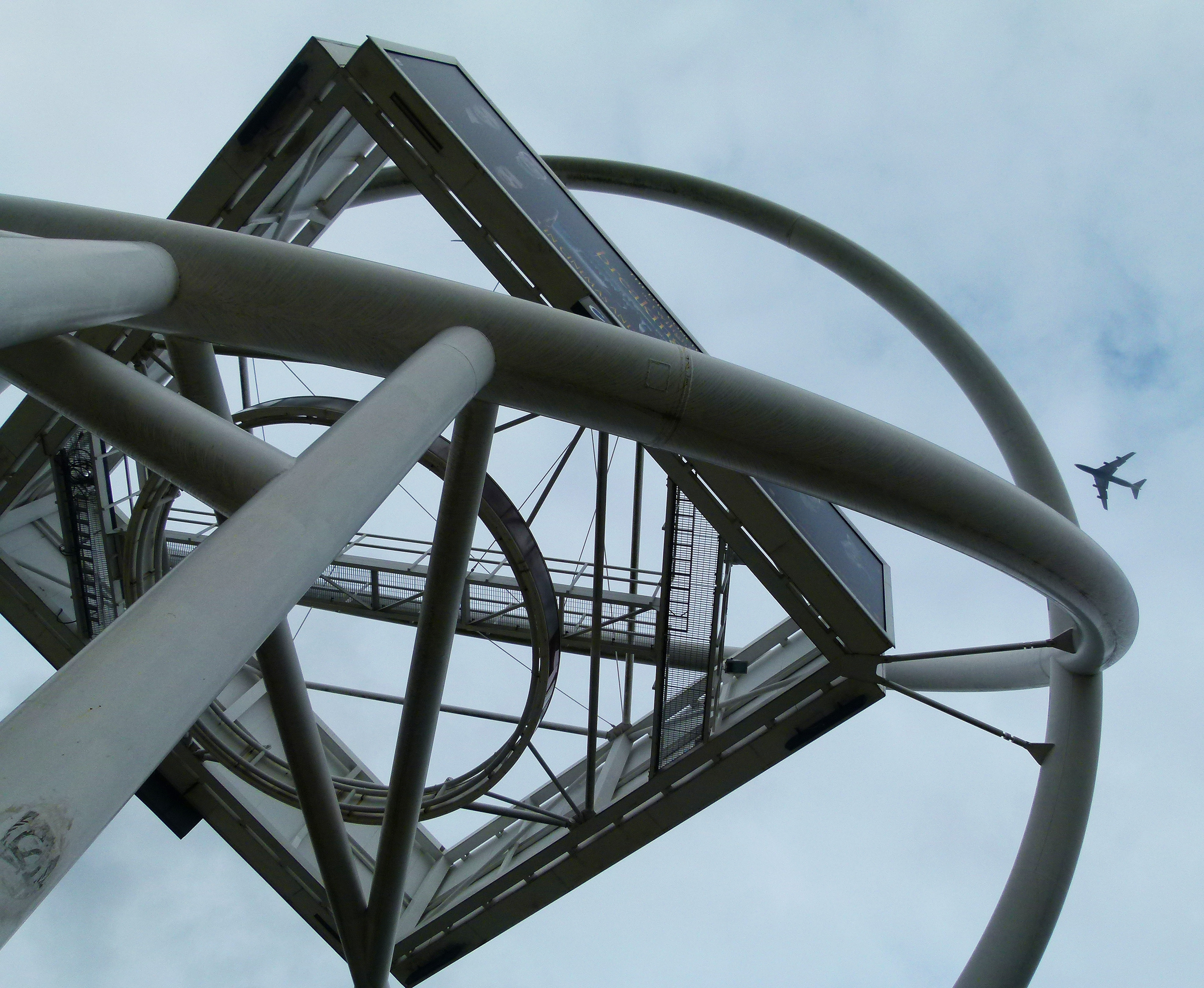
Looking up at the gantry.
*
Albert Bridge
As for the unfortunate tramp who was attacked by Alex and his droogs below Wandsworth’s grimy roundabout… don’t worry, he gets his own back…

Map of Albert Bridge
After recognising the recently released (and now, thanks to his treatment, defenceless) Alex DeLarge glumly contemplating a view of the Thames, the tramp leads his own rabble in a revenge attack on the former and now defenceless yob, right beneath Albert Bridge; one of London’s most beautiful river crossings (click below to view):
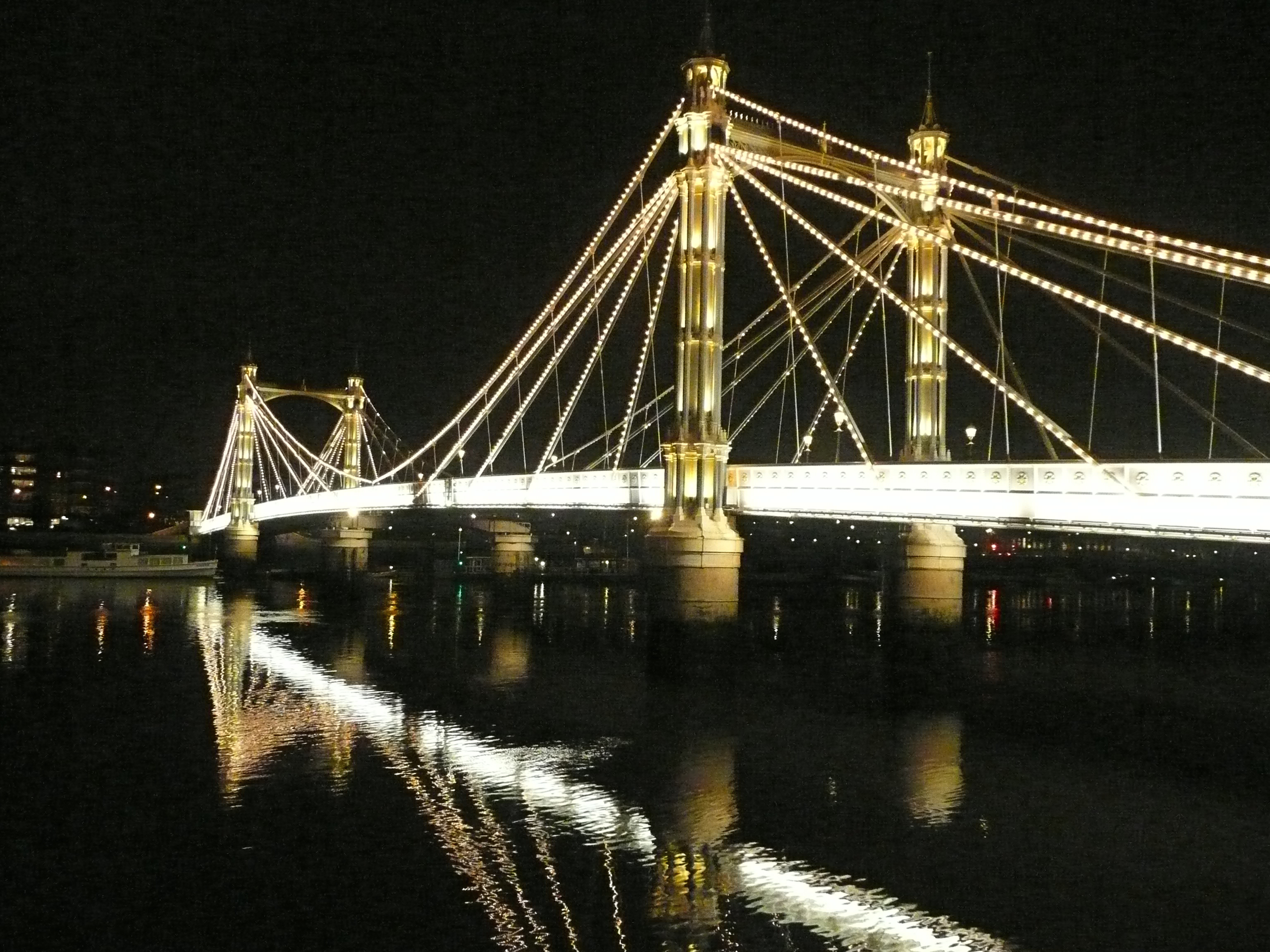
Albert Bridge… one of the more traditional sites uses in ‘A Clockwork Orange.’ (Image: Wikipedia)
*
Want more on Stanley Kubrick’s London? Then check out this post: A Monolith in St Katherine Docks…
***





 View from the Mirror