Cabbie’s Curios: The Unfinished Motorway…
First opened in 1959, the M1 is one of Britain’s major motorways. Almost 200 miles long, it links London to the city of Leeds in West Yorkshire.
The London terminal of the M1 is at ‘Staples Corner’ (named after ‘Staples Mattress Factory‘, which stood at the major junction from 1926 until 1986).
The start of the M1 is also beside ‘Brent Cross Shopping Centre’; the UK’s first major indoor shopping mall, which opened in 1976.
If leaving the M1 at Junction 1, you’ll notice that the motorway splits apart, forcing exiting traffic into a slip road. Drivers concentrating on the road ahead will easily miss the fact that the slip road runs alongside a short-stretch of derelict, weed-strewn concrete.

This abandoned length of tarmac is a ‘ghost road’; a section which was built but never used; construction quickly being stopped. The short piece of road actually marks the direction of the route which the M1 was originally intended to take…
In the 1960s and 1970s, the authorities envisioned all manner of motorways and ring-roads, ploughing right through our cities with scant regard for the surrounding environment, architecture or residents.
The primary goal of these enlightened planners was to carry the broad stretch of hulking, M1 motorway all the way into Central London; ploughing through neighbourhoods, and soaring above rooftops via monstrous flyovers.
The original M1 route would have roared through Cricklewood, thundered past Kilburn and Maida Vale and torn down through St John’s Wood. If the planners had their way,the M1 motorway would have terminated just north of Marble Arch; in the vicinity of the tranquil Montague Square (which, no doubt, would have been ripped apart and buried beneath copious amounts of stark concrete).
Thankfully, the authorities saw sense, and the scheme was never fully realised. The M1 now terminates in the suburbs, approximately 6 miles from Marble Arch.
Having said that, the M1 is my main route into London and, on my grumpier days, I sometimes wish that there was a quick, concrete strip to speed myself and my taxi into the direct centre of town! Oh well, no matter what its length, I’m sure it would have been choked with traffic!
Wembley Stadium… A little trivia
Located in north-west London, Wembley is the UK’s national stadium.
The first Wembley Stadium was opened in 1923 and, with its domed, twin towers, was a true icon.
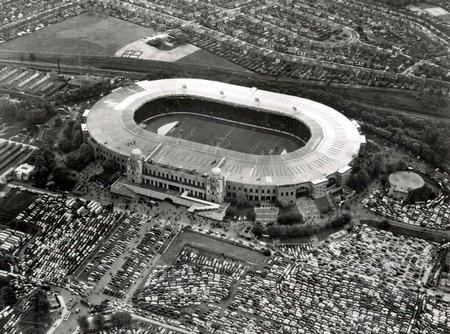
Many famous events took place at the old Wembley, including its use as a venue in the first, post-war Olympic Games (in 1948), England’s World Cup victory in 1966 and, in 1985, the staging of the spectacular ‘Live Aid‘ concert.
Sadly, the old stadium was demolished in 2003, but a spectacular new venue was built on the same site, and opened in 2007.
Here are some facts and figures about the new Wembley Stadium:
It boasts….
* 47 retail units
* 30 escalators
* 8 restaurants
* 688 food and drink service points
* 98 kitchens
* 34 bars
* 90,000 seats (with NO obstructed views)
* The two giant screens overlooking the pitch are the same size as 600 domestic T.V sets
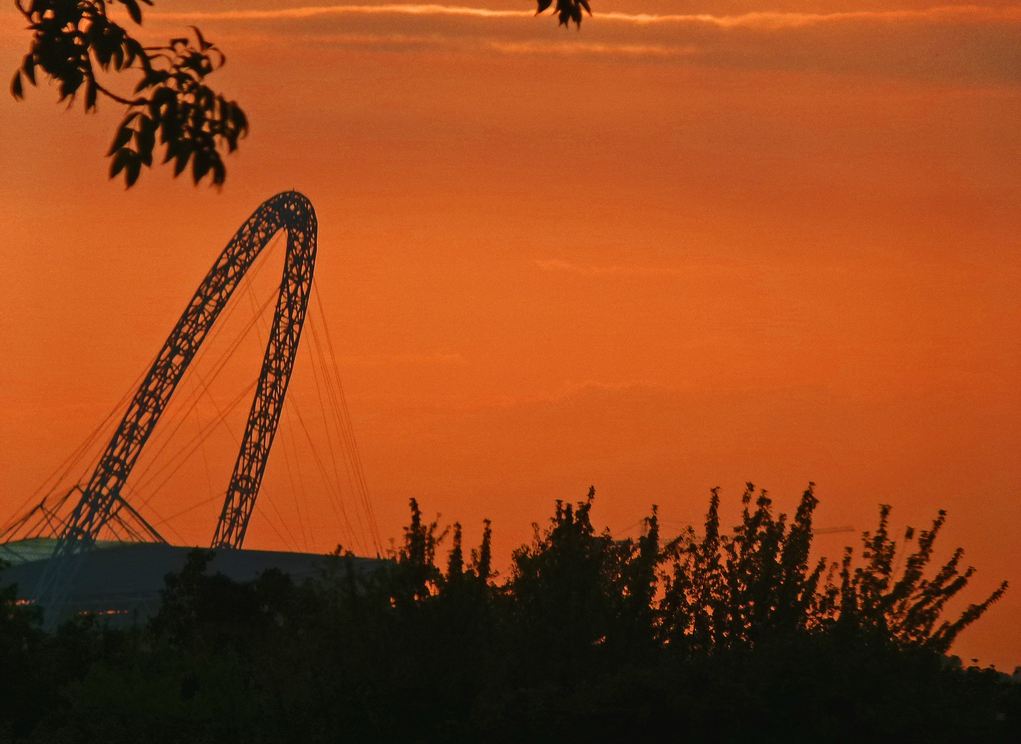
*The colossal arch is 133 metres tall, with a span of 315 metres, and can viewed from points all over London.
*The stadium’s roof covers 11 acres, 4 of which are retractable.
*And… most importantly, Wembley Stadium contains 2,618 toilets; more lavatories than any other building in the world!
Cabbie’s Curios: Old St Paul’s
This post is the first in a new series, in which I shall be sharing quick snippets of London trivia. I’ll begin with one of London’s most iconic and beloved landmarks; St Paul’s Cathedral.
St Paul’s as it stands today was completed by the genius, Sir Christopher Wren, in 1710. However, it is not the first cathedral to stand on this site. Prior to the current St Paul’s, there were four previous places of worship on this site.
The previous St Paul’s Cathedral was destroyed during the Great Fire of 1666. Opened in 1314, it was an immense, wooden structure… even bigger than the one which we know and love today!
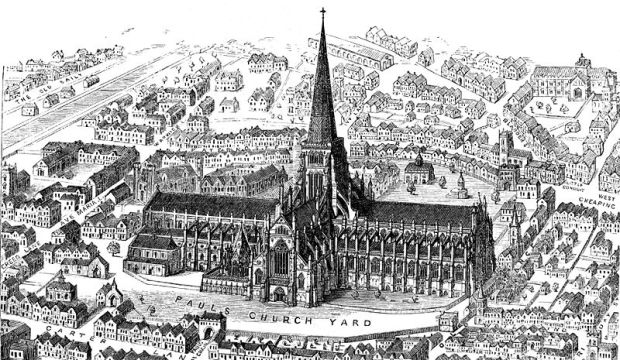
‘Old’ St Paul’s Cathedral
To give you an idea of its size, Sir Christopher Wren’s design is 365 feet tall (one foot for each day of the year). The old St Paul’s on the other hand, was 500 feet tall!
The St Paul’s of old was also longer and wider. The front of the previous cathedral is marked today by a statue of Queen Anne, which stands beside St Paul’s Churchyard taxi rank.
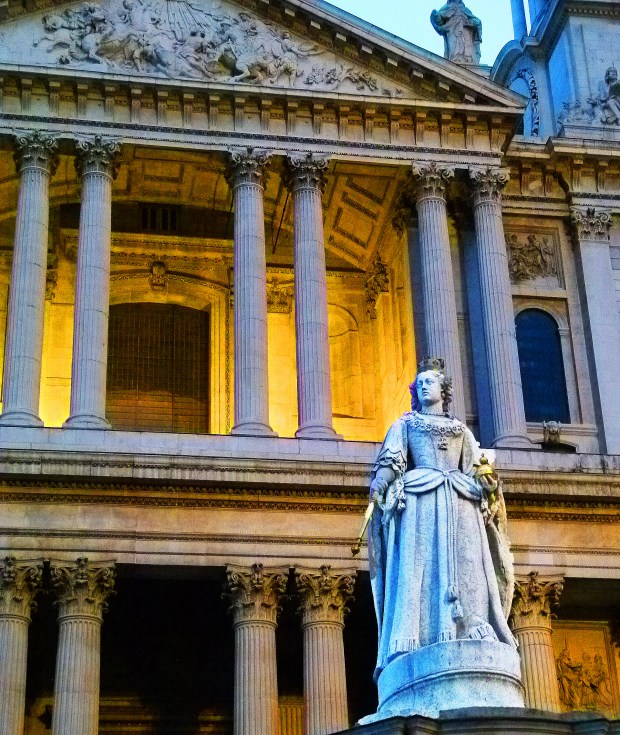
This statue of Queen Anne pinpoints the front of the previous, wooden St Paul’s Cathedral
Queen Anne was on the throne at the time of the completion of the new St Paul’s Cathedral. She was a tragic figure, mother to 18 children (yes, 18); all of whom died. Bearing this in mind, it is perhaps unsurprising that she developed a fondness for alcohol, thus gaining the nickname, ‘Brandy Nan.’
* * *








 View from the Mirror