Eerie Enfield… A Poltergeist Comes to North London
A Halloween Special
With Halloween upon us, I think now would be the ideal time to indulge in one of London’s most perplexing ghost stories…

What you are about to read is far removed from traditional tales of headless spooks and Victorian séances… this account is very much a modern-day haunting; a deeply disturbing series of events which occurred at a modest, north London council house during the late 1970s…
The Enfield Poltergeist
Green Street is an unassuming residential road in an area called Brimsdown; part of the London Borough of Enfield.

Map depicting location of Green Street, Enfield- please click to enlarge.
If you’ve ever ridden the Stanstead Express, you will have passed Brimsdown without even knowing it- at the eastern end of Green Street there is a level crossing, through which trains regularly whisk between Stanstead airport and Liverpool Street station.
Blink and you’d miss it…
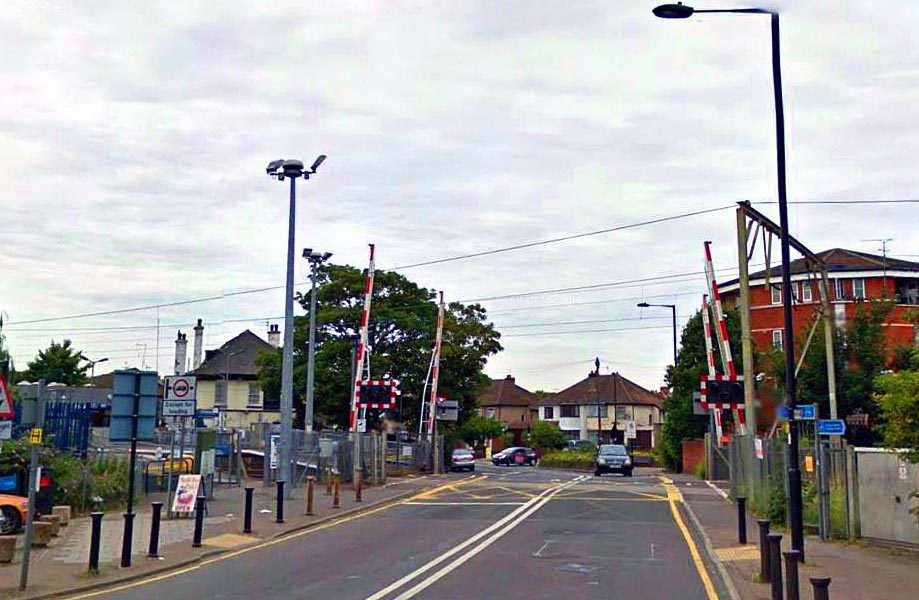
Green Street’s level crossing (image: Google).
In the 1970s, Green Street was home to Peggy Hodgson; a single mum with four children: Margaret (aged 12), Janet (11), Johnny (10) and Billy (7).
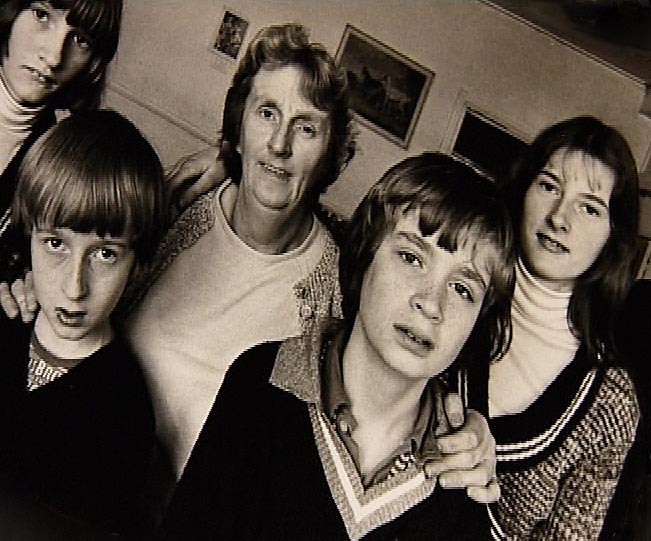
The Hodgson Family.
It was on the evening of August 30th 1977 that weird things began to happen in the Hodgson’s Enfield residence…
Upstairs, in one of the bedrooms, the children were alarmed to feel their beds wobbling.
Janet called down to her mum- but Peggy, understandably, suspected that her kids were mucking about and shouted back up at them to settle down and get to sleep.
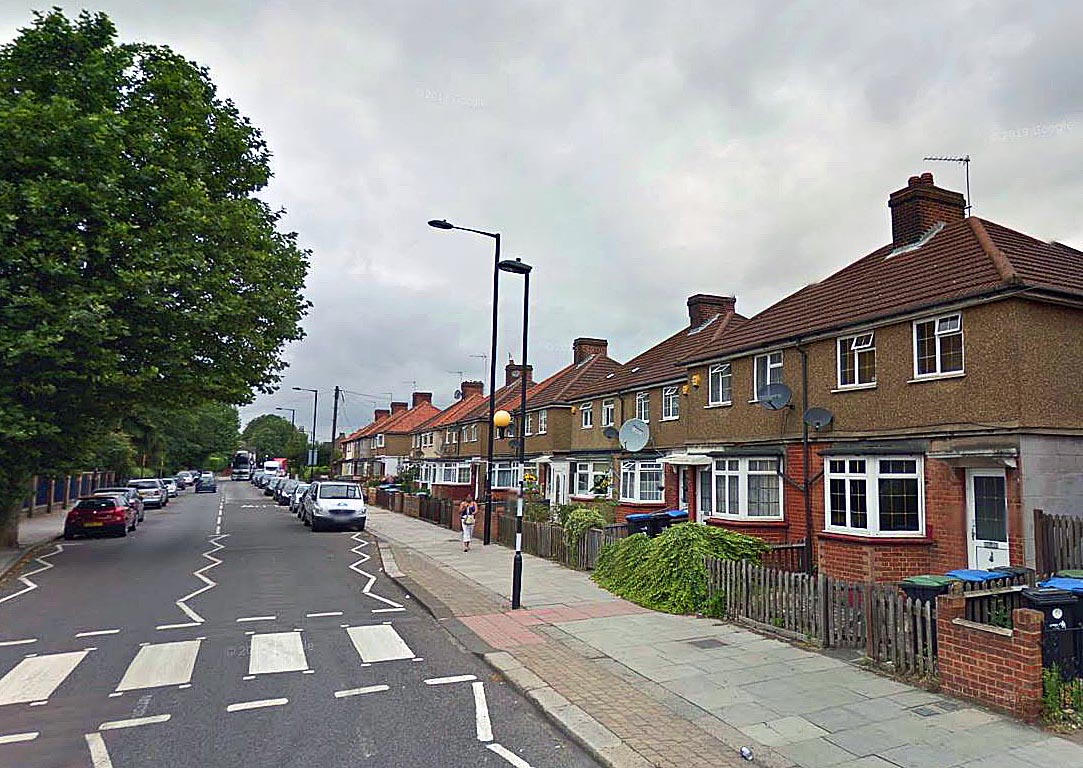
The section of Green Street which was home to Peggy Hodgson and her children (image: Google).
The following night at around 9.30pm, Peggy heard a loud crash.
Assuming her children were once again up to mischief, she stomped upstairs to administer a scolding.
As she entered the bedroom with orders to “pack it in”, Peggy spotted a chest of drawers being hauled forward by its own accord.
Instinctively, she attempted to force the furniture back- but was thwarted by an unseen force, which appeared to be pushing its might against her- rather like two opposing magnets.
Next came the noises; odd knocks and taps which started to rap around the house.
Scared witless, the family hastily donned their dressing gowns and slippers and fled, seeking refuge with their next door neighbours, the Nottinghams.
Head of the Nottingham household was Vic; a roofer by trade whose tough demeanour and practical nature made him the ideal candidate to inspect the strange goings on.
Hoping to calm his terrified neighbours, Vic ventured into the house- he later described his experience in a 1978 radio documentary:
“All I could here was this knocking… and I didn’t know what it was; no idea what it was; just a strange knock on the wall.
I went up the stairs and this knock followed me; three distinctive knocks on the wall. I carried on up the stairs into the front bedroom and there were three knocks on the wall again… strange I thought to myself. I’m beginning to shake.
I go into the back bedroom… same thing again; the knocks followed me.
Anyway, being in the building game I thought to myself, well I’ve got to have a look around the house; be brave like to try and find out what it is. So I go through all the pipes- no airlocks, nothing like that- and it wasn’t a knock like that anyway; it was a distinctive knock on the wall.”
Vic popped back next door and fetched his son and grandfather.
The three men positioned themselves at different rooms within the house- and each reported the distinctive knocks at their separate locations.
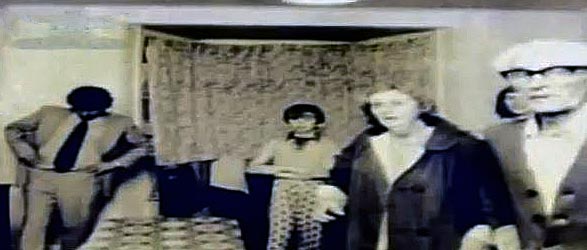
With even Vic spooked, the Green Street residents decided to phone the law- whose first question was “have you been drinking?”
Reluctantly, the police sent a squad car with two constables from nearby Ponders End.

The two police officers who visited 284 Green Street during the early hours of September 1st 1977.
The police too heard the distinctive knocking and, downstairs, WPC Carolyn Heaps witnessed a chair move unaided across the floor; something which she testified to in an official document- a brave move considering the possible ridicule from her friends and colleagues:
“On Thursday, 1st September 1977 at approximately 1am I was on duty in my capacity as a police woman when I received a radio message to Green Street, Enfield.
I heard the sound of knocking on the wall… there were four distinct taps on the wall and then silence.
Within a few minutes the eldest son pointed to a chair which was standing next to the sofa. I looked at the chair and noticed it was wobbling slightly from side to side. I then saw the chair slide across the floor towards the kitchen wall. It moved approximately 3-4 feet and then came to rest.”
Although sympathetic, the police had to inform the family that the ominous situation could not be classed as a police matter- after all, no crime had been committed…
*
The Poltergeist settles in…
Nervously, the Hodgsons returned to their home, but over the following months, the distressing activity would grow far worse… much of it witnessed by friends, neighbours, psychic investigators, council workers and news reporters.

The Hodgson children with a news reporter.
One phenomenon involved Lego bricks and marbles being hurled around the house at high speeds and odd angles- which, even more bizarrely, would stop dead still rather than bouncing when they landed. They were also hot to touch when picked up.
One journalist from The Daily Mirror was hit just above the eye by one of these small missiles- and received a small lump; a testament to the velocity at which the items were being hurled.

Soon, larger objects were being flung.
One reporter witnessed a t-shirt hop off of a table and fly across the room.
The living room sofa was seen to lift above the ground… and then spin around. The bulky television shuffled position and, in the children’s bedroom, a brick was wrenched away from the fireplace.

Aftermath of one of the Enfield Poltergeist’s many bouts of disruptive activity….
Puddles appeared and cups filled themselves with water.
Matches were scorched in their boxes and a pair of oven gloves self-combusted.
A mirror also caught fire… the charred remains of which were later collected by Turner-Prize nominee artist, Cornelia Parker, as part of her 1997 installation, ‘The Secret Life of Inanimate Objects’.
On one particular night, the BBC set up camp at 284 Green Street to capture audio evidence… only to later find that metal components in the machine had been bent and the recordings erased.
Terrified, Peggy and her children took to sleeping in the same room, where they would huddle together with the light kept on.

Billy, Janet and Margaret Hodgson.
*
Who ya’ gonna’ call?
In an attempt to garner some clarity, the editor of the Daily Mirror, George Fallows appealed to the Kensington based Society for Psychical Research to come and see if they could work out what was going on.

For the next 13 months, the Hodgsons and their haunted home were put under intense scrutiny.
The investigation was led by Maurice Grosse, a former military man and veteran of the Dunkirk evacuation.

Maurice Grosse (image: The Fortean Times).
After the war, Maurice had established himself as an inventor- his most successful patent being the rotating advertising board.
Tragically, in August 1976, his 22 year old daughter, Janet was killed in a motorbike accident. It was her death which led Maurice to join the Society for Psychical Research; no doubt as a way of helping to cope with his grief.
Although open to psychic phenomenon, Maurice’s background as an inventor meant that his mind worked in a scientific, methodical manner and as such he was considered the ideal analyst for the Enfield haunting.
He was soon joined by another experienced investigator; Guy Lyon Playfair who published an account of the haunting in 1980.
At first, Guy was reluctant to become involved; convinced that the whole thing was a hoax. However, when he arrived at the house, he soon changed his mind…

‘This House is Haunted’; Guy Lyon Playfair’s 1980 report on the Enfield Poltergeist.
By now, the events at Green Street had become even more intense.
As well as household objects being lobbed around, 11 year old Janet- who appeared to be the poltergeist’s main focus- was herself subjected to apparent levitations.
An example of this, which took place one morning at approximately 3am, was caught by an automatic camera which had been installed by the investigators:

Janet, apparently being hurled from her bed during the early hours of the morning. On a lighter note, a poster featuring David Soul (star of the 1970s cop show, ‘Starsky & Hutch) can be seen on the bedroom wall- he is one of the numerous celebrities I have met in the back of my cab!
On two occasions, two separate witnesses outside the house with a view towards the bedroom window, claimed they spotted Janet floating in the air.
The first sighting, which took place at around lunchtime on December 15th 1977, was attributed to Hazel Short; a lollipop lady who worked on the zebra crossing close to the Hodgson’s home:
“All of a sudden I heard a bang… and saw a book hit the front bedroom window and that was followed by a pillow, then the book, then the pillow again. All of a sudden, I saw Janet going up and down in front of the window- I thought she was jumping up and down on the bed, but when I looked she was horizontal going up and down with her arms and legs going everywhere; I suppose about half a dozen times. It was frightening… I didn’t think it would be, because to be truthful… I was a bit sceptical… well after that I wasn’t.”

Green Street’s zebra crossing, from which lollipop woman, Hazel Short claims to have spotted Janet Hodgson levitating (image: Google).
The second witness was John Rainbow, a baker delivering bread to the school opposite.
“Before that day I would never had believed anything about it although I had heard various rumours about what had been going on in the house.
The child appeared to float around the room- at the same time the curtains were blowing into the room as if there were a draught- although the windows were completely closed… articles and the child appeared to be revolving around the room in a clockwise direction.
The child’s arm banged against the window twice and I was frightened that the force she banged against it- that the window frame would’ve gone- I fully expected her to drop onto the road. I was frightened, there’s no doubt about it.”

Janet slumped over a cabinet following another supposed levitation.
*
Even more disturbingly, the poltergeist was supposedly beginning to talk through Janet…

The young girl, who also suffered from alarming seizures, would often adopt a deep, gruff voice which identified itself as belonging to a mysterious figure called ‘Bill.’
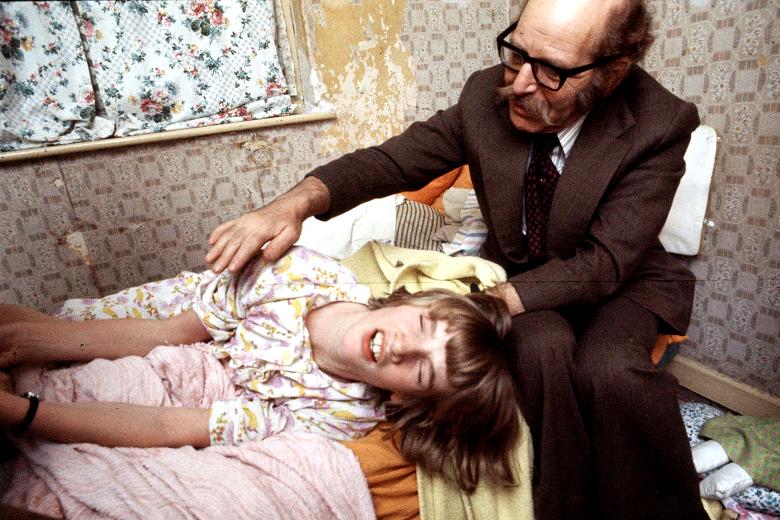
Maurice Grosse attempting to calm Janet as she suffers a seizure.
Janet would speak in the gravelly, menacing voice for hours at a time.
In one experiment, she was made to hold a quantity of water in her mouth… yet the voice still came through.
Further vocal tests were carried out by a Professor from Birckbeck College (now part of the University of London) who concluded that it was next to impossible to speak at length in such a way due to the damage such speech would cause to the vocal cords.
The academic also stated his belief that Janet was not producing the voice consciously.
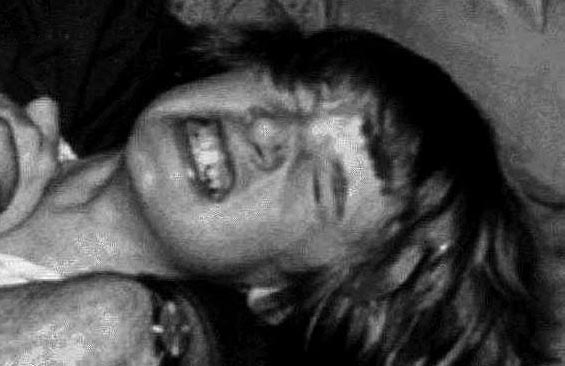
Janet in the depths of a trance…
Unsurprisingly, some sceptics accused the 11 year old of ventriloquism- which led Maurice Grosse to offer a £1,000 reward for anybody who could replicate a similar voice.
There were no takers.
*
With his often foul language and grumpy attitude ‘Bill’ made for a very sinister houseguest.
In one session- which, like many others, was caught on tape- Bill, speaking through Janet, stated that he had once lived and died at the Green Street home.
However you chose to look at it, the description of death which the supposed entity provides is most disturbing when you remember that it is being spoken by an 11 year old girl:
“Before I died I went blind…then I had a hemorrhage and I fell asleep and I died in a chair in a corner downstairs…”
This statement can be heard in the excerpt below… although please be warned, it is likely to send a chill down your spine…
Three years after the main events of the haunting, the Hodgson family were contacted by a man who claimed that his father- William (aka ‘Bill’) Wilkins had indeed lived in the house years before…and had died of a brain hemorrhage whilst resting in an armchair…
*
By the autumn of 1978 the hauntings began to die down.
However, the knocks and taps continued and there was a further burst of activity during the summer of 1980.
Following the haunting, the lives of the Hodgsons were far from blessed.
Johnny died of cancer aged just 14 and Janet lost a baby son to cot death when she was 18.
Speaking in 2007 Janet (then in her early 40s) said in a rare interview;
“I know from my own experience that it was real… it lived off me, off my energy. Call me mad or a prankster if you like. Those events did happen. The poltergeist was with me- and I feel in a sense that he always will be.”

Janet Hodgson today.
*
The presence remains…
In 2003, Peggy Hodgson died and the Green Street home was taken over by Clare Bennet who, like Peggy, was a single mum with four children- although in this case they were all boys.
Of her time at Green Street, Clare said that she frequently felt a presence; as if she were being watched- at first, she had no idea of the home’s dubious history.

284 Green Street…
Her boys would sometimes wake up in the middle of the night, saying that they could hear voices downstairs.
One of the lads; 15 year old Shaka, claimed he was woken up in the middle of one night and confronted by a ghostly vision of a man standing in the room.
The Bennets stuck Green Street for just two months…
*
Inspired Fear
In 1992, the case of the Enfield Poltergeist inspired a controversial BBC drama entitled Ghostwatch which was broadcast on Halloween night that year.

Starring Craig Charles, Sara Greene and Michael Parkinson, Ghostwatch bore many similarities to the Enfield case- it was set in an ordinary council home in suburban London (Northolt in this case) and centred on a single mum and her two daughters who were being tormented by a malevolent poltergeist- the evil spirit of a man who had died in the house years before.
Although a scripted, pre-filmed drama, Ghostwatch was made to appear as if it were an actual investigation, being broadcast live… and many people, thanks to the documentary nature of the show and the presence of the usually reassuring Michael Parkinson, tuned in half way through and believed the events depicted to be very real!

Michael Parkinson, pictured in the ‘live’ Ghostwatch studio, 1992.
The BBC switchboard was jammed with phone calls from petrified viewers… and people across Britain were reduced to nervous wrecks, unable to sleep soundly for many nights afterwards.
Ghostwatch has never been repeated on British television since.
***
Candid Capital: Victoria Rainbow
Victoria Rainbow

WW1 100: London’s Memorials… The Machine Gun Corps & the Man Who Mended Faces
2014 will mark the 100th anniversary of the outbreak of World War One.

Raging from July 28th 1914 to 11th November 1918, this hellish conflict was the world’s first truly modern war, characterized by the widespread use of tanks, aircraft, heavy artillery and poison gas.

A WWI Tank.
So intense was the fighting it is said that, during particularly heavy clashes, the thunder of guns could be heard echoing as far away as London.
Leaving Europe with deep physical and psychological scars, the Great War claimed a grand total of 16 million lives and left a further 21 million injured.
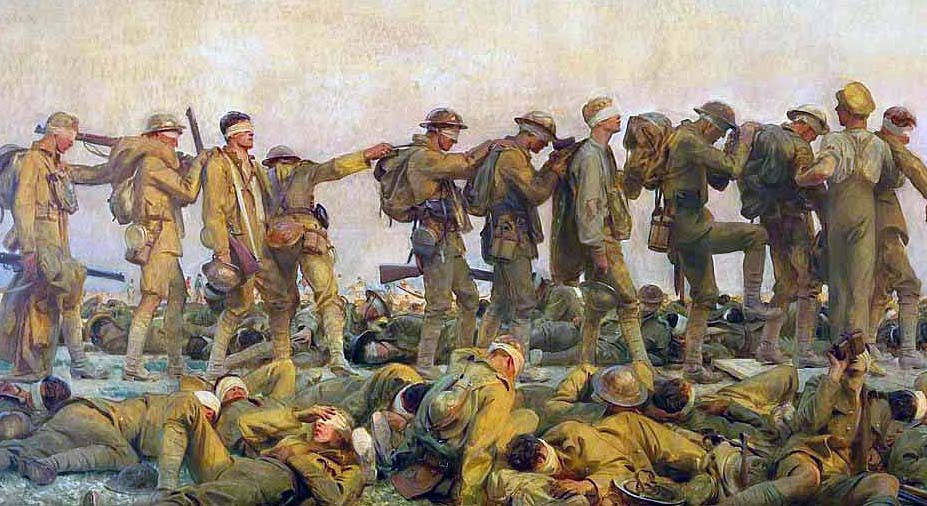
‘Gassed’ by John Singer Sargent, 1919. This painting is part of the Imperial War Museum’s collection.
On a personal level, my Great Great Grandfather- who was also named Robert- was shot at the Battle of Passchendaele in 1917.
Although he was lucky enough to survive (had he not, I would not be sitting here writing this now), the bullet he took remained in his body for the rest of his life.
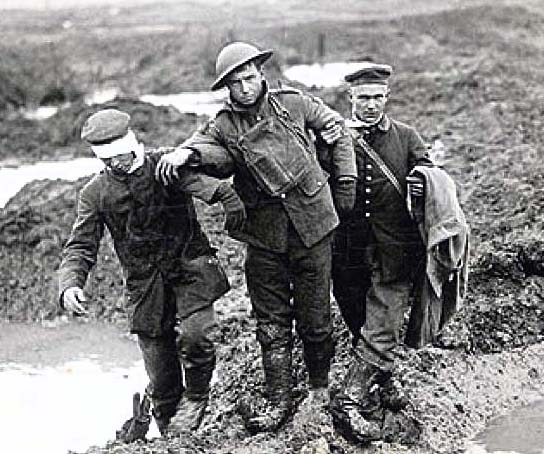
Wounded soldiers at Passchendaele, Belgium, 1917.
*
To mark this sombre landmark in our relatively recent history- and as my personal tribute to all of those who died, whatever their nationality- I have decided to start a new series which, over time, will take a look at London’s many World War One memorials and the stories behind them.
I shall begin with ‘The Machine Gun Corps’ memorial.
The Machine Gun Corps Memorial
Hyde Park Corner

Location of the Machine Gun Corps Memorial at Hyde Park Corner (image: Google).
When war first erupted in the summer of 1914, the British Military were still very much of a 19th century mind-set, confident that traditional infantry and cavalry based tactics would be sufficient enough force to seize victory… a tragically naïve assumption which was starkly portrayed in the 2011 film adaptation of Michael Morpurgo’s book, ‘Warhorse’ (please click below to view):
After a few bloody months on the Western Front, it soon became clear in which direction the conflict was heading, leading to the formation of the Machine Gun Corps in October 1915.
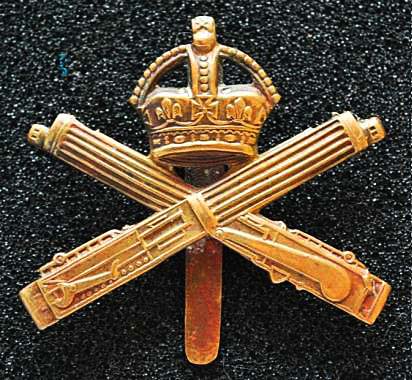
Machine Gun Corps badge (image: Wikipedia).
During WWI, the Machine Gun Corps were deployed in a wide range of theaters including France, Belgium, Palestine, Egypt, East Africa and Italy.
Because of the nature of their weaponry, troops from the MGC often fought well beyond the front line; a factor which earned the Corps both a high casualty rate and a darkly comic nickname… ‘The Suicide Club’.

Gas masked troops from the Machine Gun Corps at the Battle of the Somme, 1916.
Seven members of the Machine Gun Corps were awarded the Victoria Cross; the highest possible accolade for bravery.
The Memorial
Unveiled in 1925, the memorial to the fallen of the Machine Gun Corps is embodied by a statue known as the ‘Boy David’; the Biblical figure who proved his worth after slaying the fearsome giant, Goliath.

The ‘Boy David’ Machine Gun Corps Memorial.
Although we tend to associate David with heroism and triumph over adversity, his representation in this case is naked; something which suggests a sense of vulnerability.
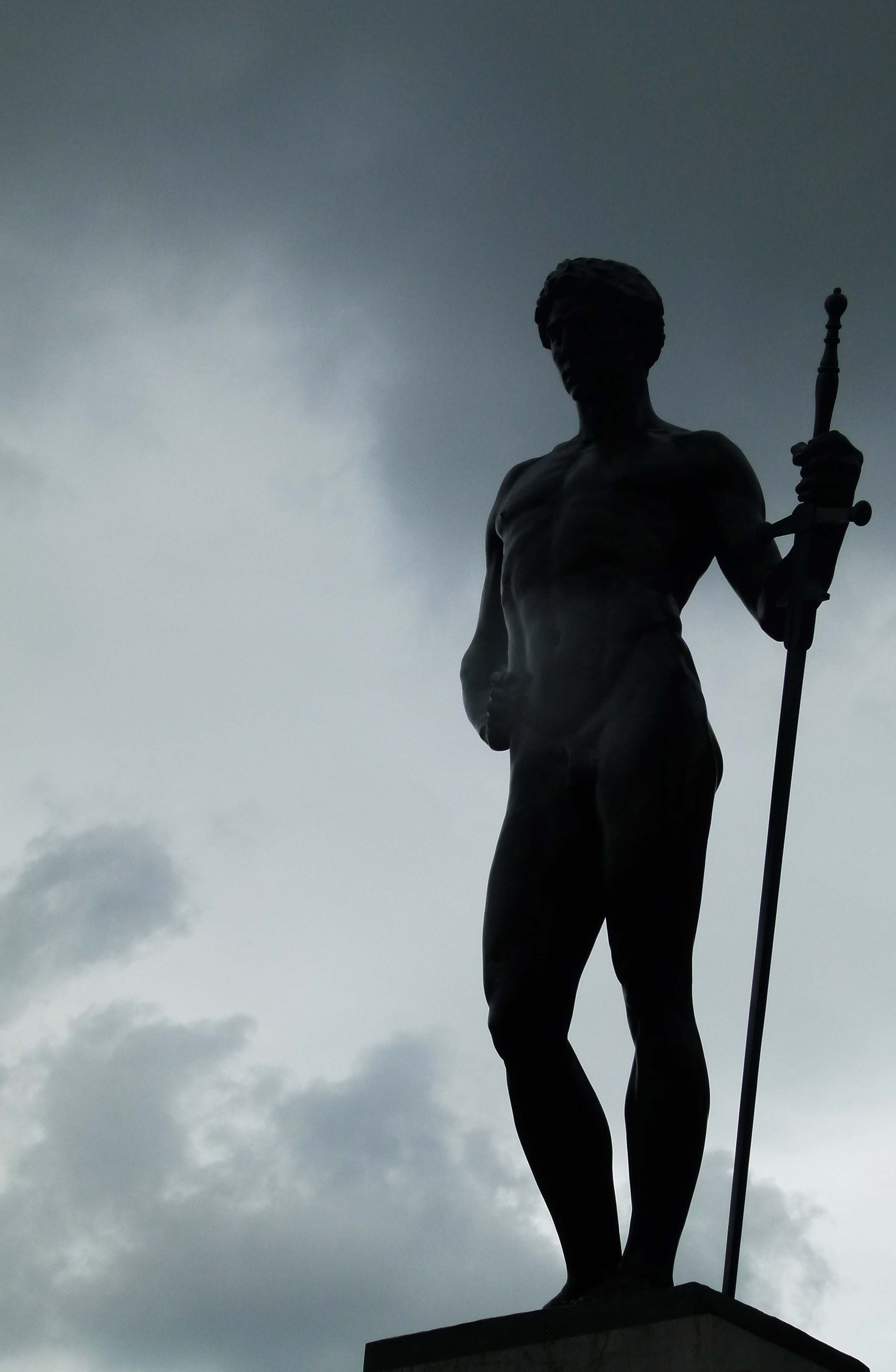
The statue’s plinth includes a quote from the Book of Samuel; “Saul hath slain his thousands but David his tens of thousands”; a grim nod to the impact which the Machine Gun Corps had on the course of the war.

On either side of the statue sit two ‘Vickers’ machine guns, each encircled with laurel wreaths. These fearsome weapons are actually real models… so it is some comfort that they are now encased in bronze.

The rear of the statue provides a brief history of the Corps:
“The Machine Gun Corps of which His Majesty King George V was Colonel in Chief, was formed by Royal Warrant dated the 14th day of October 1915.
The Corps served in France, Flanders, Russia, Italy, Egypt, Palestine, Mesopotamia, Salonica, India, Afghanistan and East Africa.
The last unit of the Corps to be disbanded was the Depot at Shorncliffe on the 15th day of July 1922.
The total number who served in the Corps was some 11,500 Officers and 159,000 other ranks of whom 1120 Officers and 12,671 other ranks killed and 2,881 Officers and 45,377 other ranks were wounded, missing or prisoners of war.”

Machine Gun Corps troops at Arras.
*
When first erected, the memorial stood on Grosvenor Place; just south of Hyde Park Corner.
This first site was short-lived, with major road works soon requiring the statue’s removal. It was placed in storage for many years, finally returning in 1963 when it was placed at its present site on the northern side of Hyde Park Corner, backing onto one of London’s busiest road junctions.

Looking towards the memorial at Hyde Park Corner (image: Google).
An annual observance is held at the statue on the 2nd Saturday of every May.
Francis Derwent Wood
Perhaps the most poignant factor about the Machine Gun Corps memorial is the story behind its sculptor; Francis Derwent Wood.

Francis Derwent Wood.
Francis Derwent Wood was born in the Lake District in 1871 and went onto teach sculpture at the Glasgow School of Art.
When war broke out in 1914, he was too old for military service, so volunteered to work in the bustling hospital wards, coming to be based at the 3rd London General Hospital in Wandsworth.
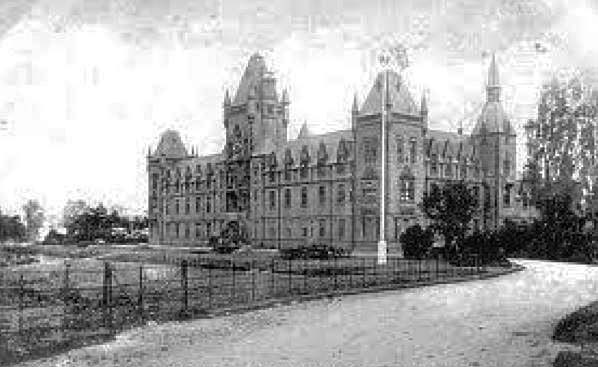
The 3rd London General Hospital.
Originally built in the 1850s as a home and school for orphans, this grand building was requisitioned in WW1 for use as a military hospital.
To cope with the sheer number of wounded troops being brought it, a temporary platform and station were built on the hospital’s western side (which backs onto one of the main lines into Clapham Junction).
A field behind the hospital (which is today a cricket ground) became an overflow area, lined with row after row of marquees standing in as temporary wards.

Postcard displaying the 3rd London General Hospital, Wandsworth. The railway lines which delivered wounded troops can be seen to the south, the overflow tent-wards towards the north.
Today, the former hospital is now known as the ‘Royal Victoria Patriotic Building’; a complex of apartments, workshops, studios, a drama school and a restaurant called ‘Le Gothique’.

The former 3rd London General Hospital today… now known as the Royal Victoria Patriotic Building (image: Google).
*
At the 3rd London General Hospital, Francis Derwent Wood encountered many young men who had suffered horrific injuries inflicted by the terrifying new weaponry.
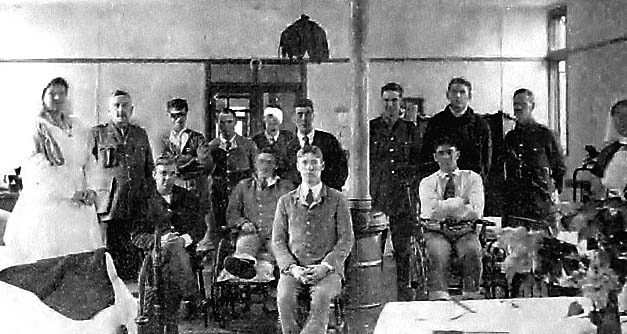
Canadian patients at the 3rd London General Hospital, Wandsworth.
Facial traumas were especially commonplace; if a squaddie quickly popped his head over the trench, an unexpected explosion or burst of enemy fire could have catastrophic results.
In one account, an American soldier, shot in the skull in 1918, described the experience; “It sounded to me like someone had dropped a glass bottle into a porcelain bathtub… a barrel of whitewash tipped over and it seemed that everything in the world turned white.”
In some cases, victims literally lost half their face… yet somehow managed to survive.
Although plastic surgery techniques were being pioneered at the time, there were some unfortunate souls who even this could not help.
Exposed to such tragedies, Francis Derwent Wood had a brain-wave.
Realising that his artistic skills may be able to help those with extensive facial scars, he took it upon himself to set up the ‘Masks for Facial Disfigurement Department’ within the hospital where, beginning in March 1916, he began to use his expertise to create custom masks for his patient’s shattered faces.

Francis Derwent Wood working on a patient’s mask (image: The Imperial War Museum).
Taking up to a month to create, each mask, which was made from ultra-lightweight metal and painted in enamel to match the wearer’s skin tone, was a work of art in itself, designed to fully disguise the affected area.
Where eyebrows and moustaches were required, slivers of tinfoil were used- rather like the technique used on ancient Greek statues.
Patients at the hospital quickly gave the department an affectionate nickname; ‘The Tin Nose Shop.’

Bits and bobs from Derwent Wood’s ‘Tin Nose Shop’ (image: The Imperial War Museum).
This creative solution did wonders for the morale of young men faced with a future of horrified stares and social exclusion- in Sidcup for example, which was also home to a facial hospital, certain park benches were designated for the use of patients…and were painted blue as a warning to passers-by of a more sensitive nature.
Interviewed in The Lancet in 1917, Francis said; “My work begins where the work of the surgeon is complete…The patient acquires his old self-respect, self-assurance, self-reliance… takes once more to a pride in his personal appearance. His presence is no longer a source of melancholy to himself nor the sadness of his relatives and friends.”

A wounded soldier examining the beginnings of his facial mask (image: The Imperial War Museum).
Derwent Wood’s work was soon noticed by the American sculptor, Anna Coleman.

Anna Coleman (image: Wikipedia).
After liaising with Derwent Wood and with support from the American Red Cross, Anna opened her own mask studio in Paris, where she continued the pioneering work on severely wounded French and American troops.
A video of this studio survives, which gives a good idea of the process involved at the hospitals in Paris and London (please click below to view):
Unsurprisingly, Anna Coleman and Francis Derwent Wood received many grateful letters from those they’d helped.
One particular response is heart-breaking in what it says;
“Thanks to you, I will have a home… the woman I love no longer finds me repulsive.”

Close up of the Boy David statue…
*
Francis Derwent Wood’s studio was wound down in 1919.
Although he was able to help several hundred men, this was a mere drop in a very sad ocean- over 20,000 would return from the continent with facial wounds.
After the war, Francis was commissioned to create memorials in honour of the men who never returned. These works include a statue for Liverpool’s Cotton Association, ‘Humanity Overcoming War’ in Bradford and work on the memorial plinth in his home town of Keswick.

Francis Derwent Wood’s sculpture for the Liverpool Cotton Exchange (image: Wikipedia).
He also created a controversial sculpture of a crucified soldier; ‘Canada’s Golgotha’ which can be seen in the Canadian War Museum, Ottawa.
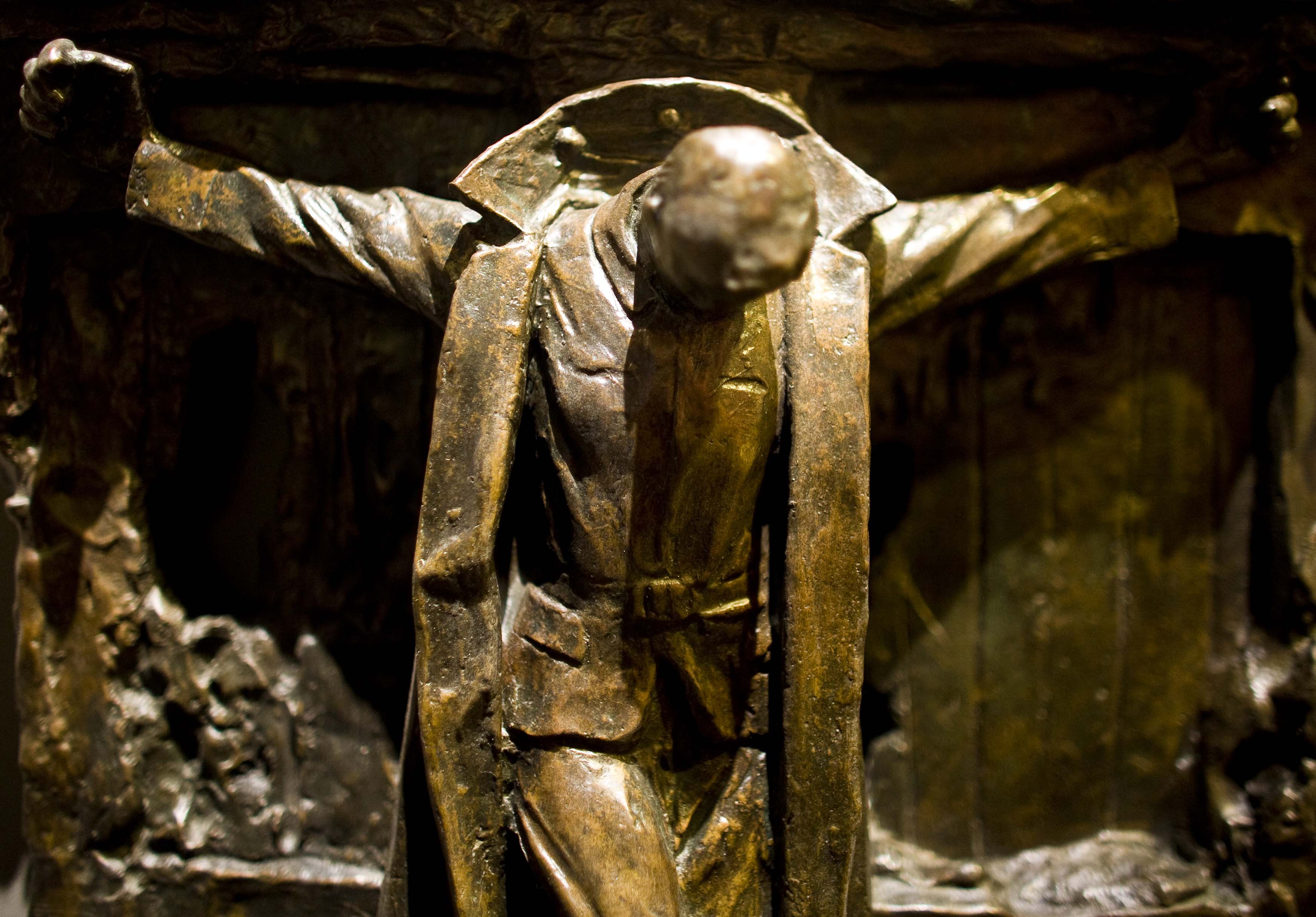
‘Canada’s Golgotha’… (image: Wikipedia).
London’s Machine Gun Corps memorial was one of Derwent Wood’s last pieces. He died just two years after its unveiling.
In 1929, a small, bronze copy of the Boy David was made by Edward Bainbridge Copnall as a memorial to Francis Derwent Wood.

The Boy David modello by Edward Bainbridge, 1929 (image: Copyright Paul Farmer, via Geograph).
Bequeathed by the Chelsea Arts Club, it can today be seen on the north side of Chelsea Embankment, overlooking Albert Bridge.






 View from the Mirror