Snakehips at the Cafe De Paris
This is the entrance to the Café de Paris, a famous London nightclub on Coventry Street near Leicester Square, which first opened to partygoers way back in 1924 and is still going strong today.

The dance-floor of the Café de Paris was originally designed to resemble the ballroom of the fated Titanic and, in its earliest days, one of the club’s most frequent regulars was Edward, Prince of Wales (Prince Harry’s wild nights out at Boujis and Chinawhite are clearly nothing new!)

Edward VIII… renowned party animal and abdicator
This particular Prince of course went onto become King Edward VIII in 1936… but he didn’t stick the throne for very long. Shortly after taking on the crown, he decided to chuck it in; abdicating so that he could pursue a relationship with U.S socialite, Wallis Simpson. I wonder if the hedonism of the Cafe De Paris had a corrupting influence on him?…
*
Shortly after it opened, the Café De Paris was the venue for the UK’s first performance of the famously hip and energetic, Charleston dance. This spontaneous debut was carried out by the American model and showgirl, Louise Brooks- a bold act which pulled London firmly into the ‘Roaring 20s’.

Louise Brooks, the woman who introduced the Charleston to Britain (photo: Wikipedia)
In 1929, the club hit the silver screen when it appeared in the silent film, Piccadilly
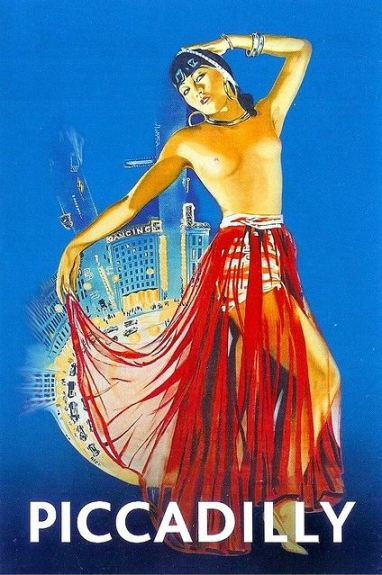
Promotional poster for the 1929 film, ‘Piccadilly’
Starring Anna May Wong- the film industry’s first ever Chinese-American actress, the plot of Piccadilly involved jealousy, betrayal, forbidden love, murder.. and, above all, dancing as demonstrated in the following excerpt!-
*
A decade later saw the outbreak of WWII and the subsequent Blitz on London- during which time the Café De Paris was considered to be one of the safest places in the West End, due to the fact that the bulk of the club was located several floors underground.

Downstairs at the Cafe De Paris
For those who had the money and style to gain entry, the assumed safety of the Café De Paris was clearly far more attractive than spending the night sleeping on a stuffy, crowded tube platform or huddled in a dank Anderson Shelter at the bottom of the garden.
*
During the Blitz, the biggest attraction at the Café De Paris was the nightly entertainment provided by Kenrick Reginald Huymans Johnson; more commonly known as Ken ‘Snakehips’ Johnson, leader of his specially put together, ‘West Indian Orchestra’ who were the club’s resident band.
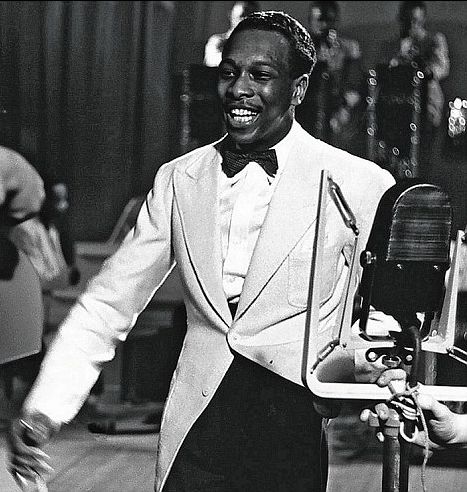
Ken ‘Snakehips’ Johnson
Ken was born in British Guyana, South America in 1914.
During the 1920s, he rose to become an acclaimed dancer, coached by Buddy Bradley who had also taught Fred Astaire.
Ken’s smooth moves quickly earned him his famous ‘Snakehips’ nickname, paving the way for appearances in a number of American cabaret acts, as well as leading to Hollywood and a role in the 1934 film, Oh Daddy.

Ken showing off his snake-like hips!
During his time in America, Ken visited New York’s Harlem where he got to witness jazz greats such as Cab Calloway practicing their craft.

The legendary, Cab Calloway (1907-1994) who would prove to be a major influence on Ken Johnson
Such experiences enticed Snakehips, encouraging him to move on from dancing and to go about establishing his own band who would soon become known as the aforementioned ‘West Indian Orchestra.’
*
By 1940, Ken and his team of musicians were in London and were already so acclaimed that the Café De Paris snapped them on a permanent basis.
Upon being hired, Ken announced that he was determined to make Londoners “like swing at the Café… or die in the attempt”…
It wasn’t just the rich and famous who got to hear the West Indian Orchestra’s exciting music- Snakehips and his talented line-up were regulars on the BBC’s Wartime Service, giving Brits a welcome and uplifting diversion from the conflict and misery which was consuming the world.

A family gather around their wireless set during WWII (photo: BBC)
*
On the evening of Saturday 9th March 1941 Ken and his gang took to the stage as per usual.
Shortly into their performance, the air-raid sirens cranked into action, sending their eerie banshee howl wailing across the capital.
It was a situation Ken and the orchestra were used to and, being the accomplished entertainers they were and safe in the knowledge that the Café De Paris was deep underground, the band played on…
It was during a rendition of “Oh Johnny” that the unthinkable happened.
A bomb hurtled down from the sky and somehow managed to pinpoint an airshaft, sending the sinister device tumbling down into the very heart of the Café De Paris where, in a blue flash, it exploded on the dance floor.
34 people- including Snakehips Johnson- were killed instantly and a further 80 were seriously injured.
A number of those killed perished as the powerful blast sucked the air out of their lungs; a deadly phenomena which caused the victim to display no outward signs of injury, but instead left them statue-like; frozen in the pose they’d been in on the moment of impact.

The aftermath of the Cafe De Paris bombing
One of the first to rush to the scene was a police officer called Ballard Berkeley… who would later go onto become an actor, playing the character of Major Gowen in the much loved sitcom, Fawlty Towers.
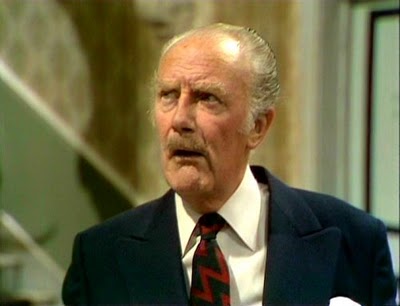
Ballard Berkeley, one of the first on the scene after the Cafe De Paris blast and who would later go onto become an actor after the war
Watching him act in such a well-known comic role, it is difficult to imagine the horrors which Ballard witnessed in the aftermath of that dreadful bombing.
Ken Johnson, whose once beautifully agile body was severely ravaged in the blast, was cremated at Golders Green Crematorium.
He was just 26 years old.
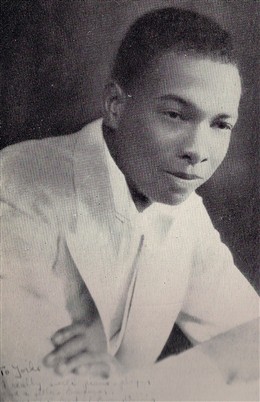
Ken Johnson 1914-1941
The loss of the great Snakehips and his band was felt deeply. When The Times reported on the disaster, they deliberately avoided mentioning the band by name for fear of damaging public morale.
The devastated Café De Paris remained closed until after the war, finally re-opening in 1948.
Below is a rare recording (made approximately two months before the Café Des Paris disaster) of Ken and his West Indian Orchestra preforming ‘I’m in Love for the Last Time’, the distinctive sound which, for an all but too brief period, lifted spirits during one of Britain’s most devastating periods.
The Trellick Tower: From Doom to Desire
When it came to architecture of the 1960s and 70s, concrete ruled supreme.
During this period, countless tower blocks sprouted up all over the UK in a rushed and misguided attempt to provide homes for families who were much more accustomed to being closer to terra firma.
The towers and the estates upon which they squatted quickly proved to be ineffectual, disintegrating communities and providing fertile grounds for crime and other social complications.
In recent years, many of these tributes to alienation and botched planning have been thankfully demolished.
However, one of the most famous examples from that era- London’s Trellick Tower– is still standing, stronger than ever… and, unlike many of its destroyed concrete cousins, it is now a celebrated piece of late 20th century architecture.

With its distinctive design, the 31 storey tower, which stands on Kensal Town’s Golborne Road, a short distance from the famous Portobello Road market, has become a modern London icon, visible from many parts of the city.
The Trellick Tower is so embedded in London’s fabric that it even featured in the promotional handover video which was played at the closing ceremony of the 2008 Beijing Olympics.

The Trellick Tower in a 2008 Olympics promotional video
Erno Goldfinger: Trellick, I am your father…
The architect behind the Trellick Tower was a chap called Erno Goldfinger… and yes, there is indeed a connection with James Bond which we shall discover shortly!

Erno Goldfinger, creator of The Trellick Tower… and who once said of himself, “There are good and bad architects. I am a good architect.”
Born in Budapest, Hungary in 1902, Erno Goldfinger was quite a character.
He moved to London in 1934 after marrying Ursula Blackwell (heiress to the Crosse and Blackwell condiments company) and by all accounts was a gruff, egotistical, arrogant man with a fierce temper and zero humour- during his career, he fired a number of assistants for simply sharing a joke in his presence!
Having said that, others who came into contact with the architect stated that, at times, he could be most charming.
Towering at over 6ft tall, Erno’s personality certainly matched the style of architecture which he would eventually became most well-known for- ‘Brutalism.’
*
His first work in London was a set of apartments which came to fruition in 1939 at numbers 1-3, Willow Road, Hampstead. Goldfinger himself lived and died here.

Goldfinger’s early design on Willow Road (photo: Wikipedia)
For its time, this design was ultra-modern and certainly didn’t fit in with the more traditional appearance of the other housing stock cluttered around the heath.
Many Hampstead residents found this striking design an unwelcome intrusion… one of these local critics was Ian Fleming, creator of Britain’s most dashing superspy, James Bond.

Ian Fleming… Erno Goldfinger’s arch nemesis!
It is said that Fleming despised Erno Goldfinger’s architecture and personality so much, he decided to borrow the distinctive surname and apply it to one of his most notorious villains- ‘Auric Goldfinger’!

Auric Goldfinger… Fleming’s fictional creation and Erno’s unfortunate namesake
When the novel was released in 1959, Erno Goldfinger was furious.
As well as the name, the fictitious baddie shared an uncannily similar family background to the architect; both being East European Jews who’d emigrated from their homelands in the 1930s.
Also of course, there was the fact that the pair were both domineering control-freaks who would let nothing stand in the way of their visionary work!
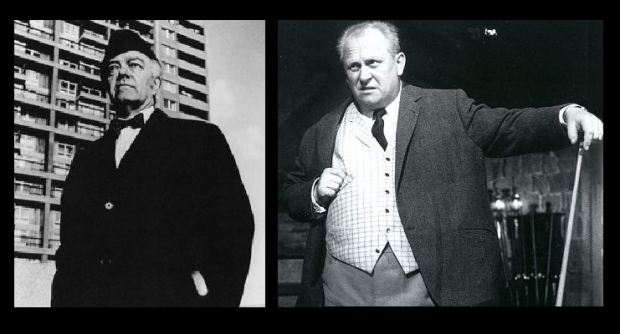
Erno and Auric… the two Goldfingers together… can you spot the difference?!
At his office, Erno Goldfinger dished out copies of Fleming’s novel, demanding an opinion on the text.
After reading the book, one brave employee quipped that the only difference between the character and the real man was that “you’re called Erno and he’s called Auric.”
It’s safe to assume that this individual was quick to receive his P45!
Erno Goldfinger decided to get his lawyers involved and the matter was quickly tided up- all the publishers had to do was pay the relevant costs and declare that all characters in the novel were fictitious.
Ian Fleming meanwhile was enraged at the fuss… and almost persuaded his publishers to change the fateful name to the rather more offensive ‘Goldpri*k!’
Today, Goldfinger’s Willow Road dwelling is owned by the National Trust and is open to the public. (Please click here for more information).
*
On the high rise
From the late 1950s onwards, looming tower blocks began to mushroom across London as council planners decided to put all of their housing eggs into one big concrete basket.
At first, these sprawling estates were embraced by many- in their early, unspoilt state, the high-rises were considered clean and modern; ‘streets in the sky’ with their apartments boasting ample space, impressive kitchens and indoor toilets- a truly rare luxury for many working class Londoners.
Erno Goldfinger was a staunch supporter of the tower-block craze and his first design in the emerging style was 1963’s Balfron Tower which still stands in the east end, overlooking the Blackwall Tunnel Northern Approach.

Goldfinger’s 1963, Balfron Tower (Photo: Wikipedia)
The Balfron would prove to be the forerunner to the Trellick Tower.
As part of a publicity stunt, Erno spent several weeks living in one of the Balfron’s flats with his wife, during which time he identified problems that required ironing out and could be avoided in future projects.
With his post-war work, Erno was influenced by a fellow architect; the Swiss-born and adopted Frenchman, Le Corbusier.

Le Corbusier; a major influence on Goldfinger’s tower blocks
Corbusier was instrumental in pioneering the architectural style known as ‘Brutalism’; derived from the French phrase, ‘beton brut’ which translates as ‘raw concrete.’
In London, two of the best examples of Brutalism are very famous buildings indeed- The Barbican complex and The National Theatre.

Towers at the Barbican and the National Theatre (photo of National Theatre from Wikipedia)
Europe’s earliest tower-blocks, built under the influence of Le Corbusier, appeared in sunnier climes; mainly around the Mediterranean in cities such as Marseilles.
In this environment, the stark concrete looked rather appealing, especially when situated close to sparkling, blue seas, their facades painted in pastel colours to reflect the sun.
However, when transplanted to Britain’s colder, greyer cities, Le Corbusier’s philosophy failed to translate and, by the 1970s, it was becoming clear that the enthusiasm poured into these sprawling swathes of concrete had been one almighty mistake…
The Trellick arrives
Erno Goldfinger’s Trellick Tower was commissioned by the Greater London Council in 1966 and was one of the last of the towering monoliths to be given the go ahead.
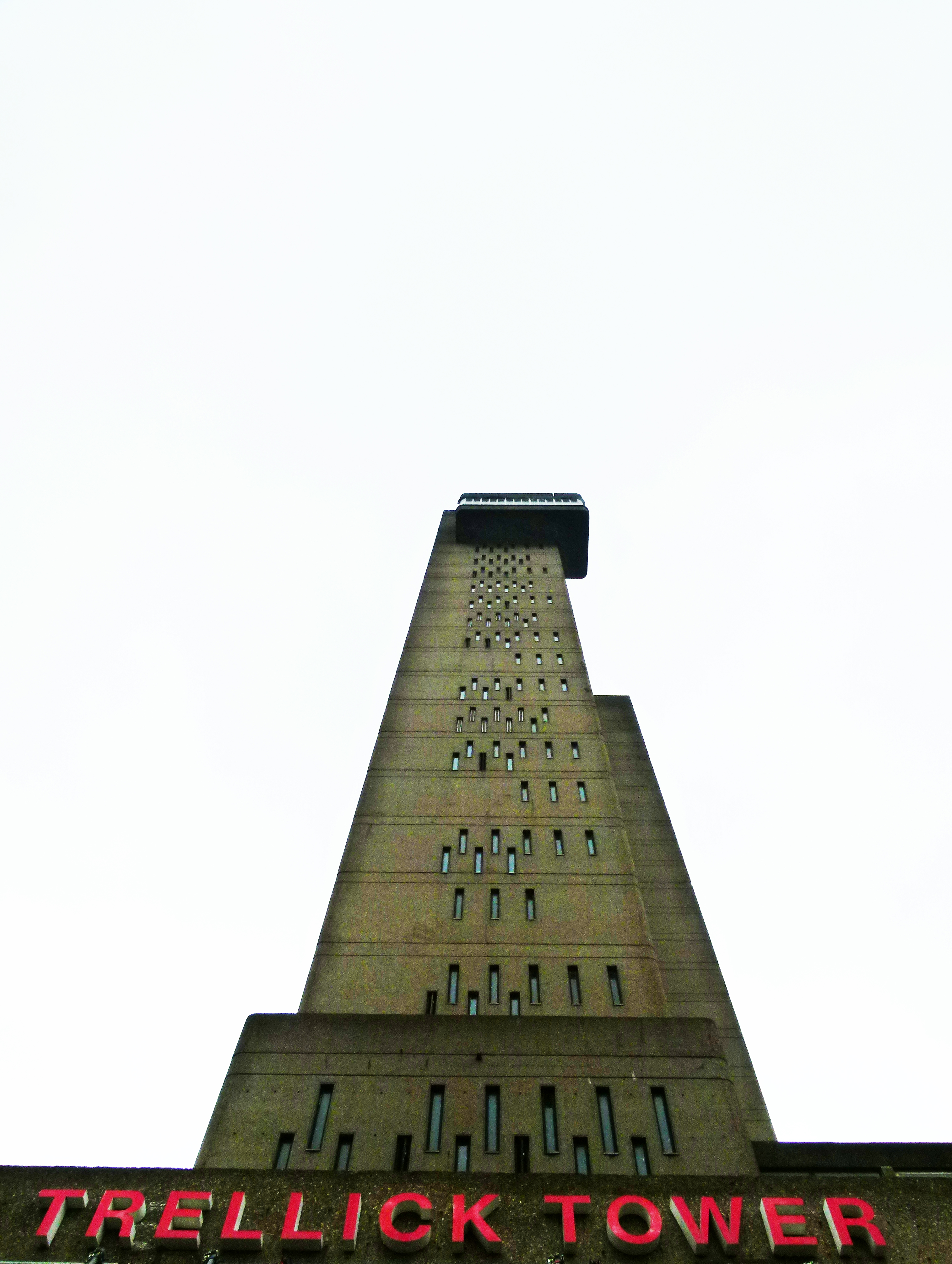
In 1968, whilst the Trellick was still under construction, the effectiveness of the tower block building spree was brought into question when Ronan Point; a 22-storey block in Newham, suffered a gas explosion, causing floors to collapse and four people to die.
Erno Goldfinger however didn’t let this event bother him, confident that his own unique design was safe and sturdy.

Aftermath of the Ronan Point explosion (photo: Geograph)
By the time the Trellick Tower opened in 1972, such council blocks had gained a notorious reputation for being harsh, alienating environments prone to crime and squalor; a reputation which would only worsen throughout the late 1970s and 1980s.
The Trellick was plunged into chaotic, hellish conditions from the start.
As journalist, Rory Carroll once recalled; “the nightmare would start moments after entering the lobby. Stench of urine, beer and stale sweat would seep from shadows, the lights would be smashed again and the corridor vandalised into gloom… walk and the broken bottles and syringes crunched underfoot.”

Entrance to the Trellick Tower today
During the Trellick’s very first Christmas, residents were left without heat, water or electricity as a group of vandals decided to smash a fire hydrant as part of their festive fun. Thousands of gallons of water were sent gushing down, flooding the lifts and corridors and blowing fuses.
Over the following years, the rota of misery grew and grew.
One pensioner, forced to climb the stairs after finding the lifts to be broken yet again, collapsed in a stairwell and died. Drug abusers lurked and muggings became rampant. There were several terrifying reports of attacks on children and women being raped.
One young mother, suffering from depression and unable to take life in the council block any longer, threw herself off of one of the Trellick’s wind-swept balconies.
Such incidents resulted in The Trellick earning a dubious nickname…
‘The Tower of Terror.’
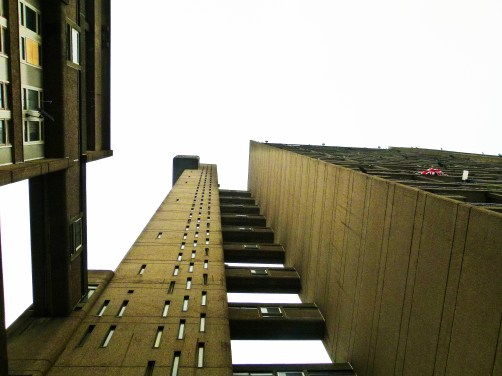
In the heart of the Trellick…
*
Tune into the Trellick
In the midst of these depressing social problems, something bold, creative and cheerful managed to emerge when a local resident- Leroy Anderson Lepke, along with his sister who went by the name of ‘Ranking Miss P’, went about establishing a hip, pirate radio station to cater for the area…. the antenna of which was secreted right on top of the Trellick’s soaring rooftop.

Leroy and Ranking Miss P; founders of DBC
Originally called ‘Rebel Radio’ and first going on air in 1981, this station quickly became known as the ‘DBC’. A play on BBC, these adapted initials stood for ‘Dread Broadcasting Corporation’.
The DBC specialised in playing reggae, dub and soca records; music which was popular amongst the local West Indian community, but was not sufficiently represented on any national radio station at the time.
As this rare and fun promotional animation demonstrates, the DBC had a lot of vitality:
Picked up on crackling sets all over North-West London and beyond, the DBC quickly became extremely popular- its organisers even running a successful side line in t-shirts boasting the DBC logo; an essential fashion accessory at the time!
At its height, it is estimated that up to 100,000 people were tuning into the cool rhythms being beamed from the Trellick’s rooftop.

A 1980s promotional flyer for DBC pirate radio
As the DBC’s popularity increased, so too did the arrests… the unlicensed station was busted on numerous occasions and was finally forced to disappear in 1984- although they did manage to go out with a bang, pulling off a live broadcast at that year’s Notting Hill Carnival.
A more detailed account of the DBC can be found here. The site also features a number of authentic recordings which were taped whilst the station was on air.
Today, an antenna for sending out broadcasts in still in place on top of the Trellick- although this one’s slightly more legit in that it’s owned not by the DBC but the BBC! In the trade, this transmitter station is officially known as ‘Kensal Town’.

The BBC’s ‘Kensal Town’ transmitter… continuing the Trellick’s tradition of broadcasting to the masses!
The Trellick undergoes a Renaissance
Despite its distressing past, the Trellick Tower today is one of London’s most sought after properties.
The change occurred gradually, the main impetus being the introduction of ‘right to buy’ and the formation of a resident’s association in 1984.
A similar body had been successfully established in another one of Goldfinger’s tower-blocks- Glenkerry House in Poplar, which was completed in 1979 and, like the Balforn Tower, is a close cousin of the Trellick:

Glenkerry House in Poplar, the last of Goldfinger’s distinctive tower blocks
The association fought hard to improve the Trellick, their main concern being security. An intercom system was introduced along with a concierge. In later years, extensive modernisation was carried out within the building’s interior, making it smart, clean and worthy of habitation.
There is a famous incident in which Ms Lee Boland- chairwoman of the Trellick’s residents association- met Erno Goldfinger (who evidently liked to keep an eye on his works) in one of the tower block’s lifts.
Erno gave Ms Boland a grilling, demanding to know what she liked and didn’t like about the flats. Ms Boland stated that she was generally happy with the design of her apartment, “except the designer hadn’t put a broom cupboard in the kitchen.”
Erno, in his typically bluff manner, replied by saying, “Bloody women… never satisfied”!
*

By the late 1990s, the Trellick had cleaned up its act considerably and was now a place where many people actually wanted to live, the prices of the apartments rising stratospherically.
A while ago, I was flagged down one evening by a young couple on their way to a swanky party at the Trellick… and they admitted that they were just as interested in seeing the architecture of their friend’s flat as they were about the drink and socialising!
Today, the distinctive tower block’s role in recent social history has been acknowledged by the authorities and has consequently been awarded grade II listed status.
Sadly, the Trellick’s grouchy creator, Erno Goldfinger passed away in 1987 and never got to witness the love which eventually flourished for his masterpiece.
In a way, it’s probably just as well, as the boasting and inevitable calls of ‘I told you so’ from the loveable old grump would have surely been insufferable!

Erno Goldfinger getting down with the youth! (Photo from ‘Sneaky Magpie’ website)
Lights, Camera, Action! The Trellick on film
Because of its unique and strangely appealing aesthetics, the Trellick Tower has appeared in many films, TV series and music videos.
Here is a gallery of some of the Trellick Tower’s most noted appearances…
Burning an Illusion (1981)
This pioneering film tells the story of Pat, a young, working-glass girl who wants to settle down in life but is increasingly frustrated in her relationship with boyfriend, Del.
After Del takes things too far, Pat realises that the time has come for her to stick up for herself and defend her rights.
In the film, the heroine is proud to own her own flat… which is situated in the lofty heights of the Trellick Tower.
After their first date, Pat’s soon to be troublesome boyfriend escorts his new love to her door all the way up on the 27th floor…
*
Tucker’s Luck (1983-1985)
In this spin-off from Grange Hill, the mischievous rogue, Tucker Jenkins finds himself recently out of school, struggling with the dole and high unemployment in 1980s Britain.
Episodes were filmed all around North-West London; Paddington, Harlesden, Acton, Shepherd’s Bush, Acton and Harrow. In the series, Tucker’s friend, Tommy Watson lives in the Trellick Tower as can be seen in the following clip (which also gives an idea of the impressive views over the city afforded by the Trellick’s sky-high corridors).
*
Shopping (1994)
Starring Sadie Frost and Jude Law (in his first major role), Shopping followed a mob of teenagers who whiled away their hours joyriding and ram-raiding. Requiring a bleak council estate as a backdrop, the film’s makers naturally turned to the Trellick Tower.
*
Incredible Games (1994-1995)
Incredible Games was a BBC children’s quiz show in which teams carried out a series of challenges housed inside a futuristic skyscraper; the aim of the game being to ascend as many floors as possible.
The exterior of this dystopian arena was portrayed in the opening credits… and, as I’m sure you’ve already guessed, the building was in fact the good old Trellick Tower! I wonder what Erno Goldfinger would have thought of his cherished icon being used for such frivolous purposes!
The games were controlled by a ‘Max Headroom’ type character who controlled the proceedings via a video screen in the tower’s lift. This somewhat disturbing looking individual was played by David Walliams who of course later went on to find fame with Little Britain.

David Walliams in an early role, playing a character whose home was inside the Trellick Tower’s elevator!
*
Music
‘I Want’, Department S (1981)
Department S were a new-wave band whose most famous hit was, Is Vic There?
The follow up to this single was, I Want and the video featured several glimpses of the Trellick Tower. Much of the promo was filmed on the estate surrounding the high-rise; most notably next to the tracks which run alongside the estate, carrying trains in and out of Paddington; a vantage point which allows commuters a good view of the Trellick.
Incidentally, my uncle was the bass player in this group! Although his bass-work can be heard in the soundtrack, he does not actually make an appearance in the video… by this point, he’d fallen out with the band over ‘creative differences’!
*
Little 15, Depeche Mode (1988)
This video features lots of spinney shots; driving around the estate and darting down the Trellick’s stairwells.

*
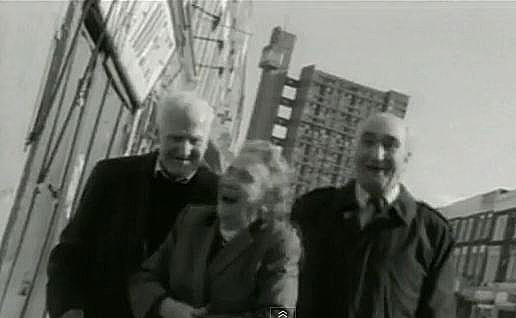
For Tomorrow, Blur (1993)
An early video from the 90s Brit pop group, For Tomorrow was filmed all over London. Being such a famous landmark, it was only natural that the Trellick Tower got a look in.
*
This is Music, The Verve (1995)
Another song from the Britpop era, this video is a fantastic showcase for the Trellick’s architecture- even the tower’s boxy, metal lifts are employed on the shoot… very cool indeed!
*
We Won’t be Here (Revere, 2010)
A more recent video featuring the Trellick and a nice one to end this piece on as it sees a colourful bunch of red balloons being released outside the famous landmark… a gesture which I’m sure would have even forced dear old Erno Goldfinger to crack a smile…
Bishops, Bones & Birds
Not far from the bustle of Southwark’s Borough Market where tourists flock, traders holler and trains rumble and thump overhead into London Bridge Station, there sits a quiet backwater called Redcross Way; a little-known street, often devoid of traffic or people.
The only sign of life down here is the ‘Boot and Flogger’; a secretive, atmospheric wine bar opposite which stand these rather extraordinary gates, draped in ribbons, trinkets and hand-written messages:
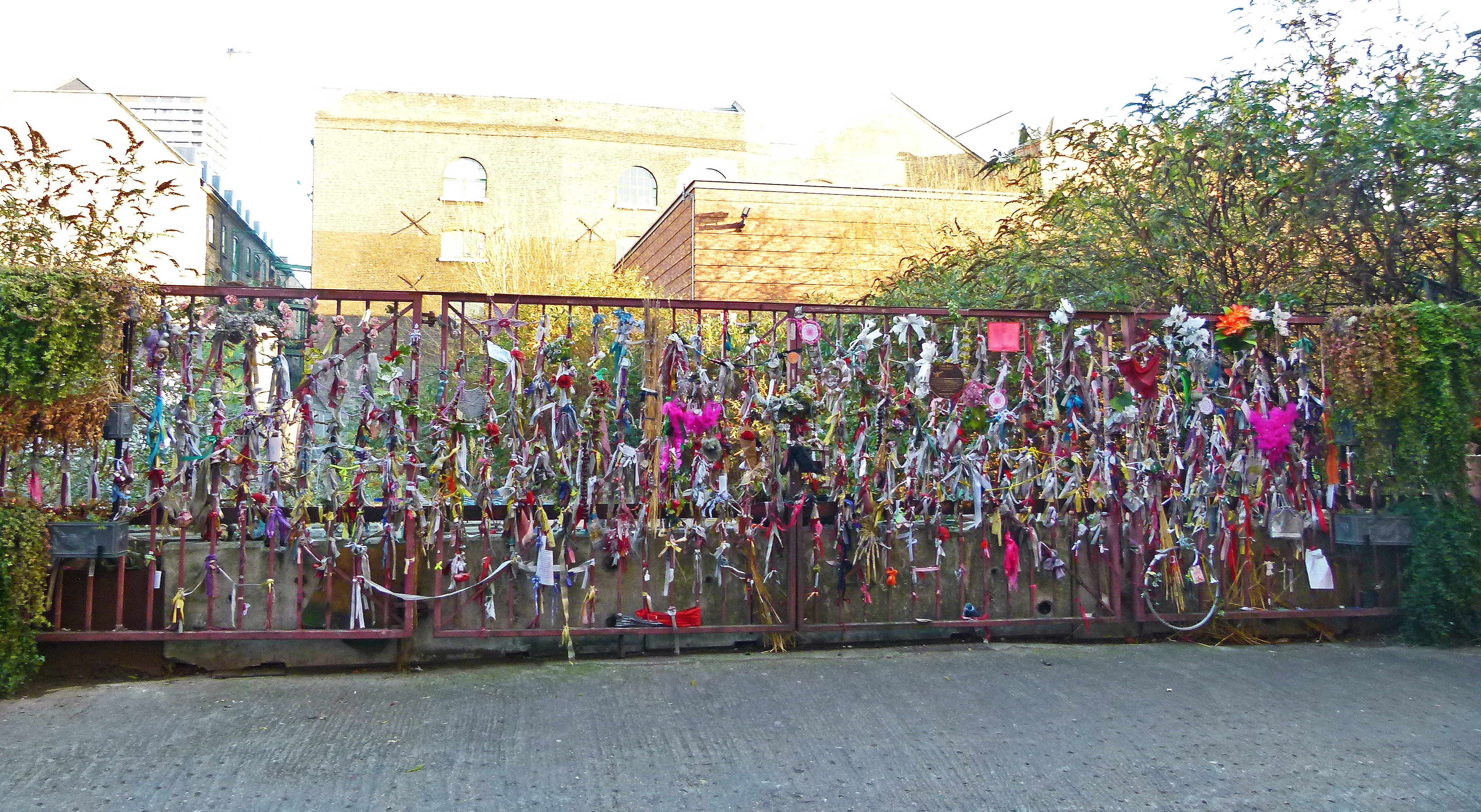
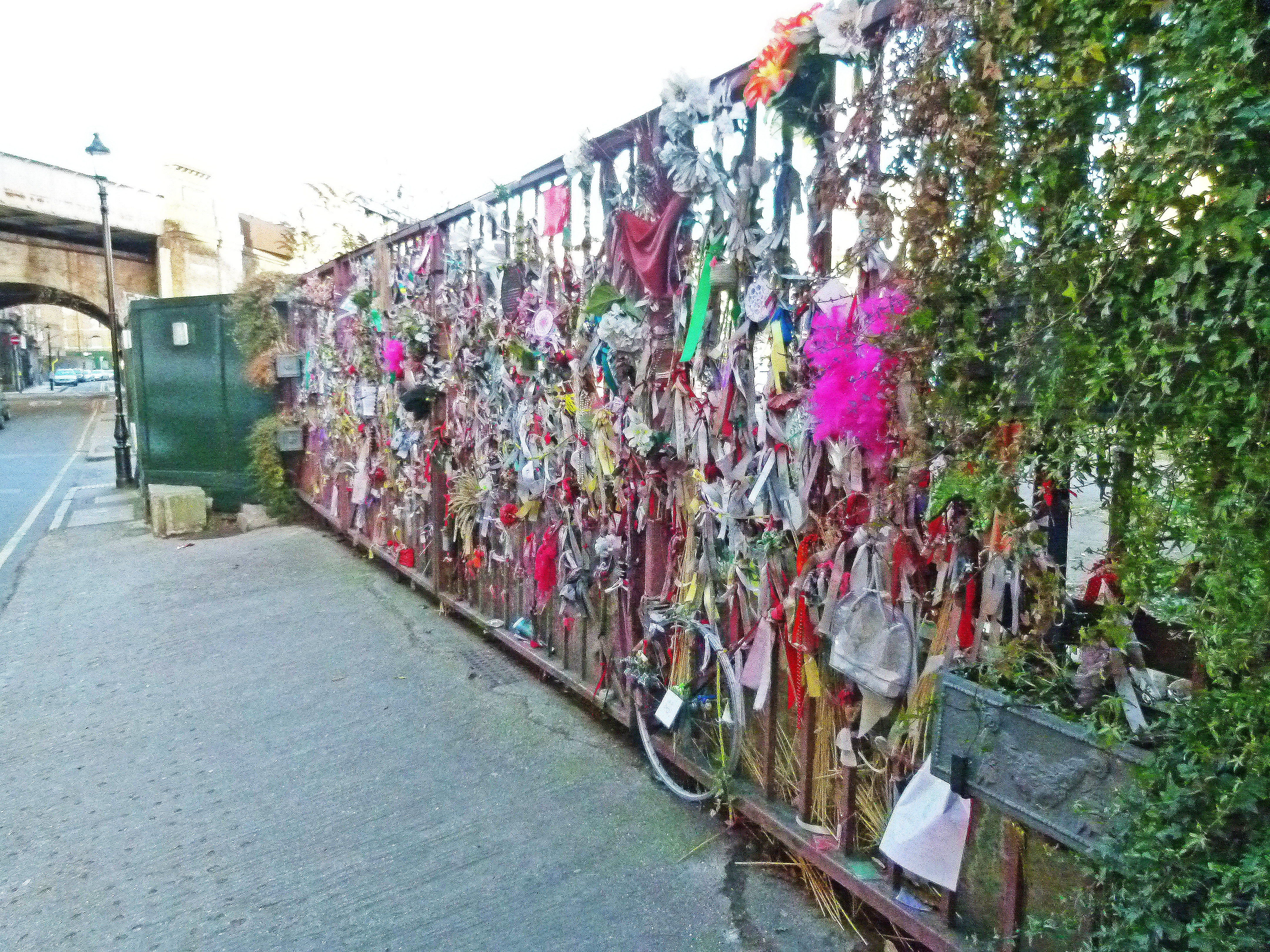
These gates guard the entrance to the morbidly named ‘Crossbones Yard’; a frequently overlooked slice of London’s murkier history.
*
The exact year in which Crossbones Yard was established is a mystery- even one or two Roman remains have been found here. It certainly dates back to at least medieval times and is primarily a remnant of an era in which Southwark acted as London’s ‘Sin-City’…
In those days, the City of London was confined to the north bank of the Thames, still locked in by the defensive wall which had been laid out by the Romans many generations before.
Already a city of immense wealth, the capital was governed by staunch laws which ensured everything ran like clockwork and that her God-fearing citizens knew their place and generally behaved themselves.
Every evening at 9pm, the bells of St Mary Le Bow Church would begin to ring, signalling the start of the nightly curfew. When these bells commenced their clanging, London Bridge- the famous crossing cluttered with shops and houses- would close its gates for business, keeping undesirable riff-raff at bay.
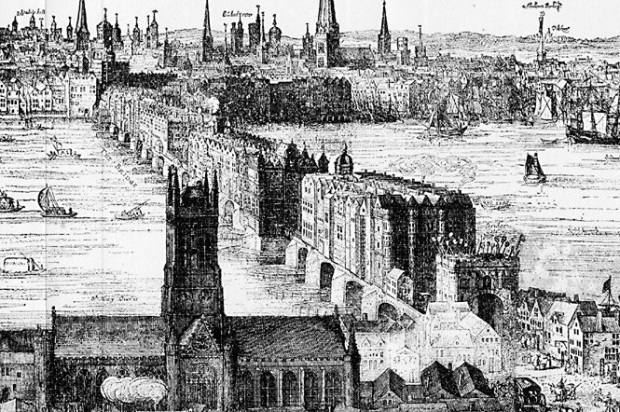
Old London Bridge… Southwark is towards the bottom of this contemporary etching
However, a few hundred feet away on the opposite bank of the Thames, things would just be starting to wake up…
Cluttered around the southern foot of London Bridge lay the settlement of Southwark which, thanks to a setup known as the “Liberty of the Clink”, was a practically lawless place where anything went and Londoners came to party…. it was rather like an extremely early, uncontrolled version of Las Vegas!
Over in the city, depraved entertainments were forbidden but here, across the Thames in sinful Southwark, there were no restrictions.
What went on in Southwark stayed in Southwark… a place where people came to frequent the many taverns, to visit the theatre (a civilised pastime today, considered a heinous pursuit back then), to bet on dice, cock-fighting and bear baiting, to have a punch up… and to pop into the ‘stews’- a slang term for brothel of which there were a great many.
*
The scant authority which did exist in Southwark emanated from a surprisingly holy source; the heathen place being presided over by the Bishops of Winchester…
Founded in AD676, the Diocese of Winchester was one of the largest and most powerful in the country. Consequently, it was decided that the Diocese should establish a base within convenient reach of the capital. So, in 1109, a palace for the Bishops of Winchester was built in Southwark- the remains of which can still be seen today on Clink Street.
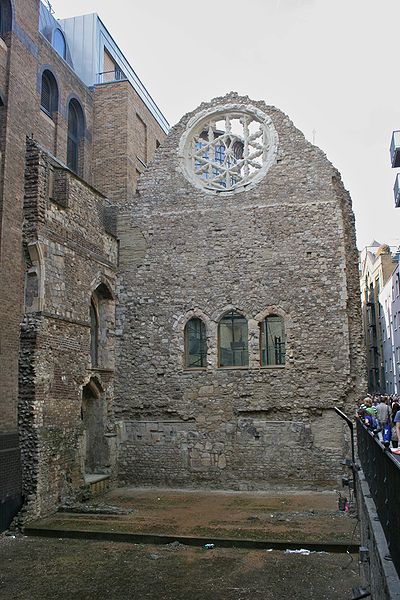
The Remains of Winchester Palace, Clink Street (Photo: Wikipedia)
Being such powerful landowners, the Bishops serving the Diocese of Winchester held a firm financial grip over Southwark.
Although a prison- ‘The Clink’ (today a museum)- was constructed near the palace to deal with certain troublemakers, the Bishops pretty much let Southwark’s sinners get on with it… in fact, due to their status as landlords, the Bishops of Winchester actually made a tidy profit out of the debauchary, renting out land and premises to facilitate the sordid goings on.
The brothels were no exception, thus paving the way for an extraordinary anomaly… the holy men technically became pimps…
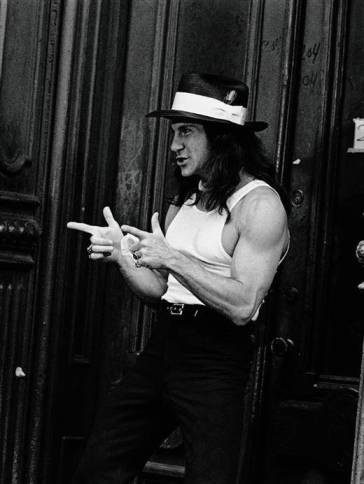
Harvey Keitel as ‘Sport’; the sinister pimp from the 1976 film, ‘Taxi Driver’… a role somewhat emulated centuries earlier by the Bishops of Winchester!
As well as collecting rent from the working girls, the Bishops also regulated the stews as a legitimate business, controlling opening hours and enforcing certain ground rules.
Buildings that belonged to Southwark’s red light district had to be painted white and were also required to display a specific sign, similar to ones used to denote inns and taverns- the most common being the image of a cardinal’s hat.
It is estimated the Bishops controlled around 18 brothels, all of which had pub-like names- ‘The Half moon’, ‘The Cross Keyes’, ‘The Boars Head’, ‘The Gun’, ‘The Castle’ and so on.
Because of this arrangement, the working girls of Southwark became known as the ‘Winchester Geese’, and it is said that this is where the rough and ready slang term, “bird” (meaning woman) may have originated from.
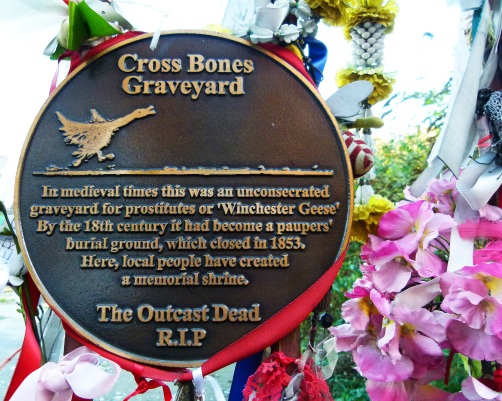
Modern plaque on the gates of Crossbones Yard
Despite helping the Bishops of Winchester turn a quick buck, the prostitutes of Southwark were still considered to represent the pinnacle of sin.
Consequently, when a Winchester Goose died, it was forbidden to bury her in consecrated ground… and this is where Crossbones Yard came in.
The yard was essentially a dumping pit for the heathen, an unconsecrated patch where bodies could be cast to the worms with zero ceremony.
In 1598, John Stow- in his fascinating book, ‘A Survey of London’ (essentially the very first guide-book ever written about the capital) recalled Crossbones Yard and its sad purpose:
“…these single women were forbidden the rites of the church so long as they continued in that sinful life, and were excluded from Christian burial if they were not reconciled before their death. And therefore there was a plot of ground called the Single Women’s Churcyard appointed for them far from the parish church.”

John Stow who described the burial ground in his early guide book
The Bishops’ lucrative pimping side-line was abruptly ended (“put down by the King’s commandment… proclaimed by sound of trumpet” as John Stow described it) in 1546 by Henry VIII- rather ironic considering that tyrannical monarch’s track record!
*
Despite being taken out of the the Bishops of Winchester’s hands, the brothels gradually began to creep back over the following decades and were once again in full swing by Shakespeare’s time, jostling for space with the Bard’s equally naughty Globe Theatre. This second wave of debauchery was later halted by the ultra-puritan, Oliver Cromwell.
Throughout this turmoil, Crossbones Yard continued to accept burials- there were plenty of crooks and poverty-stricken paupers to go around and many of these unfortunate souls found their final resting places here
When Guys Hospital was founded nearby in 1721, Crossbones Graveyard became a popular target for the ‘resurrectionists’ -aka body-snatchers for whom the large, disease ridden pit provided a regular bounty of fresh corpses, ripe for dissection and the attention of curious, scientific minds.
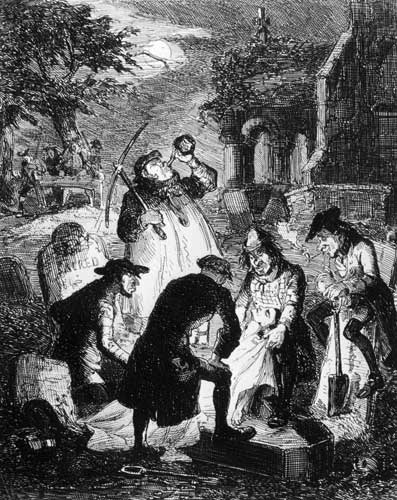
Body-snatching…
Crossbones Yard continued to accept the dead well into the 19th century.
Excavations from the 1990s revealed that between 1800-1853, 66% of the souls dumped here were under the age of 5, the main causes of death being smallpox, tuberculosis and cholera; a tragic sign of the desperate levels of poverty which haunted London at the time.
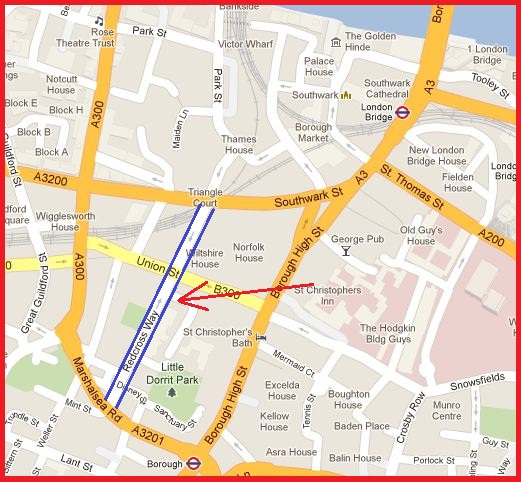
During this era, it is most likely that the great Victorian writer, Charles Dickens would have been familiar with the packed graveyard. In 1824, whilst his father was incarcerated in the nearby Marshalsea debtors’ prison, the young 12 year old Dickens lived on Lant Street, a stone’s throw from Redcross Way.
The area around Southwark would later go onto play an important role in his 1855 masterpiece, Little Dorrit.
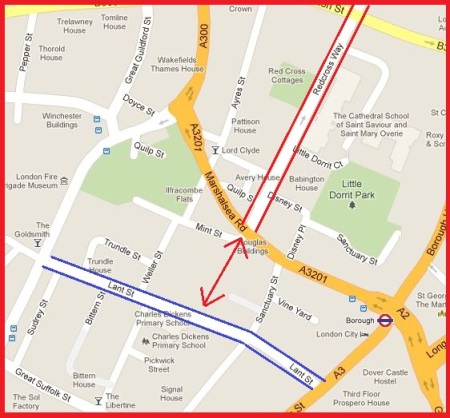
Map showing Lant Street, where Dickens lived as a youngster, in relation to Redcross Way
Towards the end its life, Crossbones Yard was quite literally full- “overcharged with dead”- with bones and body parts lurking unsettlingly close beneath the topsoil- even poking out in some cases.
Considered a public health hazard, the dejected graveyard was finally closed in 1853, the land was sold and a warehouse built on top.
Overall, it has been estimated that some 5,000 souls were buried here over the years.
*
Crossbones Yard was rediscovered in the 1990s when work was being carried out on the Jubilee line extension.
Today, it lies beneath a sorry patch of concrete and the former unconsecrated burial ground has become an unofficial shrine to the ‘outcast dead’.
As these pictures show, people come here to write messages and dedicate objects to those who are seen as having passed away whilst living on the edge of society. Many of the melancholy dedications on display are in memory of homeless people, alcoholics and prostitutes.
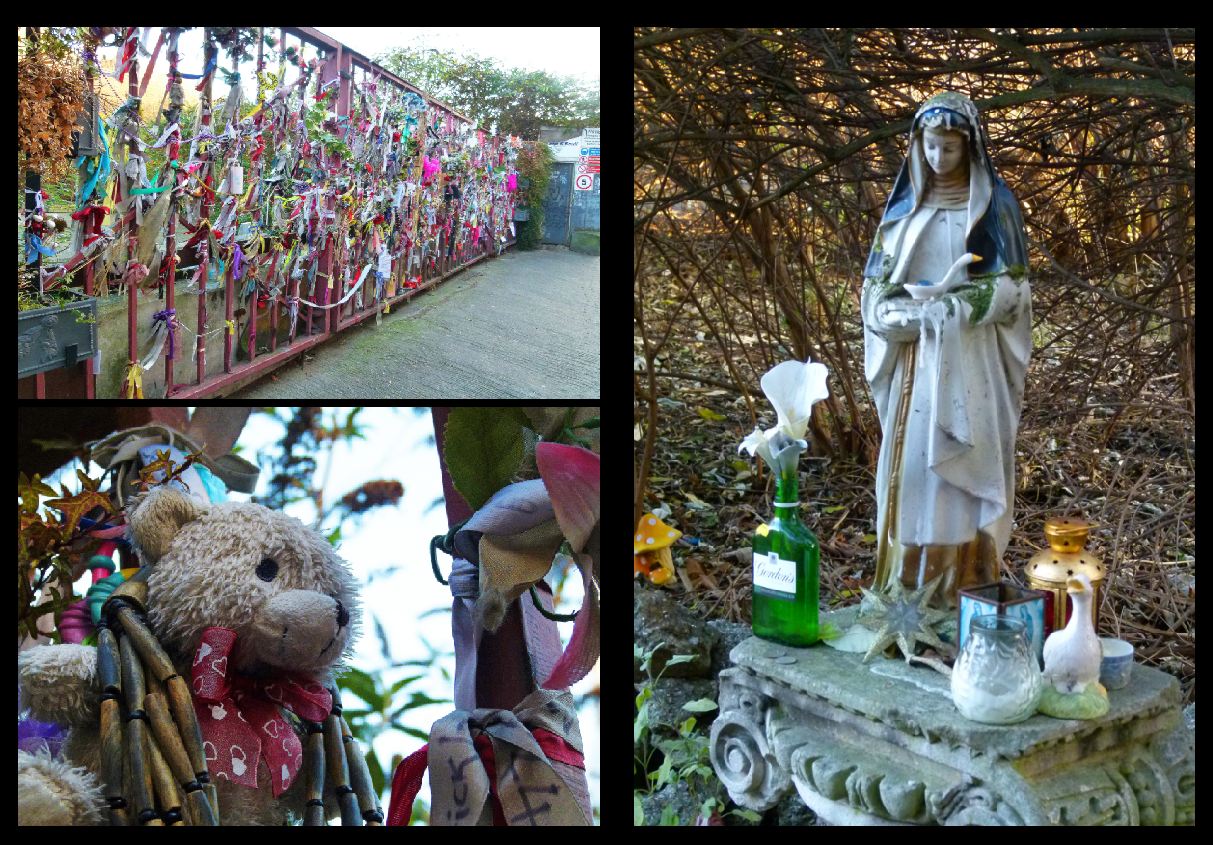
At 7pm on the 23rd day of every month, a vigil often involving poetry recitals, singing and dancing is held at the gates. All are welcome.
Depressingly, the site has been under the threat of redevelopment for some years now. Thankfully, a committed group of people have been campaigning to save this important area; the ultimate wish being that a peaceful garden of remembrance will eventually be created- a fitting tribute to the 1,000s of dead who were cast aside here so unceremoniously.
For more information, please follow this link to the excellent Crossbones website, where you can find out more and sign a petition to preserve the site.
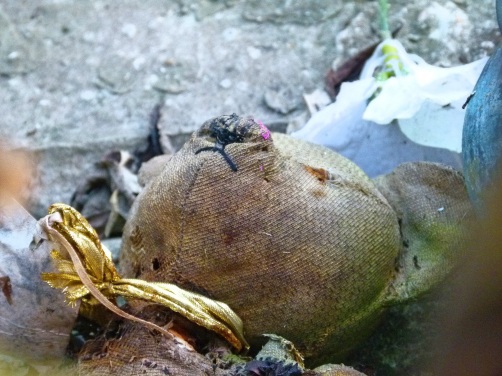
A sad teddy, lying in tribute within Crossbones Yard





 View from the Mirror