The London Temperance Hospital
With it being January and that time of year when people strive to lay off of the booze, I thought now would be an appropriate time to examine a certain derelict building which can be seen rotting away on Hampstead Road close to Euston station.

The former London Temperance Hospital as seen from the junction of Hampstead Road and Cardington Street
These mouldering remains were once the London Temperance Hospital, an institution set up by the National Temperance League in the 1870s with the aim of providing medical treatment without the aid of alcohol.

The London Temperance Hospital in its heyday
At the time, alcohol (abuse of which aside) was generally seen as a healthy, positive substance (hardly surprising considering the filthy, disease-ridden water people had to endure) and was widely used to cure patients suffering anything from malnutrition to delirium. It was also not unusual for hospital staff to enjoy the odd tipple whilst on duty…

Cartoon of a drunk Victorian man
The Temperance Society on the other hand viewed alcohol as a curse which lay at the very heart of society’s ills, and their specialist hospital therefore discouraged the use of alcohol in treatment– although it wasn’t entirely ruled out, its use being tolerated in “exceptional cases.”
When it was first founded in 1873 the London Temperance Hospital was originally based on Gower Street, Bloomsbury. It moved to the larger, purpose built premises on Hampstead Road in 1885 where it was put under the control of a board of twelve teetotallers.

Plaque commemorating the foundation of the London Temperance Hospital (image: Geograph)
The land upon which the new hospital was built was purchased from St James’s Church– the ground being previously occupied by a chapel and the St Pancras Female Charity School (i.e. workhouse).

Map of the Hampstead Road site before the Temperance Hospital was built
By all accounts the hospital was a great success and its policy of refusing to store stocks of alcohol resulted in thousands of pounds being saved every year.
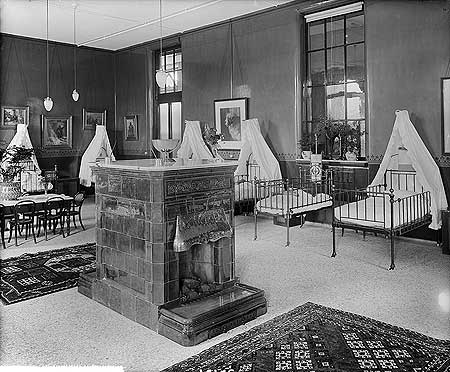
London Temperance Hospital children’s ward, 1897- complete with fireplace in the middle (image: English heritage)
*
Being so close to Euston, the hospital found itself on the front line in April 1924 when a specially chartered train carrying football supporters from Coventry en route to the Cup Final crashed with an electric train from Watford in a tunnel close to the station.

Aftermath of the 1924 Euston tunnel crash (image: London Illustrated News)
Four passengers were killed and many more injured, including the elderly driver who was trapped beneath heavy machinery for five hours.

The train driver being carted to the London Temperance Hospital after enduring a five hour rescue (image: London Illustrated News)
A less serious accident occurred later that same year when a bus crashed right outside the hospital… the driver of which, John Summers was found to be drunk! Perhaps fate was trying to tell him something…
*
In 1931, American tycoon Samuel Insull gifted the princely sum of $160,000 to the hospital allowing an extension to be created. Insull’s name can still be glimpsed on the newer building today.

Samuel Insull and the hospital wing which he kindly funded
Shortly after Insull’s donation the hospital was renamed the National Temperance Hospital. It merged with the NHS in 1948 and was formerly closed in 1982.
The building found further use however in 1986 when it was leased to the organisation, Freedom from Torture who adapted the facilities for the treatment of victims of torture from across the world.

A Turkish Kurd patient rests in the former Temperance hospital, 1990 (image: The Guardian)
Over 1,000 people were treated at the hospital, but the unit was sadly forced to close abruptly in 1990 following budget cuts.
The building limped on, finding use as a clinic and training centre, but has lain empty since 2006 and is now in a dreadful state, strangled by weeds, its windows cracked, ornate balconies rusted and basement flooded.
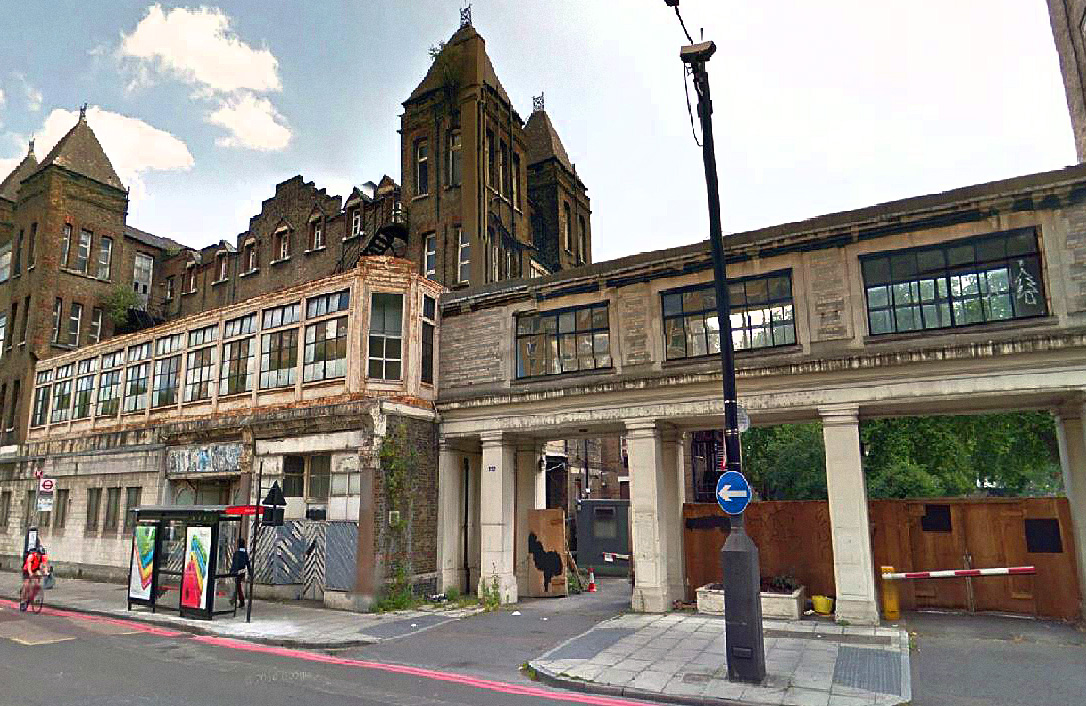
The hospital’s dilapidated entrance, as seen from Hampstead Road (image: Google)
If the planned High Speed Two rail project goes ahead it is likely the old Temperance hospital will be swept away forever.
Sneaky images of the hospital’s ruined interior, taken by an intrepid urban explorer, can be viewed here.
Cabbie’s Curios: Trafalgar Square’s American Patch
Whenever I have American tourists in my cab I always enjoy pointing out the statue of George Washington which stands outside the National Gallery on Trafalgar Square.

George Washington Statue, Trafalgar Square
Unveiled on the 30th June 1921, the statue was a kind gift from the United States and is in fact a replica, based upon Frenchman, Jean Antoine Houdon’s marble version (commissioned in the 1790s by Thomas Jefferson) which can be seen in Richmond, Virginia.

The original Washington Statue, Virginia (image: Wikipedia)
The statue shows Washington resting upon a ‘fasces’; a collection of wooden rods which the Romans employed as a symbol of authority. There are thirteen sticks in Washington’s bundle, representative of America’s original thirteen states.

The sticks which represent the thirteen original states
As the Commander In Chief during the War of Independence and of course, the first ever President of the United States, George Washington is once rumoured to have said, “I will never set foot in London again!”

Portrait of Washington by Gilbert Stuart Williamstown, painted shortly before Washington’s death
It is said that those responsible for installing Washington’s statue in London bore the legendary President’s sentiment in mind- and so arranged for a quantity of Virginian soil to be placed beneath the plinth, thus ensuring that the statue is technically on American turf…

George Washington, casting his gaze across Trafalgar Square
London’s Best Ghost Photographs
A Halloween Special

With a history dating back some two thousand years it’s hardly surprising that London is widely considered one of the planet’s most haunted cities.
So with Halloween approaching I thought now would be a good time to take a look at the top five ghostly images snapped within the capital…
1. The Queen’s House Ghosts

The Queen’s House Ghosts, 1966
Location: Queen’s House, Greenwich
Year of capture: 1966
This haunting image was taken by Reverend R.W Hardy, a retired Canadian who was visiting the Queen’s House with his wife.
Commissioned in 1616 by Anne of Denmark (wife of James I) Queen’s House was designed by pioneering architect Inigo Jones and stands beside the National Maritime Museum in Greenwich.

The Queen’s House, Greenwich (image: Wikipedia)
A major feature of Queen’s House are the Tulip Stairs; the elegance of which drew Mr and Mrs Hardy to the building.
When the photograph was taken, Reverend Hardy was simply interested in recording the architecture- no other figures were visible and whilst he framed the shot his wife checked to insure no passers-by were around to spoil the frame. The staircase was also roped off, complete with a ‘No Admittance’ sign.

The Tulip Stairs (image: Wikipedia)
Yet when Mr and Mrs Hardy had their photos developed back in Canada, the Tulip Stairs revealed a pair of mysterious, robed figures clutching the railings.

Ghosts on the Tulip Stairs…
Photographic experts have examined the original negative and found no signs of tampering.
To add to the mystery, another apparent sighting was noted more recently in May 2002 by gallery assistant Tony Anderson who, along with two other colleagues, encountered something most unusual one morning:
“Something caught my eye… I thought at first it was the girl who did the talks at weekends, then realised the woman just glided across the balcony and went through the wall, west side… the lady was dressed in a white-grey colour, old-fashioned, something like a crinoline-type dress“.
2. St Botolph’s Church Ghost
Location: St Botolph’s Without Aldgate Church, Aldgate High Street
Year of capture: 1982

St Botolph’s, Aldgate 1982… look towards the top right-hand corner
Hailing from 7th century East Anglia, Botwulf of Thorney– more commonly known as Saint Botolph– is the patron saint of travellers which is why, during the medieval era, four London churches were dedicated to his name, each built beside one of the city’s gates so that those embarking on a journey could pop in and pray for a safe trip.

Saint Botolph
Although one of St Botolph’s churches (which stood at Billingsgate) was destroyed in the Great Fire, the other three remain at Aldersgate, Bishopsgate and Aldgate.
St Botolph’s, Aldgate (officially named St Botolph’s Without Aldgate) has been rebuilt several times; the current building dates back to 1744 and was designed by George Dance the Elder.

St Botolph’s Without Aldgate (image: stbotolphs.org.uk)
A stone’s throw from Whitechapel, St Botolph’s Without Aldgate was known as the ‘Church of Prostitutes’ during the Victorian era as the women of the night used to stay close to St Botolph’s walls in order to avoid police harassment.
The church was badly damaged both in the Blitz and by a fire in 1965- of which the cause remains unknown…
The famous picture of a ghostly figure in period dress peering down from the church loft was taken by Chris Brackley in 1982.

Close up of St Botolph, Aldgate’s ghost…
At the time, Chris was aware of three other people in the church- none of whom were in the upper level. Experts examined negatives and concluded that no tampering or double exposure were evident.
3. ‘Skeletor’
Location: Hampton Court Palace
Year of capture: 2003

‘Skeletor’, Hampton Court, 2003
Nicknamed ‘Skeletor’ thanks to his resemblance to the villain from 1980s cartoon, ‘He-Man and the Masters of the Universe‘, this spook was captured on CCTV at Hampton Court, the huge palace on London’s south-western outskirts which was originally built for Cardinal Thomas Wolsey and later snapped up by Henry VIII.

Hampton Court (image: Wikipedia)
During late 2003, an alarm was activated indicating that a set of fire-doors had been opened- yet staff found the exit firmly closed and nobody in the vicinity.
But when examined the CCTV footage suggested a very different story, showing a bizarre figure quickly flinging and slamming the doors. Other cameras focused on the area behind the doors showed the building to be empty.

Close up of the mysterious Hampton Court figure
The doors opened by themselves again the next day, although no figure was present this time. Around the same time, a visitor to Hampton Court noted in the guest book that she’d glimpsed a mysterious figure…

The original ‘Skeletor’ from the 1980s cartoon, ‘He-Man’ after whom the Hampton Court ghost was named
Dr Richard Wiseman, an expert in debunking ghostly photographs is stumped by the footage “it could be the best ghost sighting ever…I haven’t seen anything that would match that at all.”
The Skeletor figure made headlines around the world, and it is reported that some staff at Hampton Court are now reluctant to work within the supposedly haunted area.
Please click below to view the CCTV footage:
4. The Bakerloo Electric Chair
Location: The Bakerloo Line, deep beneath Marylebone
Year of capture: 1983

The unsettling image snapped on the Bakerloo line in 1983
This bizarre image was clicked inside the carriage of a Bakerloo line train by Watford resident, Karen Collett whilst on a day trip to London with her family.
The sinister figure in the window behind Karen’s nephew is a disconcerting mix of the known and the unexplainable.
It is generally agreed that the ghostly figure depicts the wax effigy of Bruno Hauptmann; a convict sent to the electric chair in 1936 for his part in the kidnap and murder of Charles Lindbergh’s infant son.

Bruno Hauptmann police mug shot
When Karen took her photograph in the early 1980s, Hauptmann’s wax figure was on display in Madame Tussauds Chamber of Horrors section- a venue which the Bakerloo line passes deep beneath.

Hauptmann’s waxwork in Madame Tussauds
What is unusual is this: when the photo was taken, Karen and her family had not been to Madame Tussauds, let alone take any pictures of figures strapped in chairs. Nor does Hauptmann’s waxwork have electric blue flashes zapping out of his wrists.

The curious blue flashes…
No evidence of tampering has been found with this image and the only explanation offered so far is that the electrifying image is a poster… although the photo was taken whilst the train was speeding through a tunnel (where, of course no posters are displayed) and neither Madame Tussauds or London Underground have any record of using advertising containing such imagery.
5. The Enfield Poltergeist
Location: Green Street, Enfield
Year of capture: 1978

Janet Hodgson, apparently hurled through the air by an unknown force…
Caught by a remote camera during the early hours, the image above is one of many documenting the case of the ‘Enfield Poltergeist‘ which occurred in suburban North London during the late 1970s.
The story of the Enfield Poltergeist is deeply unsettling… either the result of true psychic malice or two supremely manipulative teenagers. A full article- written as last year’s Halloween special can be read here.






 View from the Mirror