The Cruel Capital: Two Grim Road Firsts
When not respected or used in the correct manner, roads can be very dangerous places indeed.
Driving for a career as I do, I’ve seen my fair share of road accidents; some trivial, others shockingly nasty.
In the first decade of the 21st century alone, 32,955 pedestrians, cyclists, bikers and vehicle occupants were killed on Britain’s roads, with another 3 million injured.
According to the charity, Road Peace, it is estimated that, worldwide, 4,000 people are killed on the road every single day.
Sobering figures indeed.
*
It was in 1926 that the British government first began to collate statistics on road deaths.
However, fatalities were taking place long before that, with London’s suburbs witnessing two grim firsts in the closing years of the 19th century.
The first ever fatality involving a car striking a pedestrian occurred at Crystal Palace, South London on 17th August 1896.
The unfortunate victim was 44-year-old, Mrs Bridget Driscoll from Croydon.

Bridget Driscoll (circled)
At the time of the accident, Bridget was making her way to a display of folk-dancing which was being held in Crystal Palace Park.
Stepping out onto a now vanished road called Dolphin Terrace, the unfortunate pedestrian was startled to see a car coming towards her…

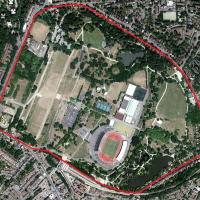
Estimated location of ‘Dolphin Terrace’, marked out in red
It must be remembered that in 1896, cars were a true novelty.
This particular car- a Roger Benz which belonged to the Anglo-French Motor Car Company was out on the road giving demonstration rides to excited passengers, keen to have a go on the new technology.

A Roger Benz
Upon seeing the pedestrian, the car’s driver, Arthur Edsel rung a bell, shouted a warning and swerved the vehicle… but it was to no avail. The bewildered Bridget was struck and she died at the scene minutes later from a head injury.
At the time of the impact, the car was travelling at 4mph… a speed which one witness described as a “tremendous pace… as fast as a good horse can gallop.”
Despite this Victorian recklessness, it was decided that Bridget’s death was accidental, the coroner stating that he hoped “such a thing would never happen again”…
*
A few years later in 1899, another unfortunate first for Britain’s road network occurred, this time at Harrow in North-West London.
This incident involved one Major James Richer and a Mr Edwin Sewell.
After a distinguished military career including service in India, Major Richer had returned to London where he landed a high-ranking job with the Army and Navy department store on Westminster’s Victoria Street (today rebuilt as a branch of House of Fraser).
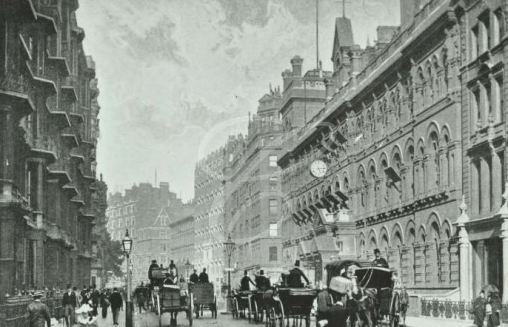
The Army & Navy Store, Victoria Street 1895 (photo copyright City of London)
On the look out to expand the department store’s ever increasing range of diverse goods, Major Richer thought it would be a good idea for the large shop to start shifting cars.
With this in mind, he turned to the Daimler motor car company who were only too happy to oblige, arranging a test drive for the 25th February 1899. The chap behind the wheel would be Mr Edwin Sewell.
*
On the day of the demonstration, the party clambered into the 8 seater vehicle and trundled all the way up to Harrow-on-the-Hill; a picturesque location which is still home to the famously exclusive school and offers a wonderful panoramic view over the capital.
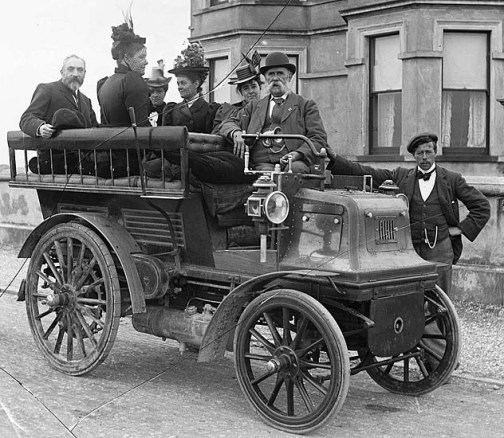
An 8-Seater Daimler from the 1890s (photo: National Library of Ireland)
Once upon the hill, the group stopped for a meal at the King’s Head Hotel… no doubt including some liquid refreshment!
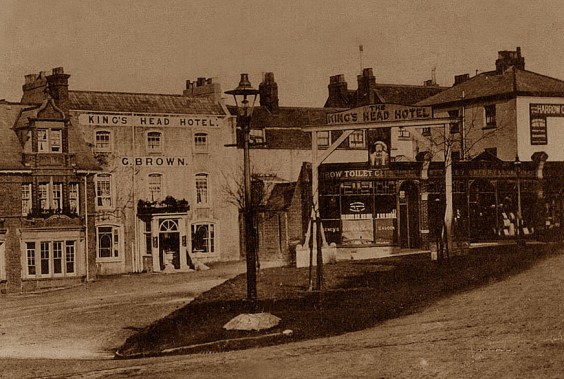
The King’s Head, Harrow-on-the-Hill (from Old UK Photos)
After their break, Edwin Sewell once again took to the wheel, heading north along Harrow-on-the-Hill’s high street, passing the many, cluttered buildings of the prestigious Harrow School.
As they approached the junction of Grove Hill and Peterborough Road where the path begins to slope downwards, disaster struck…
Gathering speed, the vintage vehicle’s speedometer began to notch up towards a hair-raising 14 mph, forcing Edwin to slam the brakes. This sudden action resulted in the collapse of a rear wheel, causing the Daimler to tip over.

Site of the UK’s first accident involving the deaths of the vehicle’s occupants

Google map showing the location of the fatal Harrow accident
Edwin Sewell was thrown from his mechanical charge and died instantly.
Major Richer was less lucky and ended up pinned beneath the hefty vehicle. He was rescued but died from his injuries a few days later on the 1st March.
This incident thus made the pair the UK’s first ever car occupants to die as the result of a road crash.
*
In 1969, a plaque was unveiled at the site of the accident to mark the event’s 70th anniversary.
Its message is simple.
‘Take Heed’…
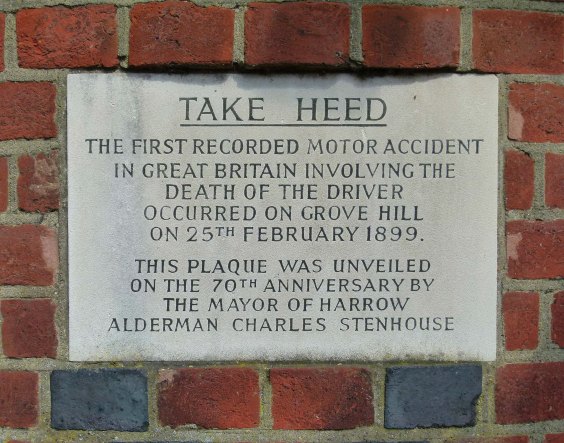
Memorial at the site of the Harrow accident
Cabbie’s Curios: An Ancient Taxi Rank
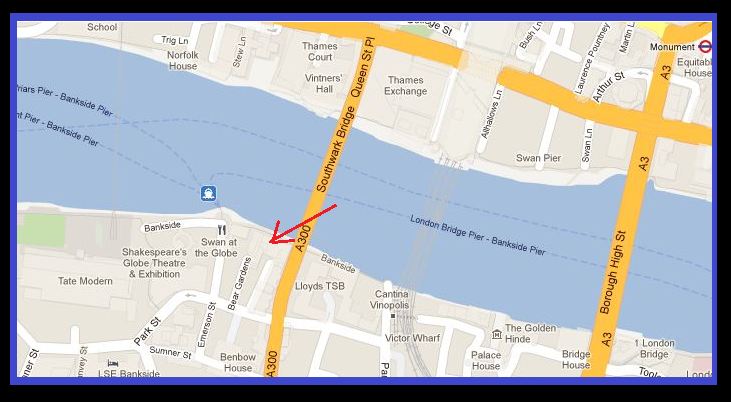
Tucked away between Southwark Bridge and Shakespeare’s Globe Theatre there sits this rather cramped looking bench:

The Ferryman’s Seat
Known as the ‘Ferryman’s Seat’, this cramped perch is essentially London’s earliest remaining example of what we’d now call a taxi rank…
*
Although the exact age of the seat is unknown, it’s most likely to have been established around the 12th or 13th century; a period when London was beginning to spread west (thanks to the consecration of Westminster Abbey in 1065) and south, where Southwark was gaining a reputation as a seedy but popular entertainment district (if you’d like to find out more about Southwark’s depravity during this era, please take a look at my previous post; Bishops, Bones and Birds…)
Despite this expansion, the city had just one river crossing- London Bridge, an inconvenient situation which remained until 1750 when Westminster Bridge was opened.
This bothersome set-up resulted in London Bridge becoming a notorious bottleneck, jammed with pedestrians, waggons and livestock, the sheer volume of which often resulted in crossing times of up to an hour.
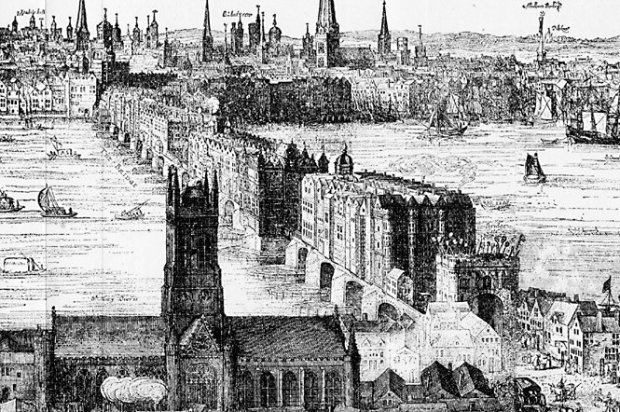
View of London Bridge in 1616. The large building in the foreground is Southwark Cathedral
As well as the excruciating journey times, there was also the multitude of mud, filth and manure to contend with… not to mention the contents of chamber pots which were lobbed out of the ramshackle houses lining the pontoon.
Taking all of this into account, it’s easy to see why traversing London Bridge was a rather unpopular task!
Those with a few pennies in their pocket therefore would often turn to the Thames Watermen…

A Thames Waterman (sadly, I couldn’t afford a proper artist, so this is my own impression!)
The Watermen were the ancestors of London’s modern-day cabbies; ferrying fares back and forth across the Thames in small boats known as ‘wherries’.

A ‘wherry’ from the Victorian era (photo: bargemen.com)
Their convenient nature was summed up in 1667 by the diarist, Samuel Pepys who described a typical commute; “by coach to the Temple, and then for speed by water thence to Whitehall.”

“I had that Samuel Pepys in the back of my wherry once!”
Rather than acquiring a knowledge of streets and roads, these early service-providers were noted for their knowledge of the water, having a sound understanding of the dangerous currents and extreme tides which characterize the Thames.
*
The worn down bench which survives today would have been used by Watermen awaiting a fare on the shores of Southwark. Punters seeking passage across the Thames would approach the Watermen and shout for “oars!” just as people today call out “taxi!”

Close up of the Ferryman’s seat
For many years, the Watermen had a reputation for being unscrupulous, often overcharging way over the expected price. In 1293 for example, it was recorded that one certain rouge, “did take from passengers unjust fares against their will.”
In 1514, Parliament stepped in to set and regulate fares- something which continues to this day with modern cabs.
Also like today, there were strict laws governing how many passengers each vehicle was permitted to hold (wherries being limited to three people at a time).
A further parallel with the present is that just like the cabbies of today, Watermen were required to wear a badge bearing their personal licence number.

A Waterman’s badge. Today, London cabbies wear a green, metal badge with their number printed across the middle in the exact same manner (photo: National Maritime Museum)
A few decades later, in 1555, the Worshipful Company of Watermen and Lightermen was established to look after the interests of those who relied upon the Thames for a living (Lightermen worked in a similar role, although they conveyed goods rather than the public).
The company are still in existence today, their grand hall being located on St Mary at Hill.
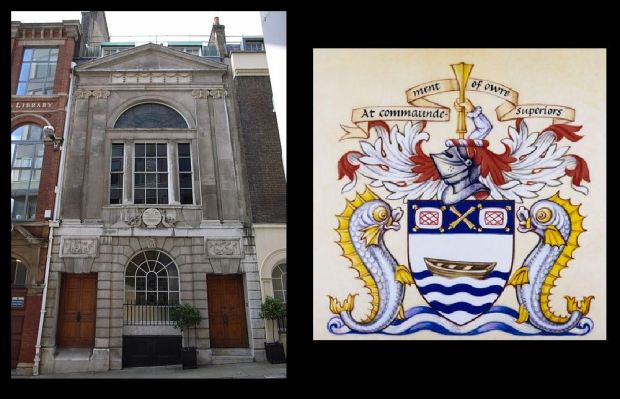
Watermen’s Hall and crest (photos: Wikipedia & National Maritime Museum)
*
Despite carrying out a job comparable to Venetian gondoliers, the Thames Water Men were far from graceful. The London Encyclopaedia describes them as being “a sturdy, rough breed with their own jargon and as quick with raillery and repartee as with their fists.”
Picking up from areas such as the lawless Southwark, with its taverns, brothels and bear-baiting pits (the alleyway upon which the Ferryman’s seat is located is actually called ‘Bear Gardens’ as a reference to this vicious spectacle), it’s no wonder that the Water Men had to toughen up.

Nowadays of course, London taxis have a Perspex screen to shield us cabbies from the rabble!
If you wish to see the historic seat for yourself, it can be found around the corner from Bankside’s, Real Greek restaurant. A map of its precise location is show below:
The Men Who Built London…
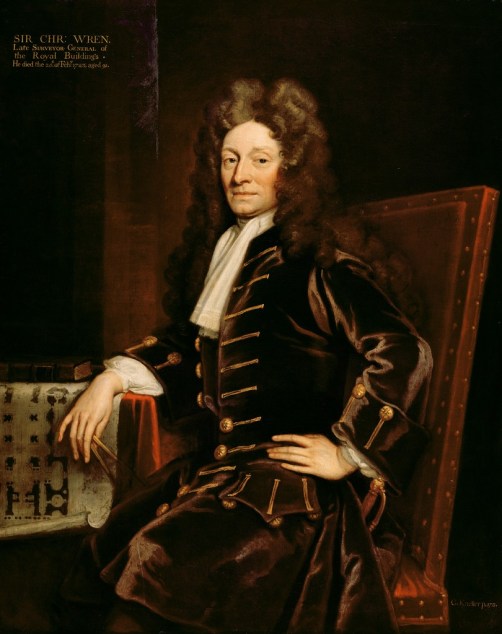
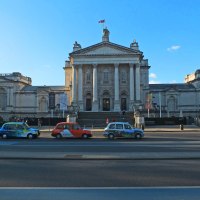
I was recently asked to guest blog a piece about London’s major architects for the wonderful, American based website, Smitten By Britain.
To read the full article, please click the image below…







 View from the Mirror