Basing Street Studios
It’s that time of year again when it becomes impossible to avoid hearing playlists of nostalgic Christmas hits, which seem to boom from every single supermarket and shopping centre across the land.
One of the most famous festive songs of course is, ‘Do They Know it’s Christmas’; written in 1984 by Bob Geldof and Midge Ure as an urgent charity single to raise money for those suffering from the appalling famine in Ethiopia; a human disaster which was brought to light in late October of that year by Michael Buerk’s shocking and deeply upsetting BBC report, in which he candidly described “the closest thing to hell on Earth…”
‘Do They Know it’s Christmas’ was put together rapidly, and recorded less than a month later, on 25th November 1984. The recording took place in London’s Notting Hill, at Sarm West Studios:
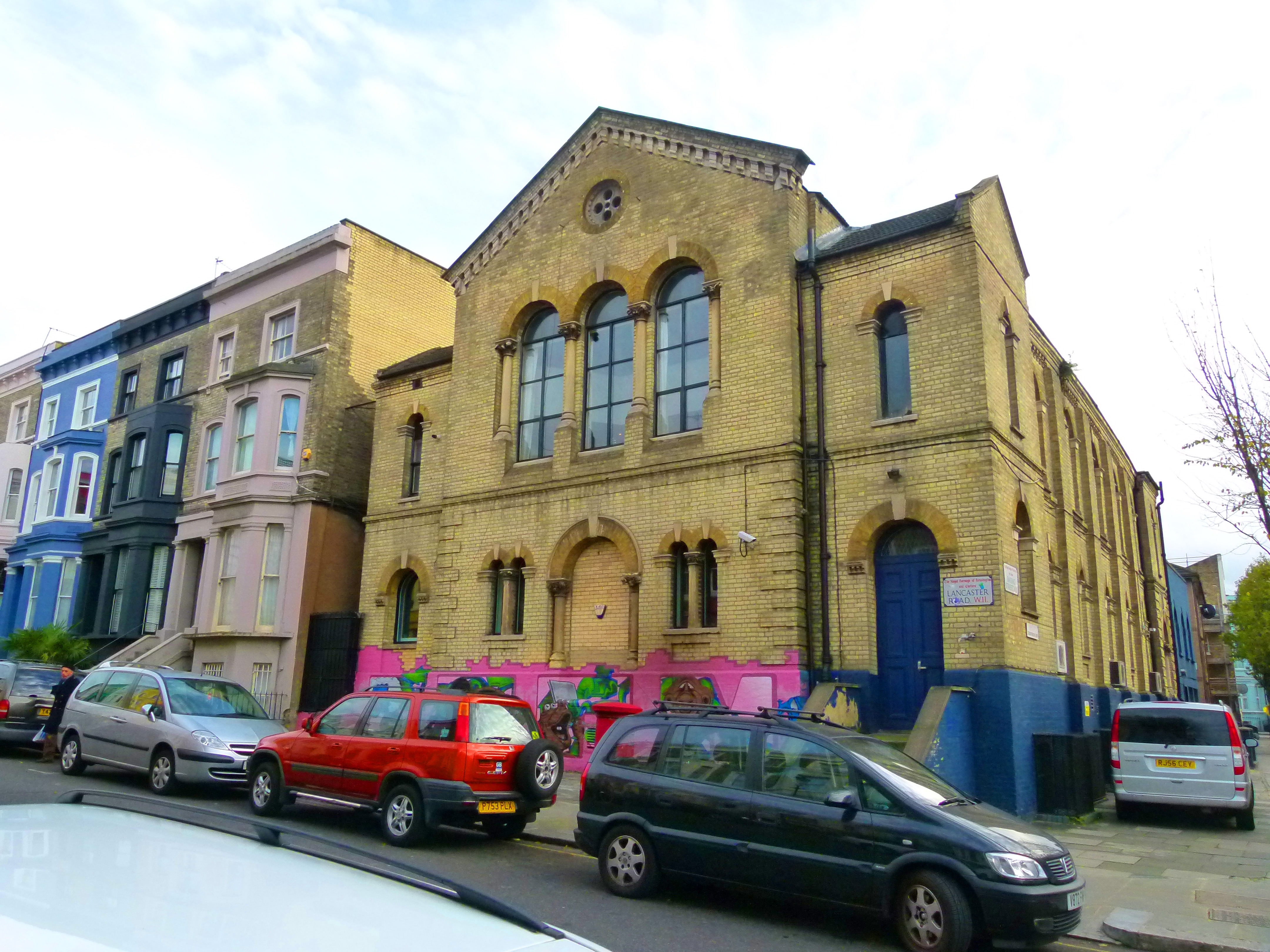
The charity single was notable for the sheer number of 1980s pop stars who participated. Phil Collins, Paul Weller, George Michael, Boy George and the groups Duran Duran, Status Quo, Spandau Ballet and Bananarama to name but a few, all descended on the West London studio, which is located on the junction of Lancaster Road and Basing Street; a quiet backwater, yet still only a 30 second walk from the trendy Portobello Road.
The song’s famous video; a kind of short documentary showing the record being put together, was shot on location at the studio.
*
The studio in which the creation of ‘Do They Know it’s Christmas’ took place has a long and interesting history.
Originally built as a church, it was later deconsecrated and used as a store room and workshop for one of London’s most famous attractions; ‘Madame Tussauds.’ With many wax-figures kept here, the building must have been a pretty creepy place late at night!
The old church then began its life as a studio in 1969 and, over the years, has been known as Basing Street Studios, Island Records Studios and (at the time ‘Do They Know it’s Christmas’ was recorded), Sarm West Studios.
A huge number of artists have recorded some of the best-known pop songs at this Notting Hill hideaway, the roster boasting names such as The Rolling Stones, Genesis, The Who, Roxy Music, John Martyn, Alicia Keys, The Pet Shop Boys, Jethro Tull, Squeeze and Madonna.
George Michael’s ‘Careless Whisper’ was cut here, as was ‘Stairway to Heaven’ by Led Zeppelin and Queen’s ‘We Are the Champions.’ In 1977, Bob Marley came here, and carried out work on his celebrated album, ‘Exodus.’
*
Since 1980, the studio has been the property of Trevor Horn who, although a prolific and much respected music producer, is perhaps best known for being the singer in New Wave group, The Buggles.
In 1979, The Buggles released the memorable single ‘Video Killed the Radio Star’ which, in August 1981, became the first song to be played on a fledgling American TV network called ‘MTV.’ The tune then featured on the group’s 1980 album, ‘The Age of Plastic’, recorded at Sarm and featuring the studio’s new owner on the cover:

Today, Sarm remains a busy recording studio popular with all manner of acts. In 2012, the premises are going to be given a comprehensive makeover, where they will be kitted out with a further two, sparkling new recording studios.
In October 2011, BBC Radio 4 broadcast a 30 minute documentary all about Sarm Studios and its influence over the years. You can listen to the programme here:
The American Connection 2
A few months ago, I was kindly invited to write a guest blog for the ‘Smitten By Britain‘ website. My article focused on the notable American links which can be found in London.
Melissa, the site’s creator, recently gave me the opportunity to write a follow-up for her.
This time, I’ve decided to look a little deeper at the American-London connection. So, if you’d like to learn a little more about Wallis Simpson, Pocahontas and the founder of ‘Selfridges’ (plus a few other notable figures), please pop over to Melissa’s wonderful site, where the article can be found:

London Can Take It
The current state of international finance has indeed created tough times.
Whilst training to be a London Cabbie, I was under the impression that the build up to Christmas (i.e November and December), would be one of the most lucrative periods of the year.
Alas, November so far has been dire.
Although not one to discuss finance, I must say that the previous week has been disastrous, and I’ve only just about managed to scrape enough to cover my costs; the profit I’ve made being barely enough to cover the price of a fish and chip supper.
To make matters worse, my local garage increased their fuel prices today… and, whenever that occurs, I have to take a pay-cut.
*
Despite living in economically harsh times, I constantly keep trying to remind myself that things go in cycles; economies dip and peak, recessions occur and ‘boom-times‘ present themselves with a fiscal bang.
As we British say; one must “keep a stiff upper lip.” Dark days may lie ahead, but a light beams at the end of the proverbial tunnel.
Bearing this in mind, and after a particularly soul-destroying Friday, I was reminded of an old film from the 1940s entitled, ‘London Can Take It’; a documentary made during the height of the London Blitz, in which Nazi bombers subjected the British Capital, and other UK cities, to an endless campaign of ferocious, night-time bombing.
This was when Londoners really did have it tough; a terrifying era which makes my current financial woes seem like chicken-feed in comparison.
I’ll let the following video; made in 1940 and narrated by the American journalist, Quentin Reynolds, speak for itself.
All that I will say is that is that it makes my current problems appear trivial… and that the resilience on display, in the face of such a disgusting fascism, only serves to make me love my City with an even greater passion… (note the scene towards the very end; a cabbie in a particularly vintage taxi, providing an Air-Raid Warden with a light for his smoke!)







 View from the Mirror