Tales from the Terminals: Euston. Part One (1830s Euston)
Continuing our journey through London’s numerous railway terminals, we now reach Euston; a station which has experienced its fair share of problems and controversy over the years.

Despite its current, modern appearance, Euston Station is in fact the oldest of London’s inter-city terminals, tracing its roots all the way back to 1837.
Euston takes its name from a small village in Suffolk, which dates back to at least 1086 when it was recorded in the Domesday Book as ‘Eustana’. In this peaceful village, you will find ‘Euston Hall’ which has been home to the Dukes of Grafton for hundreds of years.

Euston Hall, Suffolk
In 1817, Euston Square, named after the Duke of Grafton’s seat, was built. The station followed a few years later, constructed around the same area.
*
The First Euston Station
Today, trains from Euston travel great distances. Some- including the overnight Caledonian Sleeper which departs late from Euston six evenings a week- run as far as Inverness in the Scottish Highlands (a far longer journey than London’s St Pancras to Paris!)
However, the original line in and out of Euston was far shorter; first envisioned as a railway linking London to Birmingham. Christened ‘The London and Birmingham Railway’, the project did exactly what it said on the tin.
The London and Birmingham Railway, along with Euston Station, was masterminded by Robert Stephenson- son of railway pioneer, George Stephenson; the genius engineer who achieved many ground-breaking railway firsts- the most notable being the construction of the world’s first passenger line between Liverpool and Manchester, which began conveying the public in 1830.
As a young man, Robert had assisted his father in such projects, and was therefore blessed with a sound knowledge of the burgeoning Victorian technology.

George and Robert Stephenson
Planning for the railway began in the autumn of 1830; the cost of the project being estimated at £3,000,000.
When first planned, the London terminal was to be built at Chalk Farm (just outside Camden Town, and approximately 1 mile north of where the current station exists).
Some work was carried out at Chalk Farm for this purpose; in the vicinity behind what is now ‘Camden Roundhouse’ and, to this day, a siding on this site is still officially labelled as ‘The Terminus Siding’. The Roundhouse itself was built in 1847 to house a railway turntable. Today, the circular building is a popular performing arts venue.

Camden Roundhouse
In 1835, permission was granted to take the line a little further south. The Chalk Farm plans were abandoned, and the new terminal building was earmarked for a peaceful clearing called ‘Euston Grove’; a patch of land which belonged to Rhodes Farm. As mentioned earlier, the relatively new ‘Euston Square’ also existed in this locale.
*
When Euston Station first opened, it was a very simple affair with just two platforms; one for departures and one for arrivals.

Euston Station, 1837
In 1837, steam engines and railway tracks were still pretty much a novelty, and only six trains per day ran out to destinations as far flung as Harrow, Watford and Boxmoor (now part of Hemel Hempstead).
Blood, Sweat and Tears
Despite humble beginnings, it took just over a year for the railway’s builders to thrash out over a hundred more miles of track, reaching the ultimate destination of Birmingham and thus linking London to England’s second city which, in those days, was also one of the British Empire’s most important powerhouses.
The men who forged these routes were known as ‘Navvies’; a term originating from the word ‘navigator’, first given to the builders who had dug Britain’s canal network several decades before.

A Victorian depiction of a Navvy, from ‘Punch’ magazine
The Navvies, who came from all corners of the United Kingdom, were ferociously hard workers with a reputation for drinking as hard as they toiled.

The cutting at Tring (Hertfordshire) under construction in 1837
As they built the railway, the Navvies tended to form themselves into work-gangs; groups of pals who worked, lived and drank together. These gangs camped on site, their itinerant lifestyle allowing them to follow the progression of the project on which they were employed.
Conditions were harsh to say the least.
Apart from the dangerous nature of the work (‘health and safety’ in those days being non-existent), these early railway pioneers were subjected to frequent outbreaks of cholera and typhoid; diseases which struck thanks to the unsanitary conditions in which they lived and worked.
The stressful work, hard boozing and frequent gambling resulted in many quarrels and fist-fights- some so severe that, on several occasions, the army were required to ride in and put a stop to the bad behaviour!
We don’t serve your kind here…
In the area around Camden and Euston, where extensive building work on the new railway was required, the pubs in which the men drank were segregated in order to prevent nationalistic quarrels and brawling.
The four main pubs were therefore named after castles located in each part of the UK, so each worker would know where he was welcome, and where he would find his fellow countrymen.
Today, all but one of the taverns are still going strong and are well worth a visit- and don’t worry, the jingoistic divisions are no longer enforced!
Here is a quick guide to them:
The Edinboro’ Castle

As the name suggests- even though it is curiously spelt incorrectly- this pub is where the Scottish workers came for a wee dram. The pub is perched high over the railway tracks, on the main approach into Euston. Today, the Edinboro Castle is a tempting gastro pub, especially popular during the summer thanks to its large beer garden.
The Pembroke Castle

Built for the Welsh gangers, The Pembroke Castle also backs right onto the railway line, and is a short walk from Camden Roundhouse. Today, it is well known for The Hampstead Comedy Club which hosts regular stand-up evenings.
The Warwick Castle

Sadly, this pub, which provided the English builders with ale, no longer exists. Until recently, it was known as the NW1 Bar, but is now closed and appears to be undergoing renovation (for a café apparently).
The Dublin Castle
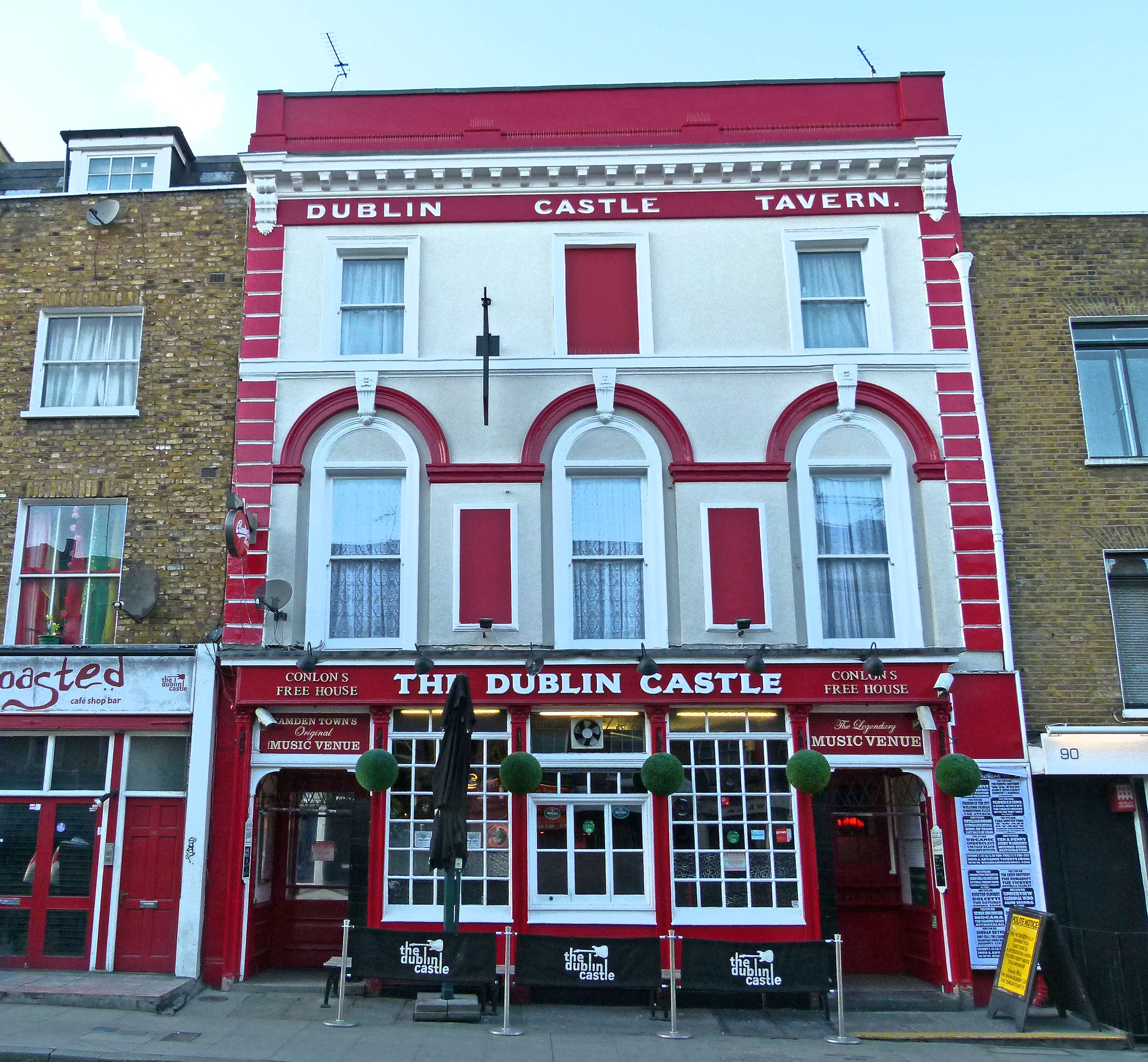
Located on Parkway in Camden, the Dublin Castle was where the Irish navvies sank their wages. Today, this pub is a legendary music venue where, over the years, bands such as Blur, Supergrass and, most famously, quintessential London group, Madness have forged their careers.
In 1979, Madness filmed the video for their song, My Girl at the Dublin Castle (the Irish gentleman seen at the beginning of the clip is Alo Conlon. He was indeed the pub’s real landlord and was a Camden legend. Alo sadly died in 2009. You can read more about him here).
*
An Uphill Struggle
Nowadays (assuming there are no leaves on the line of course), London to Birmingham by train can be achieved in about 90 minutes.
However, in 1838 when the service was first initiated, London to Birmingham on an old, puffing steam train was an ordeal which took over five hours…. five hours that is, assuming the train could actually make it out of the station!
Euston lies at the bottom of a steep incline and, for the first few years of service, this proved problematic as early steam engines simply weren’t powerful enough to haul their loads up the slope.
To overcome this obstacle, trains departing Euston therefore had to be attached to a long cable which stretched some 4,370 metres, all the way up to Camden Town.
At the Camden end, the ropes were linked to and driven by a pair of large, stationary, 60-horsepower engines; a set-up which enabled north-bound trains to be literally dragged away from Euston.

Chimneys belonging to the powerful ‘dragging’ engines which were at Camden Town
Incoming trains however used the slope to their advantage; allowing gravity, and the expertise of an experienced brakeman, to roll the carriages down to the arrivals platform. This novel process continued until 1844.
*
Victorian Grandeur
Over the next few years, building and expansion continued at Euston; the station soon being transformed into a grand and celebrated London landmark.
The most famous aspect of the burgeoning terminal was the iconic ‘Doric Arch.’

The Doric Arch… with an early rank of horse-drawn taxis!
The Doric Arch was erected in 1838, at a cost of £35,000; a stratospheric sum for the time. The architect of the centrepiece was Phillip Hardwick; an engineer who had also worked on Liverpool’s Albert Dock.
This extravagance was justified to shareholders in a report stating;
“The entrance to the London passenger station… opening immediately upon what will necessarily become the Grand Avenue for travelling between the Midland and Northern parts of the Kingdom, the directors thought that is should receive some embellishment.”
Other additions to the station included the ‘Great Hall’, which was opened in 1849. This huge hall, which doubled as Euston’s main concourse and waiting area, was a grand affair indeed.

Built in the Roman-Ionic style, the hall was long, wide and boasted a towering roof, standing 19 metres above the ground. On the hall’s opening day, a newspaper reported that Euston, “as a railway station, is without equal.”
Alongside this grandeur, two hotels were also added; The Euston, which was stately and expensive, and The Victoria, which was far cheaper; offering dormitory style accommodation.
*
Sadly, this grandiosity faded during the first half of the 20th Century.
By the 1930s, increased routes and usage had resulted in Euston becoming cramped and unfit for purpose
In response to this, the London Midland and Scottish Railway Company sought a complete rebuild of the station, and consulted Welsh architect, Percy Thomas to come up with a design. The suggested blue-print was a bold, classic affair, largely inspired by modern American architecture:

The Euston that never was… a shelved 1930s plan
However, shortly after the design was put forward, WWII broke out and the plan was dropped, never to see fruition.
*
Tragedy on the Euston Line
A few years after the War, on the morning of 8th October 1952, the tracks running into Euston witnessed the worst civilian rail crash in British history.
The disaster took place at Harrow and Wealdstone Station, 15 minutes outside of Euston and one of the London terminal’s earliest destinations when first opened in the 1830s.
The accident, which took place in heavy fog, involved three trains.
A local, commuter train, was stationary at Harrow and Wealdstone when it was struck by a speeding express; the overnight sleeper train which was travelling from Perth in Scotland, to Euston. It appeared that, due to the thick fog, the sleeper train’s driver had failed to notice a signal set at danger.
Moments after the collision, a third train; another express- this one travelling from Euston to Manchester- ploughed into the steaming wreckage.
The debris from the triple crash was scattered across all six tracks and platforms. Part of the station’s footbridge was also ripped down.
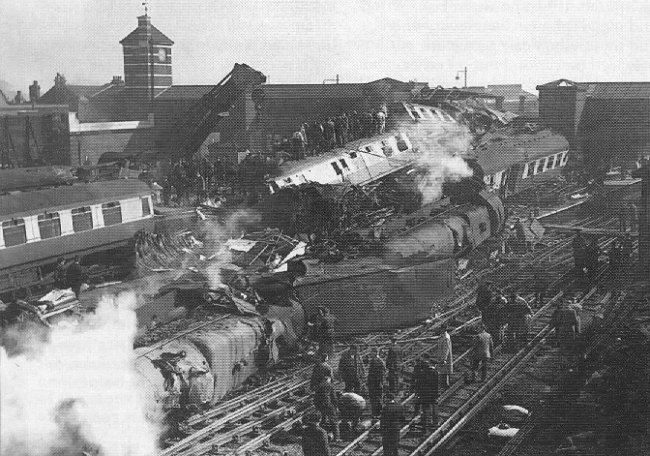
Many were trapped in the tangled mess and the resulting recovery took several days. Overall, 112 people died and 340 were badly injured. 39 of the dead were Euston station employees; killed on the local commuter train as they made their way into work.
The death toll would have been even higher had it not been for the involvement of 150 American Air Force personnel. Shortly after news of the major crash was received, the Americans (based at nearby Ruislip) rushed to the scene.
The sheer level of destruction and injury resembled a battle field, leading the Americans to instinctively set up what was essentially a field hospital.
The consequent blood and plasma transfusions, conducted in improvised conditions amongst the devastation, saved many lives.
In the unit drafted in to assist, there was only one female; a 31 year old nurse from Florida called Abbie Sweetwine.
One of the only black, American women serving in the USAF at the time, Abbie administered first aid to many, as well as providing much tea and comfort. She also had the grim task of marking patient’s heads with symbols related to how severe their injuries were and if any treatment had been received. For this, she had to improvise… and used a tube of red lipstick.
So comforting was her presence, that survivors of the disaster nicknamed Abbie the ‘Angel of Platform Six.’ Several months after the disaster, she was honoured by the Royal Variety Club and given a silver cigarette case with her nickname engraved upon it.
Abbie Sweetwine can be briefly glimpsed (around the 1:10 mark) in the following newsreel from the time:
Please click here for Part Two
Little Italy
Whenever I have the pleasure of meeting passengers from Italy in my taxi, I often joke with them that London is practically an Italian city.
The main reason for this theory of course, is that London was born way back in AD43 as ‘Londinium’; an important settlement founded by an ambitious group of Italians who, in those days, were known as The Romans.
Many of London’s grandest buildings are inspired by Italian architecture. The dome of St Paul’s Cathedral is the second largest in the world… St Peter’s Basilica in the Italian capital, Rome, is the biggest.
On Clerkenwell Road, not too far from Farringdon Station, you’ll find London’s own, St Peter’s Italian Church where, every July, the street ‘Procession of the Madonna Del Carmine’ takes place.
St Peter’s Clerkenwell can even be seen in the opening scene of the very first episode of the popular comedy-drama series, Minder which began in 1979:
London’s museums contain a wide array of Roman artefacts and Italian artworks, and the capital also harbors a substantial number of Italian restaurants and delicatessens.
‘The Shard’, near London Bridge and soon to be the tallest building in Europe, was designed by Renzo Piano… an Italian architect.
Until the 1980s, Queen Square, in Bloomsbury, was home to the Italian Hospital.
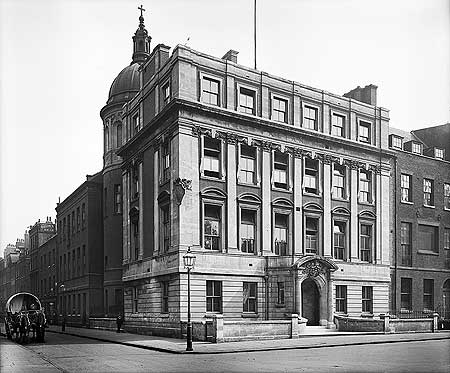
The Italian Hospital, Bloomsbury
*
London’s modern Italian community began to flourish sometime around the 1880s.
This was a time of mass migration; with political refugees and those fleeing harsh economic conditions being the main rovers. Many Italians sailed to New York during this period, but those who wished to stay a little closer to home chose London, quickly establishing a ‘Little Italy’ around the area of Clerkenwell.
With their main trades being organ-grinding, mosaic and terrazzo craftsmanship, and food-peddling, the new Italian Londoners brought a real dash of colour to the Capital. They even introduced the treat of ice cream to the masses!

‘London Life’; An Italian Organ Grinder
*
Although Italy fought alongside Britain during WWI, the nation was sadly consumed from the 1920s onwards by Benito Mussolini’s own brand of fascism. On 10th May 1940 (several months after the outbreak of WWII), the dictator declared war on Britain.
Following this grim statement, Italian businesses in London were attacked by mobs.
All Italian men living in the UK, between the ages of 16 and 60 were labelled “enemy aliens” and were consequently rounded up and interned on the Isle of Man. Many of those interned had actually been born in the UK. Others had been opponents of Mussolini, and had come to Britain seeking refuge.
A few months later, it was decided that the large number of detained Italians should be sent to camps in Canada and Australia.
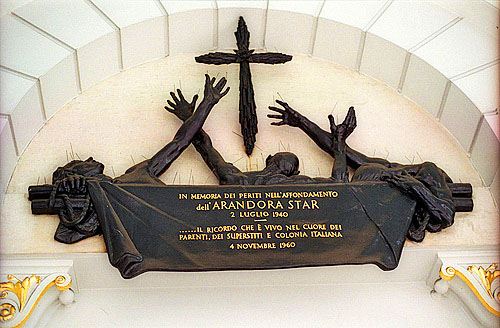
In July 1940, as part of this process, a group of 800 Italian men were put on-board a ship called The Andorra Star, which was to transport them to Canada. The ship was also carrying German internees, prisoners of war and a number of Jewish refugees.
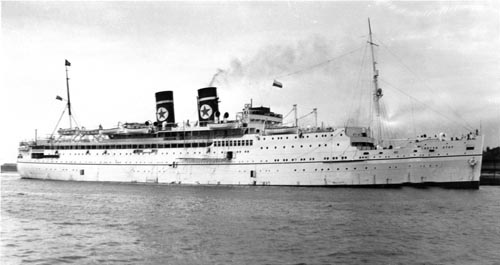
The ‘Andorra Star’ in more peaceful times…
Shortly after leaving Liverpool, The Andorra Star was torpedoed off of the Irish coast by a German submarine.
802 people lost their lives in the disaster; 471 one of whom were Italian.
Today, a memorial listing the names of all who died in this tragedy can be found outside St Peter’s Church on Clerkenwell Road.
*
After the destruction of WWII, the Italian detainees returned to London… only to find that many of their old businesses had been lost or taken over.
Despite this, the Italians began to re-establish themselves around Soho, setting up restaurants and cafes- the most famous of which was… and still is, Bar Italia.

Bar Italia was opened on Soho’s Frith Street in 1949 by Lou and Caterina Polledri, and it has been a family business ever since; a West End landmark which is open 24 hours a day, and still employs an authentic, 1950s Gaggia coffee machine.
When it first opened, the café was a vital cog in the Italian community.
As well as providing the all-important coffee, Bar Italia acted as an important meeting point, where people who had lost family members during the war could find out what had happened to their loved ones. The café was also a popular labour exchange; especially for out-of work waiters.
Another interesting point about the café is that, some twenty years before the Polledri family moved in, the apartment above the premises had been rented out by a Scottish inventor known as John Logie Baird.
Logie Baird used the flat above what is now Bar Italia as a laboratory… in which he invented and first demonstrated a new device known as television! That’s another story altogether of course, and one which I plan to cover in a future post…

*
Over the years, Bar Italia has achieved cult status.
In 1986, the popular café featured in Absolute Beginners; a film starring David Bowie (who, as a young man, was a regular at the café), about teenage life in 1950s London.
It can also be spotted in the 1992 Sade music video, Smooth Operator and there are rumours that Dave Stewart (who, in the 1980s, formed The Eurythmics with Annie Lennox), plans to write a musical about the café.

In October 1995, pop group Pulp, fronted by Jarvis Cocker, released their seminal album, Different Class, which featured hits such as Disco 2000 and the anthem, Common People.
The albumclosed with a song called, Bar Italia, all about the Soho institution.

The slow, melancholy, play-out tune was inspired by the fact that Bar Italia never closes, andis therefore a popular destination for clubbers and revellers; that hardy bunch who party through the night and suffer for it by dawn… when that point comes, good, strong coffee is needed and, as Jarvis Cocker sings; “there’s only one place we can go; it’s around the corner in Soho…”
Doctor Salter’s Daydream
Over the years, many items of precious, historical interest have been lost in London- fire, bomb-damage and the general passage of time being the main culprits.
A much rarer cause is theft.
*
I was conducting a tour earlier today, and decided to introduce my guest to my favourite London sculpture.
I first came across the statue in question whilst studying ‘The Knowledge; it was a public artwork which I hunted down mainly due to one particular examiner’s regularity in asking candidates the point of interest.
The statue was known as Doctor Salter’s Daydream.
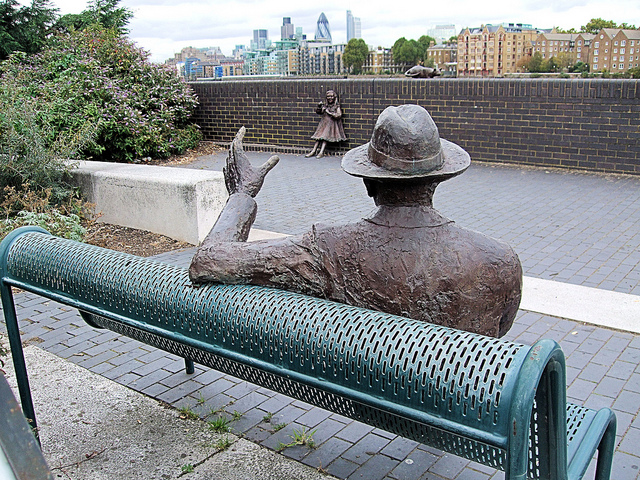
Located on Bermondsey Wall East; an isolated spot by the Thames, the statue was a fairly recent creation in London terms, having been crafted in 1991.
*
On a cold, grey winter afternoon; Tower Bridge and the Gherkin in the near distance, shrouded in a damp mist, we pulled up on Cathay Street; a quiet road opposite The Angel (a wonderful pub which is well worth the visit).
Leading my guest towards the area where the statue was based, I was dismayed to see… absolutely nothing.
A sign fastened to the bench (upon which part of the sculpture once sat) explained the situation: the piece was stolen in November 2011, and a £2,000 bounty was on offer for its safe return. A set of empty, rusty holes; once home to a pair of fastening bolts, confirmed the awful crime.
The notice also informed us that the second half of the statue; which stood by the Thames wall, had been removed and placed in storage by the local council for its own safety.
My heart sunk immediately, for I could only assume that the violation had been committed due to the current trend for pinching valuable metal and selling it for scrap.
A similar event took place in December 2011, in which an abstract Barbara Hepworth sculpture was taken from Dulwich Park having stood there since 1969.
When metal is swiped for scrap, it generally has one fate- to be melted down and re-cast.
*
In order to understand my upset at the disappearance of Dr Salter’s statue, I should explain who he was, and the great poignancy which lay behind his sculpture….
*
Doctor Alfred Salter was a Londoner; born in Greenwich in June 1873.
He came from a humble background; his parents were both deeply religious and his father worked for the Metropolitan Gas Board.
At the age of 16, the young Alfred won a scholarship to study medicine at Guy’s Hospital. He excelled in his chosen field, winning various awards and qualifying as a doctor in 1896.
As a student, Dr Salter had visited many working-class homes in the south London district of Bermondsey, and the shocking poverty he encountered encouraged him to develop a committed social conscience.
*
Shortly after becoming a doctor, Alfred met and fell in love with Ada Brown; a young woman who shared his compassionate attitude towards the poor.
In 1899, Alfred wrote a letter to his beloved Ada, saying:
“I have been paying numerous visits to derelict families… several of the homes I have just been into made me feel aghast at my helplessness and powerlessness to lift their occupants out of their existing poverty and squalor.
Oh, the cruel wickedness of our society today! To thrust down these people by means of low wages and chronic unemployment into hopeless despair, and then leave them in that condition with no organised or conscious effort to rehabilitate them. What can we do?”
Doctor Salter then went onto say:
“You and I feel we have the same mission in life… we are living and working for the same goal- to make the world, and in particular, this corner of the world, happier and holier for our joint lives.”
And so it was done; Alfred and Ada decided to devote their lives to the poverty-stricken residents of Bermondsey.
*
Whilst others with education and the means to afford decent homes in the comfortable suburbs steered well clear of such districts, Alfred and Ada moved into Bermondsey, and the kindly couple set up a practice on Jamaica Road (still a major thoroughfare today, which takes traffic towards the Rotherhithe Tunnel).
At the new practice, medicinal expertise was open to all; Dr Salter charging rock-bottom prices for his services.
It has to be remembered that this was many years before the National Health Service was established, and such a surgery was a godsend to those crippled by poverty and illness.
So successful was the enterprise that Alfred and Ada soon had to recruit more doctors in order to cope with the demand.
*
In 1902, Ada gave birth to a daughter, whom she and Alfred named Joyce, and the burgeoning family soon moved to Storks Road, Bermondsey.
Around this time, a friend called Albert Dawson noted that Dr Salter was “high-spirited and vigorous” in his work; aspects which were bolstered by Ada’s “gentle sweetness and serenity.”
*
In 1910, aged 8, Joyce Salter contracted scarlet fever and became seriously ill.
She was taken to the South Western Hospital, which stood on Landor Road in Stockwell.
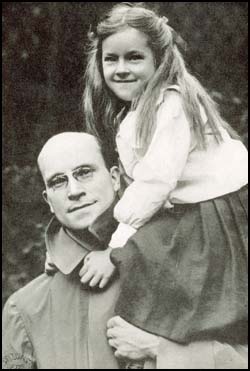
Dr Salter with his daughter, Joyce
The folk of Bermondsey- to whom Joyce’s parents had devoted their lives- had come to love the little girl so much, that they now referred to her as, “our little ray of sunshine.”
So acute was the local concern for Joyce Salter, that Alfred and Ada placed a regular bulletin on their front door, informing the distressed public of their daughter’s progress.
Tragically though, Joyce soon died.
During their lives, the commitment of Doctor Salter and his gentle wife, Ada saved many lives but the couple were sadly unable to save their own daughter.
*
The pair never truly overcame their grief.
Dr Salter kept a picture of his young daughter on the mantelpiece of his study for the remainder of his working life; a portrait which was routinely adorned with fresh flowers every single day.
*
Ada Salter died in December 1942, something which led Alfred to write, “the loneliness… is almost unbearable, but I have to learn to bear it.”
Dr Salter himself died a few years later in 1945- at Guy’s Hospital; the very same institution in which he had trained and gained the knowledge to help those whom he had devoted his life towards.
Dr Salter was buried in Peckham; at the local Friends Meeting House.
*
And so back to the statue of Dr Salter which was so cruelly stolen.
The statue, created by artist Diane Gorvin, was made in three parts.
The first- the piece which was looted- was of Dr Alfred Salter himself, and was placed upon a bench, thus allowing the public to share a seat with the great physician.
Several feet away, situated by the Thames wall, were two smaller statues representing Alfred’s daughter, Joyce and her little, pet cat.
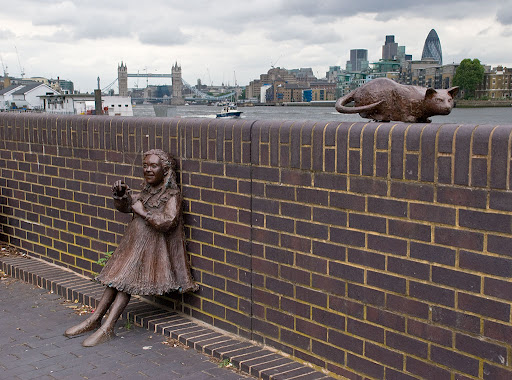
In the installation, Dr Salter was shown waving at the pair.
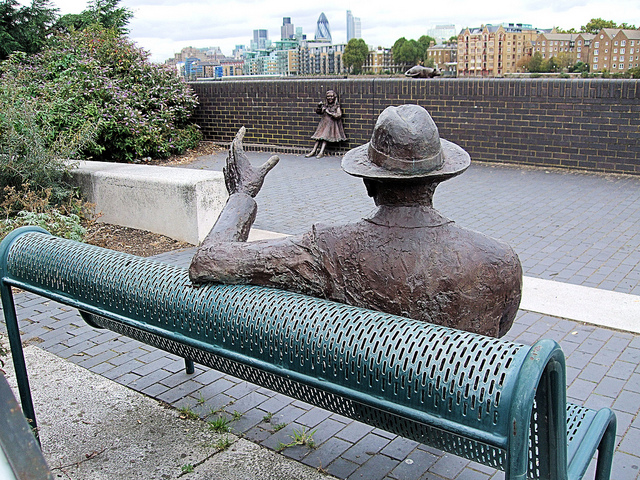
However, the doctor was also portrayed as an old man, and the images which he- and we, the public- gazed upon were effectively ghosts; “shadows of the things that have been” (to quote the ‘Ghost of Christmas Past’ from Charles Dickens’ A Christmas Carol).
The sculpture’s accompanying plaque is still in place, and describes the now missing art piece as representing, “the daydream of an old man remembering happier times when his ‘sunshine’ was still alive.”
*
How I wish that those who stole Dr Salter’s metal representation knew what life and tragedy this beautiful sculpture represented.







 View from the Mirror