Logie Baird’s London (Part Two)
Eureka!
Toiling away above Frith Street, with financial help from his family and a £200 donation from a private benefactor, John Logie Baird struggled with his invention for many months.
For his experiments, he used an old ventriloquist’s dummy’s head; a character whom he nicknamed ‘Stooky Bill’.

‘Stooky Bill’ one of the earliest stars of television!
However, try as he might, the Scottish inventor just could not get the image of his plaster prop to appear on the televisor’s wee screen.
As autumn set in, Logie Baird had been at Frith Street for almost a year, yet his invention seemed to be going nowhere.
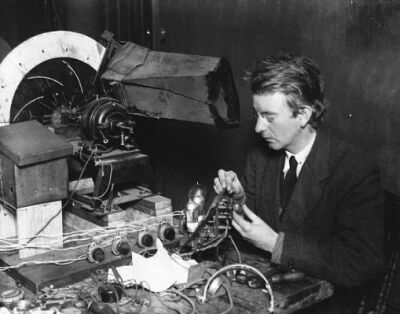
John Logie Baird, hard at work in his Frith Street lab
But then, on Friday 2nd October 1925, the breakthrough moment came:
“Funds were going down, the situation was becoming desperate and we were down to our last £30 when at last, one Friday… everything functioned properly.
The image of Stooky Bill formed itself on the screen with what appeared to me almost unbelievable clarity. I had got it! I could scarcely believe my eyes and felt myself shaking with excitement.”
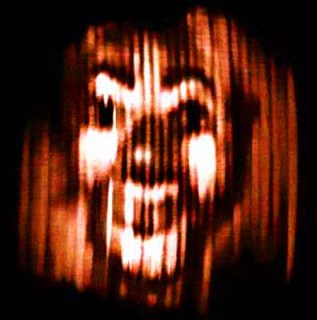
How Stooky Bill would have appeared on screen (reconstruction)
Almost immediately, Logie Baird wanted to test his televisor on a living, breathing human being.
In a sudden burst of energy, he dashed downstairs which, at that time, was home to an office belonging to a Mr Cross. Logie Baird asked if he could quickly borrow the office boy; William Taynton.
William was quickly hauled upstairs and plonked in front of the camera. Wasting no time, John Logie Baird dashed over to the viewing screen… only to find it blank.
What the inventor had failed to realise in his haste was that young William, being rather scared by the bright lights and rapidly whirring discs, had shied away from the camera!
Persuasion was on hand though- in the form of half a crown. Taking this handsome payment in hand, William Taynton diligently sat where required… as the flickering image appeared on the screen, the young lad on the other side of the camera probably didn’t realise that he was going down in history as the first ever real-life T.V star!

Reconstruction of William Taynton on the televisor’s screen
Shortly after this euphoric success, there was a knock at Logie Baird’s door… it was a group of Soho prostitutes who, having glimpsed the strange machine through a window, has mistaken it for a telescope- and demanded to know why the Scotsman was spying on them!
Going Live
Within a few months, John Logie Baird was ready to demonstrate his televisor to the public.
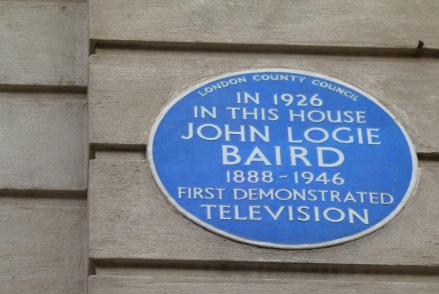
On the 26th January 1926, at Frith Street, he gave the first showing to a group of guests from the Royal Institution. The demo, also beamed to guests at Olympia and at premises on Savoy Hill (behind the Savoy Hotel), included transmitted images of Stooky Bill and also of a real person.
Today, a blue plaque at Frith Street commemorates this event:
Although the showing was a success, one critic from the Royal Institution, clearly not grasping the ground-breaking nature of the event he’d just witnessed, felt compelled to ask; “well… what’s the good of it? What useful purpose will it serve?”

The first ever photo of a broadcasted image. Taken c. 1926, the person being filmed was Oliver Hutchinson; Logie Baird’s business partner
Following the first public demonstration, ‘Baird Television Limited’ was established, its headquarters moving a short distance from Frith Street to 133 Long Acre in Covent Garden.
Further experiments were carried out at the new studio, each more ambitious than the last.
In 1927 John Logie Baird successfully broadcast test images to his native Scotland; the receiving end being a televisor set based at Glasgow’s Grand Central Hotel.
The following year, he also succeeded in beaming grainy images (of a man and woman sitting in his studio) across the Atlantic to New York.
Experiments with colour and even 3D were also conducted.
With these advancements, John Logie Baird knew that the time was ready to begin broadcasting to the public.
In those days, the only broadcaster in the UK was the British Broadcasting Corporation; itself in its infancy (and, in those days of course, a radio station).
Logie Baird approached the BBC’s director, John Reith and, after some persuasion, managed to get the corporation to give the new technology a try.
Logie Baird had built a transmitter on the roof of his Long Acre premises, but he soon realised it would be too weak for his ambitions. He therefore needed to borrow one of the BBC’s aerials- known as ‘2LO’ which was located on the roof of Selfridges.
However, 2LO’s primary use was for radio broadcasts, so the BBC only granted Baird Broadcasting access to the transmitter between 11pm and mid-morning next day, when wireless broadcasting was off-air.
Selfridges continued to play an important role in the dawn of television when the first Baird ‘Televisor’ sets went on sale at the department store.

A ‘Baird Televisor’; one of the first ever television sets
With prices for the new equipment ranging from £20 to £150 (equivalent at the time to the price of a motor-car), only a handful of wealthy people in the London area were able to receive the new-fangled programmes.
In fact, for the very first broadcast, Logie Baird himself estimated that only 30 people were tuned in! One of this select group was the Prime Minister himself; Ramsay McDonald, who watched the historical moment from 10 Downing Street on a Televisor which had been presented as a gift from the Scottish inventor.
The very first programme was broadcast from Covent Garden’s Long Acre on the morning of 30th September 1929.

‘Baird Television’ title card
Due to transmitter limitations, the sound and vision had to be broadcast separately in two minute bursts; so the viewer would first see a silent, flickering image with the crackling sound following shortly afterwards. This split process would continue for the first six months of programming.
The very first televisual broadcast opened with a speech by Sydney Moseley; Logie Baird’s business manager and one of his most supportive friends.
The tiny audience would have seen Sydney, silent but mouthing words… followed two minutes later by the vocal segment:
“Ladies and Gentlemen: you are about to witness the first official test of television in this country from the studio of the Baird Television Development Company and transmitted from 2LO; the London Station of the British Broadcasting Corporation.”
A few more short speeches followed, and then the morning’s entertainment began. The schedule ran as follows:
11.16am. Sydney Howard: televised for two minutes.
11.18am. Sydney Howard: Comedy monologue.
11.20am. Miss Lulu Stanley: televised for two minutes.
11.22am. Miss Lulu Stanley: sang ‘He’s tall, and dark, and handsome’ followed by ‘Grandma’s proverbs.’
11.24am. Miss C King: televised for two minutes
11.26am. Miss C King sang ‘Mighty like a rose.’
Morning television in those days was clearly far more sophisticated than the dross on offer today!

Plaque on Long Acre commemorating the first ever televisual broadcast
On the 14th July 1930, Baird Television were finally able to broadcast the sound and vision together for the first time. The vehicle used for this demonstration was a short play called ‘The Man With the Flower in His Mouth’, which was written in 1922 by Italian playwright, Luigi Pirandello.
Chosen for its simplicity and small cast (considerations which were driven by the tiny televisor screen), the short play is essentially a philosophical conversation in a café between a businessman who has just missed his train and another fellow who is suffering from a cancerous throat.
A preview in the Times described the drama as being “a forbidding study of emotion in the shadow of death.”
The actors, who performed the play live at Long Acre, had to have their faces painted yellow, with navy blue shading around the eyes and nose. This bizarre makeup was intended to enhance their image on the shimmering receiving screens, which glowed a characteristic reddish-orange colour.
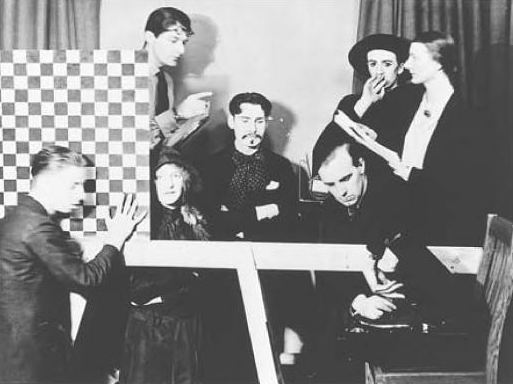
‘The Man With the Flower in His Mouth’ being broadcast live from the Covent Garden studio on Long Acre, 1930
In 1967, The Man with the Flower in His Mouth was painstakingly remade in an attempt to emulate what audiences back in 1930 would have seen. The recreation was supervised by the play’s original producer, and also includes the original artwork and gramophone music.
If you’re wondering what the box had to offer in those days, the whole play can be viewed below:
By late 1930, Baird Television’s Covent Garden studio was beaming 30 minutes of programmes in the morning; Monday to Friday and 30 minutes at midnight on Tuesdays and Fridays.
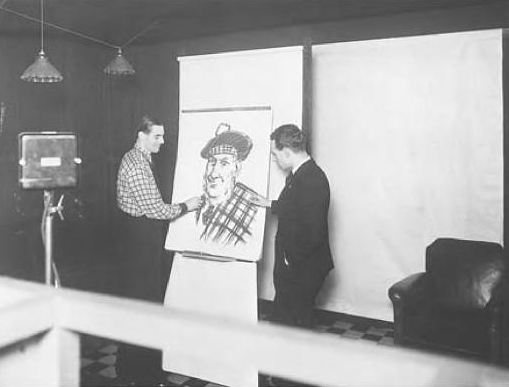
An early art show; a cartoonist draws live for the camera at Baird Studios, 1930
South of the River
In July 1933, Baird Television left Covent Garden and moved to Sydenham in deepest South London.
Here, at the Crystal Palace complex, a new studio was established, with the antenna attached to one of the glass palace’s towers.

Crystal Palace in 1934, one year after Baird Television moved in
John Logie Baird also made his own personal home in the area, on Crescent Wood Road, a short walk from the Crystal Palace studio.

John Logie Baird’s Sydenham House & Blue Plaque
However, the hard luck which had plagued John in his previous business ventures was about to come back and haunt him…
On 30th November 1936, the Crystal Palace burnt down, taking Baird Television studios with it.
Two weeks later, before the ashes had even cooled, the BBC- who were now really starting to get into the T.V thing- announced that they were scrapping Baird’s system in favour of more modern equipment which had been developed by Marconi-EMI.
The BBC moved their T.V wing to Alexandra Palace; the North London twin of the now vanished Crystal Palace.
Television continued to remain an ultra-expensive luxury and, on the 1st September 1939, following a Mickey Mouse cartoon, test card and a preview of up and coming programmes, the service suddenly went off air; closed down by the government in anticipation of the World War which was about to erupt; the fear being that enemy aircraft would use the television signals to hone in on their targets.
The first few years of television had come to an end, and the medium would not be seen again until 1946.
*
Despite the cruel setbacks, John Logie Baird’s appetite for invention remained as strong as ever.
The ingenious Scotsman went onto experiment with high definition colour, large-screen televisions, video recording devices and even made early ventures into infra-red. It is believed that, during WWII, Logie Baird carried out important work on the new radar network.
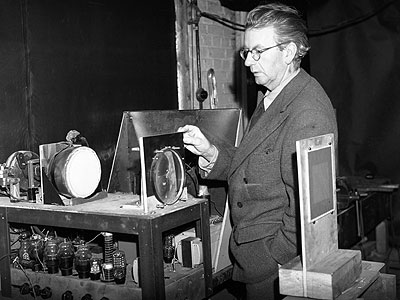
John Logie Baird hard at work in Sydenham
John Logie Baird died at the age of 57 on June 14th 1946.
This final clip, from 1937, shows the great innovator with the machine he forged in his Frith Street attic. Today, a working model of his revolutionary device can be still be viewed at the Science Museum in South Kensington.
Tales From the Terminals: St Pancras (Part One)
Tales From the Terminals now moves onto one of London’s most celebrated examples of architecture- St Pancras Station… or, as it’s been known since 2007, St Pancras International.
A Roman Martyr
It is all too easy to confuse ‘Pancras’ with the word, ‘Pancreas’… i.e., the gland organ which forms part of the digestive system!
In fact, St Pancras takes its name from a derivation of ‘Pancratius’; a 3rd century martyr who was born in Phrygia (now part of modern-day Turkey).
Orphaned at an early age, Pancratius was taken under the wing of his uncle, Dionysius.
The pair decided to travel to Rome and, whilst there, they converted to Christianity; a dangerous thing to do in those days.
Even more daring, Pancratius and Dionysius publically proclaimed their faith… an act of bravery which quickly led to their arrest. Dionysius died in jail and Pancratius- aged only 14- was beheaded for his beliefs.
The two early Christians later gained martyrdom and were made into saints.

Saint Pancratius
It is believed that a church dedicated to St Pancras the Martyr has existed in the vicinity where the railway station now stands since the 7th century.
Today, there are two churches in the area; St Pancras Old Church (which sits a short distance behind the station) and the later St Pancras Church; a far grander affair which was built in 1822 and can be found on Euston Road
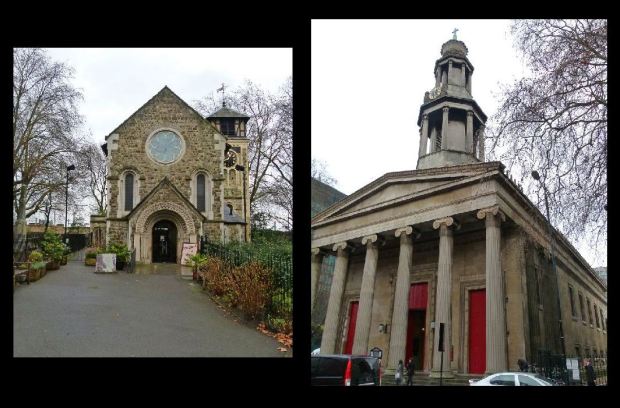
St Pancras Old and New Churches
*
A Station is born
St Pancras Station dates back to 1863, when the Midland Railway decided to construct a terminal of their own. Up until that point, they’d shared space with The Great Northern Railway; based next door at Kings Cross Station.
With their plans for a new station in mind, bosses from the Midland Railway purchased land in the area known as ‘Agar Town’ which came under the parish of Old St Pancras church.
The land upon which Agar Town stood had once been open fields, belonging to wealthy landowner, William Agar.
When William Agar died in 1838, his widow began to lease the land at cheap rates… as a result, Agar Town- essentially a shoddily built shanty community, began to spring up.

Map of Agar Town
The settlement was horrendously poor and, by the early 1860s, Agar Town was considered to be one of the worst slums in London. In 1851, Charles Dickens paid a visit to the area, describing it as:
“A complete bog of mud and filth with deep cart-ruts, wretched hovels, the doors blocked up with mud, heaps of ashes, oyster shells and decayed vegetables. The stench on a rainy morning is enough to knock down a bullock.”

Disruption
When construction of St Pancras Station and its sprouting rail tracks began, Agar Town, being inconveniently in the way, required complete flattening.
Although the landlady received a handsome £19,500 through the sale of the land, the residents of Agar Town- of whom there were approximately 5,000- were unceremoniously kicked out with no compensation offered.
The demolition of St Luke’s- an Agar Town church- was also required but, being rather pious people, the Victorians re-built the place of worship a little further north in Kentish Town at a cost of £12,000. The relocated church still stands today, and can be found on Osney Crescent.

St Luke’s Church, Kentish Town (from Google Street View)
The disruption didn’t end there though.
Old St Pancras Church also lay very close to the worksite, and the need to dig a tunnel near the new station caused major disruption to the church’s graveyard.
The cemetery belonging to Old St Pancras was the final resting place for 1,000s of people (many of whom had been refugees. who had fled to London during the French Revolution) and, although it had been closed to burials for some 30 years, there was public outcry at the railway’s interference with the burial ground.
Many of the bodies had to be exhumed and re-buried but, rather than giving the corpses fresh plots, the authorities simply dug a 40 ft. deep pit, into which 7,000 cadavers were hastily placed.
One of the officials employed to oversee this morbid task was none other than Thomas Hardy- a young apprentice architect who later went onto become one of Britain’s most celebrated authors; penning novels such as The Mayor of Casterbridge, Jude the Obscure and Tess of the d’Urbervilles.

Thomas Hardy
In 1882, nearly 20 years after taking part in the St Pancras dig, Hardy summed up the grisly mass grave in his poem, The Levelled Churchyard; with one of the verses reading thus:
“We late lamented, resting here
Are mixed to human jam,
And each to each exclaims in fear
I know not which I am!”
Today, the burial pit has been built over and, perhaps quite appropriately, St Pancras Coroner’s Court now sits on top of it.

St Pancras Coroners Court (from Google Street View)
A number of tombstones from the torn up graves were retained by the Victorian planners, and grouped around a tree. This memorial of sorts is known as ‘Hardy’s Tree’ after the famous author who unhappily took part in the desecration.
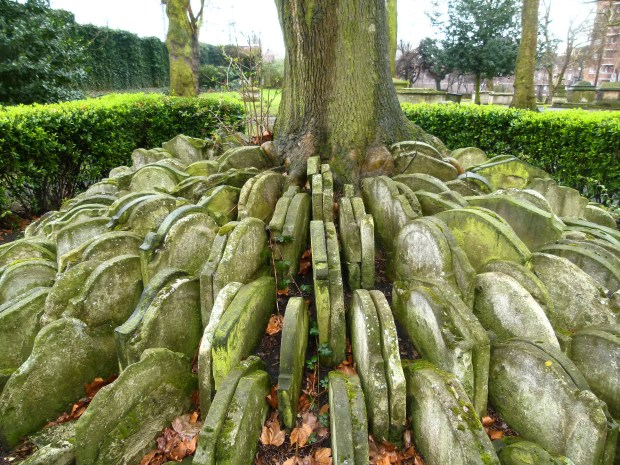
Hardy’s Tree
*
St Pancras Station Opens
By 1868, St Pancras Station was ready for business.
The new station was a true marvel of Victorian engineering, frequently drawing comparisons to a cathedral.
The Midland Railway’s directors had clearly done their homework; taking note of earlier stations and incorporating the best bits from them into their own terminal… the grandeur of old Euston, the soaring iron and glass roof at Paddington and the practicality of Kings Cross all played their part in influencing St Pancras.
The mighty roof of the train shed was designed by William Henry Barlow, a seasoned engineer who had been involved in many projects- including the task of completing Bristol’s Clifton Suspension Bridge following Isambard Kingdom Brunel’s death.
Barlow’s roof is 210 metres long, 73 metres wide and sits 30.5 metres above the rails; all supported by hefty iron ribs weighing 55 tonnes a piece.

The roof under construction, 1864
When it first opened, this breath-taking canopy boasted two records; being both the largest single span construction and the largest enclosed space in the world.

Believe it or not, St Pancras station owes much of its immense size to… beer!
When the station was built during the 1860s, ale brewing was big business.
One of the major centres of this industry was the midland town of Burton-on-Trent, which had forged close links with the Midland Railway.
So huge was the industry in Burton-on-Trent, that the town’s brewers built their own, private railway specifically for moving their product around.

‘The Crossing’ (1961) by Lowry, depicts Burton’s private beer railway
As part of this system, the brewers secured storage space at St Pancras; the new station being specifically designed to incorporate a vast network of cellars for the purpose. At its height, the vaults beneath St Pancras were able to store over a million barrels of booze, most of which went onto be shipped all over the world.
Gothic Splendour
St Pancras’s main façade, which faces the Euston Road, is in fact a hotel; the Midland Grand (now called the St Pancras Renaissance).
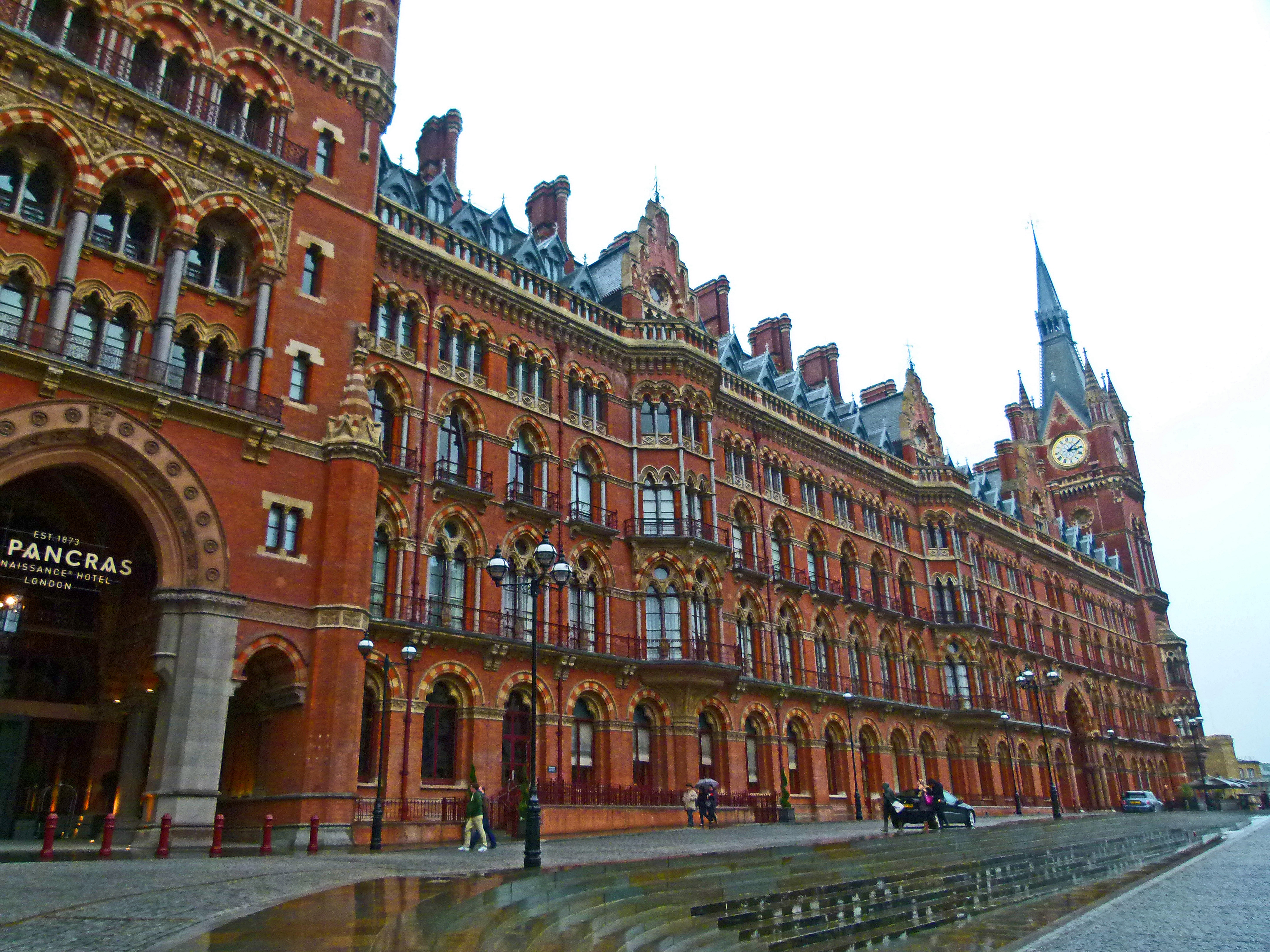
It was built between 1868-1872, following a competition held by the Midland Railway to find an architect for the ego-boosting project.
The contest was won by Sir George Gilbert Scott (father of Giles Gilbert Scott who followed in his father’s footsteps; becoming an architect and designing the iconic red telephone box, Battersea Power Station and the Bankside Power Station which now houses Tate Modern).

Sir George Gilbert Scott
It is perhaps surprising that Scott’s design proved victorious- because, out of the 11 plans entered, his was by far the most expensive!
However, it was no secret that the Midland Railway were out to impress. They wanted their new combined hotel-station frontage to be the biggest and boldest in the British Empire. Their wallets were deep and cost was no object.
*
Much of Scott’s soaring gothic design for the Midland Grand Hotel was actually based upon plans which he’d originally drawn up for Government offices in Whitehall.
However, unlike the board of the Great Midland Railway, parliament were not willing to bankroll such frivolity! The government’s rejection hurt Scott, but the opportunity to carry out similar work at St Pancras eased his upset somewhat. As he later recalled:
“It is often spoken of to me as [St Pancras being] the finest building in London; my own belief is that it is possibly too good for its purpose, but having being disappointed through Lord Palmerston of my ardent hope of carrying out my style in the Government offices…I was glad to be able to erect one building in that style in London.”
*
When the Midland Grand opened its doors in 1873, it was with the boast that the hotel was “the most perfect in every possible respect in the world”, and it did indeed remain at the height of luxury for the remainder of the century.
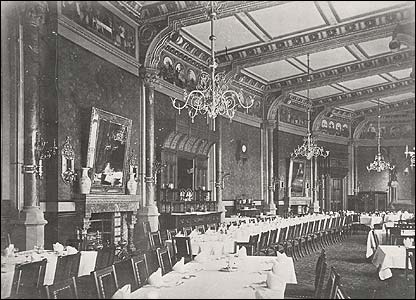
The Grand Midland’s Dining Room
The hotel was a hive of mod-cons, including flushing toilets, electric bells, hydraulic lifts (or ‘ascending chambers’ as the Victorians liked to call them) and Britain’s first revolving door.
In 1896, a ladies’ only smoking room was opened at the hotel… this liberal move proved rather scandalous at the time, as giving the ok for women to have a puff in public just wasn’t the done thing!
Beds were priced at 14 shillings a night; over £60 in today’s money. Arthur Conan Doyle (creator of Sherlock Holmes), was bowled over by the hotel, commenting that “nothing in fact or fiction can match this wonder…”
*
Decline
By the 1930s, the opulent hotel had become sadly outdated.
The main reason for its faded eminence was that the hotel had been constructed in an era when en-suite bathrooms were unheard of.
As the twentieth century wore on, concerting guests at the Midland Grand were still having to ask for jugs of hot water to be brought to their room; a once gentlemanly custom which had rapidly become uncomfortably outdated.
The management introduced more gimmicks- namely an in-house orchestra and Moroccan style coffee room- in an attempt to boost the flagging numbers, but they were fighting a losing battle.
Unable to incorporate the required plumbing or space for en-suites, the hotel closed down in 1935.
The hotel building was later renamed ‘St Pancras Chambers’, and was converted into office space for use by British Rail.
Despite the hotel’s closure, St Pancras Station continued to play its part as an important railway terminal.
During WWII, the station was a major departure point for both troops marching off to war and for 1,000s of London youngsters being evacuated to the safety of the countryside.
In August 1942, the station was heavily bombed; badly damaging tracks, rolling stock and the once magnificent roof. But, in the typical wartime spirit, it did not take long for railway workers to get St Pancras up and running again.

St Pancras war damage, August 1942
*
St Pancras Station’s greatest fight
By the 1960s, a threat far greater than a lack of plumbing or fascist bombing was presenting itself to St Pancras station…
Whilst the 1960s gave much to the world in terms of music, fashion and social advancements, its record on architecture leaves much to be desired.
As mentioned in a previous post, the old, Victorian Euston station, along with its much celebrated Doric Arch, had been smashed to pieces in the early 1960s.
As work got under way building the new, somewhat boxy Euston, nearby St Pancras was the next grand railway terminal to swing into the developers’ sights….
Planners from the mid to late 20th century were a ruthless, unsentimental bunch, with little time or appreciation for Victorian architecture.
St Pancras Station was regarded in such circles as a vulgar, over-blown building from a bygone era which warranted wiping out.
As with Euston Station, it was agreed that the old St Pancras should be demolished and replaced with structures of the utmost modernity.
The plan envisioned sweeping away Scott and Barlow’s masterpiece and plonking a towering office block, leisure centre and social housing on the vacated site; a development that would not have looked out of place in Soviet Moscow.
As part of this plan, the routes running into St Pancras would have been re-directed to next door’s Kings Cross, also earmarked for a major overhaul.
Thankfully, St Pancras found a saviour in the form of Sir John Betjeman, the noted writer, broadcaster and poet laureate from 1972 to 1984.
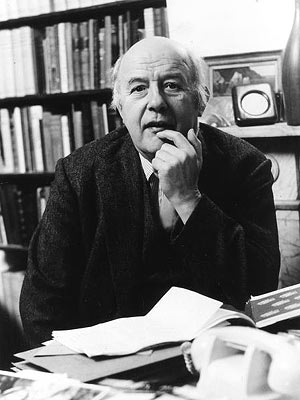
Sir John Betjeman
Born in Highgate, North London in 1906, Sir John Betjeman was a strong advocate of Victorian architecture and its preservation; a passion which, in the 1960s, seemed to be something of a lost cause.
Sir Betjeman had campaigned to save Euston and the Doric Arch in the first half of the decade but, despite popular support, had sadly failed.
In 1966, a British Rail employee who shared Betjeman’s love of Victorian architecture, leaked the proposed but hushed St Pancras demolition plans to the writer. The act of kindness from this mysterious benefactor granted the writer and his contacts at the Victorian Society valuable time to mount a large campaign to rescue the station from its fate.
Sir Betjeman branded the demolition plans a “criminal folly” and the campaign he fronted involved the constant insistence to bureaucrats that the station had a special place within the hearts of Londoners.
As the poet romantically summed up;
“What the Londoner sees in his mind’s eye is that cluster of towers and pinnacles seen from Pentonville Hill and outlined against a foggy sunset, and the great arc of Barlow’s train shed gaping to devour incoming engines, and the sudden burst of exuberant Gothic of the hotel seen from gloomy Judd Street…”

St Pancras seen from Pentonville Road
Unlike the earlier Euston campaign, the attempt to rescue St Pancras was successful… but it was a still a close call…
The station was saved when the government bowed to pressure and blessed St Pancras with a ‘Grade 1’ listing, thus making it untouchable.
This rating was decreed on the 2nd November 1967… a mere 10 days before demolition was due to begin…
Please click here for Part Two
Tales From the Terminals: St Pancras (Part Two)
Smashed!
Although the shell of St Pancras had been saved, the interior was in a rather sorry state. It had been deteriorating for some time, and would continue to do so for several decades.
An effective indicator of this decaying state could be found in the form of the station’s grand clock.
Perched high over the station’s entrance and facing the platforms, the mighty clock- which was 18ft in diameter- had informed generations of travellers of the all-important time, as they hurried to and from their trains.
The clock had been crafted by ‘Dent of London‘ ; major purveyor of luxury timepieces whose craftsmen had also provided the faces for Parliament’s clock tower (aka Big Ben), as well as equipment for Charles Darwin and David Livingstone.
By the late 1970s, the clock was peering out over a dark, smelly station; the once grand timekeeper now nothing more than a magnet for cobwebs, pigeons and bird muck.
In 1978 and in need of cash, wheeler-dealers at British Rail agreed to flog the St Pancras clock to an American collector.
The sum paid was huge- £250,000… so it must have been quite shock when, in the process of taking the clock down, the workmen fumbled their task… and dropped the valuable timepiece!
The clock plummeted to the ground, smashed to smithereens and lost its high price tag in a nanosecond-an expensive catastrophe which bears quite a similarity to one of the most famous scenes from the legendary comedy, Only Fools and Horses!….
In their shattered state, the clock pieces were now deemed to be worth only £25… and a new buyer came forward- Roland Hoggard, a train driver who was shortly due to retire.
After transporting the jigsawed clock back to his home in Nottinghamshire (a task which took over a week), Roland managed to painstakingly piece the 18ft wide clock back together, attaching his labour of love to the side of a barn on his farmland.

Roland Hoggard with his masterfully repaired, original St Pancras clock
*
The photo below depicts St Pancras in 1984 (note the obvious absence of the clock, which used to hang in the middle of the rear arch) and shows just how gloomy and dilapidated the terminal had become.
Although it had survived demolition 17 years before, the station looked positively ready to crumble and rot by its own accord.

St Pancras Station, 1984
To make matters worse, towards the end of the 1980s, the St Pancras Chambers offices (which had been converted from the old Midland Hotel) were deemed a death-trap by inspectors, who refused to grant the complex a fire safety certificate.
As a result, the offices were forced to shut down, thus transforming a vast slice of St Pancras into abandoned dereliction.
*
Renaissance
By the late 1990s, St Pancras Station was in an appalling state.
I personally remember the station around that time as being most grotty, with grimy, sticky floors and a strong odour hanging in the air; a mixture of rotting food and smoky diesel fumes.
The station was dark and forlorn, mainly because the once gleaming roof was now a patchwork of botched repairs and glass panels which had been coated in paint.
It was also surprisingly quiet, as the level of railway traffic in and out of the terminal had been steadily declining over the years.
In short, the station was a shadow of its former self; a grimy, cavernous mausoleum to a long bygone era.
However, St Pancras was about to be reborn…
At the turn of the 21st century, it was decided that St Pancras should become the new terminal for Eurostar services to and from Paris and Brussels.
At the time, the station employed for this purpose was Waterloo; a role which the station south of the Thames had been playing since the Channel Tunnel opened in 1994.
However, the line connecting Waterloo to the coast was old, twisty and torturously slow; especially embarrassing as the French tracks on the other side of the channel were sleek and hair-raisingly fast.
A new, high speed line was needed for the UK leg; one which would make the journey to the Continent as fast and efficient as possible.
Labelled ‘High Speed One’, the new route was designated to link up with St Pancras.
In line with this new project, the dilapidated terminal was expanded and given an unprecedented makeover; polishing it to a standard which exceeded all expectations and made it befitting of a major European transport hub.
The re-build took place between 2004-2007 and cost £800 million.
*

Branded as St Pancras International, the once chronically neglected station is now one of the largest railway terminals in Europe; a beautiful building, bursting with light and energy, transforming the station from crumbling backwater into what is now one of London’s most celebrated landmarks.
The former Midland Grand Hotel, which stretches across the front of the station, has also been given a new lease of life

Main entrance to the St Pancras Renaissance Hotel
Fittingly renamed the ‘St Pancras Renaissance’, the once long empty, rotting rooms have been breathtakingly restored.
Today, the hotel is a five star affair; one of London’s most luxurious destinations- and with prices to match… although prices start at £205 per night, you can always go for the ‘Royal Suite’- a 3 bedroomed apartment which will set you back a cool £10,000 per night….

Part of the Royal Suite
The new hotel contains a number of bars and restaurants- including of course the ‘Hansom Lounge’, a glamorous meeting place which incorporates the station’s old, horse-drawn taxi rank (you can find us modern cabbies ranked up around the corner; on Midland Road).
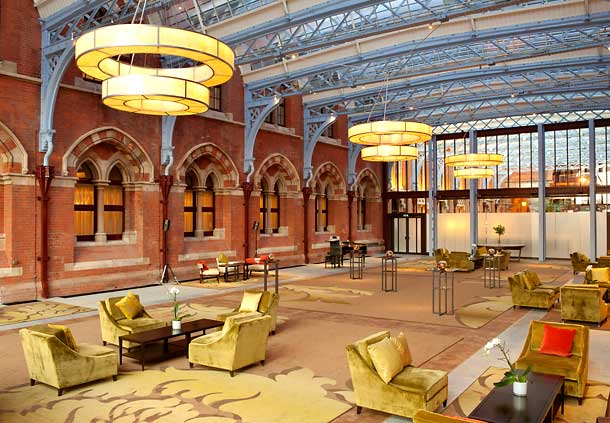
The Hansom Lounge
*
Back out on the main station concourse, St Pancras is now unrecognisable when compared to images of its former, sorry state. The station today is light, airy and enjoys all the buzz of a major European gateway.
The metalwork of the vast, restored roof has been painted an appealing sky-blue. At first, this may seem like a nod to modern tastes, but this shade is in fact the same colour used way back in 1868 when the station first opened.
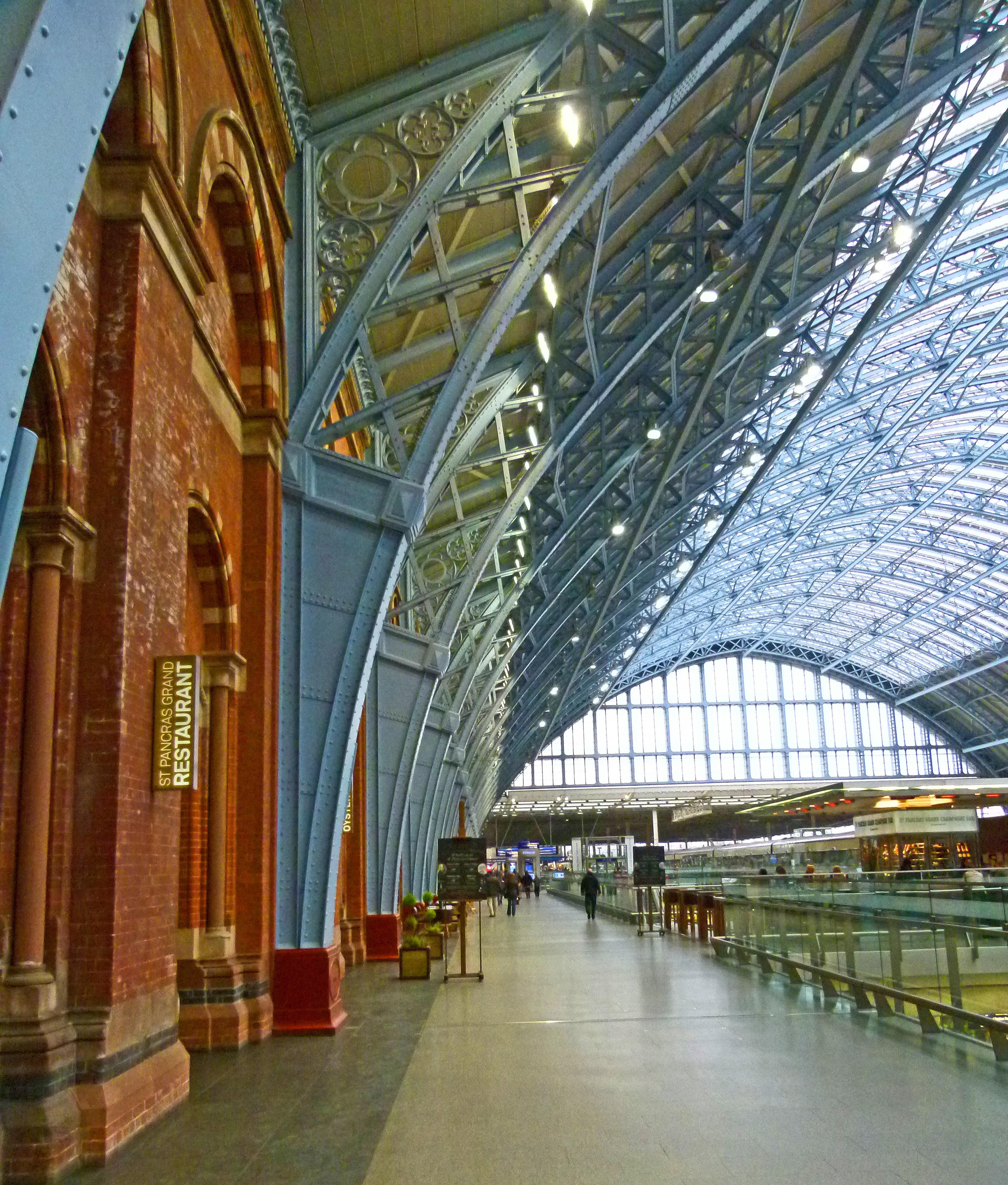
The expansive labyrinth of cellars below, once hidden and used for squirreling away beer barrels, have been thrown open and converted into a bustling shopping arcade, linked to the station’s upper decks by gleaming escalators and glass walled elevators.
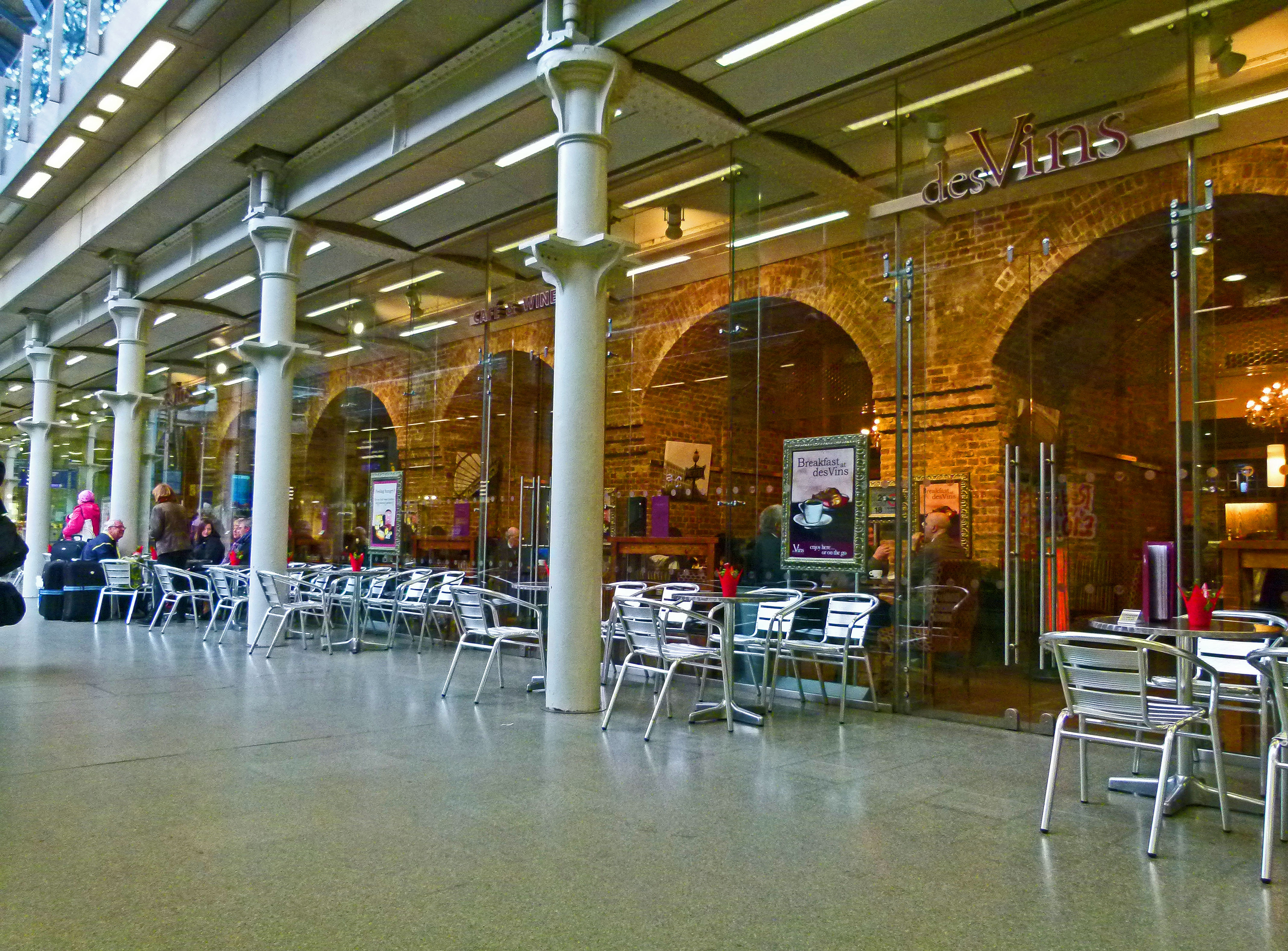
Upstairs, parallel to the Eurostar platforms, you’ll find Searcy’s St Pancras Champagne Bar– the longest of its kind in Europe.

St Pancras Champagne Bar
If you’re the sort of person who can afford the £10,000 per night price tag for the St Pancras Renaissance’s Royal Suite, then the Taittinger Brut Reserve which comes in at a mere £1,500 should pose no problem to your bank balance.
For those of us without our own personal jet though, the champagne bar’s cheapest bubblies start at £8.50…
*
As part of St Pancras Station’s overhaul, the famous clock, which had been embarrassingly destroyed in the late 1970s, was recreated by Dent of London; the very same company who had produced the original so many years before.
In order to construct the replica, clockmakers from Dent paid a visit to Roland Hoggard; the train driver (by now well into his 90s) who had purchased and repaired the smashed original.
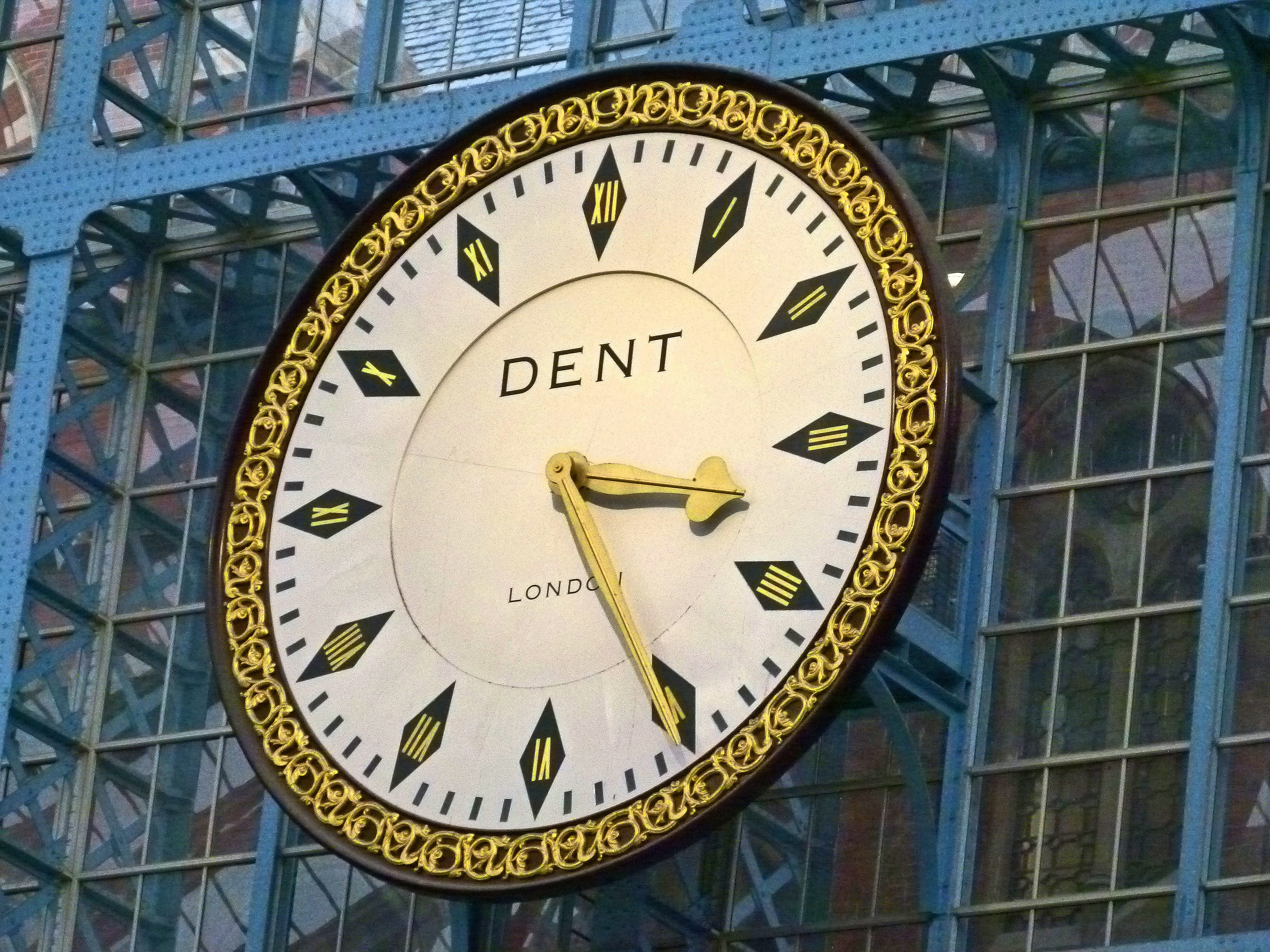
Thanks to Roland’s admirable reconstruction, the craftsmen were able to re-create an extremely accurate replica of the original. As a way of thanks, Roland Hoggard was invited to the grand opening of the remodelled St Pancras International.
*
Below the reinstated clock there stands a new, huge sculpture of a couple embracing.
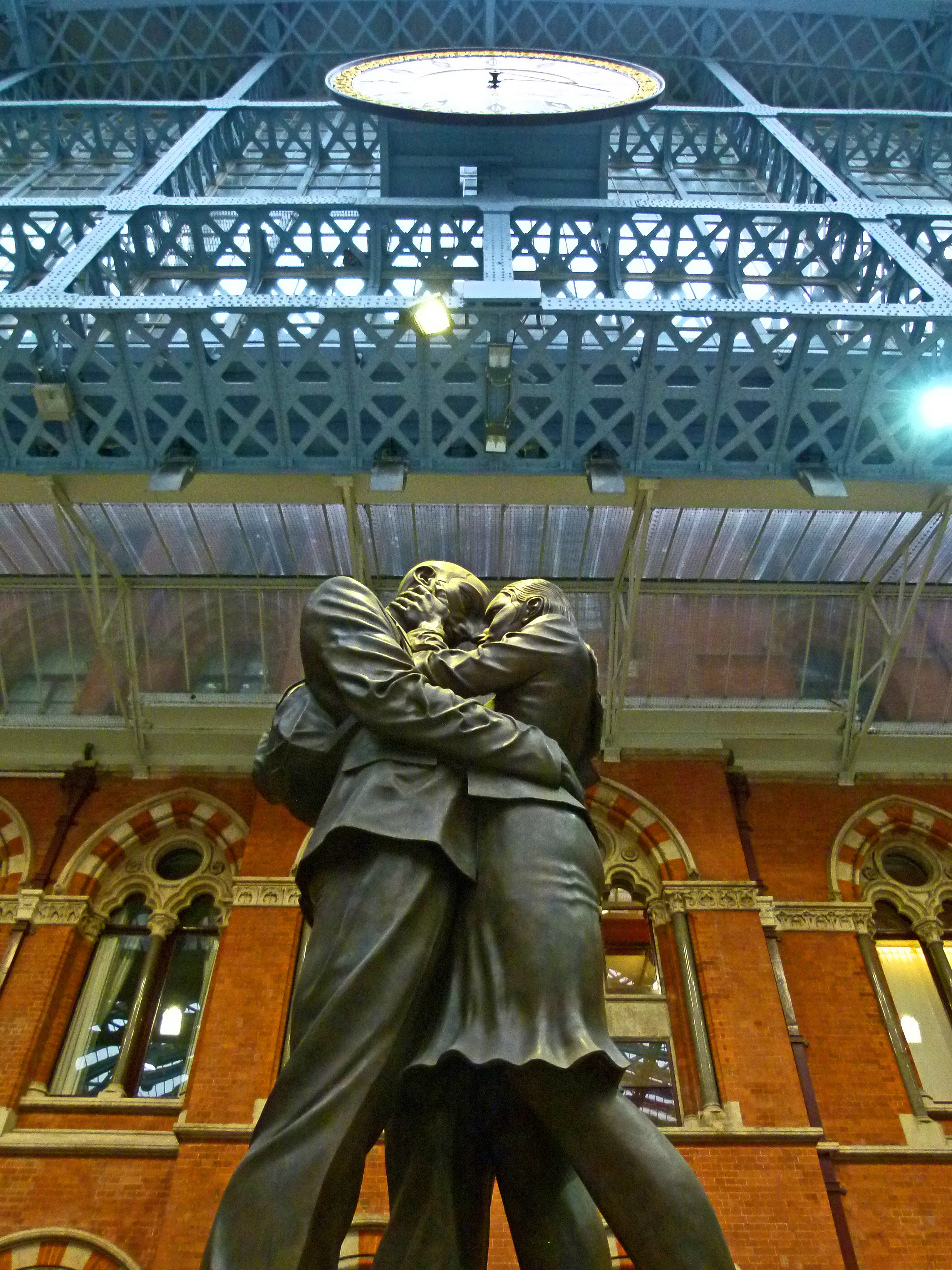
This 9 metre tall sculpture is entitled ‘The Meeting Place’ and was created by Paul Day.
The couple are intended to represent England and France, and the close bond which the Channel Tunnel has forged between the two nations. On the plinth below, there are a set of detailed friezes, representing scenes from history and everyday London life:

A short distance away from this towering sculpture, there is a far smaller, more profound statue crafted by Martin Jennings… an affectionate representation of Sir John Betjeman, peering up in awe at the beauty and resurgence of the station he loved and fought to save.






 View from the Mirror