Tales From the Terminals: King’s Cross (Part 1, History & Film)
In the previous instalment of Tales From the Terminals, we had a look around St Pancras International Station.
We now move onto its next door neighbour; King’s Cross.

Overlooking the roar of Euston Road, King’s Cross is located in the midst of one of London’s busiest areas.
However, before the tentacles of the city crept this far, the area we now know as King’s Cross was in fact a pastoral locale known by the completely different name of ‘Battle Bridge.’

‘Battle Bridge’- King’s Cross before the railways arrived….
Fights, Duels and Spas
One of the most popular legends connected to the area is that Queen Boudicca, Celtic Queen of the Iceni and leader of a blood-thirsty revolt against the occupying Roman forces around AD60, had her final stand here; a ferocious battle in which it is believed some 80,000 Britons were slaughtered.

Boudicca, Queen of the Iceni
Finally defeated and slain here by her Roman foe, it is said that the warrior-queen’s body is buried somewhere deep beneath platform 9 or 10 of King’s Cross Station. Sadly, no evidence exists to back up this age-old rumour!
*
Some say that the name Battle Bridge was connected to Boudicca’s grisly skirmish with the Romans.
Although this has never been proven, one thing is certain; a bridge did exist here; a short, rickety crossing which once spanned the now submerged River Fleet.
For centuries, Battle Bridge remained a wild, rural area whose isolated nature made it a popular spot for chaps wishing to duel and highwaymen seeking to rob.

Two gentlemen prepare for a duel…
One of the highwaymen who stalked this patch was John Everett; a notorious character who, in the 18th century, carried out robberies all over London and the surrounding countryside.
In 1731, Everett held up a stagecoach at Battle Bridge; a crime which led to his capture and eventual execution.

Contemporary etching of John Everett, pictured robbing a stage-coach at Hounslow, West London
By the 18th century, the area was starting to become a popular destination thanks to the existence of a spa (a by-product of the Fleet River).
Known as ‘St Chad’s Well’, the sparkling clean watering hole attracted hundreds of people every day, all of whom were keen to come here and sip beautiful, fresh water, uncontaminated by the filth and stench of the city.
Today, this well is remembered in the area by the small roads, ‘St Chad’s Place’ and ‘St Chad’s Street.’
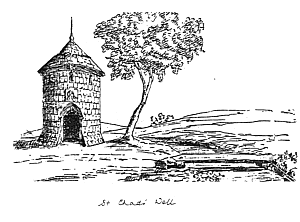
St Chad’s Well
Battle Bridge’s association with health continued when a hospital for smallpox sufferers was established in 1746. It stood for exactly 100 years, closing in 1846. King’s Cross Station itself now stands upon the site.

The Smallpox Hospital which stood upon the site now occupied by King’s Cross Station
A Change of Name
Battle Bridge changed its name to King’s Cross in 1836 when a statue of King George IV (who reigned from 1820 to 1830) was placed here.
Perched on top of an 18ft high column, this monument stood on the triangle which is now formed by Pentonville, Gray’s Inn and Euston Road

The early 19th century monument from which King’s Cross takes its name
With his life and reign characterized by unreliability, selfishness, greed, weak leadership and chronic overspending on pet projects, George IV had never been a popular character… and Londoners still bore a grudge.

George IV; a.k.a ‘The Prince Regent’, the chap whom we have to thank for King’s Cross (portrait by Sir Thomas Lawrence, 1820)
The oversized memorial to the pompous king attracted so much negativity that it was removed a few years later in 1842.
*
The Station Arrives
The birth of King’s Cross as we know it today occurred between 1851-1852, when the Great Northern Railway moved in and constructed their London terminal in the vicinity.
The station’s architect was Lewis Cubitt; brother of Thomas Cubitt (another noted Victorian architect) and William Cubitt who went onto become Lord Mayor of London.

The three Cubitt brothers (from left to right; Lewis, Thomas and William)
Straightforward, practical and forged from London Brick, King’s Cross received much praise when it first opened.
At first (as with Euston), there were only two platforms; one for departures and one for arrivals. However, it did not take long for the terminal to expand; its popularity quickly necessitating the spread of further platforms.
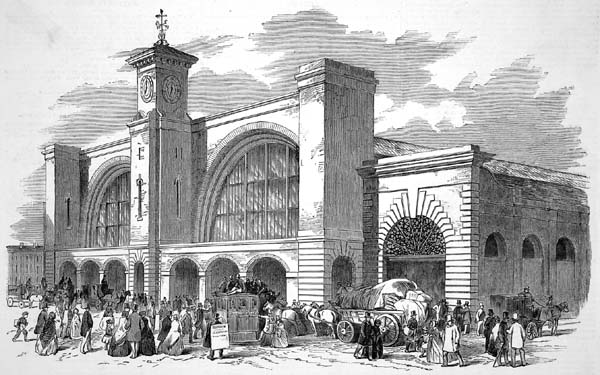
An etching of King’s Cross from 1852
The fine clock, which takes pride of place in the purpose built tower, was built by Dent of London; the same company who were responsible for Big Ben’s timepieces and the two clocks which have graced St Pancras.
Two years after the station opened, Cubitt built the Great Northern Hotel just behind the terminal; the first purpose-built hotel in London.

The Great Northern Hotel; London’s first purpose built hotel
The Great Northern finally closed its doors in 2001 and now stands derelict… although there are currently plans to renovate the building and turn it into a ‘boutique’ hotel.
*
I’ll tak’ the low Road
One of the most famous trains to operate in and out of King’s Cross is of course, The Flying Scotsman.
Still running today, this early morning service provides an important link between London and Edinburgh.
The service first began in 1862, hauled by a class of engine known as the Stirling.
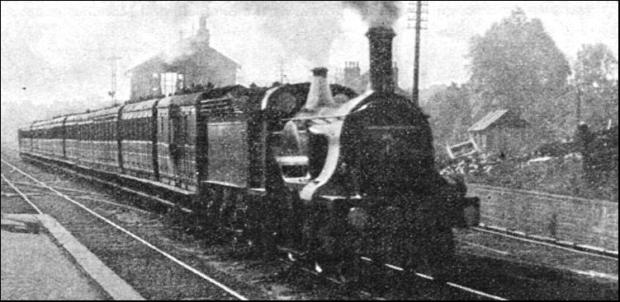
A ‘Stirling’ class engine; the first of the Flying Scotsmen
In their day, the Stirlings were amongst the fastest trains in the world. However, the journey between the two capitals still took some 10 ½ hours!
With the London to Edinburgh route proving so lucrative, railway operators were constantly striving to make the trip as fast as possible.
As a number of steam engines, each faster and more powerful than the last, were developed, the journey time between the two capitals declined steadily.
In 1924, the record stood at 8 ¼ hours and by 1938, it had dropped even further to 7 hours and 20 minutes.
By far the most famous of the Flying Scotsman to serve King’s Cross was the LNER Pacific class; a much celebrated engine which, when it was brand-spanking new, had been paraded before the public at the 1924 British Empire Exhibition, held beside Wembley Stadium.
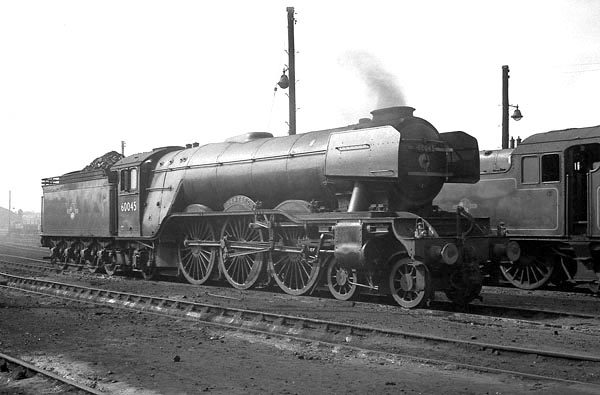
An ‘A3 Pacific’; the most famous class of the Flying Scotsmen
This wonderful machine enjoyed a long career; remaining in service until 1963.
When thundering between the two capital cities, this powerful steam locomotive was capable of reaching speeds of up to 100mph.
Needless to say the engine’s boiler was ravenous; each journey between London and Edinburgh required an amazing 9 tonnes of coal to be continuously fed into the billowing furnace. The firemen who shovelled such colossal amounts were tough fellows indeed… you probably wouldn’t have wanted to challenge them to an arm wrestle!
*
As steam was phased out in the 1960s, the Flying Scotsman service was handed over to the even more powerful British Rail Deltic locomotives which, with a nod to their purpose, were christened with names such as The Royal Scots Grey, The Royal Highland Fusilier and The Gordon Highlander.

A Deltic waiting to depart King’s Cross, November 1978. (Many thanks to David Hayes for this great picture; please click the image to view more of David’s work)
Designed for service between London and Edinburgh, these mighty machines were the most powerful diesels to have ever operated on the UK rail network, remaining in service until the early 1980s.
A journey on-board a Deltic hauled train can be seen in the opening credits to the cult 1971 film, Get Carter.
Travelling from King’s Cross to Newcastle-Upon-Tyne, a London-based gangster (played by Sir Michael Caine) is heading north on a quest to learn about- and ultimately avenge- his brother’s death.
The crew filmed the journey on board the actual train… and the clip is included below, simply because it is just so darn cool (especially when the music kicks in!)
Today, the Flying Scotsman lives on; now operated by East Coast Mainline. The journey time between London and Edinburgh now stands at approximately 4 ½ hours; quite an improvement on the early days!
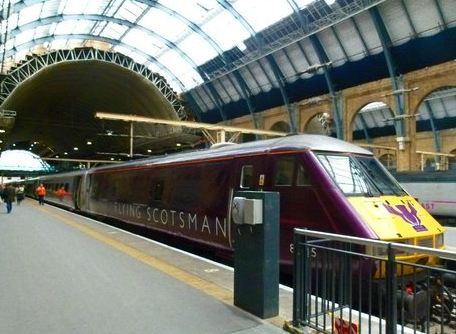
The current ‘Flying Scotsman’
Kings Cross as a Film Set
Over the years, King’s Cross has proven to be a popular location with film makers and has appeared on celluloid many times. Some of the most notable movies in which King’s Cross has played a starring role include:
The Ladykillers
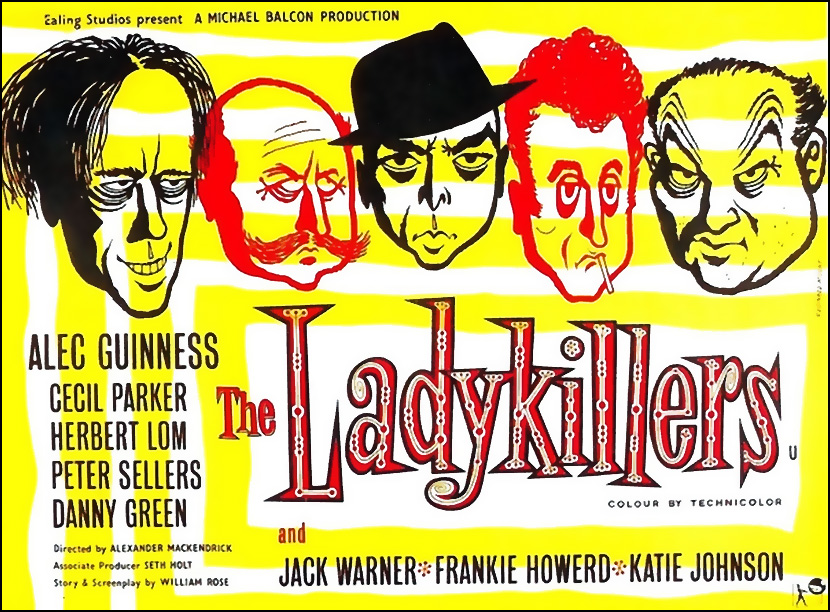
Released in 1955, this much-loved Ealing Comedy is truly ingrained within the King’s Cross area.
The plot focuses on a motely gang of armed robbers, who are planning to hold up and rob a security van as it stands within the station itself.

Publicity snap for ‘The Ladykillers’
Posing as travelling musicians in search of a rehearsal space, the crooks- led by a ‘Professor’ Marcus (played by Sir Alec Guinness)- rent out a room in a local house to act as a base for their heist.
The house, which is perched over a railway tunnel leading into King’s Cross Station, belongs to Mrs Wilberforce, a sweet, elderly and supposedly unassuming widow who susses out her the true intentions of her guests, resulting in havoc and disaster amongst the gang!
Filming took place all around the area; including York Way, Argyle Street and St Pancras Road; streets with traffic levels that look gloriously quiet when compared to today! An excellent site listing all of the locations used, along with plenty of pictures, can be found here:
www.martinunderwood.f9.co.uk/Ladykillers/
Mona Lisa
The area around King’s Cross had never been prosperous but, by the 1980s, it had become one of London’s most notorious locales; a seedy hotbed of crime, drugs and prostitution.
The atmosphere of the area around this time was chillingly captured in the 1986 film, Mona Lisa.

Made by Hand Made Films (a company which had been founded by ex-Beatle, George Harrison), Mona Lisa tells the tale of George (Bob Hoskins), an ex-con who has just completed a stretch in prison.
Looking for legitimate work, he ends up securing a job as a chauffer for Simone (Cathy Tyson); a high-class call girl who learnt the tough rules of her trade on the ‘meat rack’; the red light district centred around the depraved streets of King’s Cross.

‘Mona Lisa’ publicity shot
As the story progresses, we learn that Simone has become obsessed with finding a girl called Cathy; a teenage prostitute whom she once knew. Urging George to help her, the pair plough deep into King’s Cross’s sordid underbelly…
When portraying the red light district, certain scenes of Mona Lisa were in fact shot on Pindar Street behind Liverpool Street station, probably because King’s Cross at the time was simply too intense to carry out location filming.
The Harry Potter Series
In more recent years, King’s Cross has famously featured in the Harry Potter franchise.
Its first role was in the very first instalment; Harry Potter and the Philosopher’s Stone.
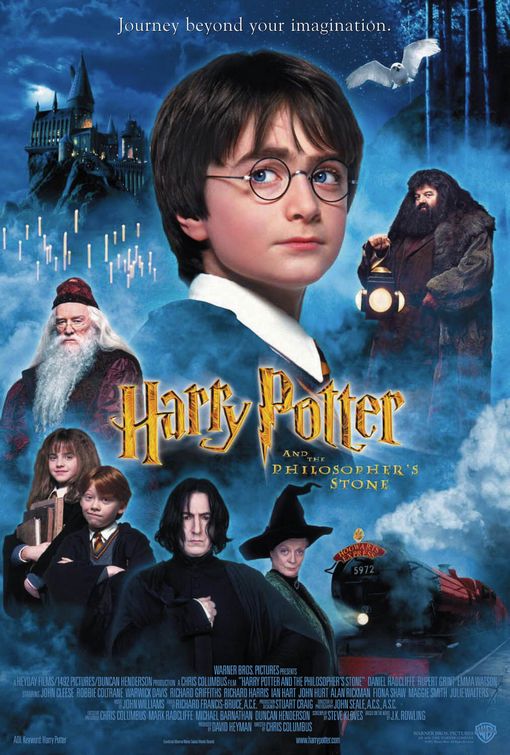
Upon discovering that he’s a wizard and is to therefore attend Hogwarts School of Witchcraft and Wizardry, Harry goes to King’s Cross station to catch the Hogwarts Express; the mystical train, hauled by a beautiful, red steam engine, which conveys pupils to the boarding school (apparently located somewhere deep within the Scottish Highlands).
Once at the station, Harry- not yet used to the magical way of doing things- is unable to find ‘Platform 9 ¾’, the departure point for his journey.
With help from the Weasely family, Harry soon realises that he has to run through what appears to be a brick wall!
The famous scene was actually filmed on a wall between platforms 4-5. Today, King’s Cross Station has paid homage to the famous scene by embedding a luggage trolley into the brickwork!

Platform 9 and 3/4…
The station then appeared at the beginning of the next instalment; The Chamber of Secrets.

In this episode, Harry and his best friend, Ron miss the Hogwarts Express, and are forced to improvise by commandeering an old Ford Anglia… which flies! As they take off, the outside of King’s Cross is cheekily portrayed as being St Pancras Station; the gothic masterpiece which stands next door!
*
In the 2007 instalment, The Oder of the Phoenix, the tone becomes far darker when Harry, waiting to depart King’s Cross, is overcome by a nightmare-like sequence in which he spots his arch enemy, Voldermort, standing like an apparition on the platform.

Harry Potter’s arch enemy… Voldermort appears at King’s Cross
Shortly after his hallucination, Harry is met by his godfather, Sirius Black (played Gary Oldman; the greatest actor to come out of south-east London’s New Cross). Before Harry’s departure, the pair meet in a King’s Cross waiting room, where Sirius departs some words of wisdom.
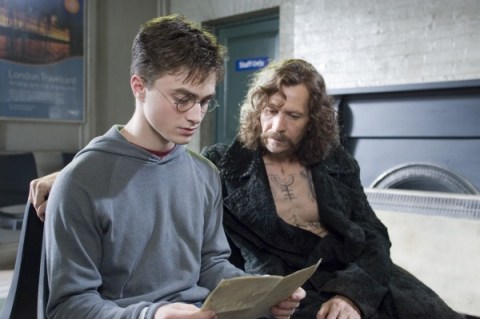
Harry Potter and Sirius Black in a King’s Cross waiting room
The final chapter in the Harry Potter series is the two-part, Deathly Hallows.
At the very end of the last film, King’s Cross station (the outside once again craftily portrayed as St Pancras!) appears in the very last scene.
Set years later, Harry is now all grown up, and we see him escorting his own children to Platform 9 ¾ as they prepare for wizzarding school. The appearance of King’s Cross in this epilogue therefore makes it the very last location and scene to feature in the series.

The final scene in the Harry Potter series; filmed at King’s Cross
Please click here for Part Two
Tales From the Terminals: King’s Cross (Part 2; Fire and Rebirth)
Horror at King’s Cross Underground
On the 18th November 1987, the underground station serving King’s Cross bore witness to one of the most tragic events in recent London history; the King’s Cross Fire.

King’s Cross, November 17th 1987
It is generally accepted that the inferno, which started on an escalator, was caused by a discarded match.
In those days, many of the escalators on the London Underground still had wooden steps, and the King’s Cross escalator in question- which connected to the Piccadilly Line- was no exception.
It had been constructed in the 1940s and, from that time until 1987, the engine room below had never once been cleaned.
Consequently, the escalator was a tinder box; a mass of firewood, slowly grinding over a tangle of machinery which was caked in fluff, grease and grime; a hazard made even worse by the surrounding litter which had accumulated over the years.
There had already been a number of fires on the tube- some 400 between 1956 and 1987- but they had always been small, understated affairs which had caused no significant damage. These fires- referred to by tube officials as ‘smoulderings’- had almost always been caused by rubbish and discarded matches and, although the London Fire Brigade had given repeated warnings (including a written plea for action, penned just one month before the King’s Cross Fire), little had been done.
However, following a combustion at Oxford Circus in which 14 people required hospitalization, one concession was made- smoking on the Underground was eventually banned in February 1985.
*
Despite the ban, it remained common practice for people to ‘light-up’ as they ascended the escalators on their way out of the station, and it is believed that this practice is was what led to the King’s Cross Fire.
A passenger, the identity of whom we will probably never know, stood on the escalator, placing a light to their cigarette. As they inhaled their first breath of nicotine, the match was carelessly tossed to one side, sliding between the wooden grooves, and down into the escalator’s machinery…
When the fire first sparked, it was not considered a true emergency. Described as being about the size of a campfire, commuters and tube staff remained calm, and passengers were still allowed to travel on parallel escalators.
However, the situation became deadly serious within seconds when the fire, stoked by a gust of wind from a passing tube train below, ‘flashed over’; the flames suddenly finding contact with the greasy mass of filth and fluff beneath the wooden stairs.
Moments later, the small fire suddenly transformed into a searing 100 degree inferno, sweeping upwards and engulfing the ticket hall with a speed which one survivor likened to that of a blowtorch.
So severe was the fire, that over 150 fire-fighters were needed to fight the conflagration.
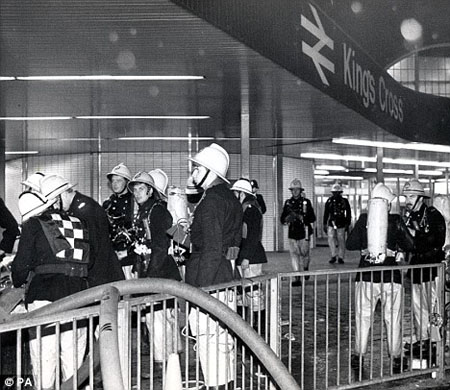
Fireman attending the King’s Cross Fire
One of these firemen was Colin Townsley who was based at Soho Fire Station.
The crew from Soho had been the first to arrive at King’s Cross, when the fire was still in its infancy, and Colin was one of the first firemen to enter the ticket hall; doing so moments before the flashover occurred.

Colin Townsley, a brave fireman who perished in the King’s Cross Fire
Whilst in the ticket hall, it is believed that Colin- who was wearing no breathing apparatus- stopped to help a woman in trouble, but the pair were rapidly overcome as the fire swept over. The speed with which the inferno took hold is demonstrated by the sad fact that the pair were found just six feet away from an exiting staircase which would have led them to fresh air and safety.

The aftermath
*
Overall, 32 people perished in the King’s Cross Fire. The youngest victim, Dean T Cottle, was just 7 years old.
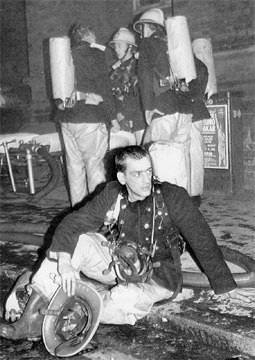
An exhausted fireman resting at King’s Cross
Mercifully, the disaster occurred as the rush hour was receding- if the fire had occurred at the height of the peak period, the casualties would have undoubtably been far higher.
A video of an ITN news bulletin, broadcast in the aftermath of the King’s Cross Fire can be viewed below:
http://www.youtube.com/watch?v=sj21xNbNKBQ
A public inquiry into the disaster- the ‘Fennell Report’ was held the following year.
The Fennell Report led to a host of new regulations.
All wooden escalators were replaced with metal ones. Heat detectors and automatic sprinklers were also installed at all stations, and all underground staff now receive fire training on an annual basis.
Today, a model of the escalator, which was used in the inquiry, can be viewed at the London Transport Museum.
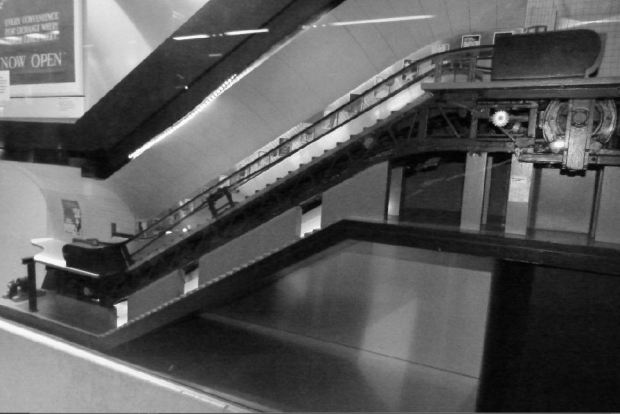
Model of the King’s Cross escalator, used during the investigation into the fire.
The Fire Leaves a Mystery
One of the victims of the King’s Cross Fire remained unidentified for many years, creating quite a mystery.
Buried in an unmarked grave, the charred body, which resembled a victim of Pompeii; crouched down and with their arms drawn in, was simply known by the tag which had labelled it in the mortuary; ‘Body 115.’
In 1990, this enigma inspired musician, Nick Lowe to pen a song about the case; Who Was That Man? (click to listen).
*
It would be 16 years before Body 115 was identified….
Using skull fragments, forensic experts managed to create a plaster cast of the victim’s face.
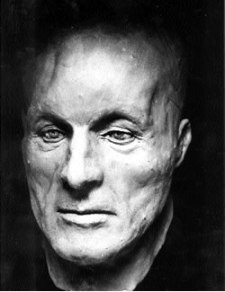
Plaster Cast of ‘Body 115’
Thanks to this likeness, backed up by evidence related to medical operations which the victim had undergone during their lifetime, Body 115 was finally identified in 2004 as being Mr Alexander Fallon; a 72 year old, homeless pensioner from Falkirk in Scotland.

Alexander Fallon, the homeless pensioner whose body remained unidentified for so many years
Alexander’s tragic death was the sad conclusion to a heartbreaking period of his life.
Up until 1974, Alexander Fallon had led a normal existence. However, in that year, he lost his wife to cancer.
Devastated by the death of his partner, Alexander found himself unable to cope, and drifted towards London where he ended up living rough for the rest of his days.
The Scottish pensioner remained in touch with his grown-up daughters via regular phone calls, but these came to an abrupt end in late 1987. From around the same time, benefits in his name ceased to be claimed.
Alexander’s daughters had had their suspicions about their father’s fate, but it was not until the plaster cast was created years later that the tragic tale was able to find its conclusion.
Although we will never know for sure, it is most likely that Mr Fallon, being homeless, was at King’s Cross Underground that evening seeking shelter from the autumn chill, waiting for the local King’s Cross hostels to open their doors for the night.
*
An Eerie Prediction
In September 1987, just two months before the King’s Cross Fire, pop duo, The Pet Shop Boys released their second record entitled Actually.
The final track on the album is a melancholy song entitled, King’s Cross which, in a rather bizarre coincidence, appears to foresee a disaster at the station with the lyric:
“Only last night I found myself lost, by the station called King’s Cross… dead and wounded on either side, you know it’s only a matter of time…”
This haunting song can be listened to in the following clip. The accompanying video (made two years later), was filmed on location in and around the station, depicting the area as it appeared in the late 1980s:
http://www.youtube.com/watch?v=jIcdlNvyRVI
Following recent modernization, the ticket hall at King’s Cross today is unrecognizable compared to how it appeared at the time of the fire.
In an understated corner, often overlooked by hurrying commuters, a memorial to the disaster can be found; a simple clock and plaque dedicated to those who died that fateful autumn evening.
King’s Cross Today
In the past few years, King’s Cross and the surrounding area have undergone a massive renaissance.
Aided by the introduction of the Eurostar terminal at its close neighbour, St Pancras, plus the need to get in shape for the Olympics, the area around King’s Cross has been cleaned up considerably.
The station itself has had £550 million spent on it. The centrepiece of this refurbishment is a dramatic new roof (liked by some to having the appearance of a string vest!), designed by Hiro Aso; an architect who specializes in transport infrastructure.

King’s Cross is now also home to the largest railway station pub in Britain… I have a feeling this record is going to lead to many missed journeys!
Surrounding the station is a vast swathe of redeveloped land; ‘King’s Cross Central’; a £2.2 billion project.
Still very much a work in process, King’s Cross Central, which already boasts a new campus of St Martins Art College, hopes to eventually become a bustling destination. A map of the site can be viewed here:
http://www.kingscrosscentral.com/the_site
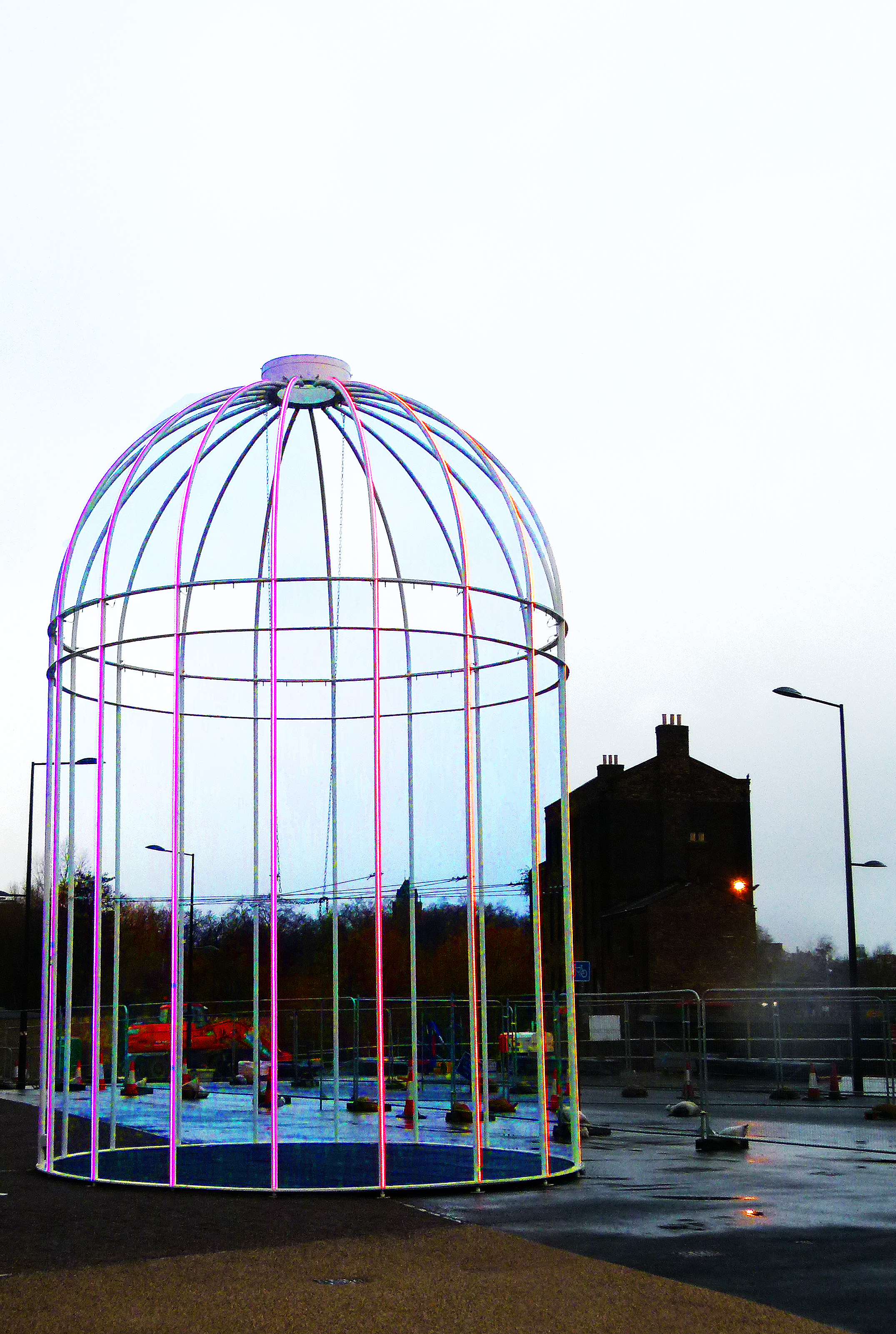
A feature of this burgeoning area is an attractive art installation which (despite resembling a bird-cage), is known as the ‘IFO’; (‘Identified Flying Object’), created by French artist, Jacques Rival. Many passengers in my taxi have commented on and asked about this new sculpture, which is designed to be hoisted into the air one night every month!
One group impressed with the latest developments at King’s Cross are the Chinese Government… so much so that they recently voiced a wish to build an ultra-high speed rail link- from Beijing to London- with King’s Cross being the terminal!
This incredibly ambitious project envisions the Chinese laying rails from their capital, across Russia and then on through Europe. Using the fastest train in the world; The Harmony Express, it is estimated Beijing to London could be achieved in just two days.

The Chinese, ‘Harmony Express’
However, as Mr Wang Mengshu of the Chinese Academy of Engineering, says, “the biggest issue is money…”
I’m not quite sure if I’ll ever be picking up passengers straight off the train from China in my lifetime, but it would be certainly be wonderful for business if the project ever did come to fruition!
As they say in Mandarin…. Zhu ni haoyun! (Good luck!)
Logie Baird’s London (Part One)
This month (April 2012) sees the T.V ‘digital switchover’ taking place in London.
The analogue signal, which has served generations of television sets, will be switched off for good and if you don’t have the necessary equipment to watch digital broadcasts, you’ll be left gazing at a blank screen!
*
Television, by far one of the most prolific inventions of the 20th century, was born right here in London.
Its father was Mr John Logie Baird; a genius Scotsman.

John Logie Baird
Early Life
The son of a vicar, John Logie Baird was born in the seaside town of Helensburgh (about 30 miles west of Glasgow) in August 1888.
As a baby, John contracted a near fatal illness; something which left him plagued with ill health for the rest of his life.
Although he suffered from a weak constitution and was branded in school reports as being “timid” and “very slow”, there was nothing wrong with John’s mind which was both curios and brilliant.
As a child, he was fascinated by technology. By the time he 13 years old, John Logie Baird had already converted his parents’ home to electrical lighting (thus making their house the first in Helensburgh to boast the new technology), dabbled in remote-controlled photography and constructed a small telephone exchange which connected a number of neighbours in his street.
At the age of 18, John Logie Baird enrolled at the University of Glasgow where he studied Electrical Engineering.
A few years later, whilst he was contemplating furthering his studies, WWI broke out. Dropping his academic ambitions, John presented himself for military service but, due to the ill health which dogged him, he was deemed unfit.
Struggling in Business
Following the disruption of war, John Logie Baird spent time at the Clyde Valley Electrical Power Company before trying his luck as an independent businessman- including a stint as a jam maker in Trinidad!
Although Logie Baird had determination, he didn’t seem to have much luck in his ventures.
The jam making business failed- mainly due to the local insect population which seemed determined to ruin every batch!
Coming back to the UK in the early 1920s, the frail Scotsman, driven by his dwindling finances, told himself that he “had to invent something.”
Settling in Hastings, on England’s south coast (where it was hoped the sea air would improve his health), John’s first idea was a rust-proof razor; the blade being made from glass. This ‘cutting-edge’ concept (pardon the pun!) was quickly shelved when the inventor suffered a vicious cut whilst testing his new prototype!
Next up- and sounding like something straight out of ‘Wallace and Gromit’ – was a pair of ‘pneumatic boots.’ Inspired by the car tyre, Logie Baird envisioned a new type of sole, which would revolutionize walking.
However, these too were doomed to fail. In his autobiography, ‘Television and Me’ the Scotsman described why:
“I bought a pair of very large boots, put inside them two partially inflated balloons, very carefully inserted my feet, laced up the boots, and set off on a short trial run. I walked a hundred yards in a succession of drunken and uncontrollable lurches, followed by a few delighted urchins. Then the demonstration was brought to an end by one of the balloons bursting.”

*
Following these setbacks, John Logie Baird turned to something which his mind had been toying with for years… the idea of transmitting moving images.
It is believed the notion first came to John as a teenager, when he discovered a German book about the chemical selenium and its photoelectric properties (youngsters in those days clearly had to find novel ways of amusing themselves!)
Whilst in Hastings, the inventor began to dabble with the idea, cobbling together equipment from whatever lay around; glue, sealing wax, knitting needles, bicycle parts, even an old hatbox.
However, this process was rudely interrupted in autumn 1924 when an electrical explosion occurred in the workshop.
Logie Baird’s landlord, worried that he had a mad boffin under his roof, kindly asked the inventor to leave.
The Scotsman obliged, and decided to head for London.
*
A Lab in Soho
Once in the capital, John Logie Baird found an attic room to rent above 22 Frith Street in Soho.
As mentioned in my earlier post on Little Italy, these premises are now home to the famous 24 hour café, Bar Italia.

22 Frith Street where John Logie Baird rented an attic room and television was born…
Once the new, cramped workshop had been established in London’s West End, John Logie Baird knuckled down on his novel invention.
The contraption which began to develop in the Soho attic was a large, complex device, characterised by fast, spinning discs, numerous lenses, powerful, flickering lights and a photosensitive detector.
Because of the power and size of the machine, accidents and breakages were common, as Logie Baird himself described;
“The apparatus would get out of balance and jump from one side of the laboratory to the other until it was stopped or the disc tore itself to pieces… I had some exciting moments.”
Despite the bulky nature of his creation, the actual screen upon which the pioneering images were displayed was tiny; just a few inches wide (even smaller than the image below)
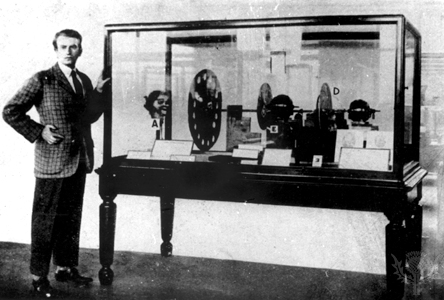
Part of the first working ‘Televisor’ which was built in Soho
From Fleet Street to Selfridges
At first, John Logie Baird was only able to transmit static images of silhouettes. Despite this, the inventor was confident that moving imagery would soon be achieved.
As well as being an inventor, Logie Baird was also a businessman, and he knew that his burgeoning creation would benefit greatly from publicity.
With this in mind, the keen Scotsman made his way to the Daily Express office on Fleet Street where he tracked down an assistant editor, and posed the immortal question:
“Are you interested in a machine for television… seeing by wireless?… An apparatus that will let you see the people who are being broadcast by the BBC…”
The assistant editor feigned interest but explained he had a meeting to get to. To compensate, he sent a colleague; “a large brawny individual” as John later recalled, to take note of the story.
This second newsman “listed sympathetically and with great interest” and then, with a handshake, told the inventor that he’d make sure the story got “a first class show” on tomorrow’s edition.

The former Express Building on Fleet Street; still one London’s finest examples of Art-Deco architecture
The next day- and perhaps unsurprisingly- the newspaper carried no sign of the story and Logie Baird quickly realised that the staff at the Express had been giving him the brush off.
It wasn’t until years later, when he happened to meet the ‘brawny individual’ again, that John got the full story. Apparently, the first fellow he’d met- the assistant editor- had run into the press room to fetch the brawny chap with the words;
“For God’s sake, Jackson, go down to the reception room and get rid of a lunatic who is there. He says he’s got a machine for seeing by wireless! Watch him carefully, he may have a razor hidden”!
*
One person who thankfully did not view John Logie Baird as a dangerous maniac, was Harry Gordon Selfridge; American owner of the world famous department store on Oxford Street.

Harry Gordon Selfridge
Selfridge was always on the lookout for new innovations- especially ones which had the potential draw in large crowds. He was greatly excited by the idea of the ‘televisor’, and insisted that Logie Baird demonstrate the device at his store.
The exhibition ran for three weeks, the promotional posters splashed with the following blurb:
‘Selfridge’s present the first public demonstration of Television in the Electrical Section…
Television is to light what telephony is to sound- it means the INSTANTANEOUS transmission of a picture, so the observer at the ‘receiving’ end can see, to all intents and purposes, what is a cinematographic view of what is happening at the ‘sending’ end.
The demonstrations are taking place here only because we know that our friends will be interested in something that should rank with the greatest inventions of the century.’
*
The demonstration at Selfridge’s was well received, but John Logie Baird knew he had to take his invention up a notch; to progress from static images to live, moving ones…

Selfridge’s, Oxford Street; site of the first ever public demonstration of television.








 View from the Mirror