The Sad Tale of Giro & Dr Leopold
Situated deep in the heart of St James’s and frequently overlooked by the crowds dashing between Regent Street and Horse Guards Parade, is this tiny gravestone:

The stone, preserved in its own miniature housing since the 1990s, is a wee memorial to ‘Giro’; an Alsatian dog who, as the German quotation on his tombstone states was “a true companion”.

Giro was killed suddenly in 1934- when the daft mutt made the fatal mistake of chewing through a live electrical cable.
*
I first discovered this curiosity whilst studying the Knowledge of London.
Being so small, the landmark was an old favourite of the examiners who liked to throw us trainee cabbies by asking us to locate points of a more obscure nature! After some time, I eventually found it… Giro’s headstone is located on Carlton House Terrace, opposite one of London’s more civilised car-parks on Waterloo Place.

The covered headstone sits in a small, gated patch beneath a tree, between the Duke of York Column and a grand row of buildings on Carlton House Terrace:

Location of Giro’s Headstone (image: Google maps)
*
Giro is often unfairly referred to as the ‘Nazi Dog’; this stigma stemming from the fact that he belonged to Dr Leopold von Hoesch, the German ambassador to the United Kingdom from 1932 1936.
In those days, the German embassy was the building right next to Giro’s grave. (Today, the premises is home to the Royal Society).
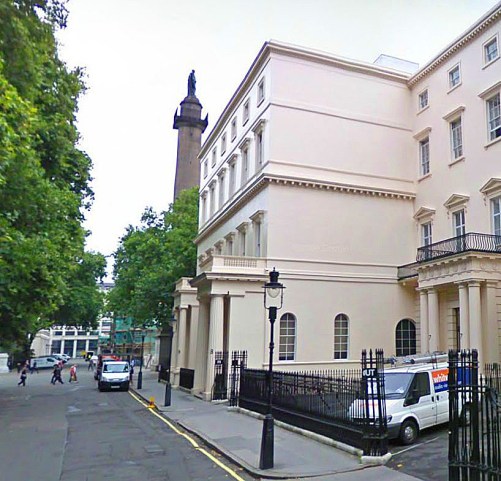
The former German Embassy (which has since relocated to Belgrave Square)
Giro’s master was certainly no Nazi.
Dr Leopold von Hoesch was a respected statesman who did much to improve relations between Britain and Germany.
When he first came to Britain, it was as a representative of Germany’s Weimar Republic; the liberal, culturally progressive government which ruled Germany for a time between the two world-wars.
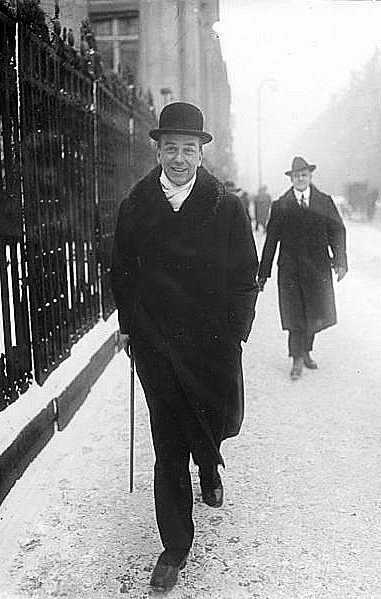
Herr Hoesch in the early 1930s
Tragically, the peaceful Weimar government was short-lived.
Following the Wall Street Crash in 1929, the world found itself in the grip of the Great Depression. In Germany this, along with hyper-inflation and unrest from various political groups, enabled Adolf Hitler to get a jackboot into the door of power in 1933.
Within days of Hitler managing to secure the position of Chancellor, Germany’s parliament building was ‘mysteriously’ set ablaze in the infamous Reichstag Fire.
Seizing upon this convenient disaster and warning of civil unrest, Hitler immediately passed an emergency powers act, granting his government the power to strip German citizens of their liberties indefinitely… a useful thing when you want to crush your opponents and destroy certain groups…

Crowds watch the Reichstag burn in 1933…
Back in London, Dr Hoesch, who had been dubious of Hitler and the Nazis from the offset, viewed the rapid take over with dismay.
He wasted no time in challenging Hitler, sending messages back to Germany about his distrust of the dubious characters in the Fuhrer’s entourage who had muscled in on the government- one of whom was Von Ribbentrop, a character whom Dr Hoesch found particularly distasteful.
Over the next few years, Hitler would be greatly vexed by his ambassador in Britain.
Things came to a head In March 1936 when Hitler invaded the Rhineland. Dr Hoesch denounced the action, accusing the Fuhrer of deliberately provoking France and Britain- a rare voice of dissent against a figure whom many now feared to confront.
Tragically, Dr Hoesch died of a heart attack less than a month later.
He passed away inside the German embassy itself and, aged just 55, it is generally believed that the attack was brought on from the stress caused by dealing with his homeland’s turbulent leadership.

Herr Hoesch… the statesman who challenged the Nazis right up until his untimely death
Thanks to the respect which the British had for the ambassador who had been a thorn in the Fuhrer’s side, Dr Hoesch was granted a grand funeral parade and gun-salute before being shipped back to his homeland.
By this time of course, the traditional German flag had been replaced with the notorious red, white and black swastika insignia and it was this therefore this banner- which represented an ideology Dr Hoesch had never embraced- that had to be draped over the ambassador’s coffin; something which would no doubt have turned his stomach.
This funeral procession therefore represented a thankfully extremely rare occurrence- the only time that the dreaded symbol of Nazism had been so openly paraded on London’s streets- and so close to Buckingham Palace too.
The following clip is a newsreel depicting the event:
*
Now that the troublesome Dr Hoesch was out of the way, Hitler was free to cart a new representative off to London; one who was a true Nazi… Joachim Von Ribbentrop; Dr Hoesch’s nemesis and the man whom he’d voiced such distrust of when the Nazis first came to power.

Von Ribbentrop
A vain, arrogant man, Ribbentrop immediately set to work ‘Nazifying’ the German embassy; altering the interior to bring its appearance more in line with the twisted ideology. This task was granted to Albert Speer, one of the Nazi’s most trusted architects.
A grand staircase was installed- created from marble donated by Benito Mussolini, and rumours still abound that a swastika mosaic (apparently now covered over) was laid upon the floor of one particular room.
Ribbentrop’s time in London would not last for very long. Three years later, the darkness of war, bombs and hatred had returned to Europe and he was promptly dismissed.
Somehow, however the little gravestone of Giro, Dr Hoesch’s faithful friend survived WWII… saved by a mixture of obscurity and respect for the man who had so strongly opposed his Nazi masters.

Herr Hoesch on Carlton Terrace… in happier times with his beloved dogs
Tales From the Terminals: Broad Street Station (1865-1986)
This edition of Tales from the Terminals is slightly unusual in that it deals with a station that no longer exists…
Broad Street
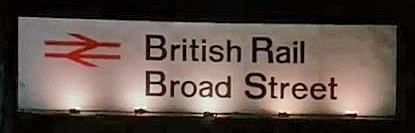

Broad Street Station in 1898
For many years, Broad Street was a vital cog in the capital’s transport infrastructure.
Situated in the heart of The City, the station sat right next door to Liverpool Street station–in fact, Broad Street was on the scene first, opening as a terminal for the Great Northern Railway in 1865, 9 years before its larger neighbour moved in.
The map below depicts the location (coloured in blue) of this now long-gone terminal:

Location of Broad Street in relation to Liverpool Street
Broad Street was originally envisioned as a goods depot; a hub designed to link rail freight travelling between Birmingham and London’s sprawling docks; both key players in Britain’s then vast empire.
However, some bright spark suggested that, being in the heart of the financial district, it would be a good idea to encourage passenger use too.
They were right and, during the first half of its life, Broad Street, along with Liverpool Street and Victoria, was one of London’s top three busiest stations, pouring 1,000s of commuters into the City every day from areas such as Camden, Stratford, Watford and Richmond.
In 1902 alone, it was recorded that 27 million people passed through Broad Street.
However, as the 20th century progressed, passenger numbers began to decline; primarily due to the increased development of the tube and tram networks which were able to ferry commuters around with greater flexibility.
Bombs over Broad Street
Broad Street’s effectiveness as a major rail terminal was also hindered during the two World Wars.
In WWI, the station suffered at the hands of Germany’s fearsome new weapon- the Zeppelin.

On the night of the 8th September 1915, an enemy airship, piloted by Heinrich Mathy- notorious as being the most brazen of the Zeppelin pilots and who had carried out the most bombing raids on the UK- unleashed the Great War’s most destructive attack on the capital.

Heinrich Mathy, the Zeppelin captain who unleashed a devastating attack on London, including Broad Street station
Approaching the UK via Cambridge, arcing around Hertfordshire and North London, Mathy navigated his hulking craft high over Golders Green, following the Finchley Road before taking a detour towards the centre of the capital where the assault commenced.
Russell Square, Theobalds Road (where the Dolphin Tavern was hit- a clock which was damaged in the attack can still be seen behind the bar), Hatton Garden, Farringdon Road (where a plaque commemorates the event) and Bartholomew Close in Clerkenwell were all pounded.

A Zeppelin caught in searchlights over london
Heading further east, the Zeppelin then approached the capital’s financial heart where it released further vengeance.
One bomb exploded directly outside Broad Street station, striking a bus; killing the conductor and several passengers.
More bombs were unleashed over nearby Norton Folgate, causing considerable damage to the tracks leading into the station.
The raid that night claimed the lives of 22 Londoners, with 87 more seriously injured.
Heinrich Mathy himself was killed a year later when the Zeppelin he was captaining was shot down over Potters Bar by the renowned flying ace, Leefe Robinson.
*
During the Blitz of WWII, Broad Street escaped being hit directly.
However, a number of East-End stations serving the terminal were so badly damaged during the nightly raids that they were forced to close for good. These included stations at Haggerston, Shoreditch, Victoria Park and an entire line which branched out to Poplar.
Such closures only served to add to Broad Street’s passenger drain.

Parade of shops at the bottom of Kingsland High Street where the old Shoreditch station once stood… a metal door which led up to the station can be seen around the corner on Old Street…
Struggling on
As passenger numbers dwindled, so too did the building itself and, by the late 20th Century, Broad Street station was in a very poor state of repair.

Broad Street, March 1985 (photo: Geograph)
Writing about the station in 1973, Sir John Betjeman lamented at the removal of a large portion of the station’s roof before going on to say;
“Standing on the empty concourse at Broad Street today, one has a feeling of its former greatness.
Incongruous and ridiculous, in red brick with pavement-light windows is a streamlined booking office for the few passengers who use this potentially popular line. May God save the Old North London!”
The following, short Cine-film clip (part of a collection from Southern Railway Films) shows Broad Street station as it appeared in 1969:
In 1984 Broad Street station was granted one final gasp of recognition; lending its name to Paul McCartney’s album and film of the same title; Give My Regards to Broad Street.

In the film, the former Beatle has 24 hours to track down the master tape for his latest album which has gone missing. The recording is discovered towards midnight, in a forgotten cupboard at Broad Street station itself, rather appropriate considering how decayed and overlooked the once grand station now was.
Sadly, the movie was a commercial and critical failure, its reviews almost as depressing as the state of the station itself.
A scene featuring Paul McCartney pacing around Broad Street station appears towards the end of the film, illustrating just how desolate and dilapidated it had become by this point.
By 1985, only 6,000 people per week were using the station’s limited service- miniscule by London standards and a colossal downfall when compared to the station’s late 19th century heyday.
Towards the end of its life, only two of Broad Street’s nine platforms were in use; the other seven being left to crumble and succumb to weeds.

Broad Street, 1983 (Photo: Wikipedia)
In June 1986, the station was finally wound down and closed for good.
After the tracks have gone…
Today, Broad Street has all but vanished.
The station’s closure coincided with the massive 1980s financial boom, when office space was in particularly high demand- planning permission for such space tripled between 1985-1986.
Consequently, before the dust from Broad Street’s demolition had even settled, developers stormed in, hard-hats on, tape measures in hand, quickly forging the 32 acre ‘Broadgate’ complex; a large area consisting of squares, offices, shops and restaurants.

The project commenced with a ceremony in which then Prime Minister, Margaret Thatcher, fired up the site’s first crane.

Part of today’s Broadgate complex… this office block stands on the former site of Broad Street’s main building. Part of Liverpool Street station can be seen to the right of the photograph.
At its full capacity, Broadgate is capable of serving some 30,000 workers.
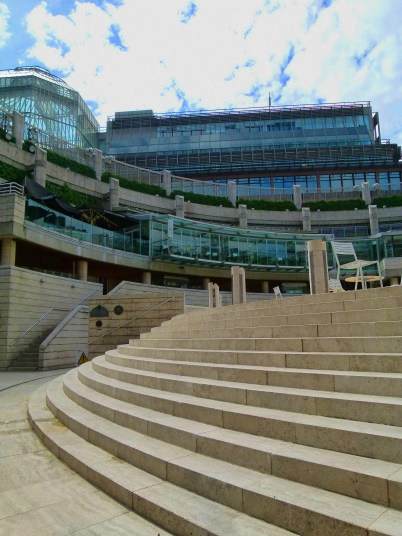
The ‘ampitheatre’ at the centre of the Broadgate complex
The Broadgate site also contains a wide collection of specially commissioned public sculptures, one of which is ‘Fulcrum’, towering over the junction of Liverpool Street and Eldon Street, roughly marking the point where Broad Street’s forecourt once stood.

‘Fulcrum’ sculpture
Sculpted in 1987 by Californian artist, Richard Serra, Fulcrum is crafted from several huge planks of steel (rumour has it that the slabs are old girders from the former station, although as yet I’ve been unable to confirm this).
The trick of this artwork is that the plates are not welded together or joined in any firm way; relying upon the law of physics alone to keep them in place… if you dare to walk beneath them, you can find a small, but well sheltered oasis from the surrounding crowds!

Inside Fulcrum…
Old sections of the mouldy, brick viaduct, which once carried trains over the rooftops and into Broad Street, can still be seen hiding north of Liverpool Street, around the Shoreditch area.

Part of the old viaduct which once led into Broad Street, located on Fairchild Place (off of Great Eastern Street)

Broad Street viaduct, sliced off at the junction of Great Eastern Street and Fairchild Place
One section of the viaduct has been cleverly recycled and is now home to the quirky ‘Village Underground’; a unique collection of artists’ studios.
What makes Village Underground so wonderfully distinctive is that the creative spaces are housed within old tube carriages!
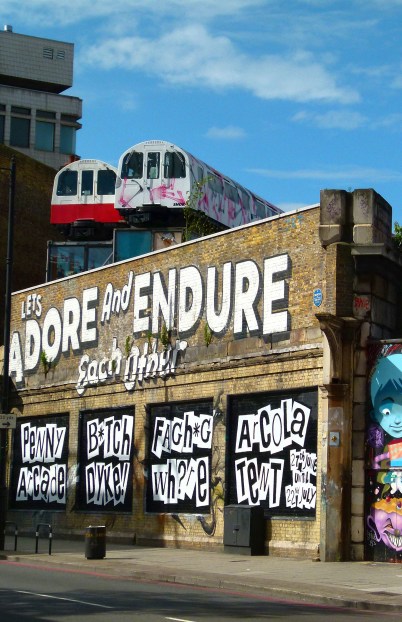
Village Underground, Shoreditch
These particular models of tube car (of which only 30 were built) ran on the Jubilee line between 1983 and 1998.
Growing up during this period, I personally remember them well, with their slattted wooden floors and orange, chequered seats. As I drive past in my cab below, I often find myself wondering how many times I travelled on the Village Underground carriages when they carrying out their original purpose down in the Jubilee tunnels!

Village Underground.. former Jubilee line carriages
Elsewhere in London, another ex-1983 stock tube carriage has been put to a similar eccentric use- you’ll find it in the grounds of Great Ormond Street Children’s Hospital, where it acts a studio for ‘Radio Lollipop’!
Back in Business
A little further up, in the vicinity of New Inn Yard (now fittingly renamed New Bridge Yard), the old arches are once again back in use; linking up with a spanking new viaduct which, since 2010, has carried the new London Overground line; an extensive route which has merged existing lines and reactivated dormant ones- including a section of tracks which once ran into Broad Street.

The brand new London Overground viaduct, linking up with the original, brick arches, half a mile away from where Broad Street station once stood…
One of the stations on the new Overground is Hoxton… where you can discover a special artefact from the old Broad Street station …

Hoxton Station
Take a walk along Geffrye Street-a tranquil road which runs alongside Hoxton station’s viaduct- and you’ll see a rare survivor from Broad Street… the terminal’s old war memorial:
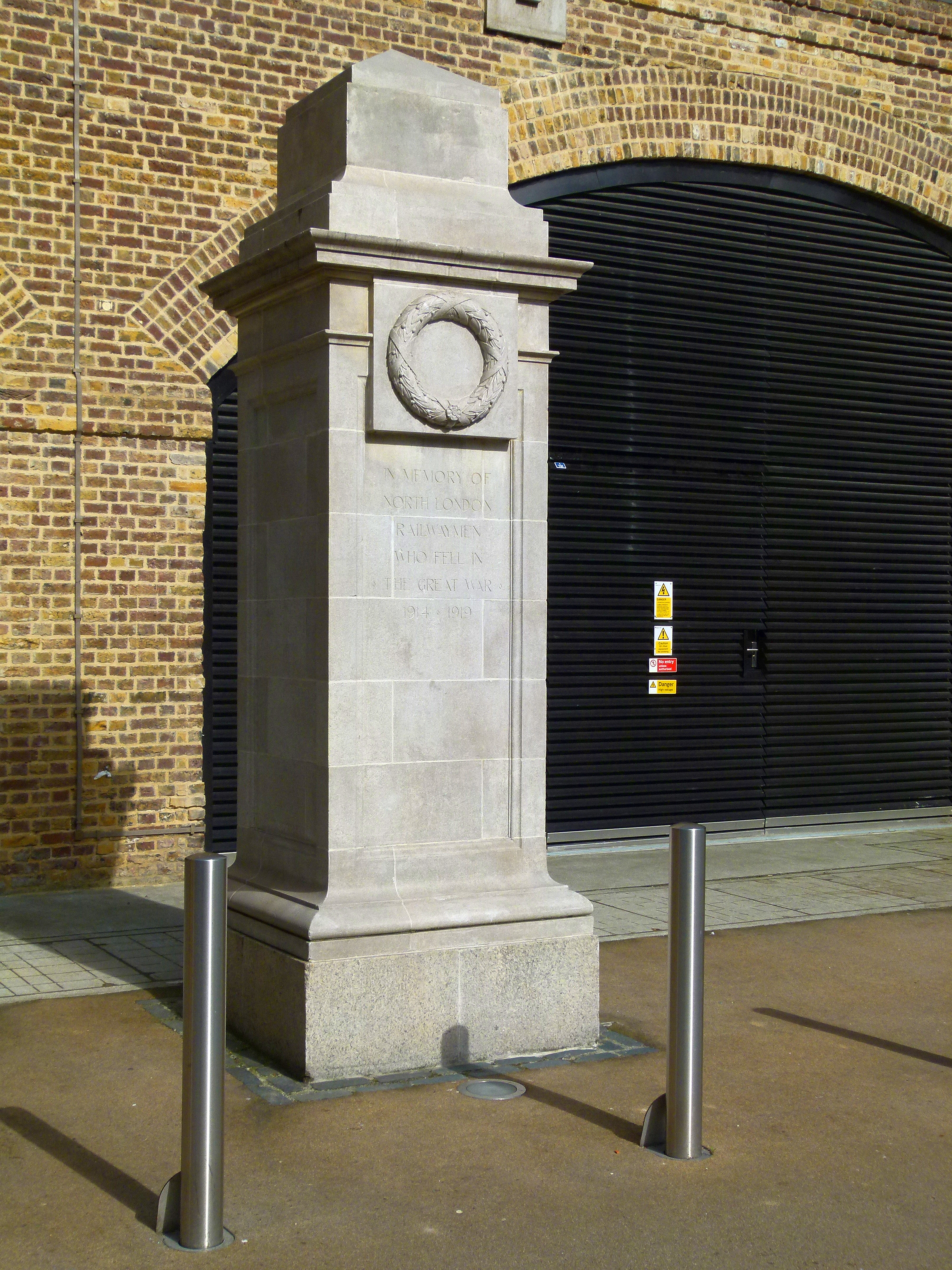
Unveiled at Broad Street in February 1921 and dedicated to the 69 men of the Great Northern Railway who lost their lives during WWI, this memorial- which resembles Whitehall’s solemn Cenotaph in miniature form- was carefully removed during the levelling of Broad Street in 1986.

The memorial in its original, Broad Street location (image from London Reconnections website)
After being kept in storage for three years, it was then moved south to Richmond, one of the more far-flung stations which had been connected to Broad Street, where it remained until 2011.
With the opening of the London Overground and the reinstatement of routes which had once served Broad Street, it was decided to move the war memorial closer to its original home.
On 7th June 2011, the little cenotaph arrived in Hoxton and was rededicated by the Reverend James Westcott (of St Chad’s Church, Haggerston) in a respectful, low-key ceremony.
The newly re-located memorial, along with the new London Overground route (the popularity of which was correctly predicted by Sir John Betjeman) have ensured that the spirit of Broad Street can quietly live on within the capital it once so effectively served.

Euston Films’ Greatest Hits… Cult TV From the Streets of 1970s and 80s London
Towards West London, on Hammersmith Road as you approach the traffic-noose that is the Hammersmith one-way Gyratory, there is a rather grand old building called Colet Court.
Fashioned from traditional, red brick, Colet Court was originally part of St Paul’s Boy’s school.

Colet Court, Hammersmith Road
After the school moved out in 1968 (to larger premises in nearby Barnes), Colet Court quickly found itself adapting to a new and unexpected purpose- it became a television production base.
The company who moved in were Euston Films; a newly established team who had been set up to create programmes for Thames Television; a subsidiary of the ITV network.
The logos for Thames Television & Euston Films
Between 1971 and 1994, Euston Films were responsible for many popular, critically acclaimed television series and films.
Shows which were made by Euston are very distinctive; their key feature being that they were filmed entirely on location around London. The capital was their stage.
Because of this, I have a personal fondness for work produced by Euston Films. It is great fun to watch these old shows and see how many streets and landmarks one can recognise… and, in many cases, take note of how much they’ve changed. In my opinion, they are also important records of recent social history.
Here is a selection of some of the most notable pieces created by Euston Films….
The Sweeney (1975-1978)
The Sweeney is by far one of the most famous shows created by Euston.
A ground-breaking police drama, The Sweeney takes its name from the Cockney rhyming slang phrase, “Sweeney Todd”- which translates as Flying Squad; the Flying Squad being a wing of London’s Metropolitan police force who deal with serious violent crimes such as armed robbery.
http://www.youtube.com/watch?v=iHkdVHqrkWw
The Sweeney’s two central characterswere Jack Regan (played by John Thaw) and George Carter (Dennis Waterman) who tore around London in their bronze, Mark I Ford Granada.
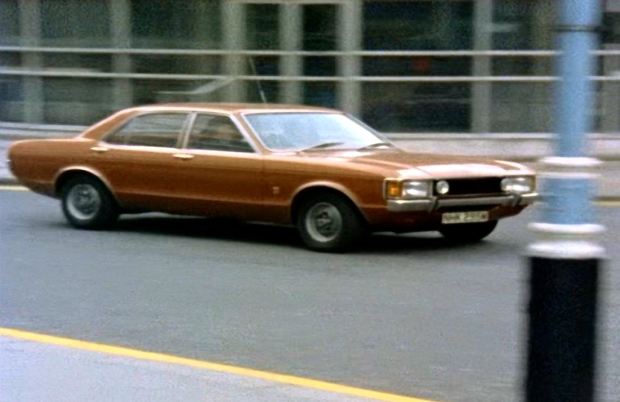
Regan and Carter’s famous Ford Granada, speeding into New Scotland Yard
Both chaps are very much of their time; hard drinkers and heavy smokers, who are quite content to administer their criminal foe with a few well-placed slaps if it gets the job done (especially if they’re in a rush to get to the canteen for their dinner!)
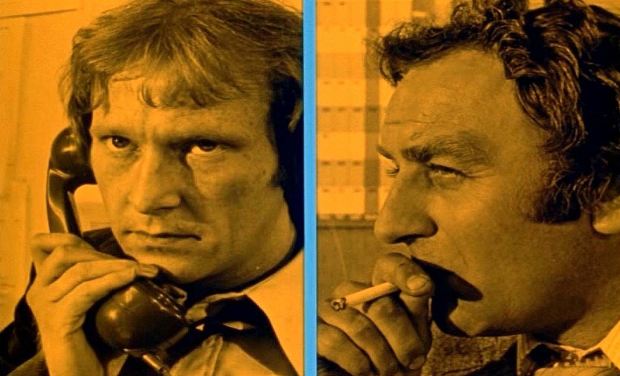
George Carter and Jack Regan
When it was first shown, The Sweeney was revolutionary, introducing a bold new realism and levels of violence which had previously been unknown in more vintage cop shows such as Z –Cars and Dixon of Dock Green.
It also demonstrated that life is full of grey areas. The ‘good guys’ certainly had their flaws- and didn’t always win the day.
So popular was the series, that two big-screen adaptations were made in 1977 and 1978 respectively.
Filming of The Sweeney (an episode of which generally took a mere 10 days to complete) took place all over London and, at the Colet Court studio in Hammersmith, a set representing the Flying Squad offices was constructed in what used to be the old school’s gymnasium.
In later series, episodes of The Sweeney featured this sequence as part of the closing credits, filmed around London’s West End at a time when the area was at its seediest.
http://www.youtube.com/watch?v=vrb3djQbz20
Danger UXB (1979)
Danger UXB was a period drama, set during WWII and the Blitz on London.
‘UXB’ stands for unexploded bomb, and the series followed the terrifying work of a bomb disposal team; men from the army’s Royal Engineers, who would often have to rely on luck, hunches and the barest of information when disarming unexploded Nazi bombs.
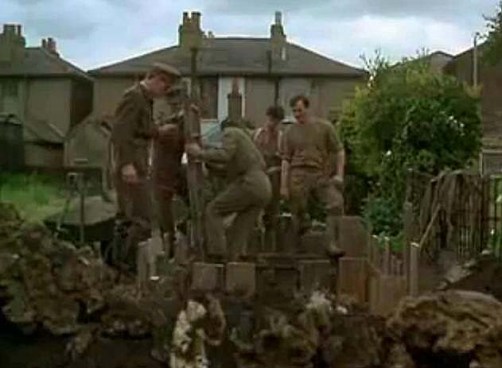
Disarming an unexploded bomb in a South London garden…
13 episodes of Danger UXB were made, with much of the filming taking place around South West London; namely Tooting, Streatham and Clapham.
Out (1978)
Out was a brooding, six part serial about Frank Ross, an ex-bank robber who has just been released from prison after an eight year stretch.
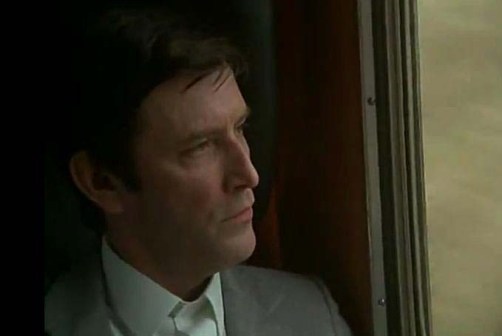
Frank Ross… fresh out of prison and on a train to London’s Paddington Station
Returning home to his native London, he discovers that the lives of his wife and son have sunken to a desperate low during his time away.
Consumed by hate and an urgent desire for revenge, Frank sets out to track down the informer who had him sent down in the first place…
The following is a short clip from the first episode, which sees Frank arrive home, fresh out of jail.
He has travelled by Taxi from Paddington Station to Tulse Hill (just south of Brixton) – a fare which, in 1978, apparently cost the princely sum of £4!
Luckily, as the Taxi driver demonstrates, we cabbies do have a heart!
http://www.youtube.com/watch?v=t_EEZEF0Mak
Fox (1980)
Taking a year to make, Fox was an epic drama about a large, Clapham-based family. So complex were the themes and structure of the story, that it has sometimes been likened to the Godfather set of films.
The head of the Fox clan is Billy Fox (played by noted actor, Peter Vaughn), a former Covent Garden market porter and staunch community figure, who has held his family together throughout the years.
However, when Billy dies, the cracks and tension in the family begin to show…
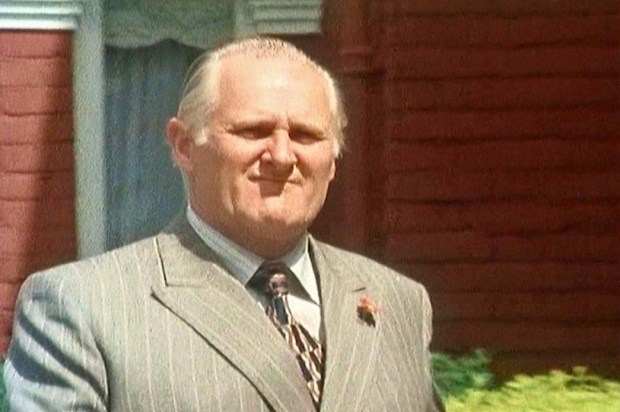
Billy Fox, marching around the streets of Clapham
Fox was notable for featuring the actors Ray Winstone and Bernard Hill (who, in 1982, would go onto portray the infamous ‘Yosser Hughes’ in Alan Bleasdale’s brilliant, Liverpool-based drama, Boys From the Blackstuff).
Quatermass (1979)
Quatermass (taking its name from the programme’s main protagonist, Professor Bernard Quatermass), is a science-fiction franchise, first conceived by the BBC in the 1950s.
In late 1979, the series was taken on by Thames Television, and Euston Films were given the task of producing the expensive show.
ITV’s Quatermass was set in the final days of the 20th century, a horrifying near-future in which civilisation seemed poised on the abyss.
In the first episode, Professor Quatermass travels to London and witnesses first-hand how far the capital has plunged into a dystopian nightmare.
One example of this is the taxi which the Professor arrives in.
Seen in the serial’s opening sequence, and as the screenshot below illustrates, the Black Cab is heavily fortified, Mad Max style, in order to guard against marauding gangs!
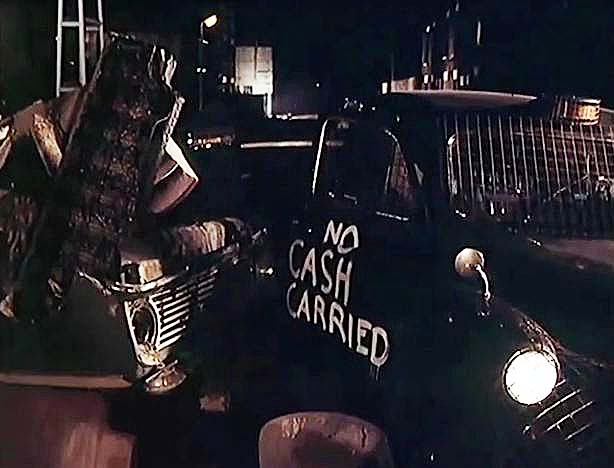
Cabbing in the dystopian future…
To add to humankind’s woes, a joint effort between the USA and USSR to link up two spacecraft, which Professor Quatermass has been invited to discuss on television, is destroyed by a mysterious alien force.
Despite this aggression, some people- especially those of the younger generation- believe the aliens are here to provide a gateway to a better life, and so gather at ancient, Neolithic sites where they believe the mysterious visitors will be beam them up. However, when the aliens cast their light over these groups, the unfortunate victims are vaporised.
In one episode, a crowd of thousands gather at a rather decrepit looking Wembley Stadium (the site being chosen, we are told, because, in years gone by, football was followed by some like a religion; the pitch itself being nicknamed the ‘hallowed turf’!)
Consequently, many thousands who are naïve enough to put their trust in the aliens, are killed by a powerful death-ray, which illuminates and consumes the stricken stadium…
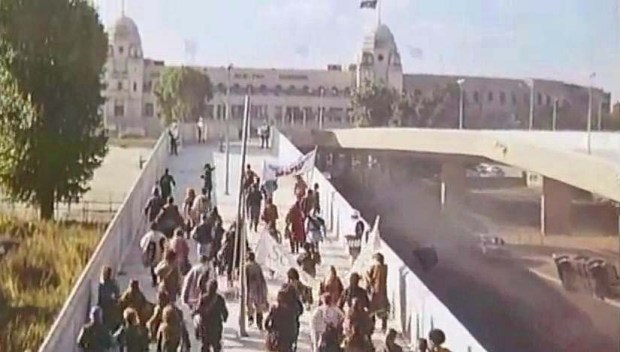
On the Wembley Way…
The Nation’s Health (1983)
The Nation’s Health was a series of four plays, made for Channel 4 which, at the time, had only been broadcasting for one year and was keen to prove itself as a provider of controversial, challenging output.
The drama, which is told through the eyes of Jessie Marvill, a junior doctor, aimed to reveal the true state of the NHS at the time which, unsurprisingly, was pretty grim.
Frustrated by increasing levels of bureaucracy and a general lack of humanity, Jessie, becomes rather jaded. Each episode of The Nation’s Health was followed by a live studio debate.
http://www.youtube.com/watch?v=8DCY0NqbSm4
Widows (1983-1985)
Widows, penned by prolific crime writer, Lynda La Plante, was a gritty series, putting a feminine spin on a genre usually regarded as being the domain of the masculine.
The widows in question were married to a gang of armed robbers; a ruthless bunch who we see in the drama’s prologue as they attempt to pull off an audacious hijack in the heart of London.
This particularly striking scene was filmed around London’s Southbank; not far from the Royal Festival Hall and National Theatre.
After passing the Tennison Way, bull-ring roundabout (where the huge IMAX cinema now stands),the subsequent chase then heads over Waterloo Bridge, reaching its explosive finale in the Strand Underpass tunnel, deep beneath Aldwych…
http://www.youtube.com/watch?v=S9J0NImR94g
Following the fatal accident which took the lives of their spouses, the three widows- Dolly, Shirley and Linda decide to adopt their late husbands’ criminal careers…
Minder (1979-1994)
Along with The Sweeney, Minder was the most famous series to emerge from Euston Films. It was also their most profitable and longest-running franchise.
The huge success of Minder owed much to the excellent casting of veteran, comic-actor, George Cole and the younger, Dennis Waterman, who was already popular with audiences thanks to his recent stint in The Sweeney.
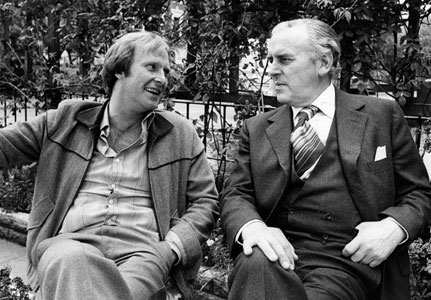
Publicity photo of Terry and Arthur
The premise of the series was simple. Terry McCann (Dennis Waterman) was a small-time crook and ex-boxer who has just finished a stretch in Wormwood Scrubs prison. Despite his criminal past, Terry is an affable character who always had the viewers on his side.
Arthur Daley (George Cole) is a roguish personality; a second-hand car salesman and general wheeler dealer, whose shady business dealings often land him in all sorts of bother.
In need of work after coming out of jail, Terry has agreed to be Arthur’s bodyguard; a ‘Minder’, thus setting the scene for all sorts of scrapes and criminal run-ins.
A secret to the success of Minder was that it mixed many elements; drama, pathos, comedy and, of course the Euston Film staple of gritty, London locations.
It also featured the immensely catchy tune; “I Could Be So Good For You” in its opening and closing credits.
Written by Dennis Waterman and his then wife, Patricia, the song proved so popular that it reached number 3 in the charts in November 1980.
The London locations used throughout Minder’s entire run are far too numerous to detail here. However, an idea of how much the city featured can be garnered from the famous end credits which can be viewed below.
Here is a guide to the locations featured in Minder’s end-credits sequence:
1) The cabin on Arthur Daley’s second-hand car yard, which was located on Blythe Road, in Shepherds Bush. Today, this plot has been built over.
2) Hammersmith Bridge
3) The Royal Albert Hall, Kensington
4) The Blue Anchor Pub, Lower Mall, Chiswick. This pub has also been used in the more recent BBC detective show, ‘New Tricks‘- also starring Dennis Waterman (and yep, he sings the theme tune for that too!) The Blue Anchor is still going strong today… why not pop along for a pint? Their website can be found here.
5) The wonky lamppost was on Newman Passage, off of Newman Street (just north of Oxford Street). Sadly, this quirky, little London landmark has now been replaced by a boring, straight version!
6) The ‘Winchester Club’; Arthur and Terry’s favourite drinking den. This was on Adelaide Road, just behind Chalk Farm tube station. Today, the location is pretty much unrecognisable.
7) Leicester Square
8) The final picture was taken outside Fulham Police Station (Heckford Place, near Fulham Broadway).
The Knowledge (1979)
Last but not least, we have The Knowledge, a one-off play written by the late, great Jack Rosenthal.
Broadcast during the Christmas of December 1979, the play follows a group of four men who have decided to undertake the gruelling process known as ‘The Knowledge’; the intense training course which you must undertake and pass in order to drive a London Black Taxi.
The process is well explained in the candidates’ ‘acceptance interview’, in which the frightful Mr Burgess (wonderfully played by Nigel Hawthorne) lays down the rules:
http://www.youtube.com/watch?v=XNOUOtaKjqY
Having of course undergone the The Knowledge myself, I can confirm that Jack Rosenthal’s treatment of this process is very true to life indeed!
Filming of the scenes featured on this page took place at the Public Carriage Office; a 1960s building on Penton Street in Islington which, until recently, was the HQ for the Knowledge. Just thinking about Penton Street is enough to stir up the fear in my stomach!
Today, the process is handled at the modern ‘Palestra’ building, opposite Southwark tube station.
Mr Burgess was based on an actual examiner who, in real life, was in fact a Scotsman who took great delight in laying on his accent in order to bamboozle the poor students! I have spoken to a number of older cabbies, who encountered this individual during their training, and they all remember him with great dread!
Everything to do with learning The Knowledge is included in the play; the frustration, the nagging doubts, the suspension of one’s social life and of course, the terror of ‘appearances’- the regular verbal examinations which test what students have learnt so far (as well as subliminally assessing your personality and ability to deal with tricky members of the public).
Personally, I had to undergo 27 of these ordeals before I was considered good enough to drive a cab…
http://www.youtube.com/watch?v=OpEbtYmnjtM
Because it is so lovingly and accurately portrayed, The Knowledge has a special place in the hearts of just about every London Cabbie, and also of those who are training to be.
*
If you would like to know more about my own personal experiences of learning The Knowledge and training to be a London Cabbie, please follow the links in the ‘On the Rank‘ side bar, or alternatively, click here.






 View from the Mirror