Lower Robert Street… a Ghostly Tunnel in the Heart of London
Mere moments away from the very centre of London there lies a quiet, almost secret little road called Lower Robert Street.
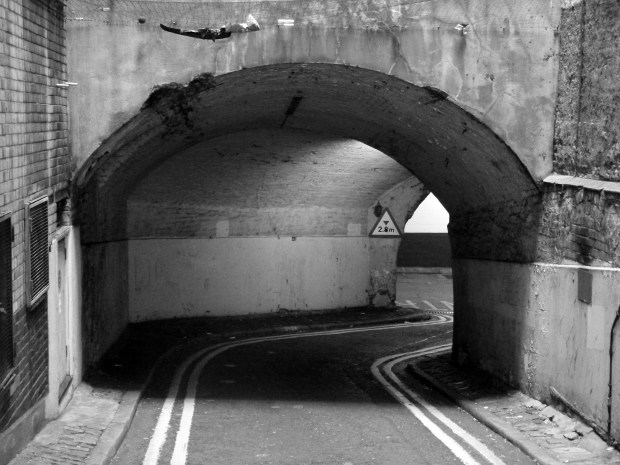
Entrance to Lower Robert Street…
Sandwiched between the Strand and Victoria Embankment and running through a twisting tunnel, Lower Robert Street is a covert cut-through we cabbies sometimes like to use if in the area and wishing to make a quick exit down to Victoria Embankment.
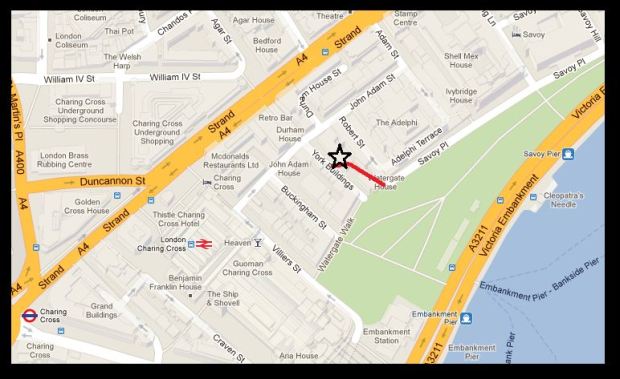
Map showing the location and approximate path (marked in red) of Lower Robert Street
Apart from the echo of the odd Taxi or bike courier, the archaic lane is pretty much devoid of any other traffic or people…
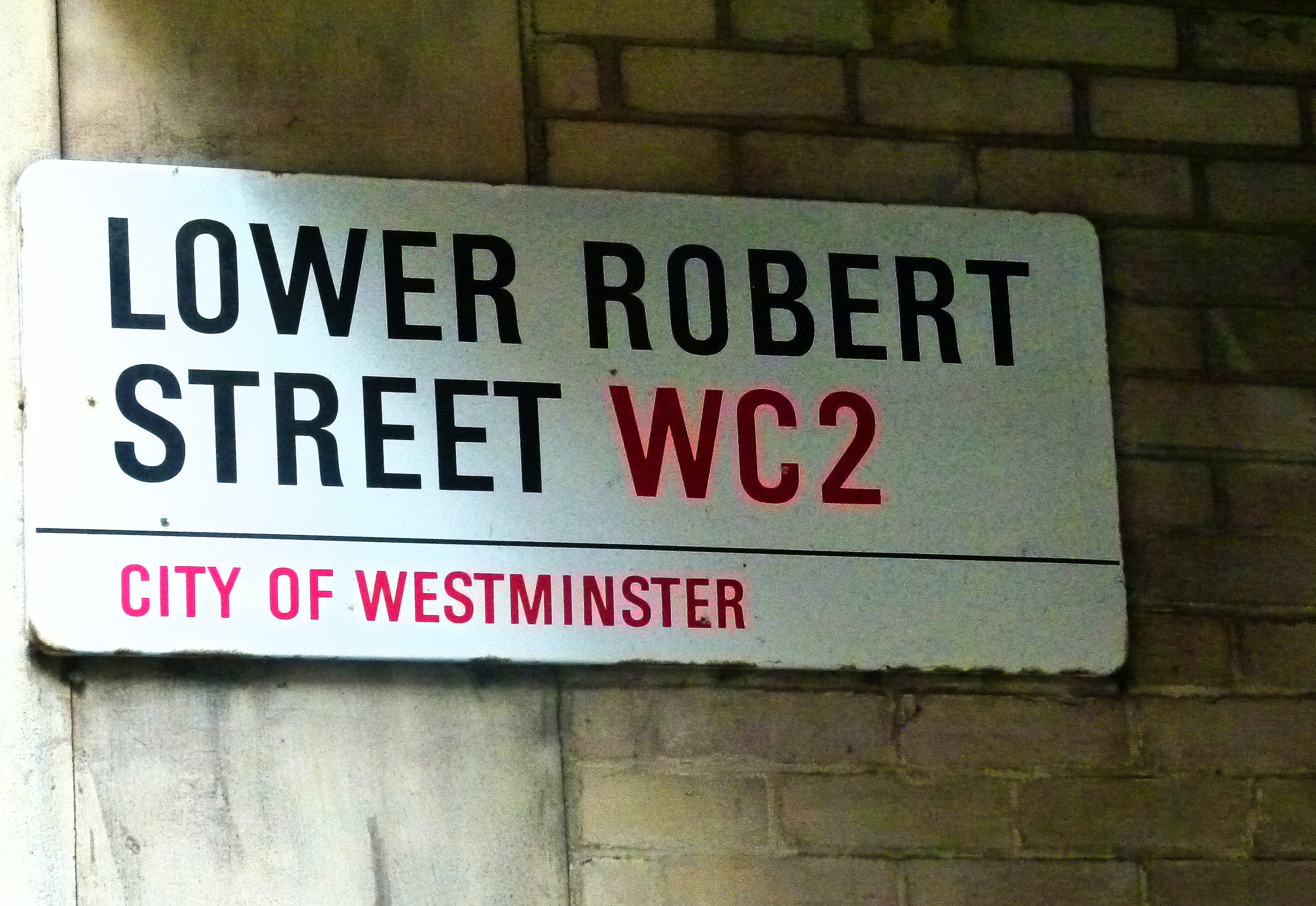
In recent years, Lower Robert Street’s grotto like appearance has gained it a nickname: the ‘Bat Cave‘!

Going underground… the modern extension of Lower Robert Street
Lower Robert Street dates back to the late 18th century, created as a by-product of ‘The Adelphi’; a large housing development consisting of 24 grand, terraced houses.
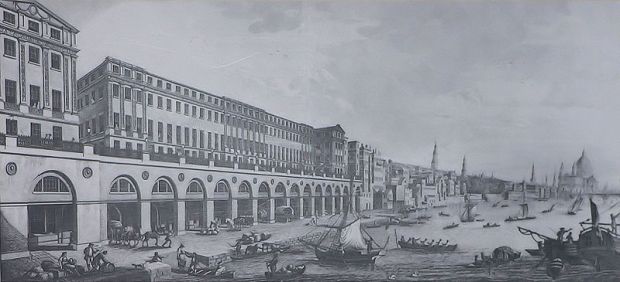
The Adelphi
The project was developed by four Scottish brothers; John, Robert, James and William Adam, whose fraternal bond blessed the scheme with its name- ‘Adelphi’ being the Greek word for brothers.
Construction began in 1772, with many of the labourers who worked on the project also being Scottish.
Nowadays of course you’ll often hear battered radios crackling away on building sites, but when the Adelphi was being built, music for the toiling workers was provided by a group of specially employed bagpipers!
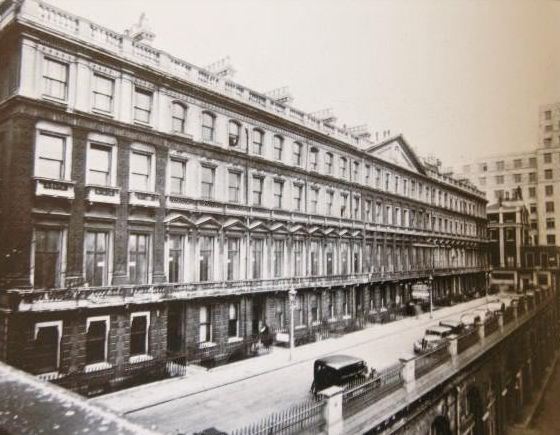
The Adelphi in later life, shortly before its demolition in the 1930s
Because it was so close to the river Thames, the Adelphi was located on a slope.
The main building – the row of ornate houses- remained level with the Strand, jutting out over the incline.
To fill in the large void below, a complex of vaulted arches and subterranean streets were created- of which Lower Robert Street is now the only remaining example in practical, public use.
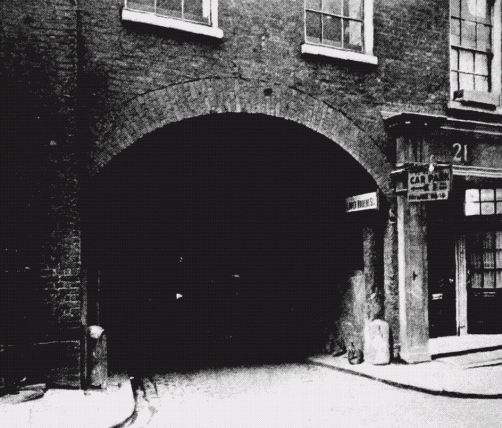
Vintage photo of the entrance to Lower Robert Street (image: British History website)
One other vault does exist it can be found in the rather more protected environment of the Royal Society of Arts on nearby Durham House Street:
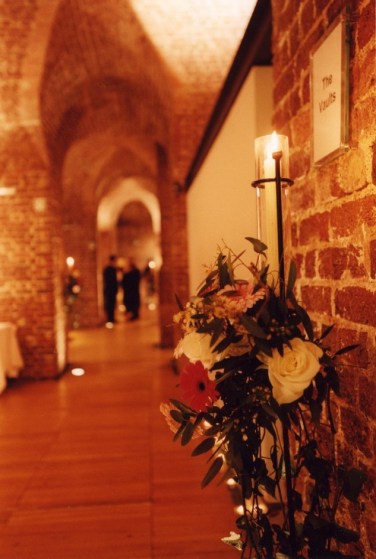
Remaining Adelphi arches incorporated within the Royal Society (image: Royal Society)
Many famous people lived in the grand apartments above including the actor David Garrick, Richard D’Oyly Carte (founder of the nearby Savoy hotel), Charles Booth (the great, Victorian social reformer) and a number of notable literary figures including George Bernard Shaw, Sir J.M Barrie and Thomas Hardy.
The Adelphi- and in particular the subterranean lair which lurked beneath- was also mentioned in Charles Dickens’ 1850 masterpiece, David Copperfield;
“I was fond of wandering about the Adelphi, because it was a mysterious place, with those dark arches. I see myself emerging one evening from some of these arches, on a little public-house close to the river, with an open space before it, where some coal-heavers were dancing; to look at whom I sat down upon a bench. I wonder what they thought of me!”
*
In the late 1860s much of the Thames in central London was reclaimed as part of a vast engineering program to improve the city’s sanitation, the waters pushed back as the wide Victoria Embankment was built.
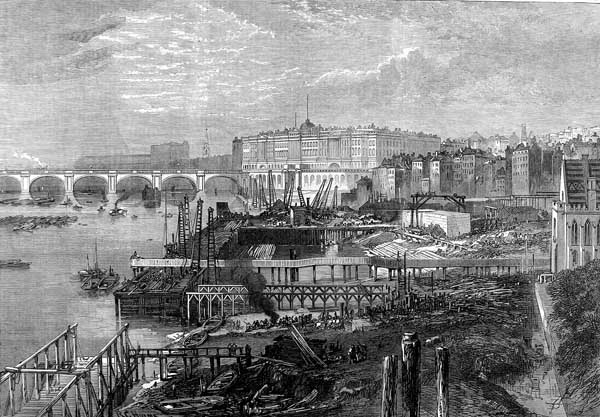
Victoria Embankment under construction, 1865 (image: Wikipedia)
This major road (which to do this day still conceals a vital sewer) was built right in front of the Adelphi’s lower vaults and roads, robbing them of their tranquil riverside location.
Once cut off from the Thames, the area beneath the Adelphi sank into decline, rapidly becoming a gloomy, foreboding place.
In line with much of Victorian London, the twisting underground roads became a haven for beggars and criminals. As one historian noted; “the most abandoned characters have often passed the night” beneath the Adelphi, “nestling upon foul straw.”
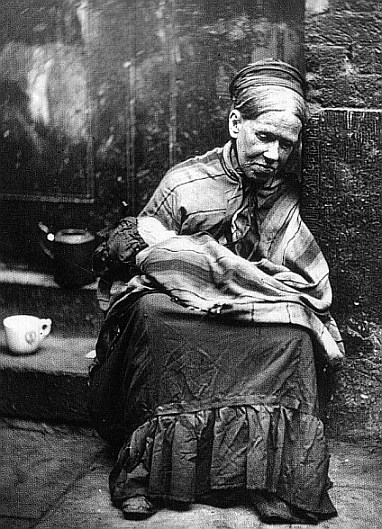
A famous image depicting the appalling conditions in which London’s Victorian poor existed. Such a sad sight would have been common place beneath the Adelphi.
Unsettlingly (and, perhaps unsurprisingly), Lower Robert Street, which was once an ingrained part of this depressing area, has its own resident ghost….
The phantom is known as ‘Poor Jenny’; a prostitute who lived and worked in the depths of Lower Robert Street, the bed upon which she languished being no more than a grotty pile of rags.
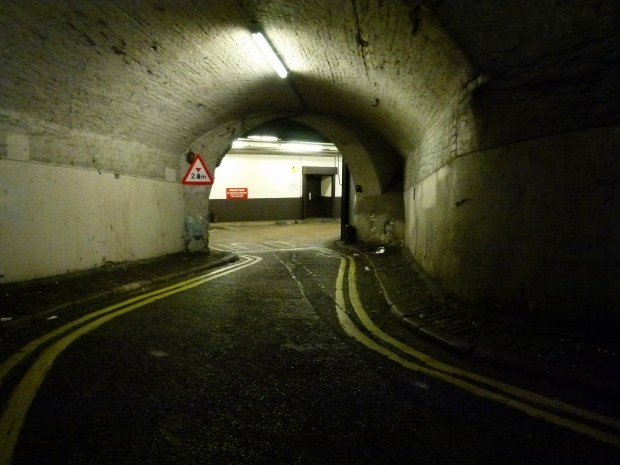
Deep within Lower Robert Street…. the haunt of ‘Poor Jenny’…
It is said that late one night, Jenny was throttled by one of her clients… today, her screams and gasps can be heard echoing through Lower Robert Street, the awful noise accompanied by a rhythmic tapping; the sound of Jenny kicking the floor as she fights against the strangulation…
Perhaps that’s why the powers that be choose to close the road every night between midnight and 7am…
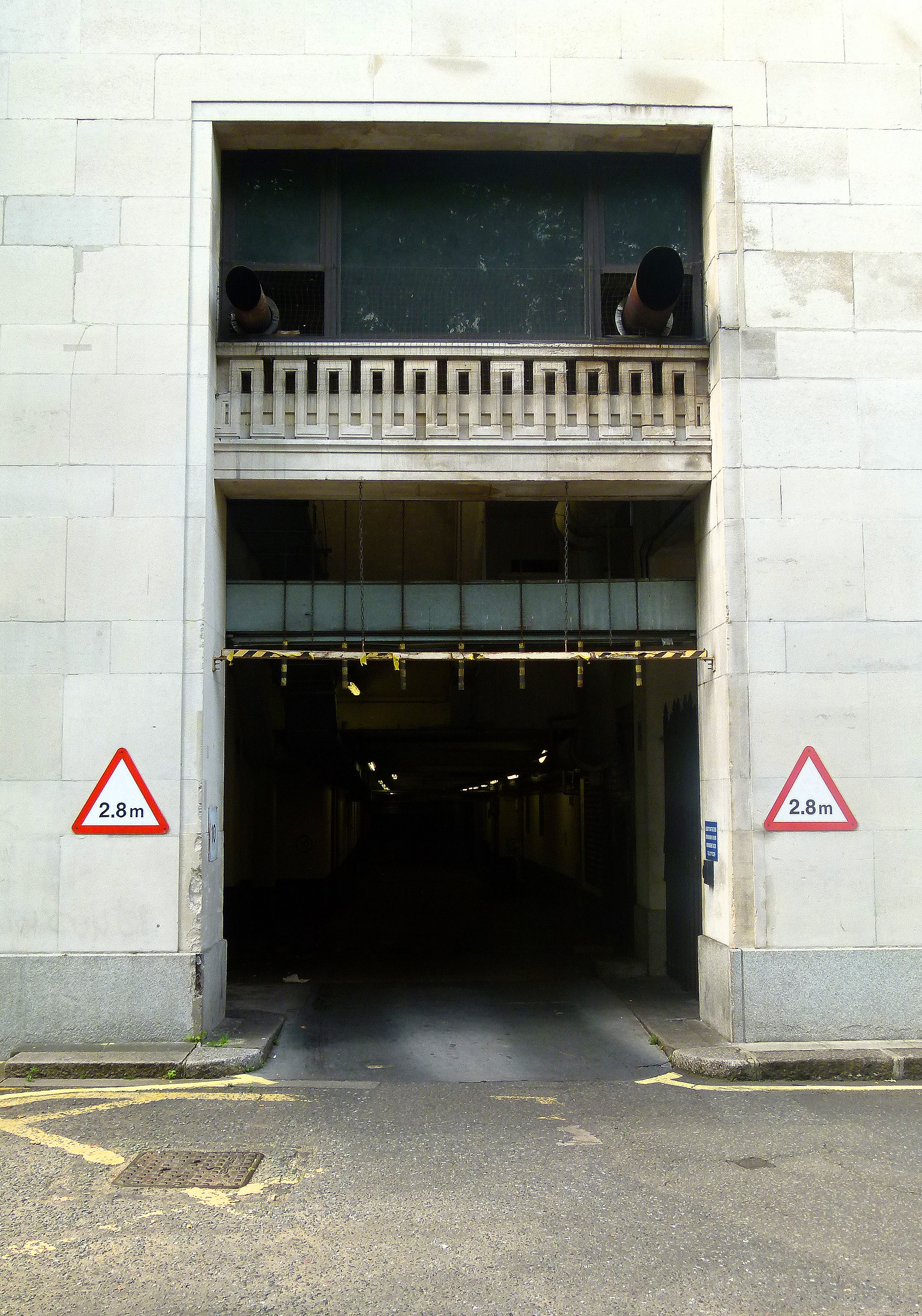
The exit to Lower Robert Street, located on Savoy Place
Tales From the Terminals: Liverpool Street…. From Bedlam to Kindertransport (Part One)

Having covered the corridor of stations which lie along the Marylebone and Euston road, we now move down into the City and onto one of the capital’s busiest terminals- Liverpool Street Station.

Liverpool Street (the road rather than the station) in its present form dates back to 1829 and is named after Robert Jenkinson; aka Lord Liverpool, a long-serving Prime Minister who was in office between 1812 and 1827.
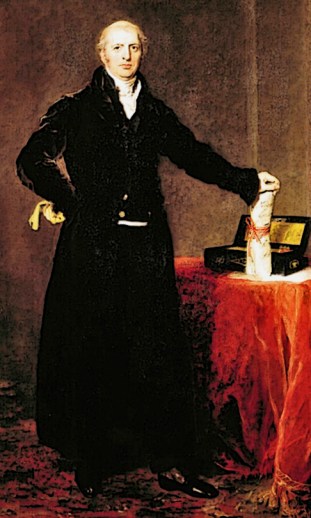
Lord Liverpool
Liverpool Street is not the first road to provide passage along the route.
The modern road was predated by a lane known as Old Bethlehem; a winding path which had existed for centuries; its name deriving from the fact that Bethlehem Hospital once stood on the ground now occupied by the station.
Bethlehem was no ordinary sanatorium… also known by its more infamous name, Bedlam it was London’s (and the world’s) first psychiatric hospital…
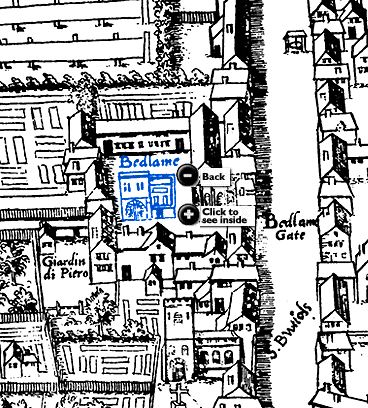
16th Century map (the ‘London Copperplate’) showing the location of Bedlam Hospital. The long, wide road to the right is the present day Bishopsgate; still a major route through the City (image from the Museum of London)
Bethlehem Hospital
The institution, which lay just outside the old city wall, first began caring for the mentally ill (or, as they were known back then, ‘distracted’) patients in 1377.
The term, ‘cared for’ however is grossly inaccurate.
Bethlehem Hospital was a hellish place, where patients were chained to their beds and considered to be no more than wild beasts.

Contemporary sketch of life inside Bedlam…
When heavy irons weren’t enough to keep them under control, patients were whipped or plunged into cold water in fruitless attempts to stifle their madness.
It comes as no surprise therefore that the word ‘Bedlam’- an old corruption of the hospital’s name- has passed into the English language as a phrase denoting a place of utter chaos and despair.
In 1676, the hospital moved a few hundred yards to Moorfields (where Finsbury Circus now lies), just across the road from where Liverpool Street station is now situated.
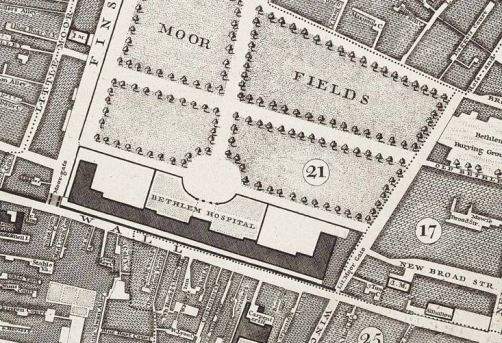
Original map showing the location of the second Bedlam Hospital which was located where the present day Finsbury Circus now lies
Designed by Robert Hooke, who was Sir Christopher Wren’s right-hand man, the new building was a very grand affair indeed.
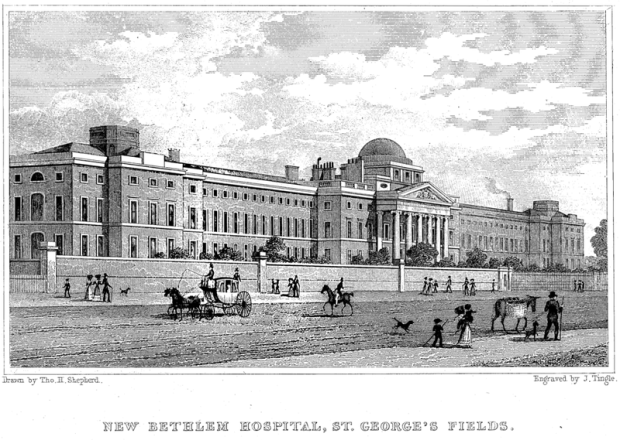
The second, grander Bedlam Hospital- the broad road in front is London Wall
The gates to the new asylum were presided over by two large sculptures; Madness and Melancholy.
Crafted by Caius Gabriel Cibber (who also created the impressive relief at the base of The Monument) the two statues are now held in the Bethlem Royal Hospital archives in Beckenham and can be seen in this following short clip from the BBC4 series, Romancing the Stone: The Golden Ages of British Sculpture:
It was within the new Bethlehem hospital that the notorious- and highly profitable-practice of inviting the public to come along and gawp at the patients first began.
Special galleries were incorporated into the building’s design for the purpose; small arenas where the patients were paraded like creatures in a menagerie.
An idea of what this process looked like can be garnered from William Hogarth’s innovative series of paintings, The Rake’s Progress.
Produced between 1732-33, Hogarth’s masterpiece consists of eight artworks which chronicle the decline and fall of Tom Rakewell, a young man who, after coming to London, is seduced by gambling, partying and prostitution.
Tom’s binge inevitably ruins him and, in the final picture, Hogarth portrays the Rake’s tragic demise as he succumbs to madness, his final days spent languishing in the pandemonium that is Bedlam whilst fan-fluttering ladies of high society look on…
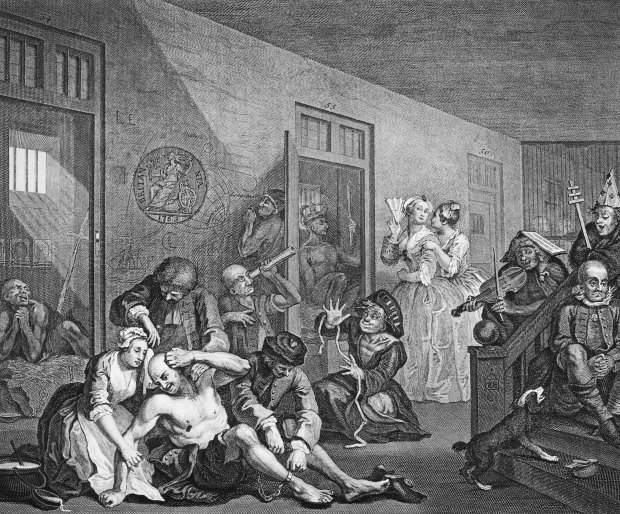
The Rake’s Progress, William Hogarth (1730s)
If you wish to see original Rake’s Progress, it can be found within the wonderful Sir John Soames Museum at Lincoln’s Inn Fields.
*
In 1815, Bethlehem Hospital moved out of the area for good, establishing a new home south of the Thames in Lambeth. During the move, patients were transferred to the new hospital in a fleet of specially chartered Hackney carriages.
Today, the Lambeth asylum is still in existence… although the building now serves a different purpose- it is home to the Imperial War Museum… where illness afflicting the mind has been swapped for the insanity of modern warfare…
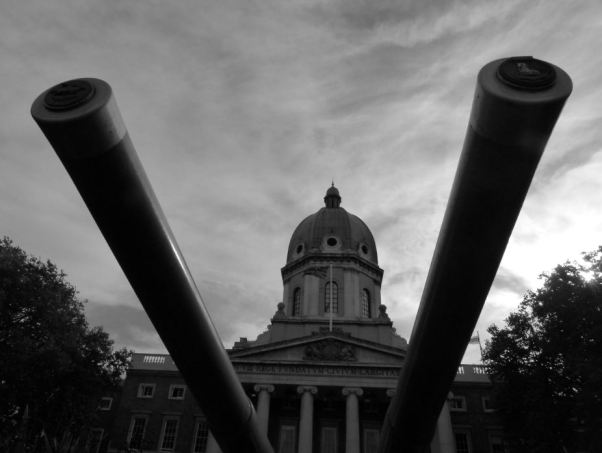
The third Bedlam… now the Imperial War Museum
The Railways Move In
The first station to arrive in the Liverpool Street area was the now vanished Broad Street, which opened in 1865 and remained in service until 1986 (an earlier post all about this former station can be found here).
Liverpool Street Station followed a few years later, opening next door to Broad Street in 1874 as the London terminal for the Great Eastern Railway.
Before their grand station opened, the Great Eastern had operated a smaller terminus just outside the City boundaries called ‘Bishopsgate’, which opened in 1840 on the junction of Shoreditch High Street and Bethnal Green Road.
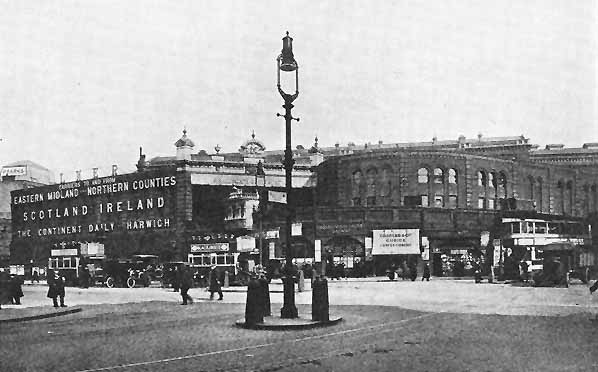
Bishopsgate Station; the prelude to the Liverpool Street terminal (photo: Subterranea Britannica)
The site remained in use as a freight depot until December 1964, when it burnt down. Today, the location is once again in use by the railways, with the London Overground’s recently opened Shoreditch High Street station occupying the former derelict land.
*
The architect behind Liverpool Street station was Edward Wilson; a Scotsman who was born in Edinburgh and was the Great Eastern’s chief engineer.
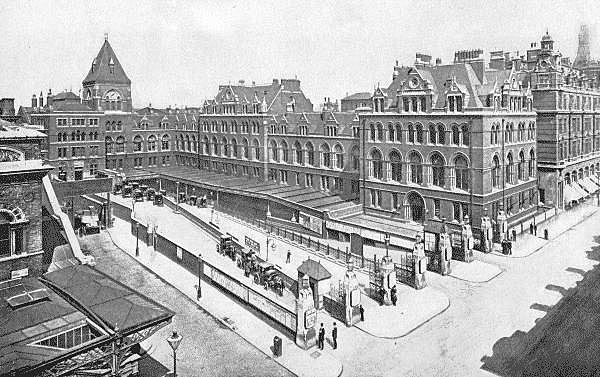
Liverpool Street in 1896 (photo: Wikipedia)
As regular users of Liverpool Street will know, the tracks actually lie below street level and one must descend stairs or escalators to reach their desired platform.
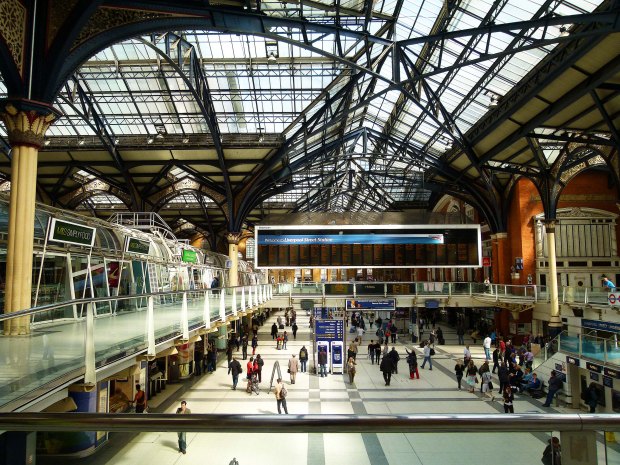
Liverpool Street’s two levels can be seen here- the balcony is at street height whilst the lower concourse, where trains arrive and depart, is below ground.
The reason for this is that the platforms were originally designed to provide a seamless link with the London Underground’s Metropolitan line.
At the time, The Great Eastern was a business partner of the new-fangled underground railway, so a smooth link-up with the subterranean system was considered to be financially beneficial.

Original emblems of former business partners, the Great Eastern and Metropolitan railways
In order to achieve this connection, the Great Eastern had to plough their tracks into Liverpool Street down a steep gradient, sending trains on their last leg steaming and groaning through a complex of dingy tunnels; a dismal approach to the metropolis which is still in use today.
The partnership between the two companies was eventually severed, and the novel set-up was condemned by Lord Salisbury- one of the Great Eastern’s chairmen- as being “one of the greatest mistakes ever committed in connection with a railway.”
The Great Eastern Hotel
In 1884, a grand hotel- The Great Eastern was added to the station which, for many years, was surprisingly the only hotel in the historic square mile.

The Great Eastern Hotel (now the ‘Andaz’)
The Great Eastern Hotel was designed by Charles E. Barry (Junior), son of Charles Barry (Senior) who was one of London’s greatest architects; the brains behind landmarks such as Trafalgar Square’s precient and the Houses of Parliament.
Charles Barry Junior was very much a chip off the old block, his design for the Great Eastern Hotel being very grand indeed.
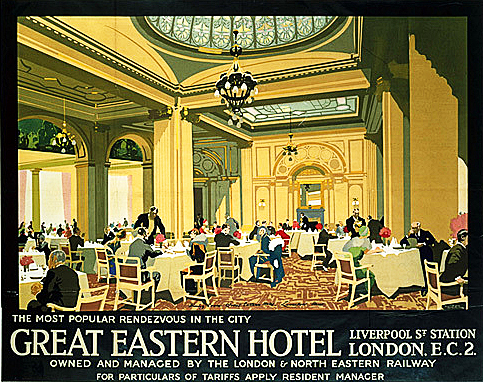
Early 20th Century advert for the Great Eastern Hotel (image from the National Railway Museum)
When it opened, the hotel boasted a glass-domed roof and no fewer than two Masonic temples.
A siding from the station was extended to reach beneath the hotel, creating a service area from where trains could take away the hotel’s waste and haul in coal to keep the well-heeled guests nice and toasty.
The Great Eastern Hotel also boasted seawater baths, the sloshing liquid being brought in from the coast by goods trains.
Speaking of water, when The Great Eastern Hotel was being constructed, it was impossible to lay down sewerage pipes due to the tunnels of the London Underground’s Metropolitan line being in the way.
As a result, the hotel had to improvise… resulting in a vacuum-flush system being designed, which to this day sees waste being sent rushing upwards! Probably best not to think about it whilst resting on your hotel bed!..
Today, the hotel- which was refurbished between 1997-2000 at a cost of £65 million- has been renamed The Andaz and is still an extremely lavish destination boasting five restaurants.
If you can’t afford a night or two at this lavish destination, the hotel is often open for public viewing during the excellent Open House weekend.
*
Notable Passengers
It was at Liverpool Street Station, one morning during the summer of 1886, that Joseph Merrick- aka ‘The Elephant Man’ was mobbed by a ferociously nosy, rush-hour crowd.
Prior to this incident, Joseph had been in Belgium where his famous deformities were pedalled in a travelling ‘freak show’.
However, by the late 1880s, such exhibitions were in decline and, seeing Joseph as a financial burden, the Elephant Man’s manager abandoned his protégé, stealing Joseph’s life savings to boot.
Penniless, frightened and alone, Joseph eventually managed to secure passage on a ferry to Harwich and, once arriving in the port, he boarded a train to London’s Liverpool Street.
Once at the busy station, his shuffling gait, oversized cloak and canvas hood quickly drew attention and within moments, Joseph was swamped by baying spectators; a nightmarish echo of the days when Bedlam existed on the site.
The terrifying event was included in the 1980 film, The Elephant Man, starring John Hurt. The scene was filmed on location at Liverpool Street itself:
Following this incident, Joseph was rescued by two policemen and taken by Hackney carriage to the Royal London Hospital where he would spend the rest of his tragically short life.
I have devoted two earlier posts to Joseph Merrick’s life and his time in London elsewhere on this website- to read please follow the links to part one here and part two here.
*
Thanks to its close links with Harwich port, Liverpool Street was also responsible for introducing some of the 20th century’s most famous left-wing political figures to London- namely the communists, Maxim Gorky, Rosa Luxemburg, Leon Trotsky (who famously suffered a nasty death when he was murdered with an ice-pick)… and the terrifying future tyrant, Joseph Stalin.

(From left to right) Maxim Gorky, Leon Trotsky, Rosa Luxemburg and and a young Joseph Stalin who arrived together in London via Liverpool Street Station
It was in 1907 that this as yet unknown group of communists travelled to London in order to attend a political conference.
In a way, it was also a spiritual journey, as their communist ideology was born in London, formulated by Karl Marx who resided in the slums of Soho and sought refuge with his writing in the British Library.
At Liverpool Street, the red-bunch were met by a small group of journalists and supporters, along with another famous party-member… comrade Vladimir Lenin who was already in London.
Upon greeting his comrades, Lenin announced that he was pleased they could come along for the event, and that they could expect a “fine old scuffle.”

Vladimir Lenin, who welcomed his Russian comrades at Liverpool street in the early 20th century
The young Stalin… the future dictator who would go onto wreak so much death and misery upon his own people, did not have far to travel from Liverpool Street to his new digs… he spent his time in London at a doss house on Fieldgate Street in Whitechapel, just over half a mile from the station… but that of course, is another story altogether…
Please click here for Part Two
Tales From the Terminals: Liverpool Street…. From Bedlam to Kindertransport (Part Two)
Liverpool Street at War
As with its former neighbour, Broad Street- which suffered at the hands of a zeppelin airship in 1915- Liverpool Street Station was the victim of enemy bombing during the First World War, with a devastating attack taking place in May 1917.
By this point the German military had realised that their airships, with their cumbersome and vulnerable nature, were no longer effective for carrying out air-raids over London.
With this in mind, they switched to smaller aircraft- the Gotha Bombers.

A Gotha Bomber; the make of aircraft which unleashed an early air-raid on Liverpool Street in 1917
With their speed and manoeuvrability, these craft proved far more deadly.
When a squadron of Gothas attacked Liverpool Street during the 1917 assault, they unleashed a lethal flurry of bombs, killing 162 people.
*
Four years after WWI, in 1922, a large memorial was installed at Liverpool Street Station as a solemn tribute to the many employees of the Great Eastern Railway who had perished during the devastating conflict.

WWI Memorial at Liverpool Street (photo: Wikipedia)
This memorial was unveiled at midday on June 22nd 1922 by Sir Henry Wilson, a 58 year old politician who had served in WWI as one of Britain’s most senior officers.
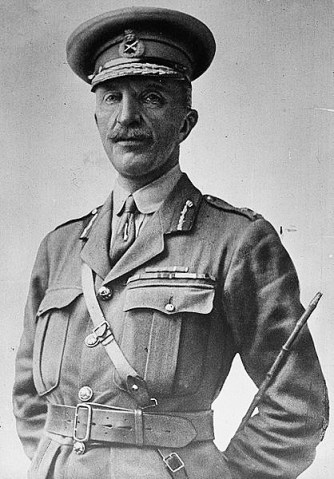
Sir Henry Wilson
Once the ceremony was over, Sir Wilson hailed a taxi, the destination being his home on Eaton Square… however, he never made it.
Lying in wait at the Belgravia address were Reginald Dunne and Joseph O’Sullivan; two members of the Irish Republican Army who were reputedly unhappy with the terms of the Anglo-Irish Treaty which had been signed six months before (coincidentally, the treaty had been signed at 22 Hans Place, a short walk from Sir Wilson’s home) .
From their vantage point, Dunne and O’Sullivan waited for Sir Wilson to pay the cabbie and then, as their target mounted the steps to his front door, the pair dashed forward, shooting the former Field-Marshall several times.
Sir Henry Wilson died on his doorstep, the murder causing chaos and outrage. His killers were both quickly caught, and executed at Wandsworth prison a few months later.
WWII and the Kindertransport
Liverpool Street’s finest hour occurred during the prelude to WWII, when the London terminal played a vital role in shepherding 1,000s of Jewish refugees- all of whom were children- to safety.
This process was known as the Kindertransport.
*
Ever since Hitler had seized power in 1933, Jews had been subject to persecution.
However, on the 10th November 1938, the Nazi’s hatred exploded dramatically and violently with the horrendous Kristallnacht; the ‘night of broken glass.’

A Synagogue burns on Kristallnacht, 1938
During the span of one evening, 267 synagogues, 7,500 Jewish businesses and 1,000s more Jewish homes were targeted, with Nazi thugs smashing windows and daubing anti-Semitic graffiti.
Arson was carried out on a huge scale, with many Jewish premises destroyed outright. A number of Jews were killed, whilst many more were rounded up and arrested.

Jews being rounded up in the aftermath of Kristallnacht
Following this night of horror, the Kindertransport concept was quickly conceived and put into action.
After getting the nod from then Prime Minister, Neville Chamberlain, certain immigration laws were suspended, thus allowing Jewish youngsters under the Nazi jackboot to enter the UK in large groups rather than waste precious time in applying individually.
In all, around 10,000 children found shelter in the UK under the system and every single one of them passed through Liverpool Street Station.

Plaque belonging to one of Liverpool Street’s Kindertransport memorials
The first group arrived just three weeks after Kristallnacht- 196 little ones whose Jewish orphanage had been callously destroyed by the Nazis.

Two Kindertransport refugees, photographed on a ferry bound for Harwich
The young refugees came to the UK by ship, landing in Harwich. From there, they boarded special steam-trains to London, where they would be introduced to their kindly guardians at Liverpool Street Station.
The process brought both salvation and utter heart-break.
Although the youngsters found safe-harbour, the vast majority would never see their parents again as the families they were torn from fell victim to the perils of war, concentration camps and gas-chambers.

Mankind at its worst…. a Star of David patch which Jews under the Nazi regime were required to wear upon their clothes
*
Today, the Kindertransport’s life-line is commemorated at Liverpool Street by two sculptures.
The first, which is tucked away on the station’s bustling concourse, was originally unveiled in 2003 and is dedicated to the Quakers, whose campaign was vital in instigating and implementing the Kindertransport.
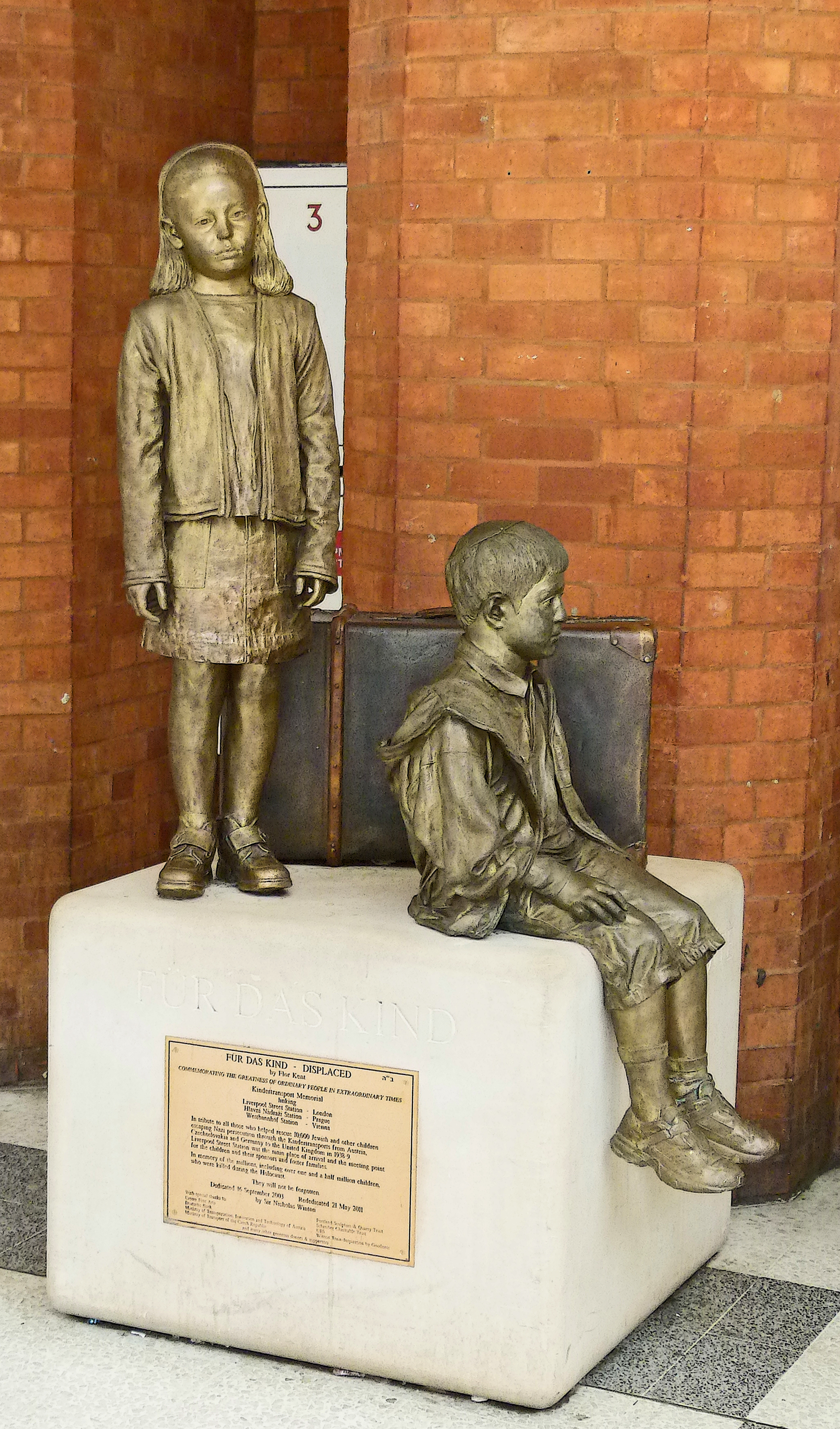
This poignant statue is twinned with similar artworks at Prague’s Hlavni Nadrazi Station and Vienna’s Westbannhof Station, both of which served as departure points for the evacuating children.

Kindertransport statue in Prague; cousin to Liverpool Street’s memorial
On 21st May 2011, a ceremony was held in which Liverpool Street’s subtle memorial was rededicated by a very special man… Sir Nicholas Winton- who is represented as the bespectacled chap holding the small child in the Prague statue above.

‘Nicky’ Winton in the late 1930s
Sir Nicholas- a Londoner, born in Hampstead in 1909- played a huge role in the Kindertransport, single-handedly organising the evacuation of 669 Jewish children from Czechoslovakia.
His amazing feat, which was carried out from a makeshift office set up in a Prague hotel room, has resulted in him being dubbed Britain’s answer to Oskar Schindler.
In 2011, a documentary film- Nicky’s Family– was made, chronicling Sir Nicholas’s efforts and the subsequent influence his humanity has had upon others.
The trailer for this moving film can be viewed in the following clip:
A humble man, Sir Nicholas didn’t speak about the immense role he’d played in saving so many youngsters from the evils of Nazism for several decades.
Things came to light again in the late 1980s when his wife, Greta discovered Nicholas’ note-books in the attic; the very books and paperwork which he’d used to administer the large scale evacuation.
Greta approached the BBC, who managed to track down 80 of those whose name appeared in the book and, in 1988, Sir Nicholas was invited onto the show, That’s Life to discuss the Kindertransport.
What the great man didn’t know as he sat in the audience was that he was surrounded by a large group of the now fully-grown up children whom he’d saved 50 years previously, all of whom would have started their new lives at Liverpool Street Station.
The following clip demonstrates what happened next….
In 2009, to mark the 70th anniversary of the Kindertransport, the lifeline’s route was re-created, with specially chartered steam locomotives linking up the stages across Europe.
The carriages, which were hauled by vintage trains, carried many of the surviving (and now very much grown up!) refugees, who had fled tyranny so many years before.
Younger guests were also invited to join the special ride, giving them the opportunity to chat to the former Kindertransport children about their tragic stories and experiences.
The final leg of the emotional event- Harwich to London- was hauled by the Winton Train; named in honour of Sir Nicholas.
The fantastic engine can be viewed in the following clip, as it thunders towards Liverpool Street on the memorial day:
Sir Nicholas Winton is still alive today; going strong and looking amazingly well at the grand old age of 103.
A true inspiration.
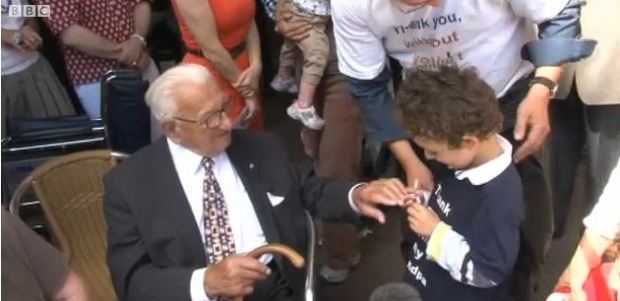
Sir Nicholas Winton at Liverpool Street in 2011
Sir Nicholas can be seen in a BBC news report from 2011, which details the re-dedication of Liverpool Street’s first Kindertransport memorial. Please click here to view the clip.
*
The second Kindertransport memorial at Liverpool Street Station can be found just outside one of the entrances, standing on a relatively peaceful area which has been named ‘Hope Square’.
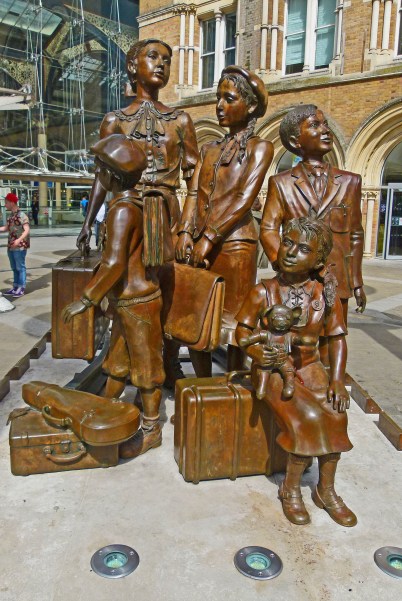
Hope Square Memorial, Liverpool Street
Unveiled in 2006 by Prince Charles, the sculpture was created by Frank Meisler- who himself was a Kindertransport refugee, arriving from the Polish city, Gdansk in 1939.
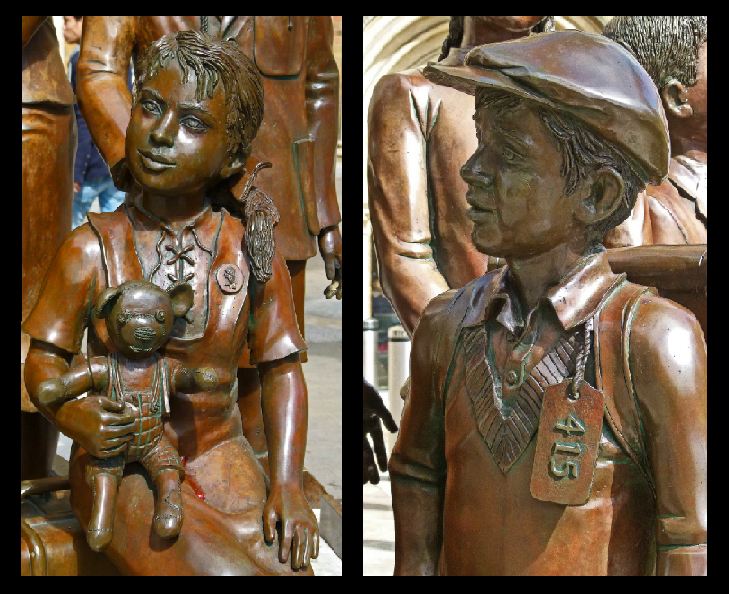
Frank’s Liverpool Street sculpture is actually part of a series, having three counterparts across Europe which chronicle the route of the Kindertransport.
The other sculptures can be found at Gdansk station in Poland, Berlin’s Friedrichstrasse station (which also commemorates the many more unfortunate youngsters who boarded more sinister trains to the death camps) and Rotterdam; the port from where the children would depart for the assured safety of England…

Kindertransport memorial at Gdansk, Poland
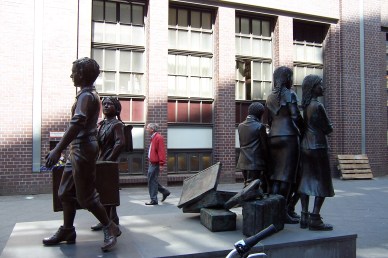
Kindertransport memorial, Berlin… ”Children on the Train to Death and Children on the Train to life’ (Photo: Wikipedia)
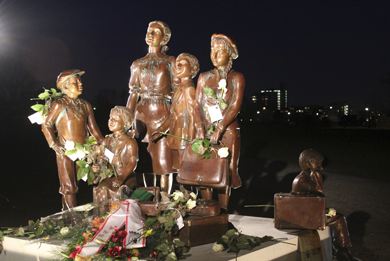
Kindertransport memorial, Rotterdam… the departure point for England (photo: Frank Meisler)
The Blitz and a challenge to authority
Once WWII was fully underway the Kindertransports were forced to cease… and, in 1940, Hitler unleashed his fury on London with the nightly Blitz.
Once the regular air-raids commenced, many Londoners considered the London Underground- with its exceptionally deep tunnels- to be a natural place in which to seek shelter.
The government however had other ideas.
They feared that allowing people to shelter on the tube would result in a ‘bunker mentality’- in other words, they believed that once the shelterers were down on the platforms, they wouldn’t want to come back up ever again, becoming subterranean dwellers!
As such, official policy was that the Underground was for transportation only; anyone attempting to stay for the night would be moved on.
On the 8th September 1940, an event at Liverpool Street station would result in this policy being re-considered…
It was a Sunday evening when the air-raid sirens kicked in and the drone of enemy bombers could be heard approaching…. Eager to get under cover, large groups of residents from Spitalfields dashed towards nearby Liverpool Street, aiming to head for the station’s deep Central Line platforms.
Once there, the crowd found the entrance to the tube barred and gated; shielded by armed troops who were under orders to enforce the government’s no-shelter on the tube policy.
The spirited East-Enders took no time in deciding that this blockade just would not do … and by sheer force of numbers, they managed to disable the barricade, barging their way through and pouring down to the deep platforms, mounting what we today would most probably label a ‘sit-down protest.’
Overwhelmed, the authorities quickly realised that the ban on sheltering on the underground was unworkable and the following day, the Minister for Home Security did a U-turn, announcing that the public were in fact more than welcome to spend the night on the tube if they so wished.

Londoners sheltering at Liverpool Street Underground during the Blitz (photo: Museum of London)
Following this change of heart, the government’s paranoid predictions of bunker mentality were proved wrong.
People sheltered in the tube by night, but were more than happy to leave the following morning…. If anything, they were probably glad of the fresh air after being stuck deep below ground for hours in stuffy, smelly and downright uncomfortable conditions.
Nor was the tube always safe- on several occasions, many civilians were killed by direct hits on stations, with explosions at Balham and Bank being particularly catastrophic.
The following clip is taken from the end of the 1941 short film, Christmas Under Fire, which was shown in American cinemas and depicts the conditions endured by Londoners who opted to shelter on the tube during the Blitz:
Liverpool Street Today
Despite being one of London’s busiest and most illustrious stations, Liverpool Street gradually sunk into a gloomy, decrepit state during the second half of the 20th century.
In 1986, Liverpool Street’s neighbour, Broad Street was demolished and a fresh, modern development of offices, restaurants and public spaces known as ‘Broadgate’ rapidly sprung up to fill the void.
Part of this complex spilled over towards Liverpool Street; namely the impressive ‘Exchange Square’, which is constructed on a vast raft, perched over the subterranean tracks leading into the station; a set-up which invites an interesting perspective of Liverpool Street’s Victorian architecture.

Liverpool Street Station, seen from Exchange Square
Popular with city-workers on their lunch break, Exchange Square is dotted with small cafes and eateries… and a wide array of public artworks, the largest of which is the ‘Broadgate Venus’:

Broadgate Venus
Weighing 5 tons, the Broadgate Venus was installed in 1990, its creator being Mr Fernando Botero, a Columbian artist who originally trained as a bull-fighter! Fernando’s work is very distinctive in that his subjects often appear tubby- his 1959 re-imagining of the Mona Lisa being a good demonstration of his style!
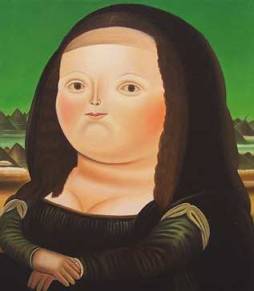
Fernando Botero’s Mona Lisa
The Future and reminders of the Past
Today, Liverpool Street continues to grow thanks to its role in the new Crossrail project; an express subway which will link the capital to a number of commuter towns stretching from Essex to Berkshire.
Deep beneath Liverpool Street, a large interchange is currently being constructed to serve the new route; a true feat of engineering which requires hefty piles to be ploughed 130ft into the ground.

Artist’s impression of Liverpool Street’s Crossrail entrance
Whilst excavations have been taking place, a large number of human skeletons have been unearthed, many of which lay only a few feet below the surface as generations of commuters trudged overhead…

A former inmate of the Bedlam Psychiatric Hospital, which once stood on Liverpool Street (photo: Crossrail)
These skeletons, which have been receiving the utmost care and attention in their removal, belong to former inmates of the Bedlam lunatic asylum; the site of the excavations marking the old hospital’s burial ground.
Archaeologists on the project have confirmed that the remains of 4,000 souls lie in this compact area, and it is hoped these sad collections of bones will give historians more insight into the lives of those who were ‘treated’ at the horrendous institution.
As this London terminal expands to meet the needs of the 21st century, these once long-forgotten skeletons are a sober reminder of Liverpool Street’s darker past.





 View from the Mirror