The London Temperance Hospital
With it being January and that time of year when people strive to lay off of the booze, I thought now would be an appropriate time to examine a certain derelict building which can be seen rotting away on Hampstead Road close to Euston station.

The former London Temperance Hospital as seen from the junction of Hampstead Road and Cardington Street
These mouldering remains were once the London Temperance Hospital, an institution set up by the National Temperance League in the 1870s with the aim of providing medical treatment without the aid of alcohol.

The London Temperance Hospital in its heyday
At the time, alcohol (abuse of which aside) was generally seen as a healthy, positive substance (hardly surprising considering the filthy, disease-ridden water people had to endure) and was widely used to cure patients suffering anything from malnutrition to delirium. It was also not unusual for hospital staff to enjoy the odd tipple whilst on duty…

Cartoon of a drunk Victorian man
The Temperance Society on the other hand viewed alcohol as a curse which lay at the very heart of society’s ills, and their specialist hospital therefore discouraged the use of alcohol in treatment– although it wasn’t entirely ruled out, its use being tolerated in “exceptional cases.”
When it was first founded in 1873 the London Temperance Hospital was originally based on Gower Street, Bloomsbury. It moved to the larger, purpose built premises on Hampstead Road in 1885 where it was put under the control of a board of twelve teetotallers.

Plaque commemorating the foundation of the London Temperance Hospital (image: Geograph)
The land upon which the new hospital was built was purchased from St James’s Church– the ground being previously occupied by a chapel and the St Pancras Female Charity School (i.e. workhouse).

Map of the Hampstead Road site before the Temperance Hospital was built
By all accounts the hospital was a great success and its policy of refusing to store stocks of alcohol resulted in thousands of pounds being saved every year.
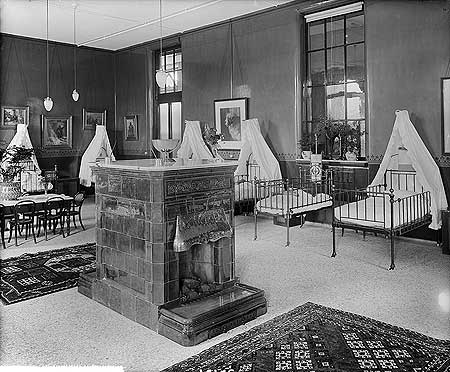
London Temperance Hospital children’s ward, 1897- complete with fireplace in the middle (image: English heritage)
*
Being so close to Euston, the hospital found itself on the front line in April 1924 when a specially chartered train carrying football supporters from Coventry en route to the Cup Final crashed with an electric train from Watford in a tunnel close to the station.

Aftermath of the 1924 Euston tunnel crash (image: London Illustrated News)
Four passengers were killed and many more injured, including the elderly driver who was trapped beneath heavy machinery for five hours.

The train driver being carted to the London Temperance Hospital after enduring a five hour rescue (image: London Illustrated News)
A less serious accident occurred later that same year when a bus crashed right outside the hospital… the driver of which, John Summers was found to be drunk! Perhaps fate was trying to tell him something…
*
In 1931, American tycoon Samuel Insull gifted the princely sum of $160,000 to the hospital allowing an extension to be created. Insull’s name can still be glimpsed on the newer building today.

Samuel Insull and the hospital wing which he kindly funded
Shortly after Insull’s donation the hospital was renamed the National Temperance Hospital. It merged with the NHS in 1948 and was formerly closed in 1982.
The building found further use however in 1986 when it was leased to the organisation, Freedom from Torture who adapted the facilities for the treatment of victims of torture from across the world.

A Turkish Kurd patient rests in the former Temperance hospital, 1990 (image: The Guardian)
Over 1,000 people were treated at the hospital, but the unit was sadly forced to close abruptly in 1990 following budget cuts.
The building limped on, finding use as a clinic and training centre, but has lain empty since 2006 and is now in a dreadful state, strangled by weeds, its windows cracked, ornate balconies rusted and basement flooded.
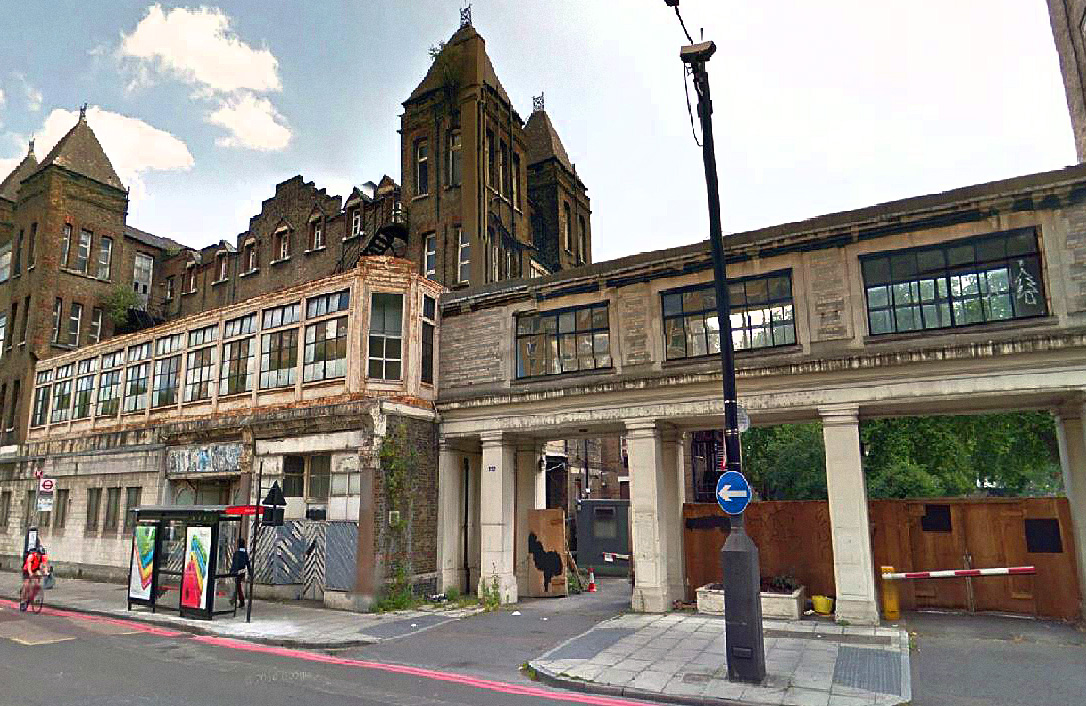
The hospital’s dilapidated entrance, as seen from Hampstead Road (image: Google)
If the planned High Speed Two rail project goes ahead it is likely the old Temperance hospital will be swept away forever.
Sneaky images of the hospital’s ruined interior, taken by an intrepid urban explorer, can be viewed here.
The Christmas Truce, December 24th 1914
In early January 1915 and with conflict raging in Europe, The Illustrated London News carried the following cover depicting a moving scene in which a German soldier, in a brave gesture of peace, approaches British troops with a little, lit tree on Christmas Eve.

Drawn by an artist on the frontline, the image was accompanied by the following caption:
“On some sections of the battle-front the Germans decorated their trenches with Christmas-trees and paper lanterns, and invited our troops to stop shooting and come over to smoke and have a palaver. With one accord a truce for the night was arranged, and the compliments of the season were passed with much enthusiasm between friend and foe.
The cessation of hostilities continued all the next day. Both sides fraternised and spent a Happy Christmas.”
Another image from the same issue depicted German and British troops swapping headgear and enjoying a good laugh and smoke together:
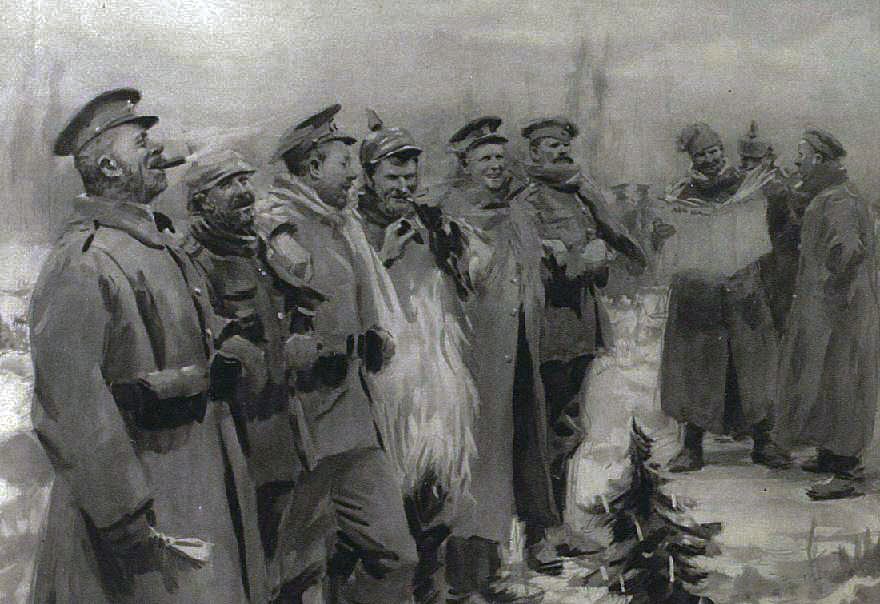
German and British troops together, Christmas 1914
Although it may sound tenuous of me to say, these are stories and images which I can relate to.
As a London Cabbie, I have the pleasure of meeting passengers from all over the world; people from a vast array of creeds, races and backgrounds…. and the one thing which always shines through is humanity; the ability of most people, no matter where they’re from, to display friendliness, a polite nature and a good sense of humour.
Peace to you all & a very merry Christmas
WWI 100: London’s Memorials… The London Troop Monument
The London Troops Monument
The Royal Exchange

The London Memorial (aka the London Troops Monument) outside the Royal Exchange
It is estimated that around 900,000 men from London fought in the Great War, approximately 300,000 of who were killed or injured.
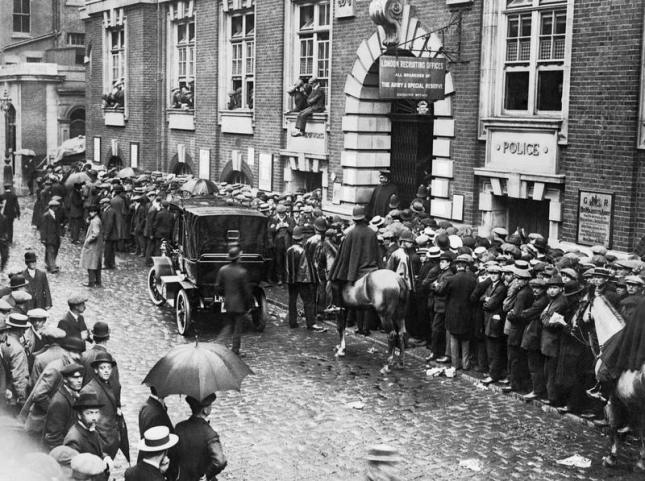
Recruiting office at Great Scotland Yard, August 1914
Standing outside the Royal Exchange in the heart of the financial district, the ‘London Memorial’ lists all of the regiments from the capital involved in the horrendous conflict and commemorates the countless Londoners who lost their lives.
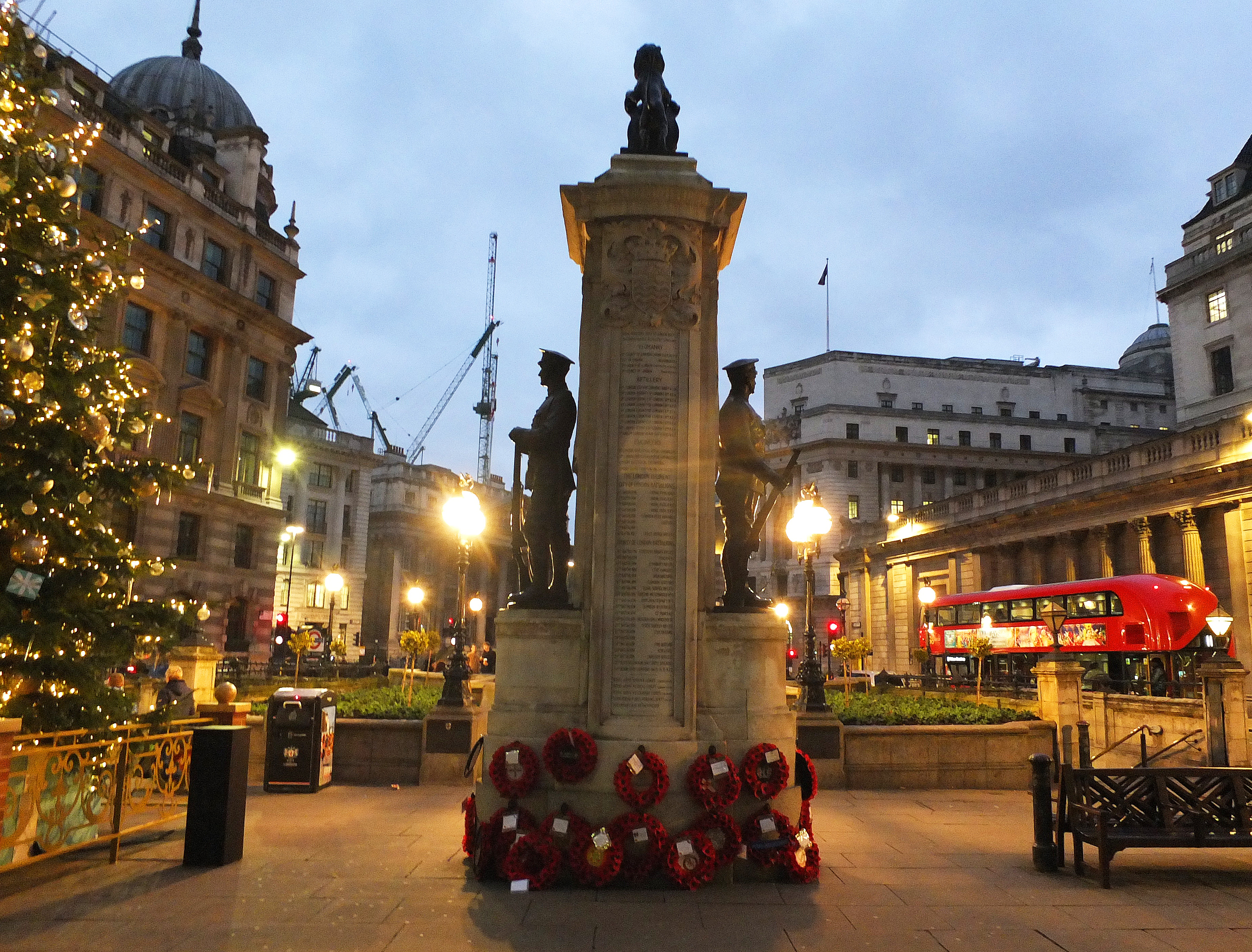
The London Memorial as seen looking towards Bank junction
The memorial’s Portland stone plinth was designed by the then President of the Royal Academy, Sir Aston Webb (who was also responsible for Admiralty Arch and the Queen Victoria Memorial outside Buckingham Palace), whilst the two figures standing either side were created by Alfred Drury.
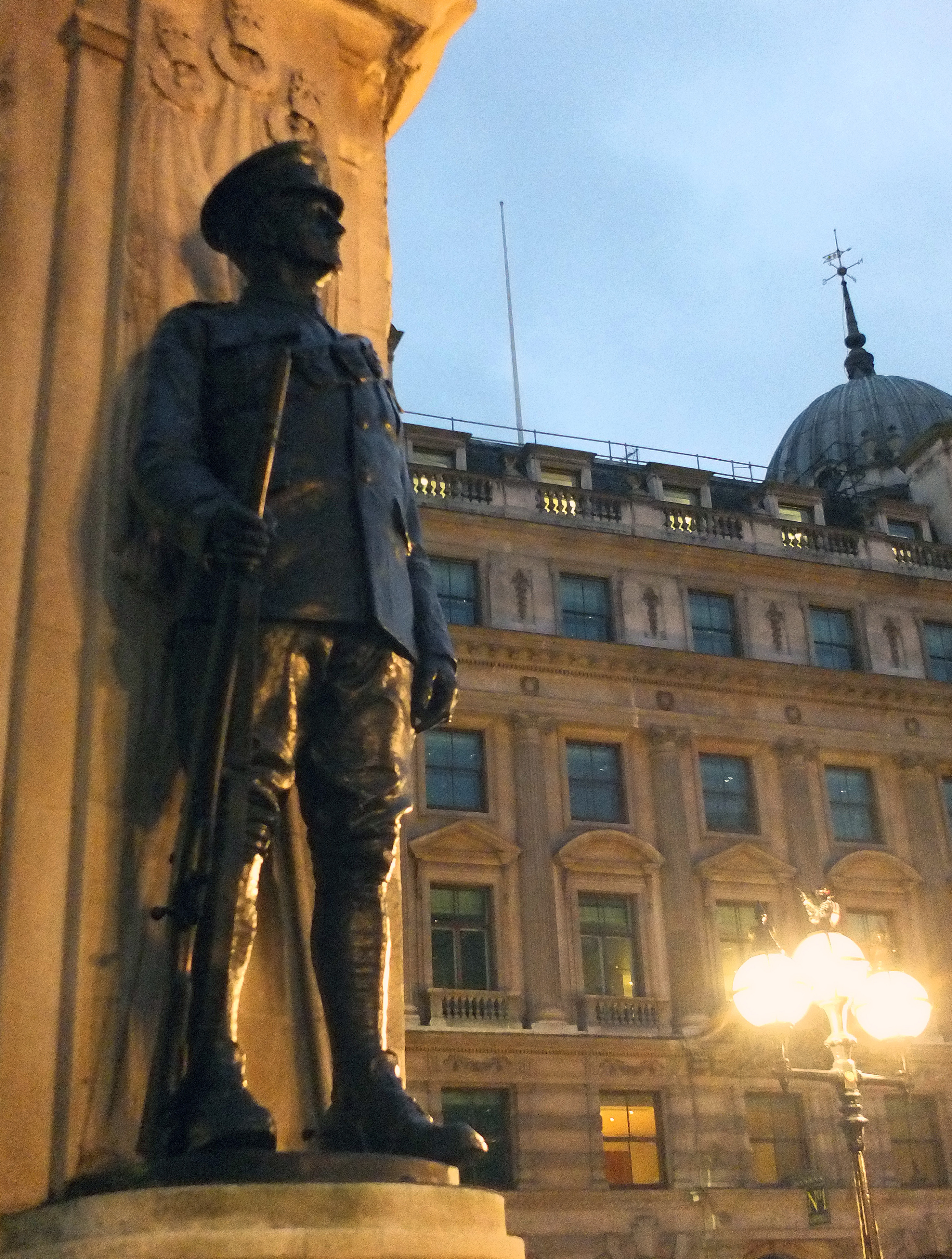
One of Alfred Drury’s life-sized figures
The memorial is topped with a small lion, bearing a shield adorned with St George and the Dragon.
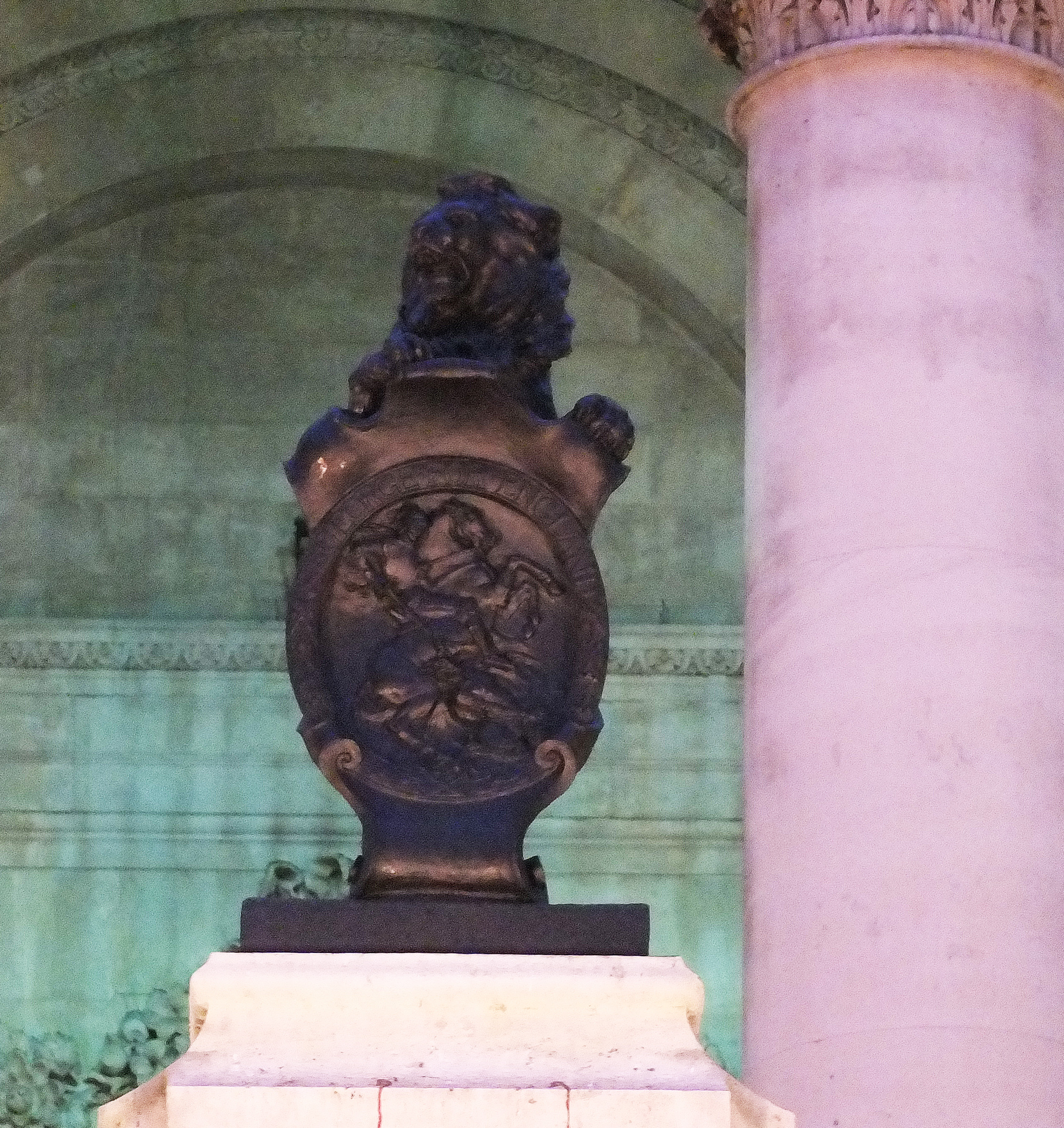
The memorial’s lion figurehead
The memorial is Sir Aston Webb’s second design– his first idea was quite different, consisting of two 75 ft. tall flag poles at the base of which would have been statues of Victory and Peace.

Sir Aston Webb, chief architect behind the London Memorial
Costing £7,000 (around £150,000 in today’s money), the monument was funded by public donations.
In order to make room for the memorial, a fountain topped by a statue of Temperance- which had been on the site since 1861 after being presented by the philanthropist, Samuel Gurney, required removal. It was relocated and can be seen today at the northern end of Blackfriars Bridge.
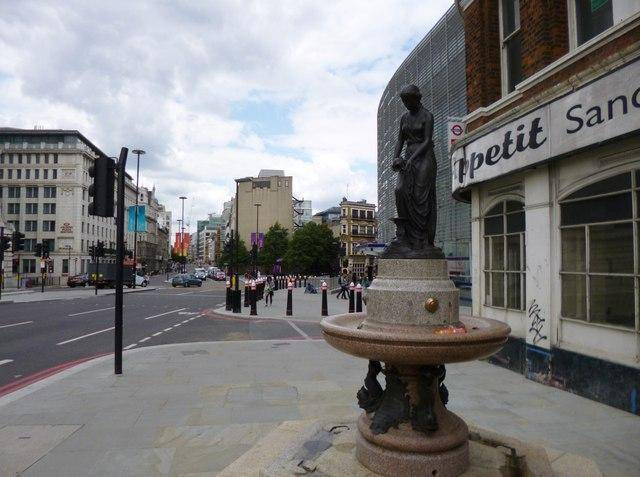
The fountain at Blackfriars which once stood outside the Royal Exchange and was relocated to make way for the London Memorial (image: Geograph)
The London Troops Memorial was unveiled in foggy conditions on the afternoon of the 12th November 1920 by the Duke of York who was accompanied by the Lord Mayor and the Bishop of London.

The London Memorial on Armistice Day in 1937 (image: London Illustrated News)
The Duke of Connaught (the King’s Uncle) was also due to participate but had to bow out due to bronchitis. He sent a telegram which was read out at the ceremony;
“While deeply regretting that I cannot unveil the memorial to London’s splendid soldiers, my thoughts and feelings are with you at today’s interesting occasion and I hope the memorial will always recall the gallant services rendered by London’s sons…”

Two young men contemplate the London Memorial, November 2014






 View from the Mirror