Christian the Lion: A Big Cat in Chelsea
Recently, there have been a number of somewhat alarming reports that a lion is on the loose in the Essex countryside….
Whether or not this turns out to be true, it’s certainly makes a dull bank holiday a little more interesting… I wonder if the scary carnivore will manage to find its way into the centre of London…
*
During the 1960s, one place you would certainly have been able to spot a real, live lion was within one of the capital’s most prestigious department stores: Harrods.

Harrods Department Store (photo: Wikipedia)
In those carefree days, the world famous shop on Brompton Road boasted its very own Zoo department.
First opened in 1917, the exotic floor space sold all manner of beasts; everything from chickens to goats to alligators and elephants. (Today, the area has now been handed over to the far tamer ‘Pet Kingdom’).
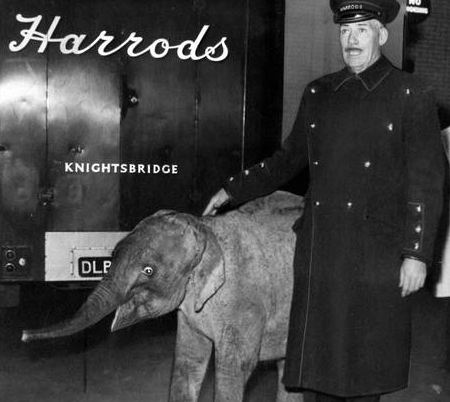
A baby elephant, purchased from Harrods’ Zoo Department in 1967
In November 1969, two young Australians- Anthony Burke (nicknamed ‘Ace’) and John Rendell– arrived in London.
As part of their obligatory sightseeing tour, the excited newcomers popped into Harrods where they were amazed to discover the store’s commercial menagerie.
What most caught their eye was a small cage… in which there sat a forlorn looking lion cub. Saddened to see the creature confined to such cramped conditions, the two Aussies vowed to rescue the lion, whom they would soon name ‘Christian’.
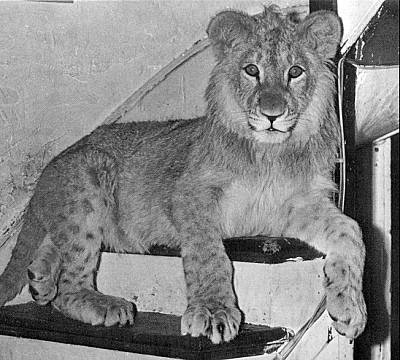
Christian the Lion
Boasting a price tag of 250 guineas (£3,500 in today’s money), Christian didn’t come cheap. However, this didn’t deter Anthony and John and they quickly managed to raise the necessary cash.
It turned out that the staff at Harrods were more than happy to see the back of Christian- the night before the pair came to collect him, the cheeky young lion had escaped from his cage and run amok through the carpet department, ripping apart several valuable goatskin rugs in the process!

Christian with Anthony Burke and John Rendell (photo: Evening Standard)
By now, Anthony and John were living in a small flat on the King’s Road, down in swinging Chelsea and, in a unit below their apartment, they ran a pine furniture shop called Sophiste-Cat.
Once Christian moved in, the little lion cub quickly became a local celebrity, attracting a number of 1960s luminaries such as Dina Rig and Mia Farrow to the shop.

Map showing approximate location of the ‘Sophiste-Cat’ shop on the King’s Road, which was home for a time to Christian the Lion. Today, the shop has been replaced by a modern parade of buildings.
Fed on raw meat, bone-meal and eggs, Christian quickly made himself at home. As Anthony and John said in their book, ‘A Lion Called Christian‘, their new pal was pretty demanding:
“We had to buy him hardy toys, for the average life of a normal teddy bear was about two minutes… He demanded our constant attention and it was impossible to ignore him. If one of us was reading a newspaper, or on the telephone, Christian would immediately climb up on to his lap.”

During Christian’s time in Chelsea, a documentary was made entitled, ‘The Lion at World’s End’ which was released in 1971. (The title refers to the southern part of the King’s Road which, taking its name from a local pub, is known as the ‘World’s End‘).
During his time in Chelsea, a local church allowed Christian to be exercised every morning on one of their cloisters which had once been an ancient Moravian burial ground.
The ground is located between Milman’s Street and Beaufort Street and Christian can be seen frolicking there in the following clip:
Within four months, Christian had grown so much that his size was becoming a hindrance.
No longer a cute, wee cub, his more mature appearance was beginning to scare customers away.
Anthony and John knew that it would soon become impossible for Christian to stay with them in London.
One couple who were not intimidated by Christian’s blossoming size were Bill Travers and Virginia McKenna; an acting couple who had starred in the 1966 film, Born Free, a true story in which they played George and Joy Adamson; the pair of British conservationists who had cared for Elsa, an orphaned lioness.
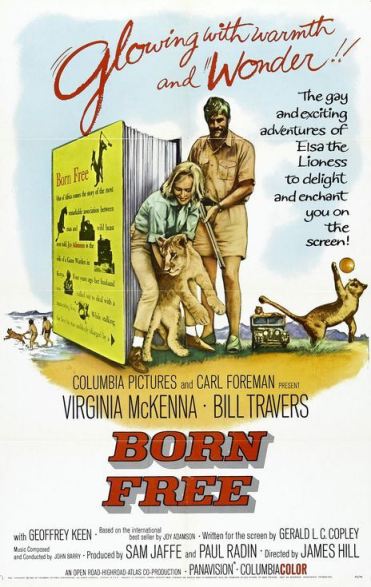
Poster for ‘Born Free’, 1966
Using their connections, Bill and Virginia helped the two young Aussies arrange for Christian to be flown out to Kenya, the departure from Heathrow taking place in the summer of 1970.
Once in Africa, Christian was taken under the wing of George Adamson who was now working at the Kora National Reserve. George’s Swahili nickname was ‘Baba ya Simba’; which translates as the father of lions.
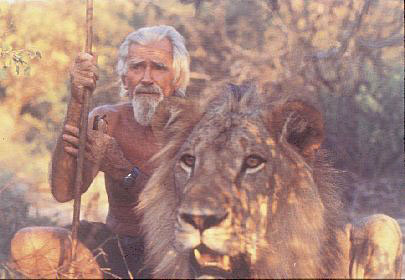
George Adamson whose life and work was portrayed in ‘Born Free’
*
Once on the reserve the urban cub was introduced to a natural pride of lions, leaving Anthony and John to bid a sad farewell to their extraordinary pet.
Unsurprisingly, the two Australians could never forget Christian and were given regular updates by George Adamson. A year later, in July 1971, the pair decided to return to Kenya to have a peek at how their old feline flatmate was faring in his new terrain.
Escorted by George Adamson, the pair were taken out into the Savannah where Christian’s pride were roaming… the recording of what happened next has become the stuff of legends:
Tragically, George Adamson, who had overseen Christian’s return to nature, was murdered by poachers in 1989.
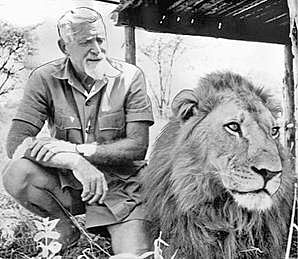
George’s last recorded sighting of the famous lion was in 1974, by which point Christian had fathered cubs of his own… who knows, maybe today the descendants of the lion cub from Harrods are out there somewhere in Kenya, still roaming free….
To find out more about the ‘Born Free’ Foundation, please click here
Snakehips at the Cafe De Paris
This is the entrance to the Café de Paris, a famous London nightclub on Coventry Street near Leicester Square, which first opened to partygoers way back in 1924 and is still going strong today.

The dance-floor of the Café de Paris was originally designed to resemble the ballroom of the fated Titanic and, in its earliest days, one of the club’s most frequent regulars was Edward, Prince of Wales (Prince Harry’s wild nights out at Boujis and Chinawhite are clearly nothing new!)

Edward VIII… renowned party animal and abdicator
This particular Prince of course went onto become King Edward VIII in 1936… but he didn’t stick the throne for very long. Shortly after taking on the crown, he decided to chuck it in; abdicating so that he could pursue a relationship with U.S socialite, Wallis Simpson. I wonder if the hedonism of the Cafe De Paris had a corrupting influence on him?…
*
Shortly after it opened, the Café De Paris was the venue for the UK’s first performance of the famously hip and energetic, Charleston dance. This spontaneous debut was carried out by the American model and showgirl, Louise Brooks- a bold act which pulled London firmly into the ‘Roaring 20s’.

Louise Brooks, the woman who introduced the Charleston to Britain (photo: Wikipedia)
In 1929, the club hit the silver screen when it appeared in the silent film, Piccadilly
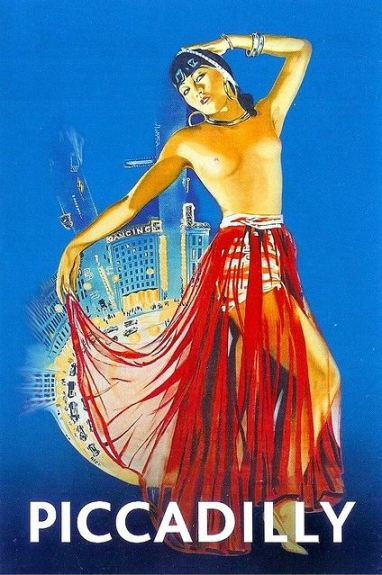
Promotional poster for the 1929 film, ‘Piccadilly’
Starring Anna May Wong- the film industry’s first ever Chinese-American actress, the plot of Piccadilly involved jealousy, betrayal, forbidden love, murder.. and, above all, dancing as demonstrated in the following excerpt!-
*
A decade later saw the outbreak of WWII and the subsequent Blitz on London- during which time the Café De Paris was considered to be one of the safest places in the West End, due to the fact that the bulk of the club was located several floors underground.

Downstairs at the Cafe De Paris
For those who had the money and style to gain entry, the assumed safety of the Café De Paris was clearly far more attractive than spending the night sleeping on a stuffy, crowded tube platform or huddled in a dank Anderson Shelter at the bottom of the garden.
*
During the Blitz, the biggest attraction at the Café De Paris was the nightly entertainment provided by Kenrick Reginald Huymans Johnson; more commonly known as Ken ‘Snakehips’ Johnson, leader of his specially put together, ‘West Indian Orchestra’ who were the club’s resident band.
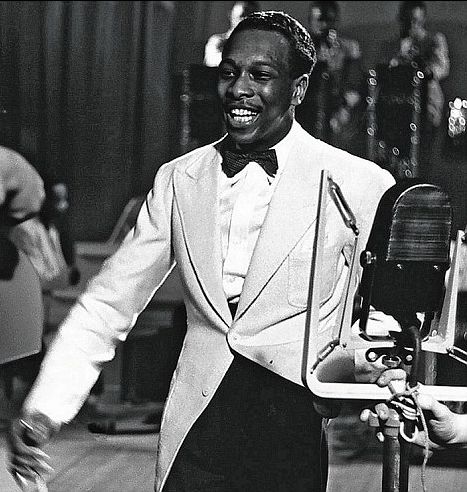
Ken ‘Snakehips’ Johnson
Ken was born in British Guyana, South America in 1914.
During the 1920s, he rose to become an acclaimed dancer, coached by Buddy Bradley who had also taught Fred Astaire.
Ken’s smooth moves quickly earned him his famous ‘Snakehips’ nickname, paving the way for appearances in a number of American cabaret acts, as well as leading to Hollywood and a role in the 1934 film, Oh Daddy.

Ken showing off his snake-like hips!
During his time in America, Ken visited New York’s Harlem where he got to witness jazz greats such as Cab Calloway practicing their craft.

The legendary, Cab Calloway (1907-1994) who would prove to be a major influence on Ken Johnson
Such experiences enticed Snakehips, encouraging him to move on from dancing and to go about establishing his own band who would soon become known as the aforementioned ‘West Indian Orchestra.’
*
By 1940, Ken and his team of musicians were in London and were already so acclaimed that the Café De Paris snapped them on a permanent basis.
Upon being hired, Ken announced that he was determined to make Londoners “like swing at the Café… or die in the attempt”…
It wasn’t just the rich and famous who got to hear the West Indian Orchestra’s exciting music- Snakehips and his talented line-up were regulars on the BBC’s Wartime Service, giving Brits a welcome and uplifting diversion from the conflict and misery which was consuming the world.

A family gather around their wireless set during WWII (photo: BBC)
*
On the evening of Saturday 9th March 1941 Ken and his gang took to the stage as per usual.
Shortly into their performance, the air-raid sirens cranked into action, sending their eerie banshee howl wailing across the capital.
It was a situation Ken and the orchestra were used to and, being the accomplished entertainers they were and safe in the knowledge that the Café De Paris was deep underground, the band played on…
It was during a rendition of “Oh Johnny” that the unthinkable happened.
A bomb hurtled down from the sky and somehow managed to pinpoint an airshaft, sending the sinister device tumbling down into the very heart of the Café De Paris where, in a blue flash, it exploded on the dance floor.
34 people- including Snakehips Johnson- were killed instantly and a further 80 were seriously injured.
A number of those killed perished as the powerful blast sucked the air out of their lungs; a deadly phenomena which caused the victim to display no outward signs of injury, but instead left them statue-like; frozen in the pose they’d been in on the moment of impact.

The aftermath of the Cafe De Paris bombing
One of the first to rush to the scene was a police officer called Ballard Berkeley… who would later go onto become an actor, playing the character of Major Gowen in the much loved sitcom, Fawlty Towers.
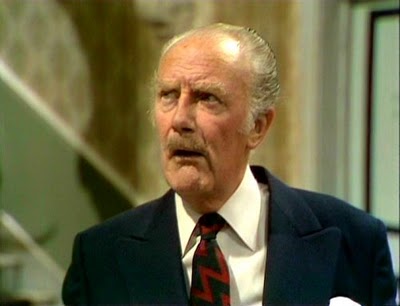
Ballard Berkeley, one of the first on the scene after the Cafe De Paris blast and who would later go onto become an actor after the war
Watching him act in such a well-known comic role, it is difficult to imagine the horrors which Ballard witnessed in the aftermath of that dreadful bombing.
Ken Johnson, whose once beautifully agile body was severely ravaged in the blast, was cremated at Golders Green Crematorium.
He was just 26 years old.
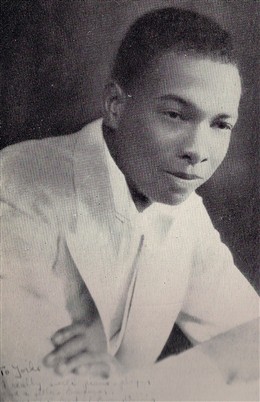
Ken Johnson 1914-1941
The loss of the great Snakehips and his band was felt deeply. When The Times reported on the disaster, they deliberately avoided mentioning the band by name for fear of damaging public morale.
The devastated Café De Paris remained closed until after the war, finally re-opening in 1948.
Below is a rare recording (made approximately two months before the Café Des Paris disaster) of Ken and his West Indian Orchestra preforming ‘I’m in Love for the Last Time’, the distinctive sound which, for an all but too brief period, lifted spirits during one of Britain’s most devastating periods.
The Sad Tale of Giro & Dr Leopold
Situated deep in the heart of St James’s and frequently overlooked by the crowds dashing between Regent Street and Horse Guards Parade, is this tiny gravestone:

The stone, preserved in its own miniature housing since the 1990s, is a wee memorial to ‘Giro’; an Alsatian dog who, as the German quotation on his tombstone states was “a true companion”.

Giro was killed suddenly in 1934- when the daft mutt made the fatal mistake of chewing through a live electrical cable.
*
I first discovered this curiosity whilst studying the Knowledge of London.
Being so small, the landmark was an old favourite of the examiners who liked to throw us trainee cabbies by asking us to locate points of a more obscure nature! After some time, I eventually found it… Giro’s headstone is located on Carlton House Terrace, opposite one of London’s more civilised car-parks on Waterloo Place.

The covered headstone sits in a small, gated patch beneath a tree, between the Duke of York Column and a grand row of buildings on Carlton House Terrace:

Location of Giro’s Headstone (image: Google maps)
*
Giro is often unfairly referred to as the ‘Nazi Dog’; this stigma stemming from the fact that he belonged to Dr Leopold von Hoesch, the German ambassador to the United Kingdom from 1932 1936.
In those days, the German embassy was the building right next to Giro’s grave. (Today, the premises is home to the Royal Society).
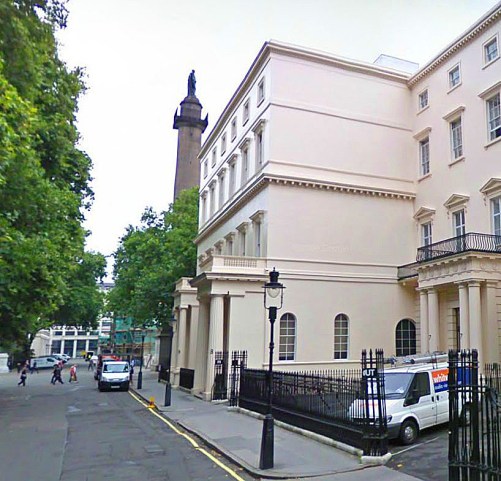
The former German Embassy (which has since relocated to Belgrave Square)
Giro’s master was certainly no Nazi.
Dr Leopold von Hoesch was a respected statesman who did much to improve relations between Britain and Germany.
When he first came to Britain, it was as a representative of Germany’s Weimar Republic; the liberal, culturally progressive government which ruled Germany for a time between the two world-wars.
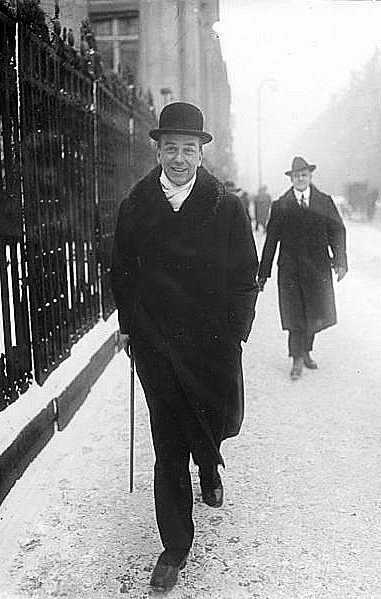
Herr Hoesch in the early 1930s
Tragically, the peaceful Weimar government was short-lived.
Following the Wall Street Crash in 1929, the world found itself in the grip of the Great Depression. In Germany this, along with hyper-inflation and unrest from various political groups, enabled Adolf Hitler to get a jackboot into the door of power in 1933.
Within days of Hitler managing to secure the position of Chancellor, Germany’s parliament building was ‘mysteriously’ set ablaze in the infamous Reichstag Fire.
Seizing upon this convenient disaster and warning of civil unrest, Hitler immediately passed an emergency powers act, granting his government the power to strip German citizens of their liberties indefinitely… a useful thing when you want to crush your opponents and destroy certain groups…

Crowds watch the Reichstag burn in 1933…
Back in London, Dr Hoesch, who had been dubious of Hitler and the Nazis from the offset, viewed the rapid take over with dismay.
He wasted no time in challenging Hitler, sending messages back to Germany about his distrust of the dubious characters in the Fuhrer’s entourage who had muscled in on the government- one of whom was Von Ribbentrop, a character whom Dr Hoesch found particularly distasteful.
Over the next few years, Hitler would be greatly vexed by his ambassador in Britain.
Things came to a head In March 1936 when Hitler invaded the Rhineland. Dr Hoesch denounced the action, accusing the Fuhrer of deliberately provoking France and Britain- a rare voice of dissent against a figure whom many now feared to confront.
Tragically, Dr Hoesch died of a heart attack less than a month later.
He passed away inside the German embassy itself and, aged just 55, it is generally believed that the attack was brought on from the stress caused by dealing with his homeland’s turbulent leadership.

Herr Hoesch… the statesman who challenged the Nazis right up until his untimely death
Thanks to the respect which the British had for the ambassador who had been a thorn in the Fuhrer’s side, Dr Hoesch was granted a grand funeral parade and gun-salute before being shipped back to his homeland.
By this time of course, the traditional German flag had been replaced with the notorious red, white and black swastika insignia and it was this therefore this banner- which represented an ideology Dr Hoesch had never embraced- that had to be draped over the ambassador’s coffin; something which would no doubt have turned his stomach.
This funeral procession therefore represented a thankfully extremely rare occurrence- the only time that the dreaded symbol of Nazism had been so openly paraded on London’s streets- and so close to Buckingham Palace too.
The following clip is a newsreel depicting the event:
*
Now that the troublesome Dr Hoesch was out of the way, Hitler was free to cart a new representative off to London; one who was a true Nazi… Joachim Von Ribbentrop; Dr Hoesch’s nemesis and the man whom he’d voiced such distrust of when the Nazis first came to power.

Von Ribbentrop
A vain, arrogant man, Ribbentrop immediately set to work ‘Nazifying’ the German embassy; altering the interior to bring its appearance more in line with the twisted ideology. This task was granted to Albert Speer, one of the Nazi’s most trusted architects.
A grand staircase was installed- created from marble donated by Benito Mussolini, and rumours still abound that a swastika mosaic (apparently now covered over) was laid upon the floor of one particular room.
Ribbentrop’s time in London would not last for very long. Three years later, the darkness of war, bombs and hatred had returned to Europe and he was promptly dismissed.
Somehow, however the little gravestone of Giro, Dr Hoesch’s faithful friend survived WWII… saved by a mixture of obscurity and respect for the man who had so strongly opposed his Nazi masters.

Herr Hoesch on Carlton Terrace… in happier times with his beloved dogs