Bishops, Bones & Birds
Not far from the bustle of Southwark’s Borough Market where tourists flock, traders holler and trains rumble and thump overhead into London Bridge Station, there sits a quiet backwater called Redcross Way; a little-known street, often devoid of traffic or people.
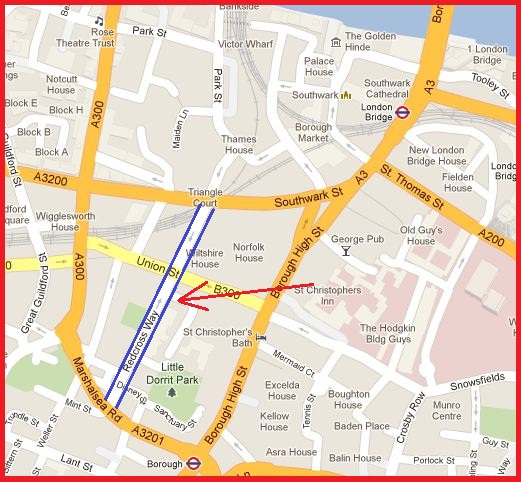
The only sign of life down here is the ‘Boot and Flogger’; a secretive, atmospheric wine bar opposite which stand these rather extraordinary gates, draped in ribbons, trinkets and hand-written messages:
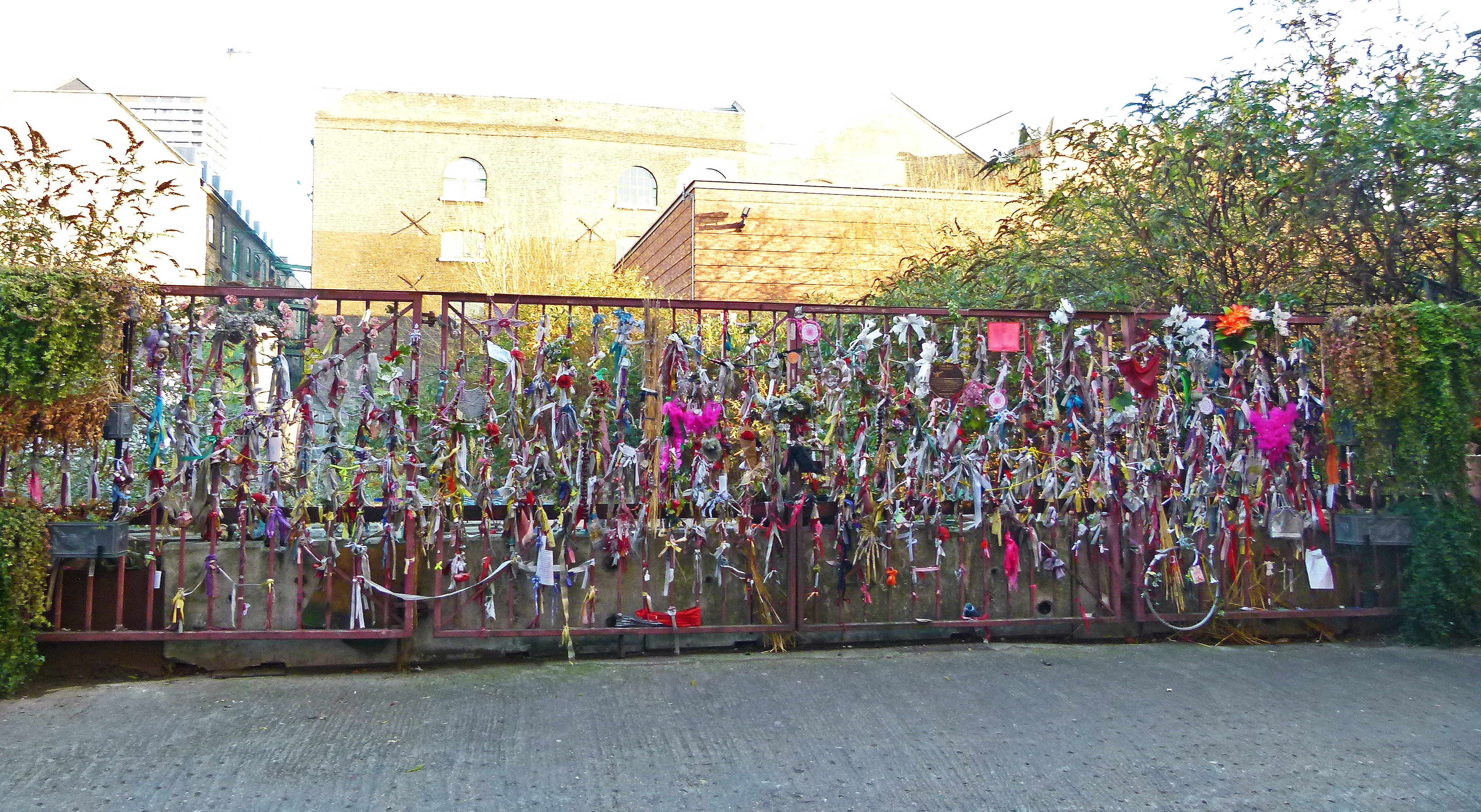
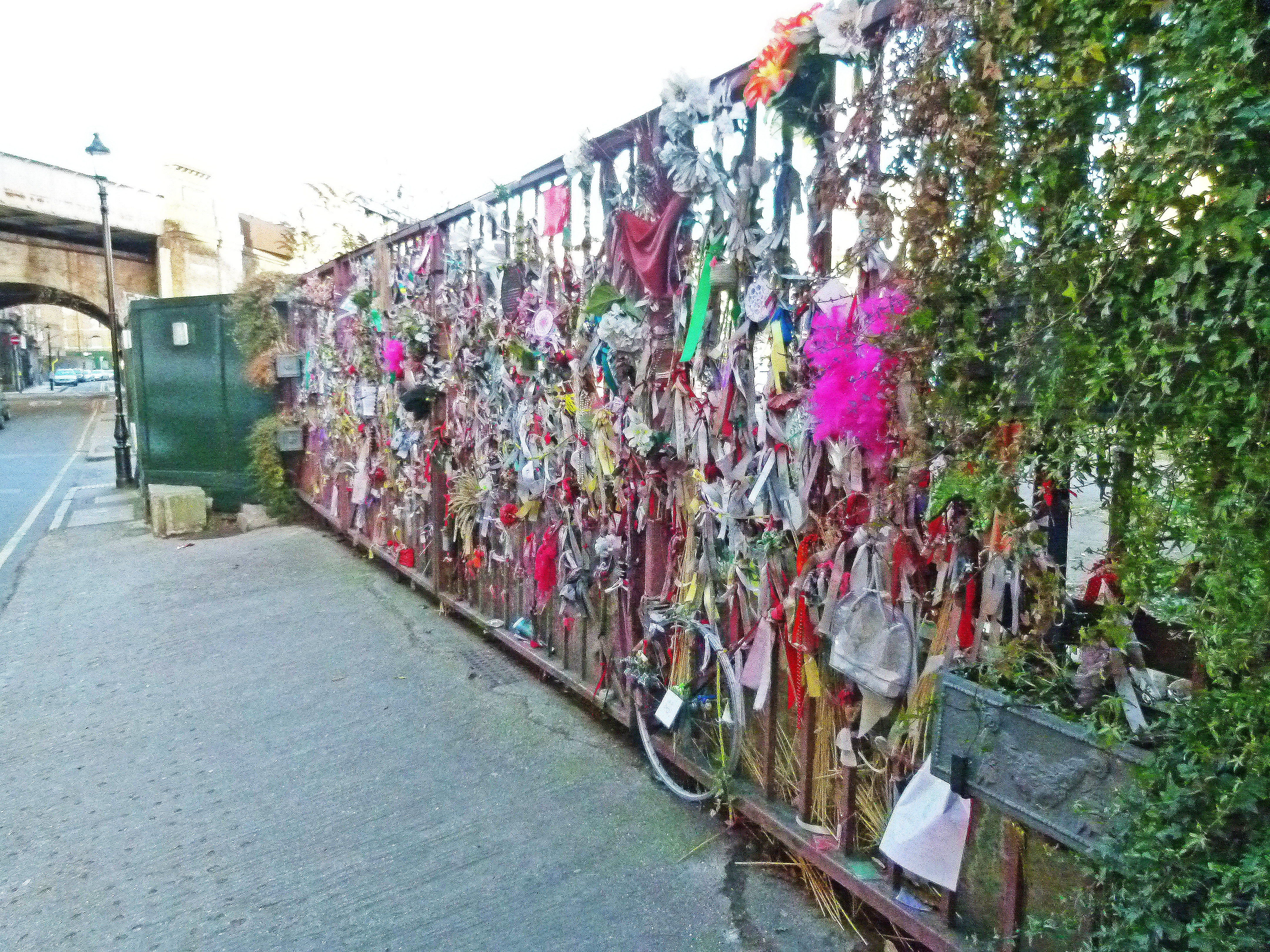
These gates guard the entrance to the morbidly named ‘Crossbones Yard’; a frequently overlooked slice of London’s murkier history.
*
The exact year in which Crossbones Yard was established is a mystery- even one or two Roman remains have been found here. It certainly dates back to at least medieval times and is primarily a remnant of an era in which Southwark acted as London’s ‘Sin-City’…
In those days, the City of London was confined to the north bank of the Thames, still locked in by the defensive wall which had been laid out by the Romans many generations before.
Already a city of immense wealth, the capital was governed by staunch laws which ensured everything ran like clockwork and that her God-fearing citizens knew their place and generally behaved themselves.
Every evening at 9pm, the bells of St Mary Le Bow Church would begin to ring, signalling the start of the nightly curfew. When these bells commenced their clanging, London Bridge- the famous crossing cluttered with shops and houses- would close its gates for business, keeping undesirable riff-raff at bay.
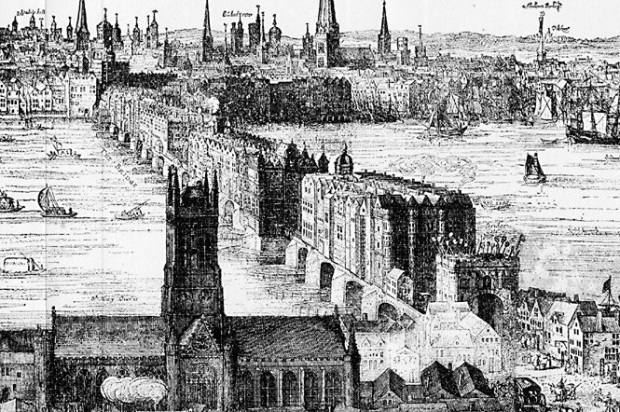
Old London Bridge… Southwark is towards the bottom of this contemporary etching
However, a few hundred feet away on the opposite bank of the Thames, things would just be starting to wake up…
Cluttered around the southern foot of London Bridge lay the settlement of Southwark which, thanks to a setup known as the “Liberty of the Clink”, was a practically lawless place where anything went and Londoners came to party…. it was rather like an extremely early, uncontrolled version of Las Vegas!
Over in the city, depraved entertainments were forbidden but here, across the Thames in sinful Southwark, there were no restrictions.
What went on in Southwark stayed in Southwark… a place where people came to frequent the many taverns, to visit the theatre (a civilised pastime today, considered a heinous pursuit back then), to bet on dice, cock-fighting and bear baiting, to have a punch up… and to pop into the ‘stews’- a slang term for brothel of which there were a great many.
*
The scant authority which did exist in Southwark emanated from a surprisingly holy source; the heathen place being presided over by the Bishops of Winchester…
Founded in AD676, the Diocese of Winchester was one of the largest and most powerful in the country. Consequently, it was decided that the Diocese should establish a base within convenient reach of the capital. So, in 1109, a palace for the Bishops of Winchester was built in Southwark- the remains of which can still be seen today on Clink Street.
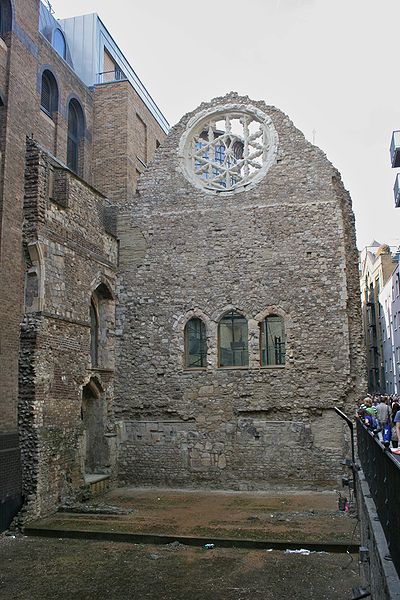
The Remains of Winchester Palace, Clink Street (Photo: Wikipedia)
Being such powerful landowners, the Bishops serving the Diocese of Winchester held a firm financial grip over Southwark.
Although a prison- ‘The Clink’ (today a museum)- was constructed near the palace to deal with certain troublemakers, the Bishops pretty much let Southwark’s sinners get on with it… in fact, due to their status as landlords, the Bishops of Winchester actually made a tidy profit out of the debauchary, renting out land and premises to facilitate the sordid goings on.
The brothels were no exception, thus paving the way for an extraordinary anomaly… the holy men technically became pimps…
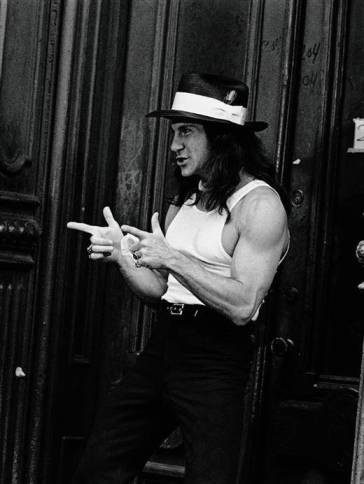
Harvey Keitel as ‘Sport’; the sinister pimp from the 1976 film, ‘Taxi Driver’… a role somewhat emulated centuries earlier by the Bishops of Winchester!
As well as collecting rent from the working girls, the Bishops also regulated the stews as a legitimate business, controlling opening hours and enforcing certain ground rules.
Buildings that belonged to Southwark’s red light district had to be painted white and were also required to display a specific sign, similar to ones used to denote inns and taverns- the most common being the image of a cardinal’s hat.
It is estimated the Bishops controlled around 18 brothels, all of which had pub-like names- ‘The Half moon’, ‘The Cross Keyes’, ‘The Boars Head’, ‘The Gun’, ‘The Castle’ and so on.
Because of this arrangement, the working girls of Southwark became known as the ‘Winchester Geese’, and it is said that this is where the rough and ready slang term, “bird” (meaning woman) may have originated from.
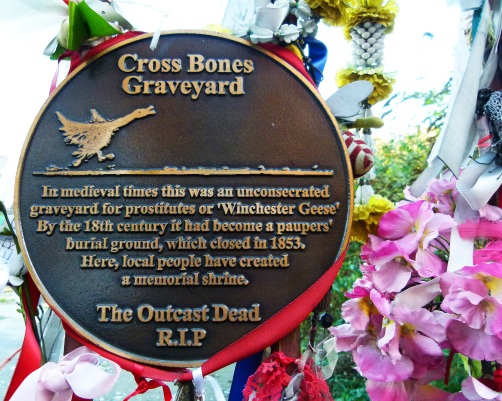
Modern plaque on the gates of Crossbones Yard
Despite helping the Bishops of Winchester turn a quick buck, the prostitutes of Southwark were still considered to represent the pinnacle of sin.
Consequently, when a Winchester Goose died, it was forbidden to bury her in consecrated ground… and this is where Crossbones Yard came in.
The yard was essentially a dumping pit for the heathen, an unconsecrated patch where bodies could be cast to the worms with zero ceremony.
In 1598, John Stow- in his fascinating book, ‘A Survey of London’ (essentially the very first guide-book ever written about the capital) recalled Crossbones Yard and its sad purpose:
“…these single women were forbidden the rites of the church so long as they continued in that sinful life, and were excluded from Christian burial if they were not reconciled before their death. And therefore there was a plot of ground called the Single Women’s Churcyard appointed for them far from the parish church.”
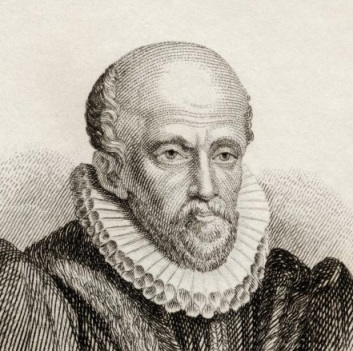
John Stow who described the burial ground in his early guide book
The Bishops’ lucrative pimping side-line was abruptly ended (“put down by the King’s commandment… proclaimed by sound of trumpet” as John Stow described it) in 1546 by Henry VIII- rather ironic considering that tyrannical monarch’s track record!
*
Despite being taken out of the the Bishops of Winchester’s hands, the brothels gradually began to creep back over the following decades and were once again in full swing by Shakespeare’s time, jostling for space with the Bard’s equally naughty Globe Theatre. This second wave of debauchery was later halted by the ultra-puritan, Oliver Cromwell.
Throughout this turmoil, Crossbones Yard continued to accept burials- there were plenty of crooks and poverty-stricken paupers to go around and many of these unfortunate souls found their final resting places here
When Guys Hospital was founded nearby in 1721, Crossbones Graveyard became a popular target for the ‘resurrectionists’ -aka body-snatchers for whom the large, disease ridden pit provided a regular bounty of fresh corpses, ripe for dissection and the attention of curious, scientific minds.
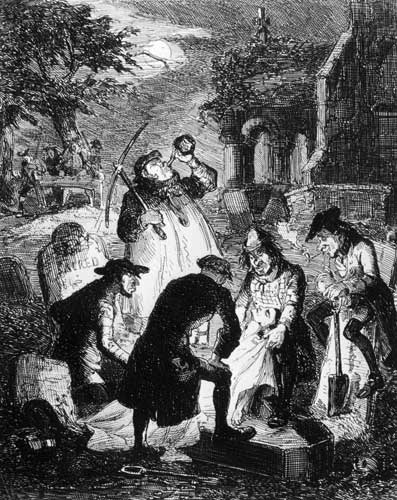
Body-snatching…
Crossbones Yard continued to accept the dead well into the 19th century.
Excavations from the 1990s revealed that between 1800-1853, 66% of the souls dumped here were under the age of 5, the main causes of death being smallpox, tuberculosis and cholera; a tragic sign of the desperate levels of poverty which haunted London at the time.
During this era, it is most likely that the great Victorian writer, Charles Dickens would have been familiar with the packed graveyard. In 1824, whilst his father was incarcerated in the nearby Marshalsea debtors’ prison, the young 12 year old Dickens lived on Lant Street, a stone’s throw from Redcross Way.
The area around Southwark would later go onto play an important role in his 1855 masterpiece, Little Dorrit.
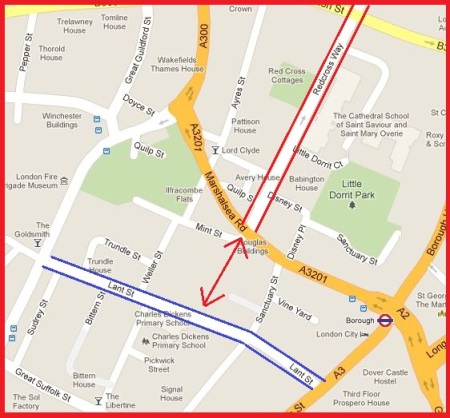
Map showing Lant Street, where Dickens lived as a youngster, in relation to Redcross Way
Towards the end its life, Crossbones Yard was quite literally full- “overcharged with dead”- with bones and body parts lurking unsettlingly close beneath the topsoil- even poking out in some cases.
Considered a public health hazard, the dejected graveyard was finally closed in 1853, the land was sold and a warehouse built on top.
Overall, it has been estimated that some 5,000 souls were buried here over the years.
*
Crossbones Yard was rediscovered in the 1990s when work was being carried out on the Jubilee line extension.
Today, it lies beneath a sorry patch of concrete and the former unconsecrated burial ground has become an unofficial shrine to the ‘outcast dead’.
As these pictures show, people come here to write messages and dedicate objects to those who are seen as having passed away whilst living on the edge of society. Many of the melancholy dedications on display are in memory of homeless people, alcoholics and prostitutes.
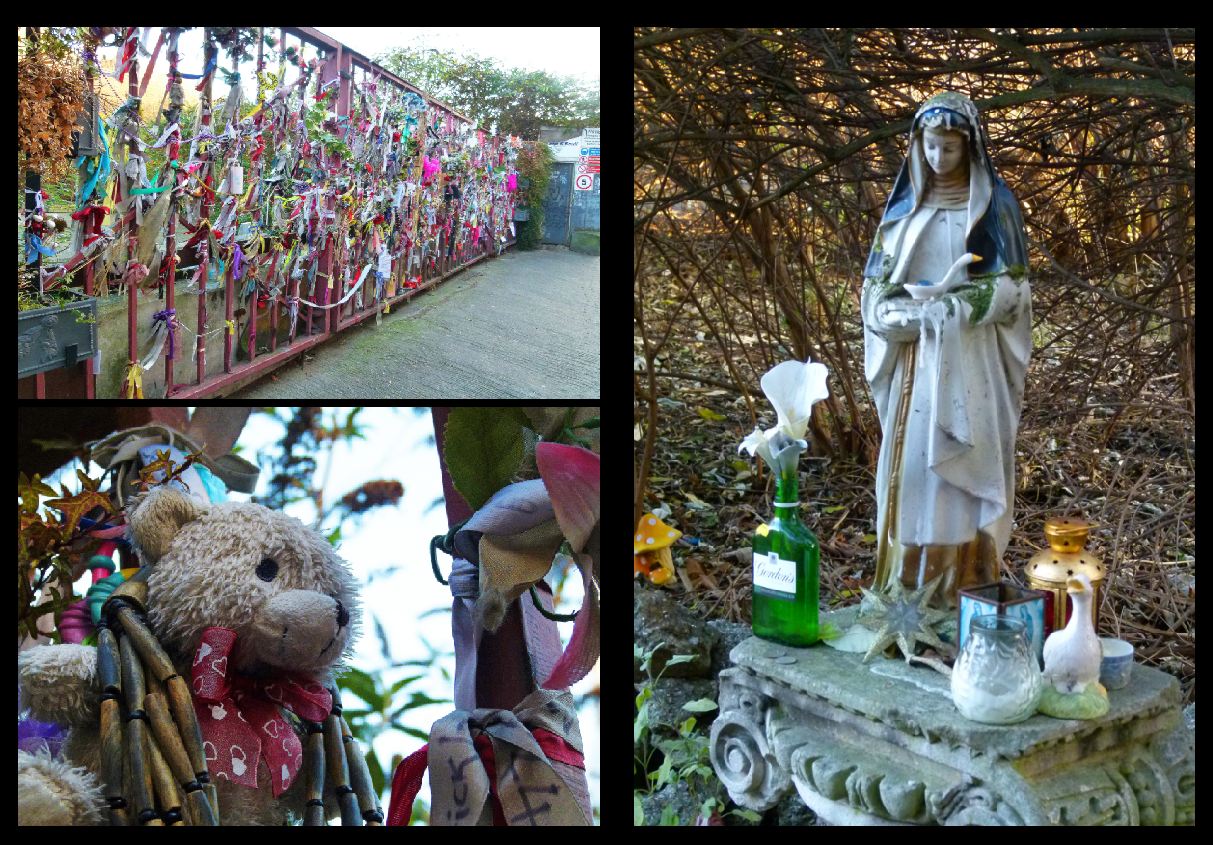
At 7pm on the 23rd day of every month, a vigil often involving poetry recitals, singing and dancing is held at the gates. All are welcome.
Depressingly, the site has been under the threat of redevelopment for some years now. Thankfully, a committed group of people have been campaigning to save this important area; the ultimate wish being that a peaceful garden of remembrance will eventually be created- a fitting tribute to the 1,000s of dead who were cast aside here so unceremoniously.
For more information, please follow this link to the excellent Crossbones website, where you can find out more and sign a petition to preserve the site.
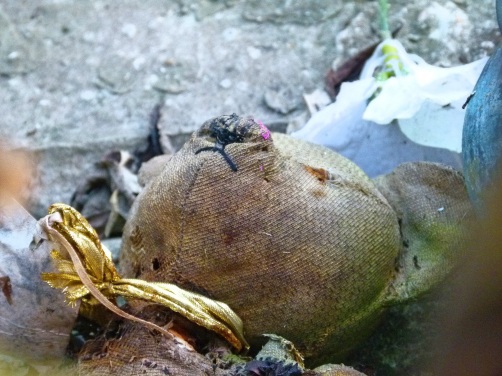
A sad teddy, lying in tribute within Crossbones Yard
The Sad Tale of Giro & Dr Leopold
Situated deep in the heart of St James’s and frequently overlooked by the crowds dashing between Regent Street and Horse Guards Parade, is this tiny gravestone:

The stone, preserved in its own miniature housing since the 1990s, is a wee memorial to ‘Giro’; an Alsatian dog who, as the German quotation on his tombstone states was “a true companion”.

Giro was killed suddenly in 1934- when the daft mutt made the fatal mistake of chewing through a live electrical cable.
*
I first discovered this curiosity whilst studying the Knowledge of London.
Being so small, the landmark was an old favourite of the examiners who liked to throw us trainee cabbies by asking us to locate points of a more obscure nature! After some time, I eventually found it… Giro’s headstone is located on Carlton House Terrace, opposite one of London’s more civilised car-parks on Waterloo Place.

The covered headstone sits in a small, gated patch beneath a tree, between the Duke of York Column and a grand row of buildings on Carlton House Terrace:

Location of Giro’s Headstone (image: Google maps)
*
Giro is often unfairly referred to as the ‘Nazi Dog’; this stigma stemming from the fact that he belonged to Dr Leopold von Hoesch, the German ambassador to the United Kingdom from 1932 1936.
In those days, the German embassy was the building right next to Giro’s grave. (Today, the premises is home to the Royal Society).
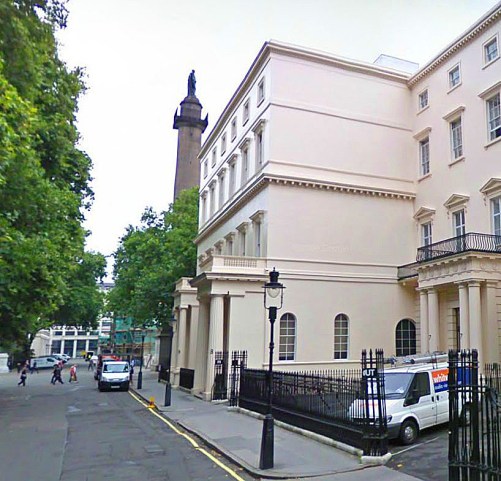
The former German Embassy (which has since relocated to Belgrave Square)
Giro’s master was certainly no Nazi.
Dr Leopold von Hoesch was a respected statesman who did much to improve relations between Britain and Germany.
When he first came to Britain, it was as a representative of Germany’s Weimar Republic; the liberal, culturally progressive government which ruled Germany for a time between the two world-wars.
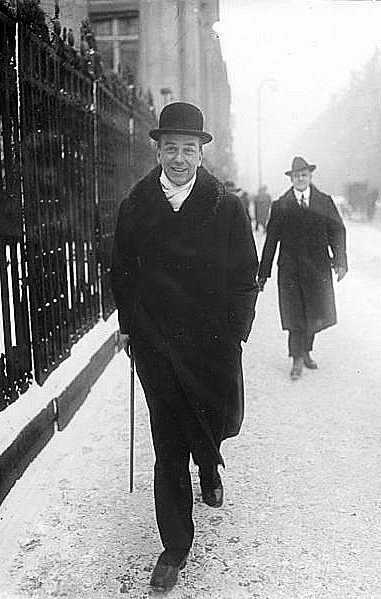
Herr Hoesch in the early 1930s
Tragically, the peaceful Weimar government was short-lived.
Following the Wall Street Crash in 1929, the world found itself in the grip of the Great Depression. In Germany this, along with hyper-inflation and unrest from various political groups, enabled Adolf Hitler to get a jackboot into the door of power in 1933.
Within days of Hitler managing to secure the position of Chancellor, Germany’s parliament building was ‘mysteriously’ set ablaze in the infamous Reichstag Fire.
Seizing upon this convenient disaster and warning of civil unrest, Hitler immediately passed an emergency powers act, granting his government the power to strip German citizens of their liberties indefinitely… a useful thing when you want to crush your opponents and destroy certain groups…

Crowds watch the Reichstag burn in 1933…
Back in London, Dr Hoesch, who had been dubious of Hitler and the Nazis from the offset, viewed the rapid take over with dismay.
He wasted no time in challenging Hitler, sending messages back to Germany about his distrust of the dubious characters in the Fuhrer’s entourage who had muscled in on the government- one of whom was Von Ribbentrop, a character whom Dr Hoesch found particularly distasteful.
Over the next few years, Hitler would be greatly vexed by his ambassador in Britain.
Things came to a head In March 1936 when Hitler invaded the Rhineland. Dr Hoesch denounced the action, accusing the Fuhrer of deliberately provoking France and Britain- a rare voice of dissent against a figure whom many now feared to confront.
Tragically, Dr Hoesch died of a heart attack less than a month later.
He passed away inside the German embassy itself and, aged just 55, it is generally believed that the attack was brought on from the stress caused by dealing with his homeland’s turbulent leadership.

Herr Hoesch… the statesman who challenged the Nazis right up until his untimely death
Thanks to the respect which the British had for the ambassador who had been a thorn in the Fuhrer’s side, Dr Hoesch was granted a grand funeral parade and gun-salute before being shipped back to his homeland.
By this time of course, the traditional German flag had been replaced with the notorious red, white and black swastika insignia and it was this therefore this banner- which represented an ideology Dr Hoesch had never embraced- that had to be draped over the ambassador’s coffin; something which would no doubt have turned his stomach.
This funeral procession therefore represented a thankfully extremely rare occurrence- the only time that the dreaded symbol of Nazism had been so openly paraded on London’s streets- and so close to Buckingham Palace too.
The following clip is a newsreel depicting the event:
*
Now that the troublesome Dr Hoesch was out of the way, Hitler was free to cart a new representative off to London; one who was a true Nazi… Joachim Von Ribbentrop; Dr Hoesch’s nemesis and the man whom he’d voiced such distrust of when the Nazis first came to power.

Von Ribbentrop
A vain, arrogant man, Ribbentrop immediately set to work ‘Nazifying’ the German embassy; altering the interior to bring its appearance more in line with the twisted ideology. This task was granted to Albert Speer, one of the Nazi’s most trusted architects.
A grand staircase was installed- created from marble donated by Benito Mussolini, and rumours still abound that a swastika mosaic (apparently now covered over) was laid upon the floor of one particular room.
Ribbentrop’s time in London would not last for very long. Three years later, the darkness of war, bombs and hatred had returned to Europe and he was promptly dismissed.
Somehow, however the little gravestone of Giro, Dr Hoesch’s faithful friend survived WWII… saved by a mixture of obscurity and respect for the man who had so strongly opposed his Nazi masters.

Herr Hoesch on Carlton Terrace… in happier times with his beloved dogs
Cabbie’s Curios: A Ghostly Canine…
This is the Central Criminal Court, more commonly known as the ‘Old Bailey.’

The present building, which opened in 1907, stands on the site of the former Newgate Prison; a gaol notorious for its appalling conditions and general wretchedness. As the 18th century writer, Henry Fielding once summed up, Newgate was a “prototype of hell”…

Newgate Prison, shortly before demolition
Tucked behind Newgate was a narrow alleyway known as ‘Deadman’s Walk’, so called because the passageway was used to convey condemned criminals as they were led towards their execution.
Today, Deadman’s Walk is known as ‘Amen Court’; a quiet courtyard off of Warwick Lane.
However, despite the far gentler renaming, Amen Court is home to one of London’s most fearsome ghosts… the petrifying ‘Black Dog of Newgate’.
This sinister legend is said to have originated in 1596 when a chap was thrown into Newgate for dabbling in sorcery. Unfortunately for him, his incarceration coincided with a great famine which had struck London.
Starving to death, some prisoners within Newgate had turned to cannibalism; a nasty turn of events which the sorcerer quickly fell victim to; gruesomely slaughtered by his cell-mates who promptly tucked in hungrily- rather like the zombies in the classic 1968 cult film, Night of the Living Dead…
(WARNING the following short clip is rather gory!)
Unsurprisingly, the sorcerer was a bit peeved at being made dish of the day and, several nights after his murder, his spirit managed to conjure up a chilling vengeance; the nemesis coming in the form of a terrifying black dog….

Artist’s (or rather my!) impression of the Black Dog of Newgate
It is said that this wild creature tore into Newgate several nights in a row, ripping limbs off of prisoners and causing others to perish from pure fright. All very far-fetched of course, but it seems that something around this time did indeed cause considerable panic, because a number of guards were murdered by convicts, desperate to escape before the beast returned.
Several of those who managed to flee were guilty of snacking on the sorcerer and, once they’d broken out of Newgate, were promptly hunted down and slain by the fearsome pooch.
Once all of those implicated in the sorcerer’s death had been dealt with, the dog’s nocturnal rampaging came to an end.
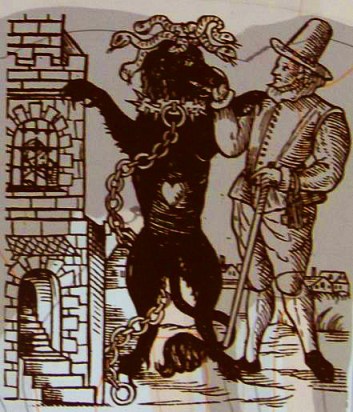
A 16th century portyal of the Black Dog of Newgate
However, to this day, the ghastly canine’s presence continues to be felt.
It is said that Amen Court is haunted by the dog, with numerous accounts reporting that its ghost appears as a shapeless, black form, slithering along walls and giving off a hideous odour. Whenever this apparition appears, witnesses often state that the visitation is accompanied by the sound of dragging footsteps.
Why not pop along to Amen Court one night and take a peek for yourself?…






 View from the Mirror