Christian the Lion: A Big Cat in Chelsea
Recently, there have been a number of somewhat alarming reports that a lion is on the loose in the Essex countryside….
Whether or not this turns out to be true, it’s certainly makes a dull bank holiday a little more interesting… I wonder if the scary carnivore will manage to find its way into the centre of London…
*
During the 1960s, one place you would certainly have been able to spot a real, live lion was within one of the capital’s most prestigious department stores: Harrods.

Harrods Department Store (photo: Wikipedia)
In those carefree days, the world famous shop on Brompton Road boasted its very own Zoo department.
First opened in 1917, the exotic floor space sold all manner of beasts; everything from chickens to goats to alligators and elephants. (Today, the area has now been handed over to the far tamer ‘Pet Kingdom’).
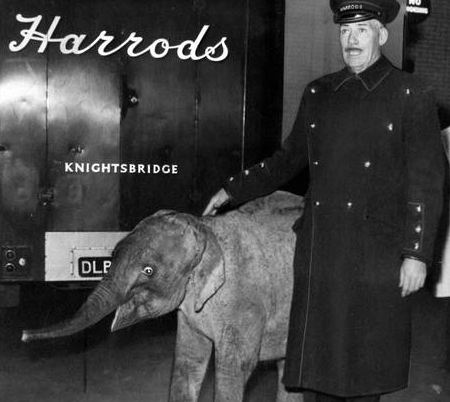
A baby elephant, purchased from Harrods’ Zoo Department in 1967
In November 1969, two young Australians- Anthony Burke (nicknamed ‘Ace’) and John Rendell– arrived in London.
As part of their obligatory sightseeing tour, the excited newcomers popped into Harrods where they were amazed to discover the store’s commercial menagerie.
What most caught their eye was a small cage… in which there sat a forlorn looking lion cub. Saddened to see the creature confined to such cramped conditions, the two Aussies vowed to rescue the lion, whom they would soon name ‘Christian’.
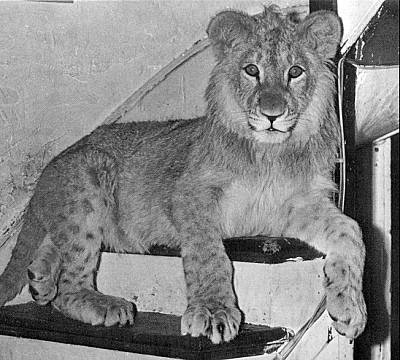
Christian the Lion
Boasting a price tag of 250 guineas (£3,500 in today’s money), Christian didn’t come cheap. However, this didn’t deter Anthony and John and they quickly managed to raise the necessary cash.
It turned out that the staff at Harrods were more than happy to see the back of Christian- the night before the pair came to collect him, the cheeky young lion had escaped from his cage and run amok through the carpet department, ripping apart several valuable goatskin rugs in the process!

Christian with Anthony Burke and John Rendell (photo: Evening Standard)
By now, Anthony and John were living in a small flat on the King’s Road, down in swinging Chelsea and, in a unit below their apartment, they ran a pine furniture shop called Sophiste-Cat.
Once Christian moved in, the little lion cub quickly became a local celebrity, attracting a number of 1960s luminaries such as Dina Rig and Mia Farrow to the shop.

Map showing approximate location of the ‘Sophiste-Cat’ shop on the King’s Road, which was home for a time to Christian the Lion. Today, the shop has been replaced by a modern parade of buildings.
Fed on raw meat, bone-meal and eggs, Christian quickly made himself at home. As Anthony and John said in their book, ‘A Lion Called Christian‘, their new pal was pretty demanding:
“We had to buy him hardy toys, for the average life of a normal teddy bear was about two minutes… He demanded our constant attention and it was impossible to ignore him. If one of us was reading a newspaper, or on the telephone, Christian would immediately climb up on to his lap.”

During Christian’s time in Chelsea, a documentary was made entitled, ‘The Lion at World’s End’ which was released in 1971. (The title refers to the southern part of the King’s Road which, taking its name from a local pub, is known as the ‘World’s End‘).
During his time in Chelsea, a local church allowed Christian to be exercised every morning on one of their cloisters which had once been an ancient Moravian burial ground.
The ground is located between Milman’s Street and Beaufort Street and Christian can be seen frolicking there in the following clip:
Within four months, Christian had grown so much that his size was becoming a hindrance.
No longer a cute, wee cub, his more mature appearance was beginning to scare customers away.
Anthony and John knew that it would soon become impossible for Christian to stay with them in London.
One couple who were not intimidated by Christian’s blossoming size were Bill Travers and Virginia McKenna; an acting couple who had starred in the 1966 film, Born Free, a true story in which they played George and Joy Adamson; the pair of British conservationists who had cared for Elsa, an orphaned lioness.
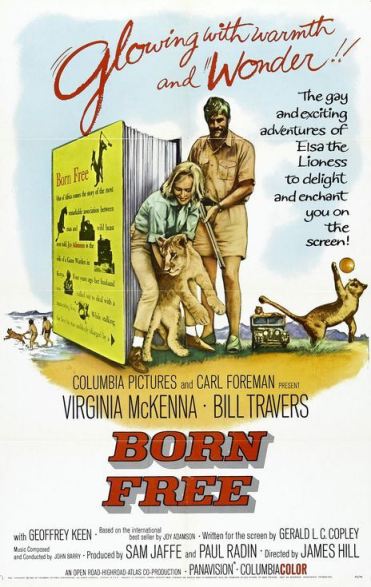
Poster for ‘Born Free’, 1966
Using their connections, Bill and Virginia helped the two young Aussies arrange for Christian to be flown out to Kenya, the departure from Heathrow taking place in the summer of 1970.
Once in Africa, Christian was taken under the wing of George Adamson who was now working at the Kora National Reserve. George’s Swahili nickname was ‘Baba ya Simba’; which translates as the father of lions.
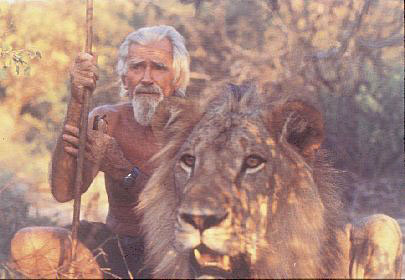
George Adamson whose life and work was portrayed in ‘Born Free’
*
Once on the reserve the urban cub was introduced to a natural pride of lions, leaving Anthony and John to bid a sad farewell to their extraordinary pet.
Unsurprisingly, the two Australians could never forget Christian and were given regular updates by George Adamson. A year later, in July 1971, the pair decided to return to Kenya to have a peek at how their old feline flatmate was faring in his new terrain.
Escorted by George Adamson, the pair were taken out into the Savannah where Christian’s pride were roaming… the recording of what happened next has become the stuff of legends:
Tragically, George Adamson, who had overseen Christian’s return to nature, was murdered by poachers in 1989.
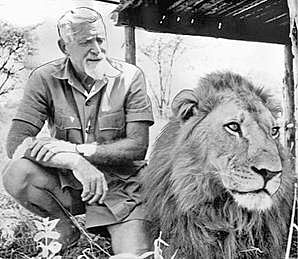
George’s last recorded sighting of the famous lion was in 1974, by which point Christian had fathered cubs of his own… who knows, maybe today the descendants of the lion cub from Harrods are out there somewhere in Kenya, still roaming free….
To find out more about the ‘Born Free’ Foundation, please click here
Cabbie’s Curios: An Ancient Taxi Rank
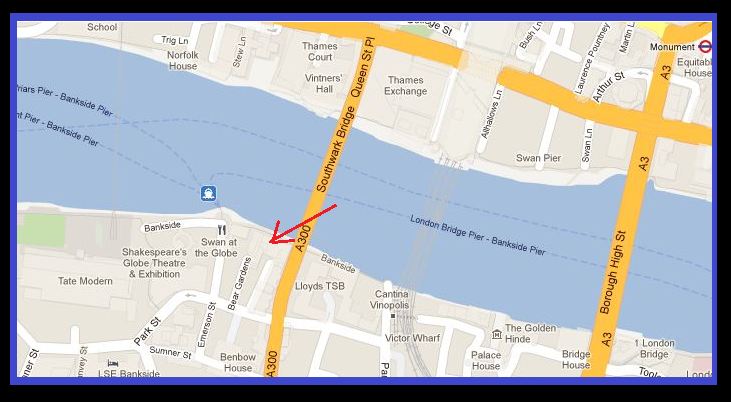
Tucked away between Southwark Bridge and Shakespeare’s Globe Theatre there sits this rather cramped looking bench:

The Ferryman’s Seat
Known as the ‘Ferryman’s Seat’, this cramped perch is essentially London’s earliest remaining example of what we’d now call a taxi rank…
*
Although the exact age of the seat is unknown, it’s most likely to have been established around the 12th or 13th century; a period when London was beginning to spread west (thanks to the consecration of Westminster Abbey in 1065) and south, where Southwark was gaining a reputation as a seedy but popular entertainment district (if you’d like to find out more about Southwark’s depravity during this era, please take a look at my previous post; Bishops, Bones and Birds…)
Despite this expansion, the city had just one river crossing- London Bridge, an inconvenient situation which remained until 1750 when Westminster Bridge was opened.
This bothersome set-up resulted in London Bridge becoming a notorious bottleneck, jammed with pedestrians, waggons and livestock, the sheer volume of which often resulted in crossing times of up to an hour.
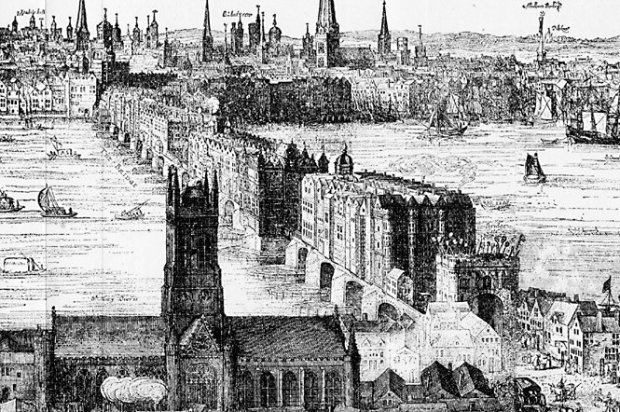
View of London Bridge in 1616. The large building in the foreground is Southwark Cathedral
As well as the excruciating journey times, there was also the multitude of mud, filth and manure to contend with… not to mention the contents of chamber pots which were lobbed out of the ramshackle houses lining the pontoon.
Taking all of this into account, it’s easy to see why traversing London Bridge was a rather unpopular task!
Those with a few pennies in their pocket therefore would often turn to the Thames Watermen…

A Thames Waterman (sadly, I couldn’t afford a proper artist, so this is my own impression!)
The Watermen were the ancestors of London’s modern-day cabbies; ferrying fares back and forth across the Thames in small boats known as ‘wherries’.

A ‘wherry’ from the Victorian era (photo: bargemen.com)
Their convenient nature was summed up in 1667 by the diarist, Samuel Pepys who described a typical commute; “by coach to the Temple, and then for speed by water thence to Whitehall.”

“I had that Samuel Pepys in the back of my wherry once!”
Rather than acquiring a knowledge of streets and roads, these early service-providers were noted for their knowledge of the water, having a sound understanding of the dangerous currents and extreme tides which characterize the Thames.
*
The worn down bench which survives today would have been used by Watermen awaiting a fare on the shores of Southwark. Punters seeking passage across the Thames would approach the Watermen and shout for “oars!” just as people today call out “taxi!”

Close up of the Ferryman’s seat
For many years, the Watermen had a reputation for being unscrupulous, often overcharging way over the expected price. In 1293 for example, it was recorded that one certain rouge, “did take from passengers unjust fares against their will.”
In 1514, Parliament stepped in to set and regulate fares- something which continues to this day with modern cabs.
Also like today, there were strict laws governing how many passengers each vehicle was permitted to hold (wherries being limited to three people at a time).
A further parallel with the present is that just like the cabbies of today, Watermen were required to wear a badge bearing their personal licence number.

A Waterman’s badge. Today, London cabbies wear a green, metal badge with their number printed across the middle in the exact same manner (photo: National Maritime Museum)
A few decades later, in 1555, the Worshipful Company of Watermen and Lightermen was established to look after the interests of those who relied upon the Thames for a living (Lightermen worked in a similar role, although they conveyed goods rather than the public).
The company are still in existence today, their grand hall being located on St Mary at Hill.
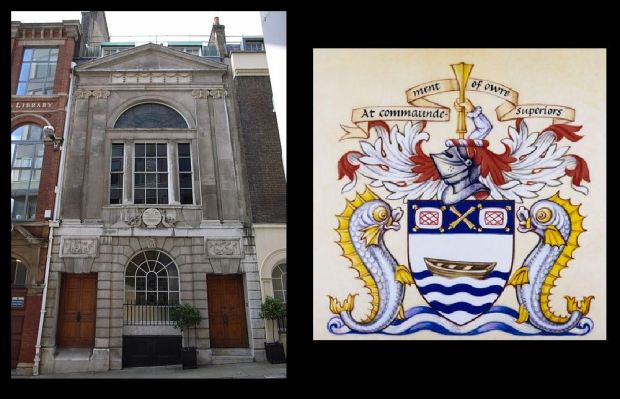
Watermen’s Hall and crest (photos: Wikipedia & National Maritime Museum)
*
Despite carrying out a job comparable to Venetian gondoliers, the Thames Water Men were far from graceful. The London Encyclopaedia describes them as being “a sturdy, rough breed with their own jargon and as quick with raillery and repartee as with their fists.”
Picking up from areas such as the lawless Southwark, with its taverns, brothels and bear-baiting pits (the alleyway upon which the Ferryman’s seat is located is actually called ‘Bear Gardens’ as a reference to this vicious spectacle), it’s no wonder that the Water Men had to toughen up.

Nowadays of course, London taxis have a Perspex screen to shield us cabbies from the rabble!
If you wish to see the historic seat for yourself, it can be found around the corner from Bankside’s, Real Greek restaurant. A map of its precise location is show below:
Cabbie’s Curios: Achilles’ Willie
In the south-eastern corner of Hyde Park, gazing across the constant din of traffic roaring between Park Lane and Hyde Park Corner, there towers this mighty effigy… the Achilles Statue:

The monument was unveiled in 1822 as a tribute to Arthur Wellesley- aka the Duke of Wellington; the politician and Field Marshal who led the coalition armies to victory at the Battle of Waterloo in June 1815; a monumental clash which marked the end of Napoleon Bonaparte’s increasingly tyrannical reign.

The Duke of Wellington, painted by Sir Thomas Lawrence shortly before the Battle of Waterloo
The 18ft tall figure was forged by the renowned sculptor, Sir Richard Westmacott at his workshop in Pimlico.

Sir Richard must’ve had trouble reading his tape-measure because when the monumental artwork came to be installed, it transpired that it was far too big to squeeze through Hyde Park’s gates! This problem was quickly overcome however by knocking a great big hole in a nearby wall!
The bronze used to create the statue was obtained by melting down twenty-two French cannons which had been seized at the battles of Salamanca, Vittoria, Toulouse and Waterloo.
Construction cost a hefty £10,000- approximately £490,000 in todays money, the cash being raised solely by the ‘women of England’.
The unveiling ceremony was carried out by King George III; the monarch who famously suffered from poor mental health throughout his life.

Achilles in full glory. Combined together, the statue and plinth reach an impressive height of 36 ft.
In Greek mythology, Achilles was the powerful warrior from Homer’s Iliad, a hero of the Trojan War who liked a good scrap and was practically invincible (except of course, for the small matter of his troublesome heel).
It was this grand reputation, which the Georgians believed was comparable to their own victorious Duke, that led to the statue sharing the ancient hero’s name.

An Ancient Greek representation of Achilles
However, on closer inspection the powerful character turns out to be more Roman than Greek.
As a young man, Richard Westmacott had spent four years in Rome where he was taught his craft by the Italian sculptor, Antonio Canova.
Westmacott’s statue of Achilles is actually based on the two ‘Horse Tamer’ statues (known as ‘Castor’ and ‘Pollux’) which stand on Rome’s Quirinal Hill and with which the Pimlico based sculptor would’ve been most familiar.
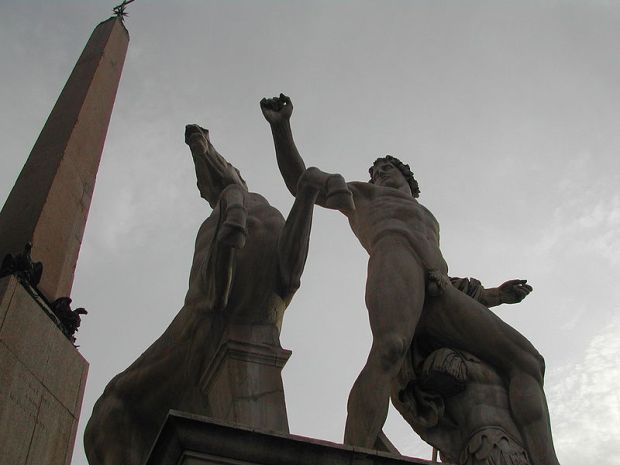
One of Rome’s ‘Horse Tamers’, upon which London’s Achilles statue was based (photo: Wikipedia)
It is also said that the head of the Achilles statue is based upon that of the Duke of Wellington himself. What do you think?…

Of course, the most important fact about the Achilles statue is this:
It was London’s first public, nude statue…
At the time, this was something which caused quite a stir (especially considering the generous financial contribution from the nation’s ladies as mentioned above!)
A fig leaf was later added to cool down the flustered Georgians… and so far there have been two incidents (in 1870 and 1961) in which several cheeky Londoners have attempted to chisel off the organic codpiece.

Georgian censorship…
Shortly after being revealed in 1822, the saucy statue was lampooned in a cartoon by George Cruikshank entitled, ‘Making Decent!’ in which the politician, William Wilberforce is depicted holding his top hat over Achilles’ privates!
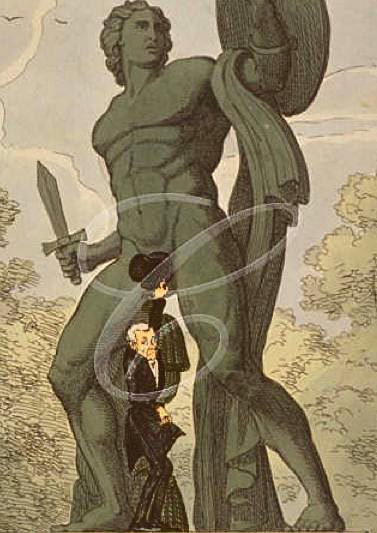
‘Making Decent!’ (image from cityoflondon.gov)





 View from the Mirror