Great Loss of Life: Oceanic House & the Titanic Newsboy
Quietly sitting on Cockspur Street just yards away from Trafalgar Square is a grand Edwardian block known as Oceanic House.

Oceanic House
The site was originally home to the Pall Mall restaurant where, on January 26th 1871 the Rugby Football Union was founded- an event now commemorated by a plaque.

Rugby Union plaque
Oceanic House was built between 1903 and 1906 as the London office for the Oceanic Steam Navigation Company– more commonly known as the White Star Line.
During their time, White Star operated many mighty vessels… the most famous being the luxurious RMS Titanic which sank during the early hours of April 15th 1912 whilst on her maiden voyage.
1,517 perished as a result.

The Titanic departs Southampton, 10th April 1912
Shortly after news of the Titanic’s fate reached shore one of the most iconic images associated with the disaster (and indeed the 20th century itself) was snapped outside London’s Oceanic House:

Newspaper boy bearing the awful headline outside White Star’s London office, April 16th 1912
The newsboy clutching the poster was Ned Parfett, a 16 year old lad from Waterloo’s Cornwall Road.
In 1916, four years after the famous picture was taken, Ned enlisted in the army and soon found himself embroiled in the hellish trenches of the Great War.
Ned’s service was exemplary- he was awarded the Military medal for bravery.
Tragically, aged 22, Ned was killed by a shell on the 29th October 1918 just 13 days before the guns fell silent on the armistice.

Outside Oceanic House today… where Ned Parfett once bore newspapers announcing the Titanic’s fate
*
Cabbie’s Curios: In Town
‘In Town‘, a cheerful sculpture depicting two parents holding their young child aloft, can be viewed close to the southern end of Battersea Bridge.
The piece was created in 1983 by John Ravera, a sculptor who trained at the Camberwell School of Art and whose outdoor works can be spotted at various locations across the UK, Hong Kong and Tokyo. John passed away in 2006.
Originally, ‘In Town‘ incorporated a little bird towards which the child was reaching, but this feature is now sadly missing.

Leake Street: London’s Urban Gallery (Waterloo station Part 10)
Deep beneath Waterloo station and just 800ft from the London Eye runs Leake Street; a disused road tunnel which is now a designated legal graffiti area.

Leake Street SE1
Last open to traffic when Waterloo was home to the Eurostar terminal (more of which in the next and final part of this history on the station), Leake Street’s status as a graffiti hotspot originated in May 2008 when renowned street artist, Banksy arranged the ‘Cans Festival’; an exhibition featuring murals and art installations.

Poster for the 2008 ‘Cans Festival’
In his own words, the secretive artist expressed his wish that the project would “transform a dark forgotten filth pit into an oasis of beautiful art… I’ve always felt anyone with a paint can should have as much say in how our cities look as architects and ad men.”

Today, Leake Street continues to provide street artists with a vast, urban canvas.
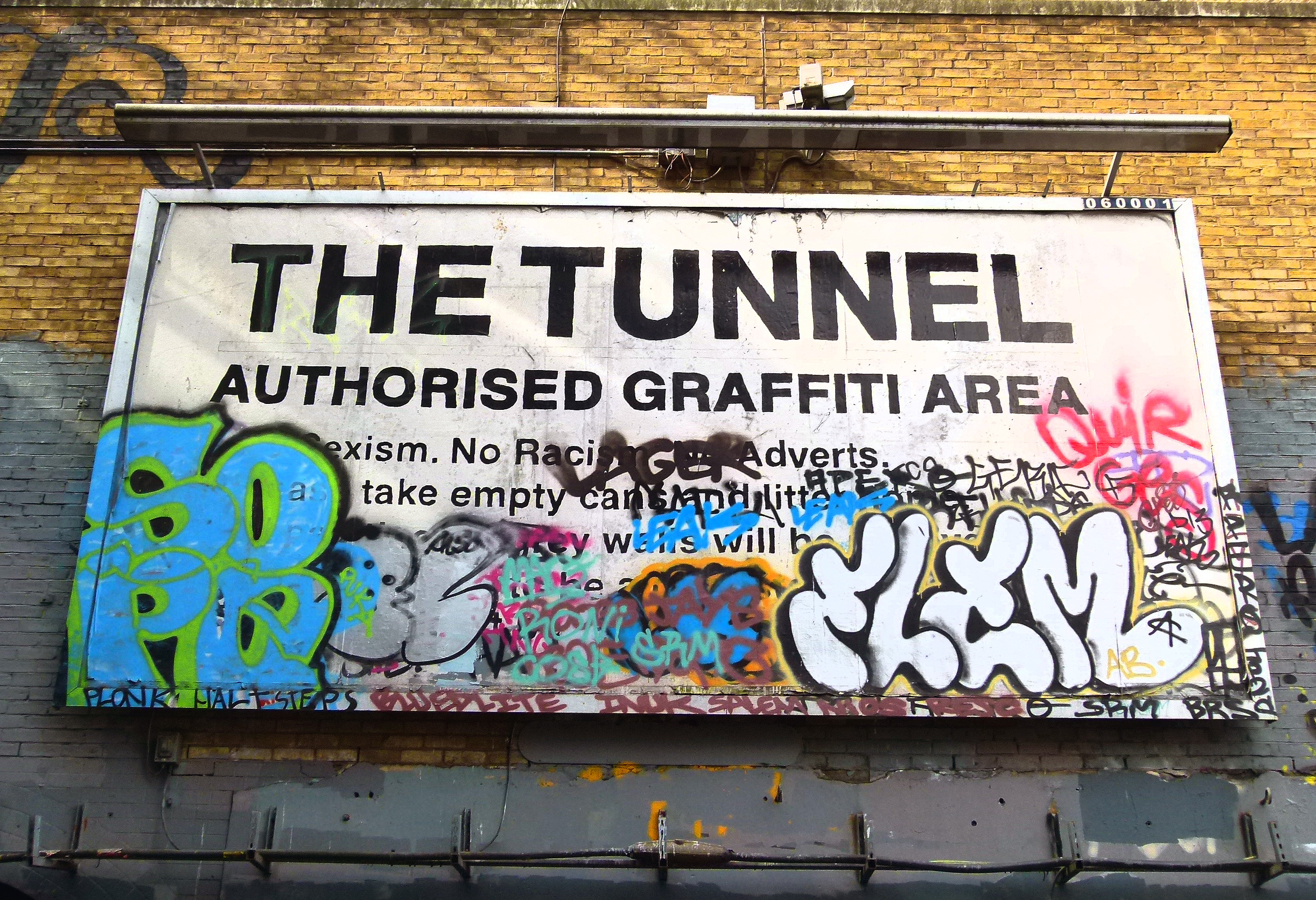
Due to the nature of the style, the artwork changes frequently so repeated visits are well rewarded.

Where to find the Leake Street graffiti tunnel…
Images from my own recent visit can be viewed below.






 View from the Mirror