Tales From the Terminals: Broad Street Station (1865-1986)
This edition of Tales from the Terminals is slightly unusual in that it deals with a station that no longer exists…
Broad Street
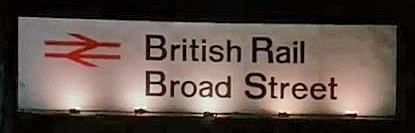

Broad Street Station in 1898
For many years, Broad Street was a vital cog in the capital’s transport infrastructure.
Situated in the heart of The City, the station sat right next door to Liverpool Street station–in fact, Broad Street was on the scene first, opening as a terminal for the Great Northern Railway in 1865, 9 years before its larger neighbour moved in.
The map below depicts the location (coloured in blue) of this now long-gone terminal:

Location of Broad Street in relation to Liverpool Street
Broad Street was originally envisioned as a goods depot; a hub designed to link rail freight travelling between Birmingham and London’s sprawling docks; both key players in Britain’s then vast empire.
However, some bright spark suggested that, being in the heart of the financial district, it would be a good idea to encourage passenger use too.
They were right and, during the first half of its life, Broad Street, along with Liverpool Street and Victoria, was one of London’s top three busiest stations, pouring 1,000s of commuters into the City every day from areas such as Camden, Stratford, Watford and Richmond.
In 1902 alone, it was recorded that 27 million people passed through Broad Street.
However, as the 20th century progressed, passenger numbers began to decline; primarily due to the increased development of the tube and tram networks which were able to ferry commuters around with greater flexibility.
Bombs over Broad Street
Broad Street’s effectiveness as a major rail terminal was also hindered during the two World Wars.
In WWI, the station suffered at the hands of Germany’s fearsome new weapon- the Zeppelin.

On the night of the 8th September 1915, an enemy airship, piloted by Heinrich Mathy- notorious as being the most brazen of the Zeppelin pilots and who had carried out the most bombing raids on the UK- unleashed the Great War’s most destructive attack on the capital.

Heinrich Mathy, the Zeppelin captain who unleashed a devastating attack on London, including Broad Street station
Approaching the UK via Cambridge, arcing around Hertfordshire and North London, Mathy navigated his hulking craft high over Golders Green, following the Finchley Road before taking a detour towards the centre of the capital where the assault commenced.
Russell Square, Theobalds Road (where the Dolphin Tavern was hit- a clock which was damaged in the attack can still be seen behind the bar), Hatton Garden, Farringdon Road (where a plaque commemorates the event) and Bartholomew Close in Clerkenwell were all pounded.

A Zeppelin caught in searchlights over london
Heading further east, the Zeppelin then approached the capital’s financial heart where it released further vengeance.
One bomb exploded directly outside Broad Street station, striking a bus; killing the conductor and several passengers.
More bombs were unleashed over nearby Norton Folgate, causing considerable damage to the tracks leading into the station.
The raid that night claimed the lives of 22 Londoners, with 87 more seriously injured.
Heinrich Mathy himself was killed a year later when the Zeppelin he was captaining was shot down over Potters Bar by the renowned flying ace, Leefe Robinson.
*
During the Blitz of WWII, Broad Street escaped being hit directly.
However, a number of East-End stations serving the terminal were so badly damaged during the nightly raids that they were forced to close for good. These included stations at Haggerston, Shoreditch, Victoria Park and an entire line which branched out to Poplar.
Such closures only served to add to Broad Street’s passenger drain.

Parade of shops at the bottom of Kingsland High Street where the old Shoreditch station once stood… a metal door which led up to the station can be seen around the corner on Old Street…
Struggling on
As passenger numbers dwindled, so too did the building itself and, by the late 20th Century, Broad Street station was in a very poor state of repair.

Broad Street, March 1985 (photo: Geograph)
Writing about the station in 1973, Sir John Betjeman lamented at the removal of a large portion of the station’s roof before going on to say;
“Standing on the empty concourse at Broad Street today, one has a feeling of its former greatness.
Incongruous and ridiculous, in red brick with pavement-light windows is a streamlined booking office for the few passengers who use this potentially popular line. May God save the Old North London!”
The following, short Cine-film clip (part of a collection from Southern Railway Films) shows Broad Street station as it appeared in 1969:
In 1984 Broad Street station was granted one final gasp of recognition; lending its name to Paul McCartney’s album and film of the same title; Give My Regards to Broad Street.

In the film, the former Beatle has 24 hours to track down the master tape for his latest album which has gone missing. The recording is discovered towards midnight, in a forgotten cupboard at Broad Street station itself, rather appropriate considering how decayed and overlooked the once grand station now was.
Sadly, the movie was a commercial and critical failure, its reviews almost as depressing as the state of the station itself.
A scene featuring Paul McCartney pacing around Broad Street station appears towards the end of the film, illustrating just how desolate and dilapidated it had become by this point.
By 1985, only 6,000 people per week were using the station’s limited service- miniscule by London standards and a colossal downfall when compared to the station’s late 19th century heyday.
Towards the end of its life, only two of Broad Street’s nine platforms were in use; the other seven being left to crumble and succumb to weeds.

Broad Street, 1983 (Photo: Wikipedia)
In June 1986, the station was finally wound down and closed for good.
After the tracks have gone…
Today, Broad Street has all but vanished.
The station’s closure coincided with the massive 1980s financial boom, when office space was in particularly high demand- planning permission for such space tripled between 1985-1986.
Consequently, before the dust from Broad Street’s demolition had even settled, developers stormed in, hard-hats on, tape measures in hand, quickly forging the 32 acre ‘Broadgate’ complex; a large area consisting of squares, offices, shops and restaurants.

The project commenced with a ceremony in which then Prime Minister, Margaret Thatcher, fired up the site’s first crane.

Part of today’s Broadgate complex… this office block stands on the former site of Broad Street’s main building. Part of Liverpool Street station can be seen to the right of the photograph.
At its full capacity, Broadgate is capable of serving some 30,000 workers.
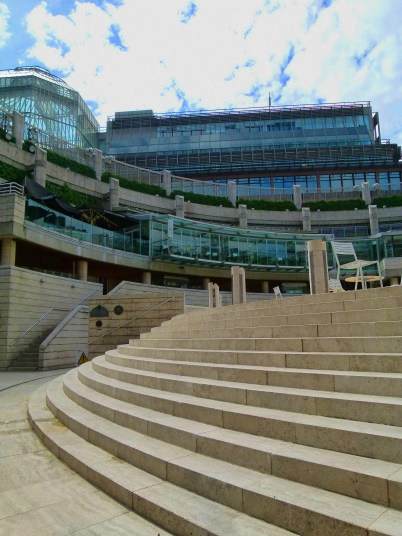
The ‘ampitheatre’ at the centre of the Broadgate complex
The Broadgate site also contains a wide collection of specially commissioned public sculptures, one of which is ‘Fulcrum’, towering over the junction of Liverpool Street and Eldon Street, roughly marking the point where Broad Street’s forecourt once stood.

‘Fulcrum’ sculpture
Sculpted in 1987 by Californian artist, Richard Serra, Fulcrum is crafted from several huge planks of steel (rumour has it that the slabs are old girders from the former station, although as yet I’ve been unable to confirm this).
The trick of this artwork is that the plates are not welded together or joined in any firm way; relying upon the law of physics alone to keep them in place… if you dare to walk beneath them, you can find a small, but well sheltered oasis from the surrounding crowds!

Inside Fulcrum…
Old sections of the mouldy, brick viaduct, which once carried trains over the rooftops and into Broad Street, can still be seen hiding north of Liverpool Street, around the Shoreditch area.

Part of the old viaduct which once led into Broad Street, located on Fairchild Place (off of Great Eastern Street)

Broad Street viaduct, sliced off at the junction of Great Eastern Street and Fairchild Place
One section of the viaduct has been cleverly recycled and is now home to the quirky ‘Village Underground’; a unique collection of artists’ studios.
What makes Village Underground so wonderfully distinctive is that the creative spaces are housed within old tube carriages!
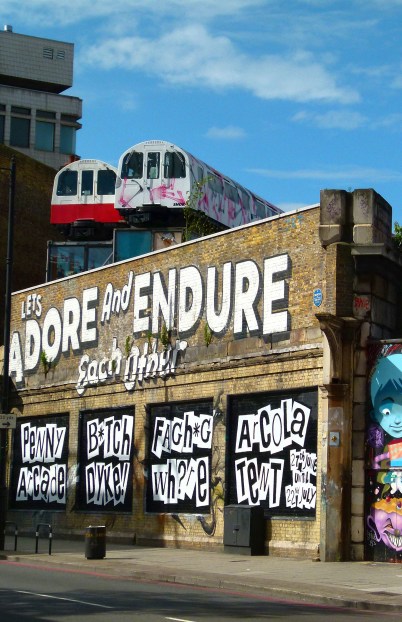
Village Underground, Shoreditch
These particular models of tube car (of which only 30 were built) ran on the Jubilee line between 1983 and 1998.
Growing up during this period, I personally remember them well, with their slattted wooden floors and orange, chequered seats. As I drive past in my cab below, I often find myself wondering how many times I travelled on the Village Underground carriages when they carrying out their original purpose down in the Jubilee tunnels!

Village Underground.. former Jubilee line carriages
Elsewhere in London, another ex-1983 stock tube carriage has been put to a similar eccentric use- you’ll find it in the grounds of Great Ormond Street Children’s Hospital, where it acts a studio for ‘Radio Lollipop’!
Back in Business
A little further up, in the vicinity of New Inn Yard (now fittingly renamed New Bridge Yard), the old arches are once again back in use; linking up with a spanking new viaduct which, since 2010, has carried the new London Overground line; an extensive route which has merged existing lines and reactivated dormant ones- including a section of tracks which once ran into Broad Street.

The brand new London Overground viaduct, linking up with the original, brick arches, half a mile away from where Broad Street station once stood…
One of the stations on the new Overground is Hoxton… where you can discover a special artefact from the old Broad Street station …

Hoxton Station
Take a walk along Geffrye Street-a tranquil road which runs alongside Hoxton station’s viaduct- and you’ll see a rare survivor from Broad Street… the terminal’s old war memorial:
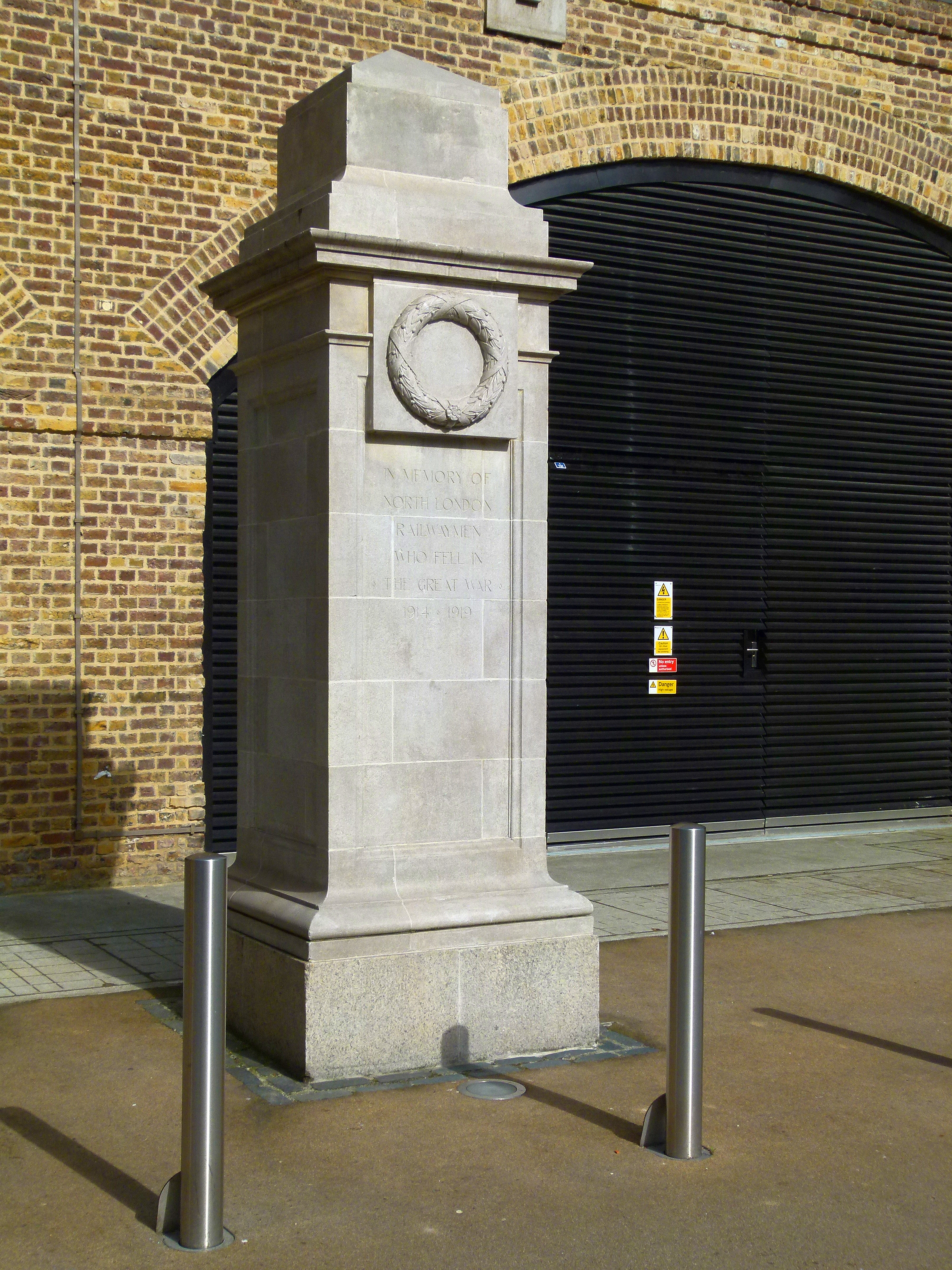
Unveiled at Broad Street in February 1921 and dedicated to the 69 men of the Great Northern Railway who lost their lives during WWI, this memorial- which resembles Whitehall’s solemn Cenotaph in miniature form- was carefully removed during the levelling of Broad Street in 1986.

The memorial in its original, Broad Street location (image from London Reconnections website)
After being kept in storage for three years, it was then moved south to Richmond, one of the more far-flung stations which had been connected to Broad Street, where it remained until 2011.
With the opening of the London Overground and the reinstatement of routes which had once served Broad Street, it was decided to move the war memorial closer to its original home.
On 7th June 2011, the little cenotaph arrived in Hoxton and was rededicated by the Reverend James Westcott (of St Chad’s Church, Haggerston) in a respectful, low-key ceremony.
The newly re-located memorial, along with the new London Overground route (the popularity of which was correctly predicted by Sir John Betjeman) have ensured that the spirit of Broad Street can quietly live on within the capital it once so effectively served.

Metro Blog: London’s First Mascots
In my second guest blog for Metro, I’ve been taking a look at Wenlock’ and ‘Mandeville’; the official mascots for the 2012 Olympics. Writing about the two characters led me to consider London’s very first mascots; two ferocious giants known as ‘Gog’ and Magog’.

Gog and Magog
To read the full article, please click the Metro logo below.

Brook Street & The Bee Gees
Following the recent, sad death of musician, Robin Gibb, I thought now would be a good time to share the following plaque with you:

Robin Gibb of course, along with his brothers Maurice (who passed away in 2003) and Barry, formed The Bee Gees, the much celebrated group who wrote and performed many hits from the 1960s onwards.
The green plaque pictured above can be found at 67 Brook Street in the heart of London’s exclusive Mayfair district. It was unveiled by Robin himself in May 2008.
As the commemorative disc shows, the Bee Gees spent a considerable amount of time at this address for a period of 12 years between 1968 and 1980.
The reason the brothers were so well acquainted with this residence is that 67 Brook Street was the home of Robert Stigwood; manager of the Bee Gees and head of ‘RSO Records’. Stigwood, an Australian by birth, used the exclusive Mayfair address as both his home and office.
The RSO label had great success, dealing with the release of numerous soundtracks including Grease, The Who’s rock opera, Tommy and the scores for the original Star Wars films.
The famous RSO Records logo
The Bee Gees worked on many of their most famous hits at this address, including tracks for the 1977 film, Saturday Night Fever– indeed, it was at 67 Brook Street that they first met the movie’s lead role, John Travalota (who I’m sure would have felt quite at home on Brook Street as the American Embassy is only a few hundred yards up the road on Grosvenor Square).
Excerpts from How Deep is Your Love? and Stayin’ Alive can be heard during Saturday Night Fever’s end credits:
During their time at 67 Brook Street, the Bee Gees also put together their hit 1979 album, Spirits Having Flown which went onto sell over 20 million copies. They also penned the songs, Heartbreaker which was used by Dionne Warwick in 1982, and Chain Reaction, would later prove a successful hit for Diana Ross.
The Bee Gees weren’t the only musical greats familiar with Brook Street.
A little further up the road, number 23, during the late 1960s, was home to legendary guitarist, Jimi Hendrix (another story altogether of course!) and, next door to Jimi- although many, many years previously, there lived the great, 18th century composer, George Frideric Handel.
Today, Handel’s house is a museum; open to the public- click here for the link.






 View from the Mirror