Metro Blog: The Olympic National Pavilions
My latest blog for ‘Metro’ appeared online today; a quick guide to the ‘National Pavilions’ which will be in London throughout the Olympic Games.
These really are something to look forward to, offering exhibitions, music and plenty of food and drink from all over the globe!
Please click the logo before to read the full article:

Cabbie’s Curios: London’s Secret Runway…
For some time now, there has been considerable debate over whether of not Heathrow Airport should build a third runway.
What many people involved in these discussions don’t realise is that there may already be an extra runway in London ready for use… and it’s right in the city centre!
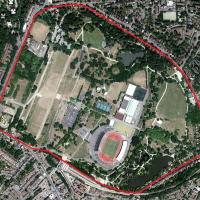
This is of course all based on hearsay and secrecy, but if the rumours are to be believed, this covert runway lies on the western edge of Kensington Gardens…. a wide, tarmacked path more commonly known as the ‘Broad Walk’; a popular thoroughfare through the park.

The Broad Walk marked in pink (image from A-Z imaging)
The belief that Broad Walk may be a secret runway dates back to the mid-1950s when a large number of trees were uprooted and re-planted 25 yards back, thus making the Broad Walk wider and clearer, without obstruction.

The wide, Broad Walk today
Some say that this overhaul was carried for a specific reason- to enable the Broad Walk to act as an emergency base where, in the event of a national crisis (specifically a Soviet nuclear attack), a small aircraft could land and take off- thus enabling the Queen to be evacuated from the capital.
Although this rumour remains strictly unconfirmed, it certainly fits in with the history of the period. By the 1950s, the world was firmly in the icy grip of the Cold War and governments were quickly having to think up contingency plans to deal with the consequences of the terrifying new atomic weapons.
The era is well portrayed in the following short clip from 1958, which shows how RAF crews were required to get their Vulcan nuclear bombers into the skies within a nail-biting four minutes:
If the Broad Walk had been utilised as a platform to flee London, it would have been just one component of a wider evacuation plan. In the early days of the Cold War, the Royals would have been taken to a bunker in the West Country or possibly transferred to Canada.
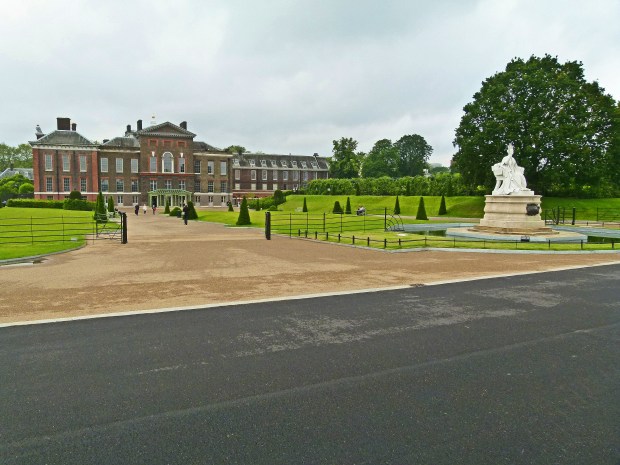
Kensington Palace which sits right opposite the Broad Walk
A new course of action drawn up in the late 1960s and known as the ‘Python Plan’ would have seen the Queen taken to Scotland where, on the Royal yacht, Britannia she would have been kept on the move; transferred to a different Scottish loch each night, the Highland mountains providing sound cover from Soviet detection.
The Python Plan continued to be updated right up until the early 1990s…
If you’d like to know more about London’s Cold War connections, I have written two previous articles on the subject which can be found under the following links:
London & the Cold War: The Spying Game
London & the Cold War: Bunker Mentality
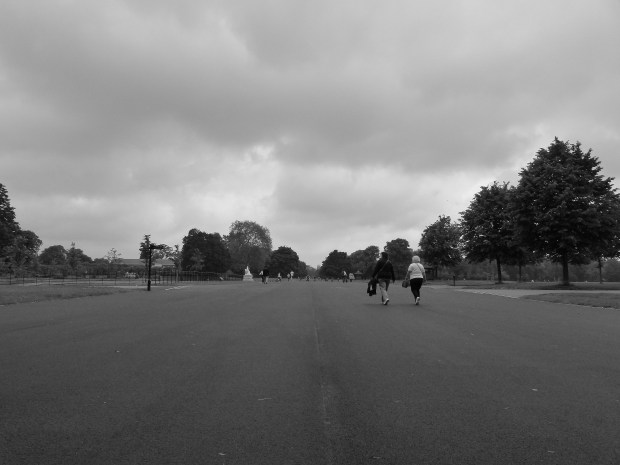
The Broad Walk… all ready for take off!
Bishops, Bones & Birds
Not far from the bustle of Southwark’s Borough Market where tourists flock, traders holler and trains rumble and thump overhead into London Bridge Station, there sits a quiet backwater called Redcross Way; a little-known street, often devoid of traffic or people.
The only sign of life down here is the ‘Boot and Flogger’; a secretive, atmospheric wine bar opposite which stand these rather extraordinary gates, draped in ribbons, trinkets and hand-written messages:
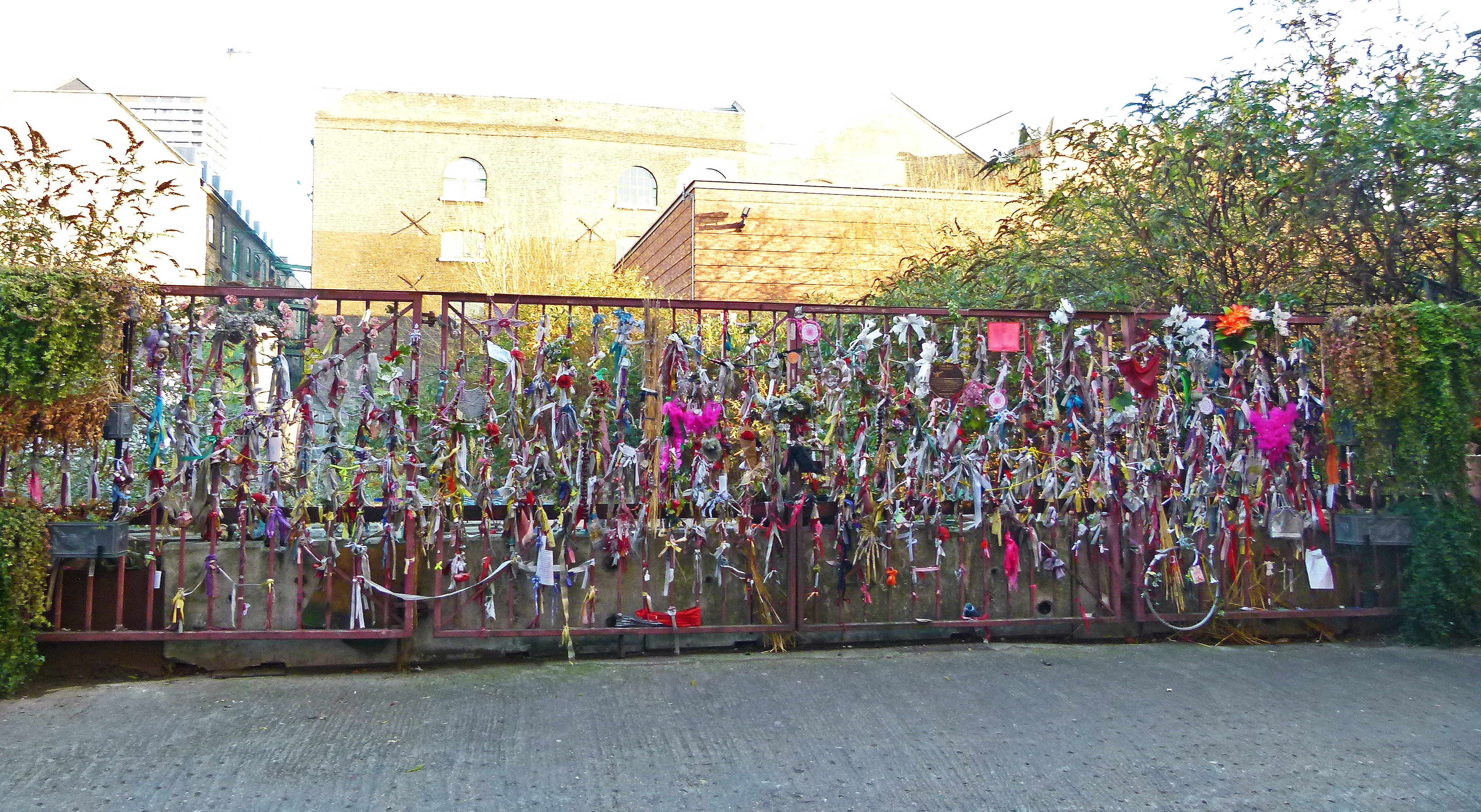
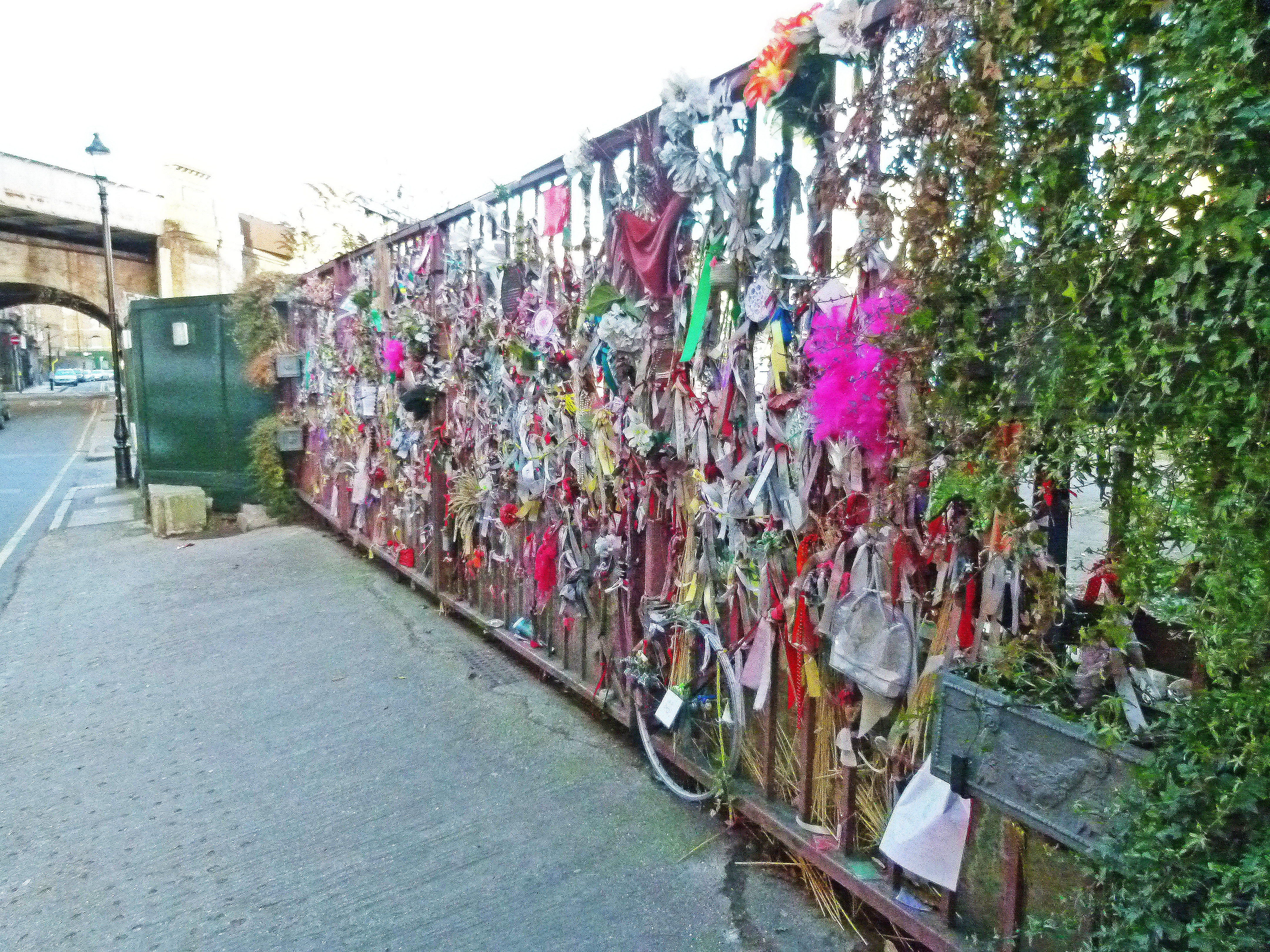
These gates guard the entrance to the morbidly named ‘Crossbones Yard’; a frequently overlooked slice of London’s murkier history.
*
The exact year in which Crossbones Yard was established is a mystery- even one or two Roman remains have been found here. It certainly dates back to at least medieval times and is primarily a remnant of an era in which Southwark acted as London’s ‘Sin-City’…
In those days, the City of London was confined to the north bank of the Thames, still locked in by the defensive wall which had been laid out by the Romans many generations before.
Already a city of immense wealth, the capital was governed by staunch laws which ensured everything ran like clockwork and that her God-fearing citizens knew their place and generally behaved themselves.
Every evening at 9pm, the bells of St Mary Le Bow Church would begin to ring, signalling the start of the nightly curfew. When these bells commenced their clanging, London Bridge- the famous crossing cluttered with shops and houses- would close its gates for business, keeping undesirable riff-raff at bay.
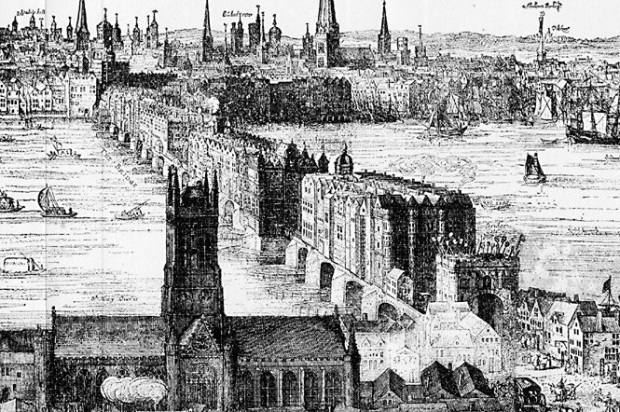
Old London Bridge… Southwark is towards the bottom of this contemporary etching
However, a few hundred feet away on the opposite bank of the Thames, things would just be starting to wake up…
Cluttered around the southern foot of London Bridge lay the settlement of Southwark which, thanks to a setup known as the “Liberty of the Clink”, was a practically lawless place where anything went and Londoners came to party…. it was rather like an extremely early, uncontrolled version of Las Vegas!
Over in the city, depraved entertainments were forbidden but here, across the Thames in sinful Southwark, there were no restrictions.
What went on in Southwark stayed in Southwark… a place where people came to frequent the many taverns, to visit the theatre (a civilised pastime today, considered a heinous pursuit back then), to bet on dice, cock-fighting and bear baiting, to have a punch up… and to pop into the ‘stews’- a slang term for brothel of which there were a great many.
*
The scant authority which did exist in Southwark emanated from a surprisingly holy source; the heathen place being presided over by the Bishops of Winchester…
Founded in AD676, the Diocese of Winchester was one of the largest and most powerful in the country. Consequently, it was decided that the Diocese should establish a base within convenient reach of the capital. So, in 1109, a palace for the Bishops of Winchester was built in Southwark- the remains of which can still be seen today on Clink Street.
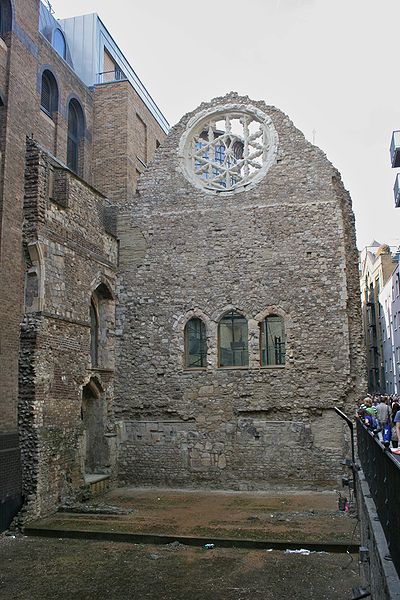
The Remains of Winchester Palace, Clink Street (Photo: Wikipedia)
Being such powerful landowners, the Bishops serving the Diocese of Winchester held a firm financial grip over Southwark.
Although a prison- ‘The Clink’ (today a museum)- was constructed near the palace to deal with certain troublemakers, the Bishops pretty much let Southwark’s sinners get on with it… in fact, due to their status as landlords, the Bishops of Winchester actually made a tidy profit out of the debauchary, renting out land and premises to facilitate the sordid goings on.
The brothels were no exception, thus paving the way for an extraordinary anomaly… the holy men technically became pimps…
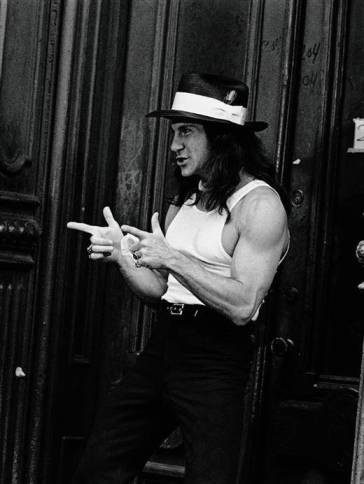
Harvey Keitel as ‘Sport’; the sinister pimp from the 1976 film, ‘Taxi Driver’… a role somewhat emulated centuries earlier by the Bishops of Winchester!
As well as collecting rent from the working girls, the Bishops also regulated the stews as a legitimate business, controlling opening hours and enforcing certain ground rules.
Buildings that belonged to Southwark’s red light district had to be painted white and were also required to display a specific sign, similar to ones used to denote inns and taverns- the most common being the image of a cardinal’s hat.
It is estimated the Bishops controlled around 18 brothels, all of which had pub-like names- ‘The Half moon’, ‘The Cross Keyes’, ‘The Boars Head’, ‘The Gun’, ‘The Castle’ and so on.
Because of this arrangement, the working girls of Southwark became known as the ‘Winchester Geese’, and it is said that this is where the rough and ready slang term, “bird” (meaning woman) may have originated from.
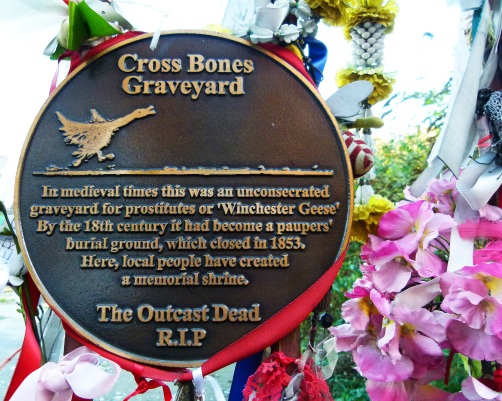
Modern plaque on the gates of Crossbones Yard
Despite helping the Bishops of Winchester turn a quick buck, the prostitutes of Southwark were still considered to represent the pinnacle of sin.
Consequently, when a Winchester Goose died, it was forbidden to bury her in consecrated ground… and this is where Crossbones Yard came in.
The yard was essentially a dumping pit for the heathen, an unconsecrated patch where bodies could be cast to the worms with zero ceremony.
In 1598, John Stow- in his fascinating book, ‘A Survey of London’ (essentially the very first guide-book ever written about the capital) recalled Crossbones Yard and its sad purpose:
“…these single women were forbidden the rites of the church so long as they continued in that sinful life, and were excluded from Christian burial if they were not reconciled before their death. And therefore there was a plot of ground called the Single Women’s Churcyard appointed for them far from the parish church.”

John Stow who described the burial ground in his early guide book
The Bishops’ lucrative pimping side-line was abruptly ended (“put down by the King’s commandment… proclaimed by sound of trumpet” as John Stow described it) in 1546 by Henry VIII- rather ironic considering that tyrannical monarch’s track record!
*
Despite being taken out of the the Bishops of Winchester’s hands, the brothels gradually began to creep back over the following decades and were once again in full swing by Shakespeare’s time, jostling for space with the Bard’s equally naughty Globe Theatre. This second wave of debauchery was later halted by the ultra-puritan, Oliver Cromwell.
Throughout this turmoil, Crossbones Yard continued to accept burials- there were plenty of crooks and poverty-stricken paupers to go around and many of these unfortunate souls found their final resting places here
When Guys Hospital was founded nearby in 1721, Crossbones Graveyard became a popular target for the ‘resurrectionists’ -aka body-snatchers for whom the large, disease ridden pit provided a regular bounty of fresh corpses, ripe for dissection and the attention of curious, scientific minds.
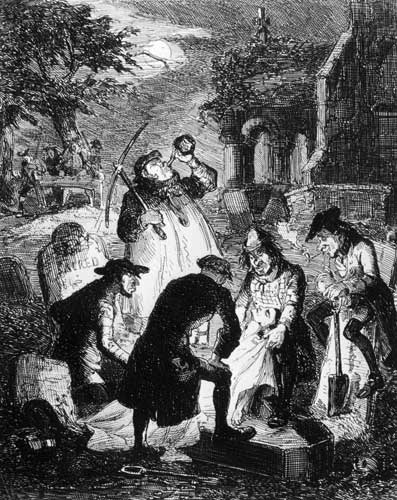
Body-snatching…
Crossbones Yard continued to accept the dead well into the 19th century.
Excavations from the 1990s revealed that between 1800-1853, 66% of the souls dumped here were under the age of 5, the main causes of death being smallpox, tuberculosis and cholera; a tragic sign of the desperate levels of poverty which haunted London at the time.
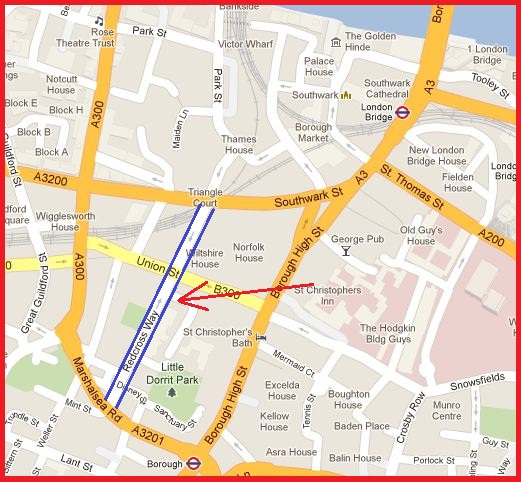
During this era, it is most likely that the great Victorian writer, Charles Dickens would have been familiar with the packed graveyard. In 1824, whilst his father was incarcerated in the nearby Marshalsea debtors’ prison, the young 12 year old Dickens lived on Lant Street, a stone’s throw from Redcross Way.
The area around Southwark would later go onto play an important role in his 1855 masterpiece, Little Dorrit.
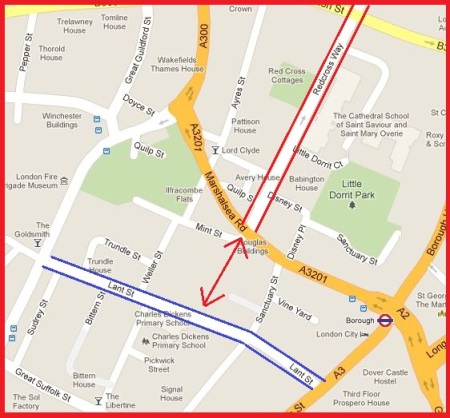
Map showing Lant Street, where Dickens lived as a youngster, in relation to Redcross Way
Towards the end its life, Crossbones Yard was quite literally full- “overcharged with dead”- with bones and body parts lurking unsettlingly close beneath the topsoil- even poking out in some cases.
Considered a public health hazard, the dejected graveyard was finally closed in 1853, the land was sold and a warehouse built on top.
Overall, it has been estimated that some 5,000 souls were buried here over the years.
*
Crossbones Yard was rediscovered in the 1990s when work was being carried out on the Jubilee line extension.
Today, it lies beneath a sorry patch of concrete and the former unconsecrated burial ground has become an unofficial shrine to the ‘outcast dead’.
As these pictures show, people come here to write messages and dedicate objects to those who are seen as having passed away whilst living on the edge of society. Many of the melancholy dedications on display are in memory of homeless people, alcoholics and prostitutes.
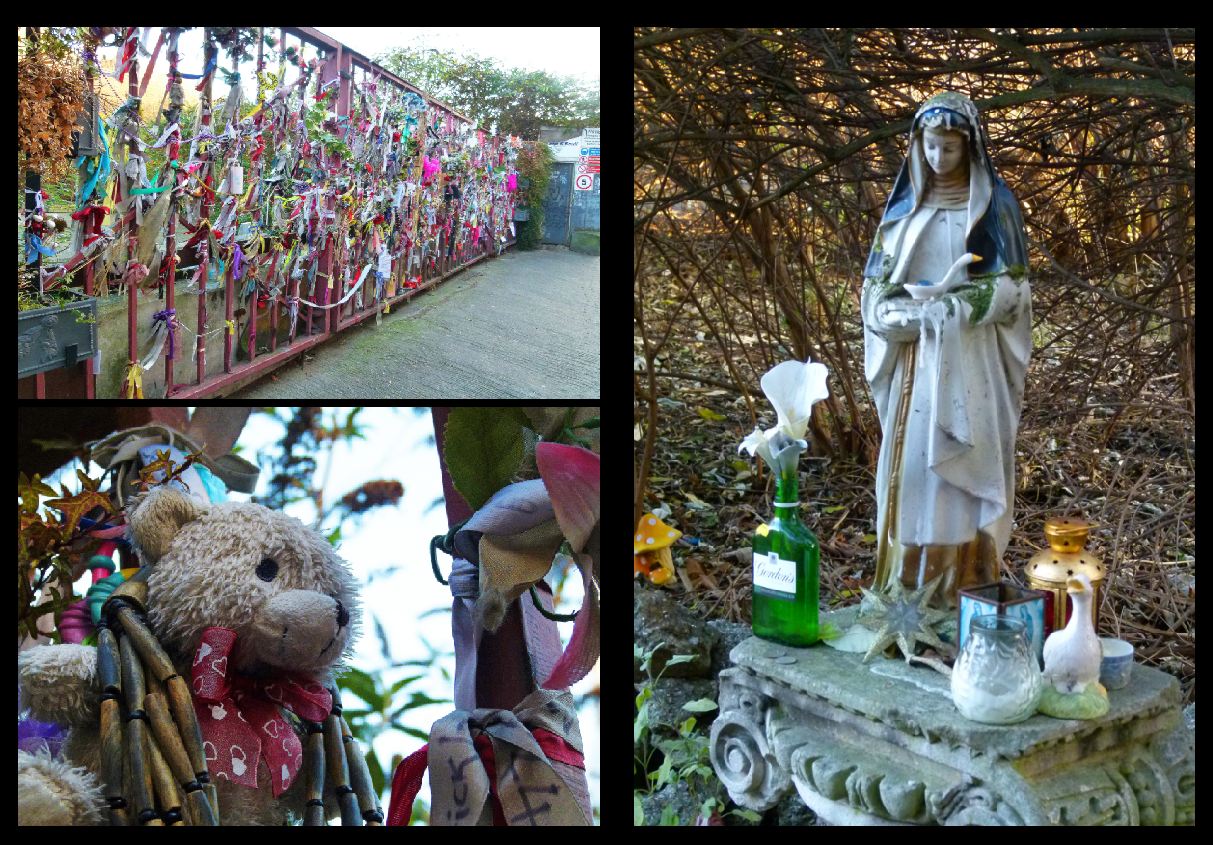
At 7pm on the 23rd day of every month, a vigil often involving poetry recitals, singing and dancing is held at the gates. All are welcome.
Depressingly, the site has been under the threat of redevelopment for some years now. Thankfully, a committed group of people have been campaigning to save this important area; the ultimate wish being that a peaceful garden of remembrance will eventually be created- a fitting tribute to the 1,000s of dead who were cast aside here so unceremoniously.
For more information, please follow this link to the excellent Crossbones website, where you can find out more and sign a petition to preserve the site.
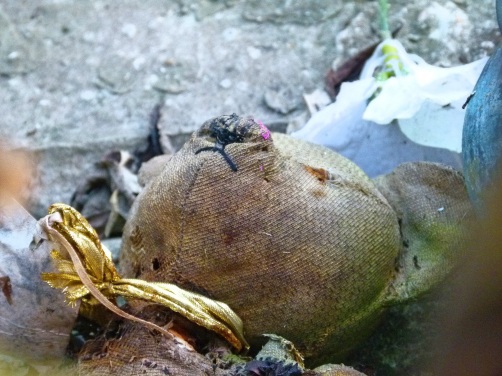
A sad teddy, lying in tribute within Crossbones Yard







 View from the Mirror