Happy Birthday, London Underground
January 10th 2013 is an extremely important date in the capital’s history, for it marks the 150th anniversary of the inauguration of the London Underground; the world’s oldest subway system.
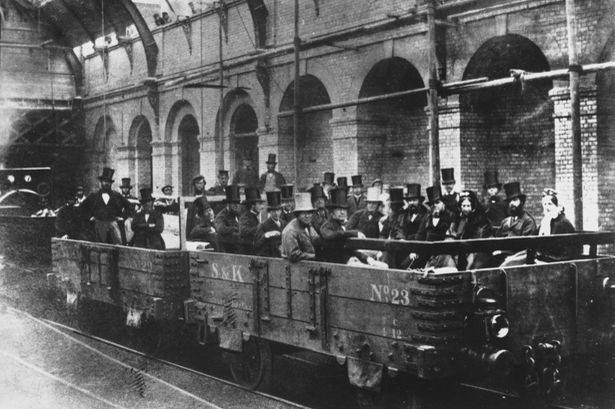
VIPs gaining on a sneak preview of the Metropolitan Railway.
First opened to the public on the 10th January 1863 as the Metropolitan Railway, the pioneering line originally ran between Paddington and Farringdon; a distance of 3.75 miles.
Although the original route and tunnels are still in use today (now occupied by trains running on the Circle, Hammersmith & City and of course the Metropolitan lines), passengers travelling on the Underground during its earliest days would have undergone a very different experience indeed.
Being the mid-19th century, trains were powered by steam and, despite a special engine design and the inclusion of regular ventilation shafts, clouds of choking smoke still swirled within the dingy tunnels.

Open wagons rumbling through the world’s first underground railway… no need for air conditioning here!
As with main-line services of the time, the carriages were designated into first, second and third class. The coaches themselves were wooden and lit by atmospheric gas-lamps; a health and safety nightmare by today’s standards.
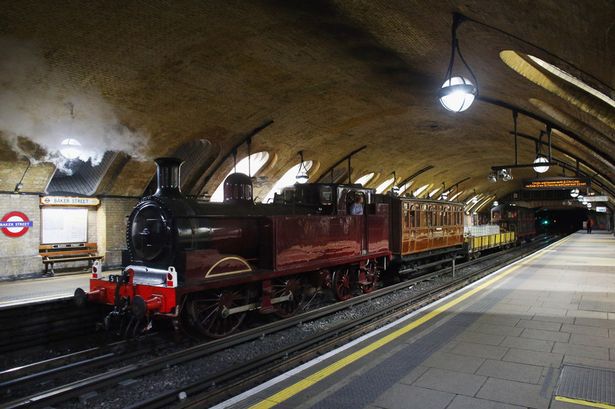
A steam engine at Baker Street station, carrying out a a trial run for 2013’s commemorative trip. (Image: The Daily Mirror)
Some idea of how these pioneering locomotives would have appeared whilst in service can be seen in the following BBC clip:
Carrying tens of thousands of passengers on the first day alone, the revolutionary underground railway proved popular with Londoners from the outset and has remained packed ever since.
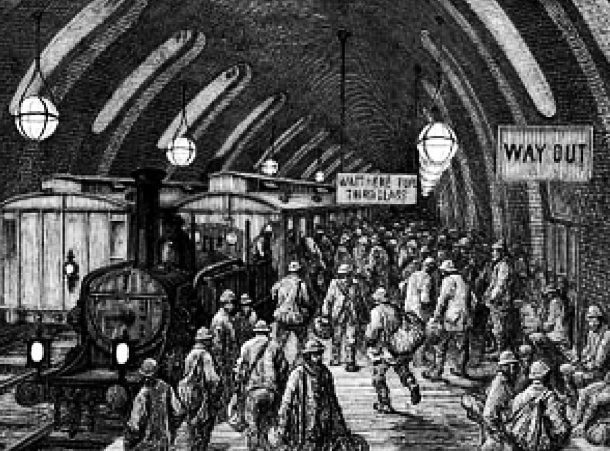
Rush hour at Baker Street… Victorian style.
Being a totally new concept there were naturally one or two teething problems; the main ones being summed up in the Times just ten days after the Metropolitan Railway opened.
The main issue was clearly that of smoke which, despite the best efforts of the skilled railwaymen, still managed to accumulate and create discomfort.

An early Metropolitan steam engine (image: Watchet Museum).
Those who suffered most were the engine drivers, who complained of “pains in the head from working the trains”; an apparent result of the build-up of sulphurous fumes- a phenomenon which the early railway staff quickly nicknamed “choke-damp.”

Chugging along… The junction represented here lies beneath Praed Street, Paddington.
Porters and signalmen were also prone to feeling ill from smoke inhalation; so much so that in the first few days of service, several of these workers were “carried away insensible from the effect of noxious vapours.”
However, the report also suggested that staff’s weakened state may have been caused by “exhaustion from long hours of work” and “that, owing to the pressure of traffic, the men had not really been able to leave for their meals.”
Shame these early tube workers didn’t have Bob Crow around to fight their corner!
*
Just like today, the prospect of anti-social behaviour on the underground network was a concern in Victorian London.
On April 2nd 1863, when the Metropolitan line had been open barely three months, a letter appeared in the Times from an anonymous, “occasional traveller” who wished to bring to light the details of a rather humiliating situation which he’d experienced whilst using the new subterranean line.
The passenger describes how, travelling between King’s Cross and Portland Road (now renamed Great Portland Street), he took a seat in a third-class carriage…
“When a somewhat powerful man entered, and after pushing and showing by gestures he wished for my seat, remarked it was no matter to him, if I did not like to move he should sit on my knee which he accordingly did”!
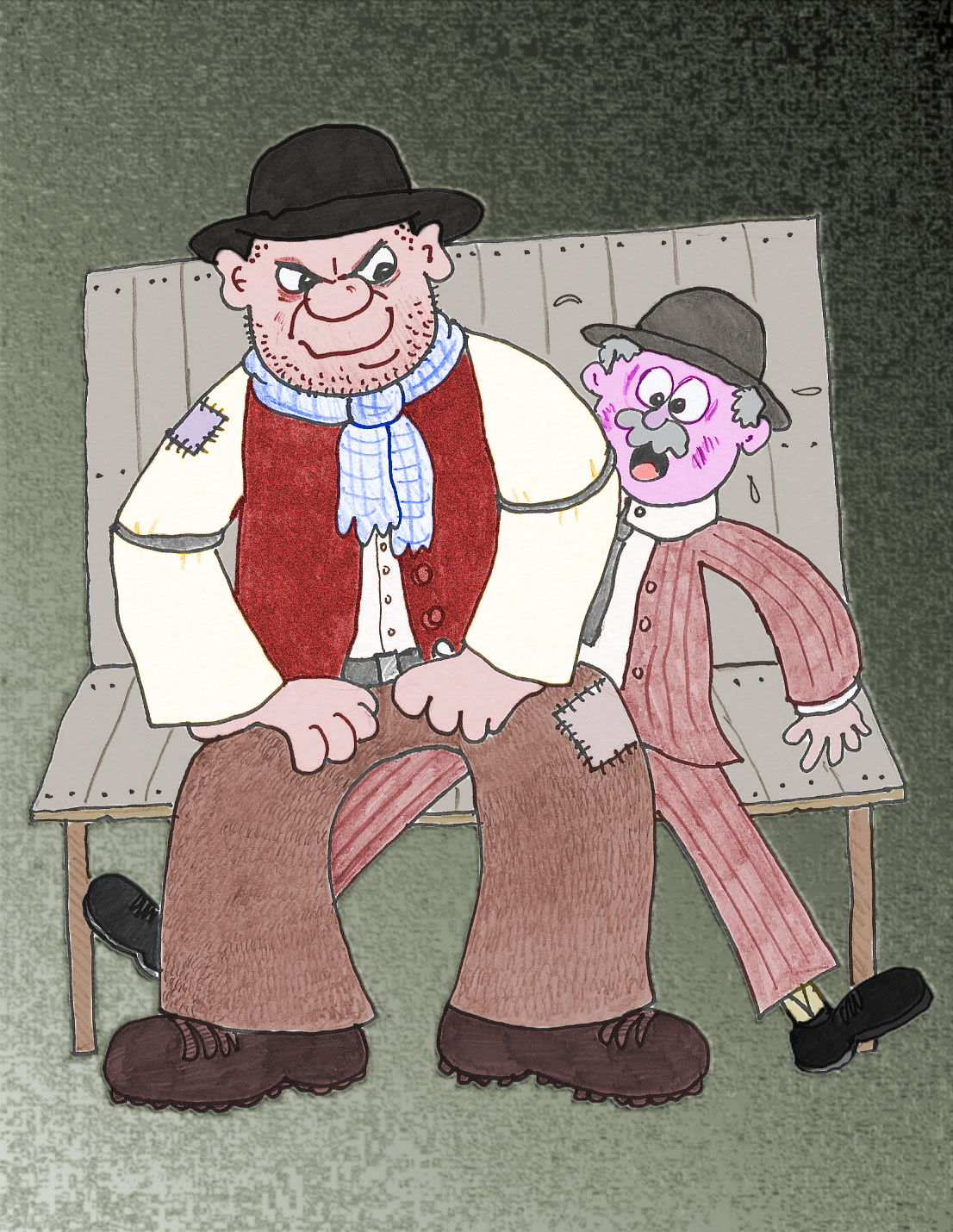
Unable to summon help at King’s Cross, the commuter resigned himself to “nursing my amiable companion until we reached the Gower-Street station [now Euston Square]…I contrived after some difficulty to get out and immediately sought the guard.”
Sadly, the poor victim of the unprovoked knee-sitting was unable to find anybody willing to help and, after much buck-passing, was eventually granted an audience with the stationmaster- who simply said by way of consolation,
“That there were a number of persons continually travelling on the Metropolitan Railway for no other purpose than annoying the passengers.”
Certainly something to bear in mind next time you find yourself on a crowded tube with rising blood pressure!
The infuriated Times correspondent concluded that,
“If such excuses as these are to be accepted for allowing insulting scoundrels, thieves, or persons guilty of any other crime to escape scot-free, the Metropolitan Railway is likely to become, instead of a great public benefit, a disgrace to the metropolis.”
150 years on, I think we can safely say that the occasional traveller’s fears have been proved unfounded!
Happy birthday, London Underground
* * *
Candid Capital: Meeting her Maj
Meeting her Maj

Cabbie’s Curios: A Quack in Hatton Garden
Back in the days when medicine was messy, painful and still in its infancy, ‘Quack Doctors’ were big business.

‘The Visit to the Quack Doctor’ by William Hogarth, 1743.
Exploiting the public’s medical naivety, these roguish characters promised a staggering array of seemingly miracle cures- all for a tidy sum of course.
In 18th century London, one of the more brazen quacks appears to have been a certain Doctor Sangrado who, in the summer of 1788, established a practice on Hatton Garden (home today to the capital’s jewellery quarter).

Hatton Garden today (image: Google)
Arriving from a spell in Jamaica where he claimed to have forged a lucrative career as a veterinary surgeon, Doctor Sangrado took out a lengthy advertisement in The Times, claiming that he had now “turned philosopher” and intended to “cure all kinds of disorders.”
In the marketing stunt, Doctor Sangrado listed his catalogue of apparent skills, including the supposed ability to “restore reason to a mad-man in three minutes”, “to make a new leg grow out of the stump from which the former had been amputated”, “to recover a person drowned after he had lain six weeks in the water” and, in a boast which was surprisingly ahead of its time, to “change the male into the female sex” and vice versa- a procedure which he stated would take a mere “one hour thirty three minutes and a half”!
*
Ludicrous as all this may sound, some gullible Londoners with more money than sense appear to have been willing to entrust their bodies to Doctor Sangrado.
On the 5th June 1789, another edition of The Times printed the contents of a mysterious medical bill which had been discovered abandoned on Hatton Garden.
Although the patient and practitioner were never identified, it is highly likely that, due to the location in which it was found, the bill was drawn up and accidently dropped by the Hatton Garden quack.
The baffling receipt detailed work conducted between 1788 and 1789 and read thus….
Aug 2nd. Taking your right arm off, repairing and fitting the bone below the shoulder.
Aug 6th. Three new fingers to your left hand.
Aug 10th. A new knee-pan to your left knee, replacing your thigh bone…and one new toe nail.
Aug 19th. A new foot to your left leg.
Oct 20th. Taking out three of your old ribs, and putting in three new ditto, and stitching your sides.
Oct 30th. Taking out your guts, untwisting them; turning, cleaning and putting in ditto.
Nov 1st. Filling your old bones with hog’s marrow.
Nov 12th. Filling your veins with goat’s blood.
Nov 20th. Mending your skull and putting in some…brains, altering your face and reparing the bridge of your nose.
Jan 20th. A new eye and brigtening the other.
Jan 31st. A new toungue, new lining for your mouth and widening ditto, the old parts being put repair.
March 10th. Cleaning and reparing the foul parts of your heart.
March 11th. Rubbing up your bad memory and sundry other repairs done to your person.
March 12th. A new cheek and mending your wind pipe.
March 13th A complete set of new lungs… and some repairs done to the stomach….

‘Hymn’ by Damien Hirst, exhibited outside the Tate Modern in 2012.






 View from the Mirror