Werewolves & Make Up
I was recently driving along ‘Parkway’; a busy road lined with bars and restaurants which ploughs through trendy Camden.
Being a Monday afternoon, it wasn’t exactly the busiest part of the day for the area, and I wasn’t really expecting a job. If truth be told, I was in fact heading towards Camley Street, a small, Camden backwater which happens to be home to a popular cabbie’s café (where a cup of will set you back a mere 60p!)
However, whilst waiting at a set of traffic lights, a woman jogged towards me, arm held aloft.
“I need to get to Earl’s Court please.”
From Camden, that’s a very good journey indeed, and I was more than happy to forfeit my cuppa!
Only problem was, we were in the middle of Camden’s complex one-way system and, in order to head in the right direction, a bit of twisting and turning along a number of small side-streets was required. Whenever I have to do this (which, unsurprisingly in London, is quite often), I often quickly explain the reason to my passenger, for fear that it looks like I’m deliberately going around the block in order to nudge the meter up!
“No problem; you’re the boss! Do what you have to do.”
The passenger was most cheerful and clearly very friendly; an energetic woman colourfully dressed in a long, purple coat and red hat.
“Have you been shopping at the markets?” I asked, turning into yet another one-way street.
“Oh no, I wish! No, I’ve been working at rehearsals.”
“Oh… are you an actress?”
“No, nothing that glamorous I’m afraid! I’m a make-up artist; been working on a sitcom for the BBC.”
Now that I’m finally out of Camden’s labyrinth one-way network and heading through the quicker, tranquil roads of Regent’s Park, I ask the passenger where exactly in Earl’s Court she’s heading for.
“Redcliffe Square, please; I’m meeting a friend there.”
I’m interested to learn a little bit more about my passenger’s experience in make-up.
“You probably get asked this all the time,” I ask, “but what shows and films have you worked on?”
“Oh, quite a lot… I’ve been doing makeup professionally for over 25 years now. I suppose my favourite job I worked on was ‘Frankenstein’; the one directed in the 1990s by Kenneth Branagh.”
I’m quite familiar with that version, mainly because the creature cobbled together from various corpses is played by Robert De Niro; a popular actor amongst cabbies thanks to his role as ‘Travis Bickle’, the troubled loner in the classic 1976 movie, ‘Taxi Driver.’
It is perhaps the most clichéd question I could possibly ask on the subject, but I can’t help but inquire;
“What was De Niro like to work with?…”
“He’s very approachable… a polite man but, when working; whilst in character, he is deeply intense.
I worked on Saving Private Ryan too; that was an interesting job. Very upsetting though.
I did make-up on the opening scene… you know; where the soldiers storm the beach and get shot at and blasted from all sides.
It made you realise what those men went through. For that scene, they used a lot of amputees; guys with arms and legs missing. False limbs were made, and then blown off; graphic stuff. That wasn’t filmed in France though; they did it on a beach over in Ireland.”
“Do you get to travel much with your job then?” I ask.
“Quite a lot yes. I don’t mean to sound ungrateful; I know how lucky I am, but it can get pretty tiring sometimes; especially when you’re stuck in an open field for 12 hours in the freezing rain, it doesn’t feel that glamorous!
I did another film though with Kenneth Branagh; ‘Much Ado About Nothing’ and that was wonderful… got to spend lots of time in the Mediterranean sunshine; a real treat!”
By now, we’ve hit the inevitable traffic. I apologise for the hitch, and start to wind through a number of twisting shortcuts.
“Oh, don’t worry about it” my passenger reassures me.
“I grew up in London; I know what the roads are like around here.
When I was younger, I used to drive around town all the time. It was so much easier back then; traffic didn’t seem quite as bad, you could park a lot easier. No cameras watching your every move- that’s the worst thing, isn’t it? You know the ‘Ritz’ Hotel; where they have that covered walkway outside?”
I do indeed know it. The passenger is referring to a fancy pedestrian walkway; a colonnade sheltered by a long, fancy roof. It runs along the front of the famous hotel; the windows and blue-coated doormen offering a tantalising glimpse into the luxury which lies within.

“Well, I was just a kid at the time; only about 19. I’d just passed my driving test, and I became the proud owner of an old Mini.
I went all around London in it and, early one Sunday morning, I drove through the Ritz’s walkway! Ha ha! It was like something out of the ‘Italian Job’! You’d never get away with that now would you; the CCTV would catch you out like a shot!”
The image which this conjures up in my mind makes me laugh so much that I nearly have to pull the taxi over! The make-up artist laughs too, amused at the impact her tale of juvenile anarchy has on me.
“I bet you’ll never be able to look at the Ritz in quite the same way again now, will you?!”
Usually, I’d take such a story with a pinch of salt, but the passenger is certainly eccentric enough to have committed such a reckless stunt!
*
As we drive on, I’m reminded of a film; revolutionary in its make-up and special effects which was filmed in the very square to which we are headed.
“Going back to movie make-up,” I say, “do you know the film, ‘An American Werewolf in London’?”
“Ohh, of course I do… it was the very first film I worked on!”
“You’re kidding? Did you know that they actually filmed that on Redcliffe Square?!”
“I do indeed… “
She pauses and looks out of the window briefly, clearly remembering, and then smiles to herself.
“Didn’t really think about it until you mentioned it, but I’m returning to where my career started aren’t I?”
*
To those unaware, ‘An American Werewolf in London’ is a film which has steadily gained the status of cult classic.
Released in 1981, the movie tells the story of two young, American friends; David and Jack who, as the story begins, are backpacking across the windswept, Yorkshire Moors.
Seeking a hot meal and a cup of tea, the pair come across a rather sinister pub called ‘The Slaughtered Lamb’.

(London has its very own ‘Slaughtered Lamb’ pub, named in homage to its famous movie namesake. It can be found on Great Sutton Street in Clerkenwell, and has a great music venue downstairs).
After being made to feel rather unsettled by the somewhat sinister, cagey locals, the two Americans leave the pub and resume their hike across the moors…
However, shortly after leaving the pub and as night sets in, the pair are attacked by a large and wild, vicious beast. Jack is killed instantly but David, who is severely injured, survives and slips into a coma.
*
When he awakes several weeks later, David finds himself lying in a London hospital bed.
The authorities tell him that he and Jack were ambushed by a crazed lunatic, but David knows better and insists that the attacker was a creature; a werewolf. Naturally, his bizarre recollections are brushed off as a symptom of the trauma through which he has been.
After being discharged from medical care, David is invited home by a young nurse; Alex Price (played by Jenny Agutter) who has rather fallen in love with the young American. Her flat is on Redcliffe Square, near Earls Court.
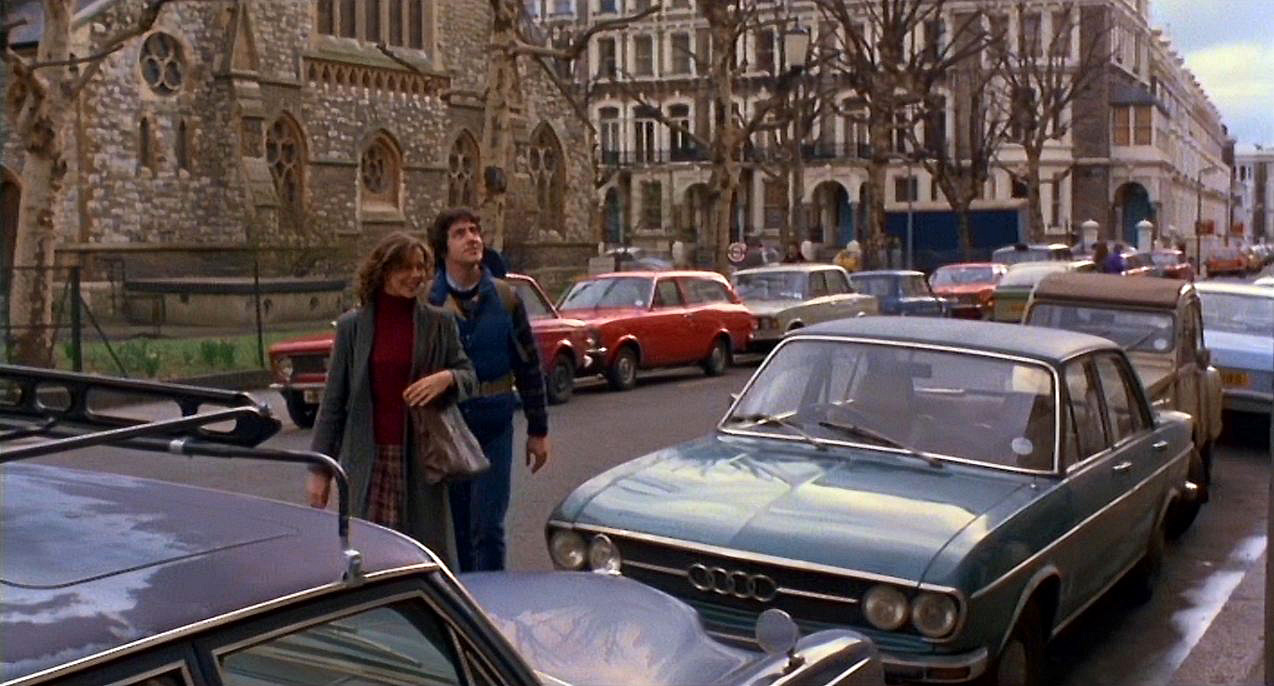
As he recuperates, David is haunted by gruesome nightmares and visions of his dead friend, Jack. Every time Jack appears- including a haunting in the Redcliffe Square apartment- he appears to be in an advanced state of decay. He warns David that, as he has been clawed by a werewolf, he is destined to become one himself.
Sure enough, on the full moon, and whilst Alex is on night-duty at the hospital, David undergoes a startling and painful transformation… Never before has Redcliffe Square witnessed something so terrifying!

Following the metamorphosis, David- in werewolf form- proceeds to go on a midnight rampage across London; feasting on a number of hapless victims.
In one of the film’s most famous scenes, the beast finds its way into Tottenham Court Road tube station and chases a late-night commuter along the eerily deserted walkways before cornering him on an escalator…

The following morning, David has returned to his human form. Despite waking up in the unusual location of London Zoo, he has no memory of his violent antics from the night before… and it takes a talkative London cabbie to make him realise what his nocturnal self has become!
(I must say, I wish I could drive from Earl’s Court to Trafalgar Square that quickly; it would do wonders for my blood pressure!)
After failing to get the police or authorities to take him seriously, David is forced to roam the streets of London and, as night falls, he finds himself in the ‘Eros Cinema’ on Piccadilly Circus.
(The Eros was a cinema which used to screen films of a more adult nature. Back in 1981, the area around Soho and Piccadilly Circus was notorious for its seediness and attractions of a more red-lit nature. The Eros closed in 1985, and has since been replaced by a far more clean-cut Gap clothing store).
Being a full moon, David once again warps into a werewolf. Bursting out of the grubby cinema, he proceeds to cause havoc in the West End, as the following clip demonstrates (Warning! Some if it’s a bit gory!)
For this amazing sequence, director John Landis was granted permission to completely close Piccadilly Circus off to the public for a night-time shoot.
All of the people you can see are actors, all of the vehicles carefully choreographed. The only other film to have been granted this amount of access to this famous London landmark was the more recent Harry Potter and the Deathly Hallows.
When the American Werewolf in London scene was being prepared, the film crew had to do a sweep of the area, making sure all entrance points were closed, and no members of the public were around to stumble upon the carefully organised set.
There is a story (probably an urban legend, but fun all the same!) that an elderly homeless fellow, tucked away and fast asleep in an alleyway was missed by these roaming checks.
A few hours later, when he awoke, the filming was well underway; complete with crashing cars, screaming actors and a marauding, animatronic werewolf… needless to say, the elderly tramp received quite a shock!
* * *
“I was 16 years old when I got that job” continues the make-up artist. “Gosh, I was a precocious kid; a little snot really! I just went up to them and asked them to take me on. I practically insisted.
But you could do that in those days- it was certainly a lot easier to get into that business than it is today. Nowadays, you have to go through all sorts of hoop-jumping; lots of expensive courses and training.
On the American Werewolf set, I was just a tea girl; they had me running all over the place. I got to see things though; I picked up lots of knowledge on set.
I remember seeing one of the werewolf models; it was on a sort of see-saw contraption, and I got to move that up and down a bit.. quite primitive really, but then I still think models and puppets like that are miles better than the computer animation they use today, don’t you agree? You can’t beat having something solid in front of you; you know; something that actually exists. I learnt a lot on that job, and I’ll always be grateful to them.”
*
We finally arrive at Redcliffe Square and the friendly make-up artist bids me a cheerful farewell, leaving a generous tip in the process.
Putting the cab in gear, I drive off, turn the corner, and drive past the apartment where a team of talented make-up artists worked their magic all those years ago.
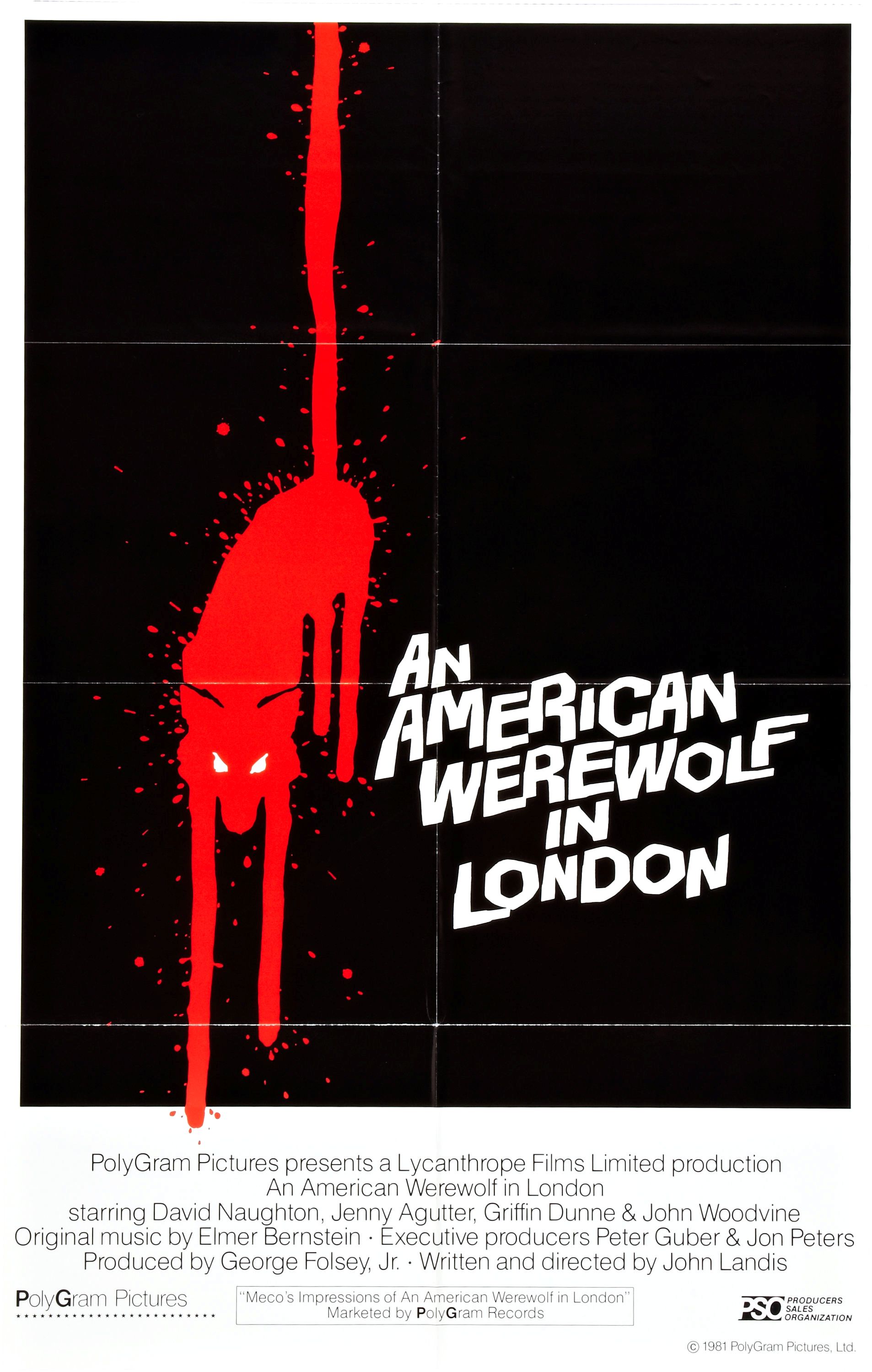
Tales from the Terminals: Paddington
Every day, I’m guaranteed at least one job to one of London’s numerous main railway terminals; those huge cathedrals devoted to train travel which suck in and belch out thousands upon thousands of commuters, tourists and casual visitors on an hourly basis.
London’s rail termini are hectic places indeed, and dropping passengers off is always a chaotic, yet strangely predictable process which can be summarized thus:
1) If heading for one of the larger, more complex stations, it is often advisable to determine which of the various entrances or drop-off points you’re going to aim the cab for. Veteran taxi-riders (generally City workers and patrons of swish Pall Mall clubs) are always in the know and will make this task a lot easier for you:
“Victoria Station please, driver… the old Gatwick Express entrance”…
or
“I need to get to Victoria, mate; just by Shakes” (‘Shakes’ is common commuter slang for The Shakespeare; a pub just across from the station’s main entrance.
Another popular Victoria drop off is the “hole in the wall.”
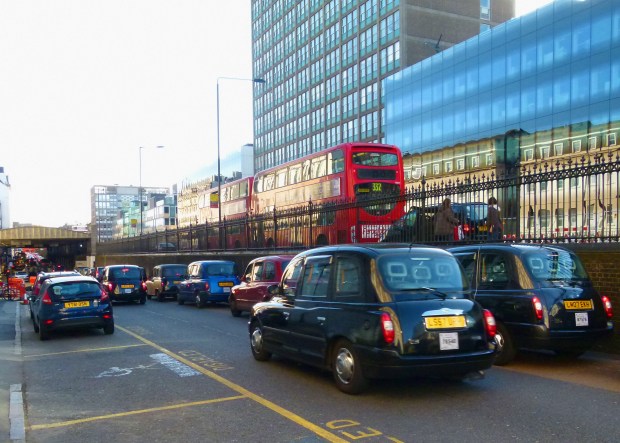
Heading into Paddington Station
“Paddington Station, cabbie… drop us on Spring Street, will you?”
(I’m always relieved when I meet such knowledgeable passengers- these clued up people are all too aware of the logistical nightmare that is trying to get into Paddington Station- when approaching from the south, you are not allowed to turn right into the station… you have to drive past Paddington (often through thick traffic), take the next available turn onto ‘Bishop’s Bridge’ and then spin a u-turn; all time-consuming, meter-ticking stuff. This process can be avoided with a quick, simple drop-off on nearby Spring Street).
“Waterloo Station… I don’t want the main entrance- just by the steps is fine; I don’t mind walking up”
or…
“Waterloo please; I’m in a hurry. Run it through that cut-through…umm… you know; Cornish or something…”
“Cornwall Road and Alaska Street, Sir?”
“That’s the one!”
2) Once you’ve dodged and weaved your way through the traffic, the next task is to find a place where you can pull over and let your passenger out safely.
In an ideal world, where things are smooth and geared towards actually helping people go about their daily business in an efficient manner, this should be a relatively straight-forward task.
In London, of course, it is not.
Upon reaching a station, you are guaranteed to be confronted with an anarchic tangle of taxis, buses and cars; all temporarily pulled over any which way they can in order to execute the very same task you are currently battling to complete. Usually, this vehicular mess resembles a minor pile-up, and you have no option but to slide along and nudge in wherever you can.
If the passenger has luggage, then you quickly hop out and around the cab in order to lend a hand; a risky business considering the never-ending stream of other taxis, buses and cars which are still swarming past, trying to absorb themselves into the mess which you’ve just joined.
It is amazing just how heavy some suitcases (many of which bristle with airport tags from all over the world) can be, and I’ll often worry that my sandwiches, which I carry in a small pack beside me, have been squashed during transit!
3) Once the journey is complete, the final hurdle is to actually exit the station.
Again, this sounds (and, in terms of common sense, should be) fairly easy.
However, when you have to count out change and (if required) jot down time-consuming receipts (for passengers who, only moments before were fretting that they only have a few precious minutes in which to catch their train), this is a fraught process- mainly because of the other taxis, buses and cars which continue to pour behind in a metallic, diesel-shrouded fug, all impatient, all desperate to negotiate their way through.
I’ve lost count of the times I’ve had hot-headed horns blasting at me, or the times in which I’ve been blocked in and unable to manoeuvre out. Leaving stations is often a frantic process, and involves money being stuffed into my coat pocket and pens being hastily being tucked behind my ear or chucked on the dashboard; leaving a slap-dash mess to sort out when I finally escape the station and arrive at my first red-traffic light.
*
Gosh! Now that I’ve relieved that from my tightened chest, I can move on… and state something which I’ve always believed:
Mainly due to the stress-ridden environments in which they fester, London’s railway terminals are in fact truly neglected places; criminally overlooked and shockingly ignored.
When our trains are on time, we breeze through them, paying no attention to the building whatsoever.
When our trains are delayed, we sit around, stewing with hate, cursing everything we see around us; animosities focused on the nearest uniformed representative whom we perceive to be responsible for obstacles which, in reality, often lie many miles, many counties and many regional accents away down the line.
This is very sad indeed… you see, London’s main railway terminals are actually amazing, wonderful places; glorious pieces of architecture; vital components of the capital, with long histories and fascinating stories.
In this new series; ‘Tales From the Terminals’, I shall be writing all about these important buildings; discovering their backgrounds and hopefully sharing some interesting trivia….
*
I’ll begin this exploration with central London’s most westerly terminal:
PADDINGTON STATION
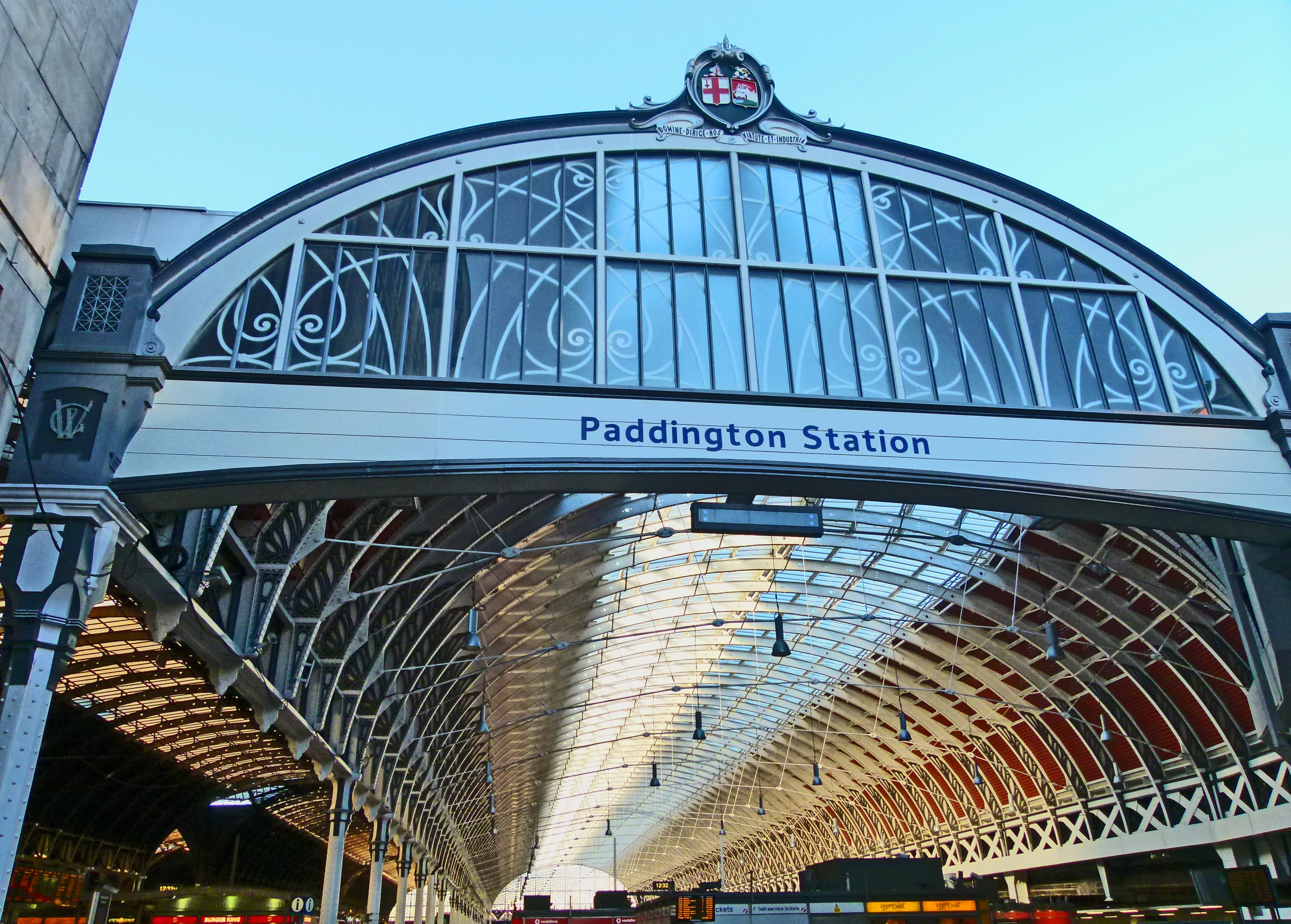
Paddington, which serves trains heading to and from the West Country, is one of London’s most historical stations.
The name, ‘Paddington’ is believed to derive from ‘Padda’; an Anglo-Saxon chieftain who, sometime after the Romans withdrew from Britain in 410 AD, settled his clan in the vicinity of what is now the area around the junction of the Edgware and Bayswater roads.

An artist’s (or, to be more accurate, my) impression of ‘Padda’- which probably isn’t very accurate!
Paddington station was originally a wooden structure, first opened in June 1838 as the London terminal of the Great Western Railway, eventually linking the capital to the bustling port of Bristol, some 120 miles away.
The Great Western railway line was masterminded by the genius engineer, Isambard Kingdom Brunel:

Isambard’s French-born father, Marc Brunel, had also been an engineer- responsible for pioneering the very first tunnel to be burrowed beneath the River Thames (the tunnel is still in use today; now part of the London Overground network, providing a passage for trains between Wapping and Rotherhithe. Above ground, at Rotherhithe, you can visit the Brunel Museum).
In 1833, the Great Western Railway appointed Isambard Kingdom Brunel as their chief engineer, granting him the huge responsibility of creating their planned railway line…. Quite a feat, considering Isambard was only 27 years old at the time!
*
Brunel was a true workaholic.
Setting to work on the task at hand and using a horse and cart as his main transportation, the young engineer surveyed the entire route on his own; a task which he completed within just 3 months.
Brunel was a keen visionary, and he regarded the London to Bristol railway route as the first section of a wider network, ultimately linking London’s Paddington to New York City- the idea being that passengers would travel to Bristol and board a transatlantic steamer (such as The SS Great Britain steam ship- also built by Brunel), which would then whisk them across the ocean.

Statue of Brunel situated at Paddington Station beside Departures Road. The great engineer also has a statue in Bristol (crafted by the same sculptor), both of which were unveiled in May 1982
*
The building of the Great Western Railway was far from easy, necessitating the construction of numerous bridges, viaducts, cuttings and tunnels (including the 2-mile long ‘Box Tunnel’ near Bath; the longest railway tunnel in the world when it first opened).
However, Brunel and his huge team of tough, hard-working navvies were more than capable of the task, and they had the first section open to trains within three years.
So smooth was the route, that the Great Western Railway soon gained the nickname, ‘Brunel’s Billiard Table.’
*
It was at Paddington Station, in 1842, that Queen Victoria arrived after her first ever railway journey, something which would still have been quite a novelty at the time. The Queen travelled from Slough… yep; the very same Slough which was the setting for the BBC comedy, ‘The Office’. Many forget that Slough is actually rather close to Windsor Castle…
Queen Victoria’s engine driver on that historic trip must have really put his foot down, as the trip took a mere 23 minutes at an average speed of 44mph.
The Queen’s husband, Prince Albert, wasn’t too happy with the driver’s speed-demonic ways and, after disembarking at Paddington, he scolded the driver with the words; “Not so fast next time, Mr Conductor”!
Being conveniently placed between Windsor Castle and Buckingham Palace, Paddington Station was well suited to Royal travel, and it was a role which the Great Western Railway were keen to encourage. A royal waiting room; octagonal in shape and lavishly decorated, was therefore built at Paddington Station, and was used by the Royal family right up until the outbreak of WWII.
Today, the waiting room once patronised by Kings and Queens, now serves as the first class waiting lounge.
*
Paddington Station, as we see and use it today, was another Isambard Kingdom Brunel creation, built between 1850 and 1854.
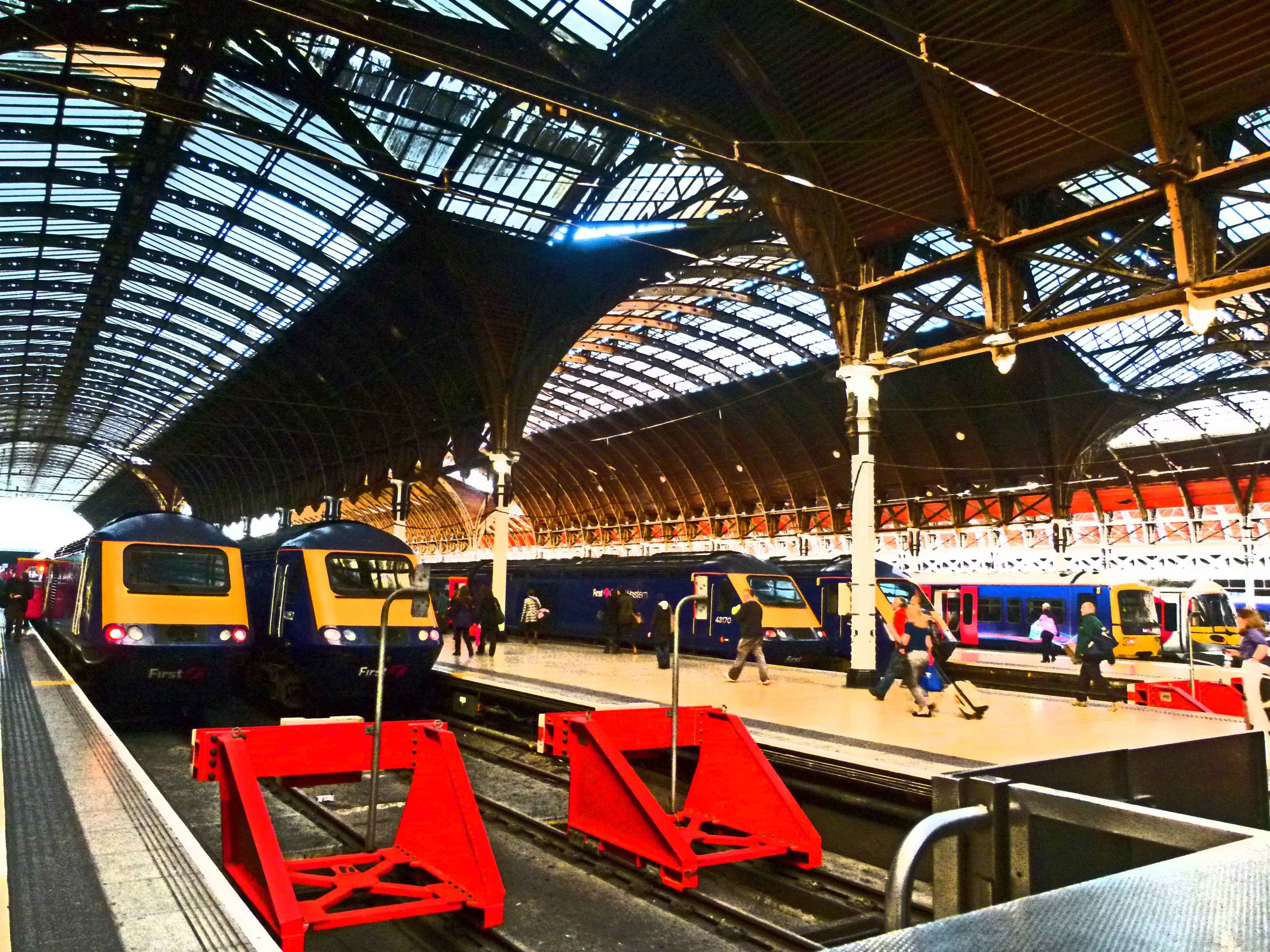
For the beautiful glass roof, Brunel took inspiration from the mighty ‘Crystal Palace’ display venue, which was a contemporary piece of architecture at the time, having opened for the ‘Great Exhibition’ in 1851.
Brunel’s new station was faithfully captured in the 1862 painting, ‘The Railway Station’ by Yorkshire born artist, William Powell Frith.

In his day, Frith was incredibly popular, and large crowds flocked to see his works; The Railway Station being one of his most celebrated.
It was displayed at a gallery on the Haymarket (very close to Trafalgar Square); an exhibition which attracted 21,150 eager visitors; all of whom paid a shilling to study the painting’s many quirks and characters. Contemporary sources reported that Frith was paid somewhere between £8700 and £9000 to create the piece; a fee almost unheard of at the time. Today, the painting is owned by the University of London’s Royal Holloway College.
*
Paddington Station is notable for playing a key role in the creation of the Metropolitan Railway; the great-grandfather of the London Underground (and the world’s very first subway system).
By the 1850s, London’s roads were choked with traffic (sound familiar?!) and, as a result, plan were drawn up to run a railway line beneath the city streets; primarily in order to link London’s major railway termini.
Although many in Victorian society regarded such plans as being rather eccentric and unorthodox, the Great Western Railway agreed to help fund the project and, in return, Paddington Station was made the western terminus of the new-fangled subway.
The world’s first underground railway, linking Paddington in the west to Farringdon in the east, opened in January 1863.
The early London Underground lines were a lot shallower than the later deep-level ‘tubes’ (such as the Bakerloo, Piccadilly and Northern lines), and were built just below street-level using a construction method known as ‘cut and cover.’
In those early days, the trains used on the London Underground were good old fashioned steam engines; noisy, clunking mechanical beasts with a furnace blazing in their guts.
Because they ran underground through confined spaces, the clamour and choking smoke from these engines was intense to say the least. As The Times noted in 1864, a year after the Metropolitan Railway opened;
“it is an insult to common sense to suppose that people would ever prefer to be driven amid palpable darkness through the foul subsoil of London.”

An early, steam-driven, London Underground Train (which can be seen at the London Transport Museum in Covent Garden)
Despite early concerns, the world’s first underground line proved to be a roaring success.
Steam engines were used in the underground tunnels right up until the early 20th century (and were still in service on the Metropolitan line’s outer branches- such as Amersham- right up until 1961).
Today, the historic, trailblazing tunnels which emanate out of Paddington still carry 1,000s upon 1,000s of passengers every day; albeit in cleaner, quieter electric trains!
*
With such a long history, it is perhaps inevitable that Paddington has had to suffer some tragedy during its lifetime.
During WWII, railway lines (which were strategically important in carrying troops and vital supplies) were a key target for Nazi bombers. In 1941, Paddington Station was hit by a particularly powerful parachute-deployed bomb.
The resulting explosion led to a large section of Paddington’s offices being destroyed- leaving a broad gap which is still clearly visible between the buildings today:

More recently, early on 5th October 1999, The Paddington Train Crash occurred a short distance outside the station, in the vicinity of Ladbroke Grove. The accident involved an intercity train, heading from Cheltenham into Paddington, colliding with a smaller, local train, which had mistakenly passed through a red signal.
The resulting crash resulted in a huge fireball in which 31 people lost their lives and some 250 were seriously injured.
Much of the blame for the tragedy lay with ‘Signal SN109’; a set of lights which perched on a particularly high gantry and was notoriously difficult for train drivers to see, especially in the bright sunlight of a crisp, autumn morning.
Thankfully this problem has now been rectified, and such incidents are exceptionally rare on the British railway network.
*
Of course, no account of Paddington Station is complete without mentioning its most famous namesake; the loveable character, Paddington Bear who was first created by author, Michael Bond in 1958.
As the story goes, the little bear, who hails from deepest, darkest Peru, has been sent to England by his Great Aunt Lucy, who is rather elderly and has been forced to enter a home for retired bears, thus making her unable to care for her nephew any longer.
Upon his arrival in England, the refugee bear finds himself at Paddington Station, where he is discovered by the kindly Mr and Mrs Brown.
Upon spotting a tag around the bear’s neck, which pleads, “Please look after his bear…”, the Browns decide to adopt the stray, naming him ‘Paddington’ after the very station in which he was found.
Paddington moves into the Browns’ home; at ’32 Windsor Gardens’ (Windsor Gardens is indeed a real road, and is situated quite close to Paddington Station, just off of the Harrow Road. However, it is little more than a short, stubby dead-end, and there is nothing much to see) and all manner of adventures ensue.
Today, a bronze sculpture of Paddington Bear (based upon the original 1950s drawings) sits within the station. Being life-sized, it is naturally quite small and tricky to find! If you wish to share a seat with the little bear, head for the area towards the rear of the station; you’ll find him hiding amongst the shops, not far from a set of escalators.

Over the years, there have been many Paddington Bear stories, and the furry, railway-station foundling has also starred in a number of TV spin offs; the most well-known being the distinctive BBC adaptation which aired in the 1970s and 1980s.
*
Here, in all its glory, is the very first episode of the BBC series, which dates from 1975.
This is where we first meet the little bear, and much of the action is set within Paddington Station (keep an eye out for the grumpy London cabbie towards the end of the cartoon who appears to be the first ever person in the UK to receive Paddington Bear’s infamous ‘hard stare’! Just for the record, I personally would never dream of charging “sixpence extra” for a bear… let alone an extra nine pence for “sticky bears”!)






 View from the Mirror