Doctor Salter’s Daydream
Over the years, many items of precious, historical interest have been lost in London- fire, bomb-damage and the general passage of time being the main culprits.
A much rarer cause is theft.
*
I was conducting a tour earlier today, and decided to introduce my guest to my favourite London sculpture.
I first came across the statue in question whilst studying ‘The Knowledge; it was a public artwork which I hunted down mainly due to one particular examiner’s regularity in asking candidates the point of interest.
The statue was known as Doctor Salter’s Daydream.
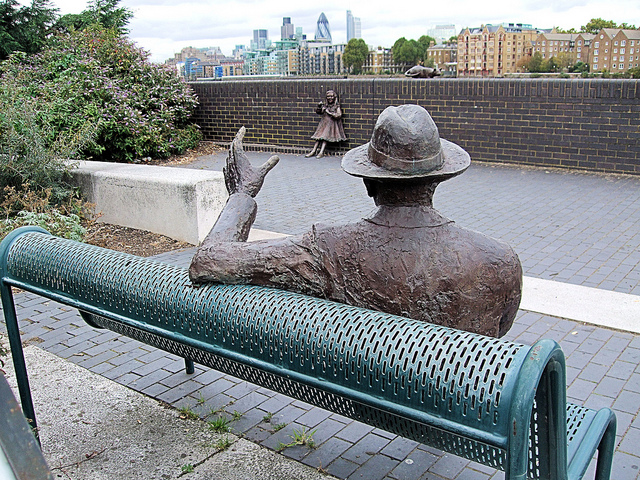
Located on Bermondsey Wall East; an isolated spot by the Thames, the statue was a fairly recent creation in London terms, having been crafted in 1991.
*
On a cold, grey winter afternoon; Tower Bridge and the Gherkin in the near distance, shrouded in a damp mist, we pulled up on Cathay Street; a quiet road opposite The Angel (a wonderful pub which is well worth the visit).
Leading my guest towards the area where the statue was based, I was dismayed to see… absolutely nothing.
A sign fastened to the bench (upon which part of the sculpture once sat) explained the situation: the piece was stolen in November 2011, and a £2,000 bounty was on offer for its safe return. A set of empty, rusty holes; once home to a pair of fastening bolts, confirmed the awful crime.
The notice also informed us that the second half of the statue; which stood by the Thames wall, had been removed and placed in storage by the local council for its own safety.
My heart sunk immediately, for I could only assume that the violation had been committed due to the current trend for pinching valuable metal and selling it for scrap.
A similar event took place in December 2011, in which an abstract Barbara Hepworth sculpture was taken from Dulwich Park having stood there since 1969.
When metal is swiped for scrap, it generally has one fate- to be melted down and re-cast.
*
In order to understand my upset at the disappearance of Dr Salter’s statue, I should explain who he was, and the great poignancy which lay behind his sculpture….
*
Doctor Alfred Salter was a Londoner; born in Greenwich in June 1873.
He came from a humble background; his parents were both deeply religious and his father worked for the Metropolitan Gas Board.
At the age of 16, the young Alfred won a scholarship to study medicine at Guy’s Hospital. He excelled in his chosen field, winning various awards and qualifying as a doctor in 1896.
As a student, Dr Salter had visited many working-class homes in the south London district of Bermondsey, and the shocking poverty he encountered encouraged him to develop a committed social conscience.
*
Shortly after becoming a doctor, Alfred met and fell in love with Ada Brown; a young woman who shared his compassionate attitude towards the poor.
In 1899, Alfred wrote a letter to his beloved Ada, saying:
“I have been paying numerous visits to derelict families… several of the homes I have just been into made me feel aghast at my helplessness and powerlessness to lift their occupants out of their existing poverty and squalor.
Oh, the cruel wickedness of our society today! To thrust down these people by means of low wages and chronic unemployment into hopeless despair, and then leave them in that condition with no organised or conscious effort to rehabilitate them. What can we do?”
Doctor Salter then went onto say:
“You and I feel we have the same mission in life… we are living and working for the same goal- to make the world, and in particular, this corner of the world, happier and holier for our joint lives.”
And so it was done; Alfred and Ada decided to devote their lives to the poverty-stricken residents of Bermondsey.
*
Whilst others with education and the means to afford decent homes in the comfortable suburbs steered well clear of such districts, Alfred and Ada moved into Bermondsey, and the kindly couple set up a practice on Jamaica Road (still a major thoroughfare today, which takes traffic towards the Rotherhithe Tunnel).
At the new practice, medicinal expertise was open to all; Dr Salter charging rock-bottom prices for his services.
It has to be remembered that this was many years before the National Health Service was established, and such a surgery was a godsend to those crippled by poverty and illness.
So successful was the enterprise that Alfred and Ada soon had to recruit more doctors in order to cope with the demand.
*
In 1902, Ada gave birth to a daughter, whom she and Alfred named Joyce, and the burgeoning family soon moved to Storks Road, Bermondsey.
Around this time, a friend called Albert Dawson noted that Dr Salter was “high-spirited and vigorous” in his work; aspects which were bolstered by Ada’s “gentle sweetness and serenity.”
*
In 1910, aged 8, Joyce Salter contracted scarlet fever and became seriously ill.
She was taken to the South Western Hospital, which stood on Landor Road in Stockwell.
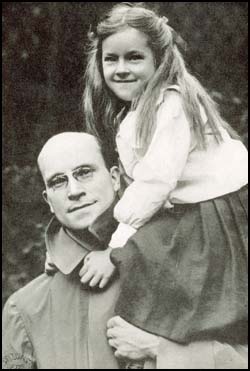
Dr Salter with his daughter, Joyce
The folk of Bermondsey- to whom Joyce’s parents had devoted their lives- had come to love the little girl so much, that they now referred to her as, “our little ray of sunshine.”
So acute was the local concern for Joyce Salter, that Alfred and Ada placed a regular bulletin on their front door, informing the distressed public of their daughter’s progress.
Tragically though, Joyce soon died.
During their lives, the commitment of Doctor Salter and his gentle wife, Ada saved many lives but the couple were sadly unable to save their own daughter.
*
The pair never truly overcame their grief.
Dr Salter kept a picture of his young daughter on the mantelpiece of his study for the remainder of his working life; a portrait which was routinely adorned with fresh flowers every single day.
*
Ada Salter died in December 1942, something which led Alfred to write, “the loneliness… is almost unbearable, but I have to learn to bear it.”
Dr Salter himself died a few years later in 1945- at Guy’s Hospital; the very same institution in which he had trained and gained the knowledge to help those whom he had devoted his life towards.
Dr Salter was buried in Peckham; at the local Friends Meeting House.
*
And so back to the statue of Dr Salter which was so cruelly stolen.
The statue, created by artist Diane Gorvin, was made in three parts.
The first- the piece which was looted- was of Dr Alfred Salter himself, and was placed upon a bench, thus allowing the public to share a seat with the great physician.
Several feet away, situated by the Thames wall, were two smaller statues representing Alfred’s daughter, Joyce and her little, pet cat.
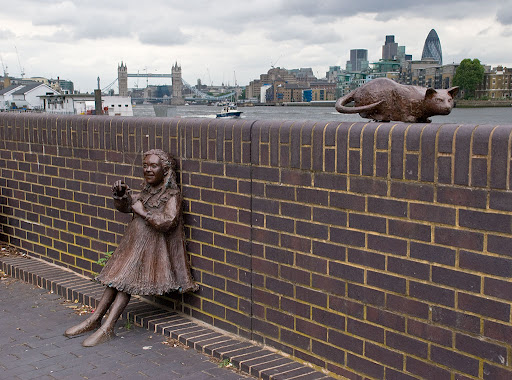
In the installation, Dr Salter was shown waving at the pair.
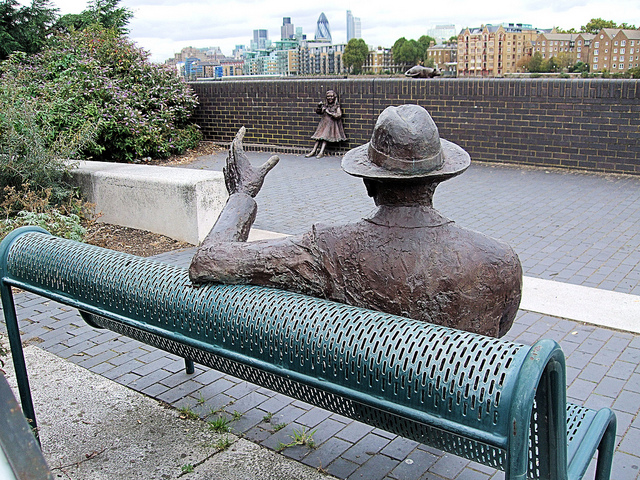
However, the doctor was also portrayed as an old man, and the images which he- and we, the public- gazed upon were effectively ghosts; “shadows of the things that have been” (to quote the ‘Ghost of Christmas Past’ from Charles Dickens’ A Christmas Carol).
The sculpture’s accompanying plaque is still in place, and describes the now missing art piece as representing, “the daydream of an old man remembering happier times when his ‘sunshine’ was still alive.”
*
How I wish that those who stole Dr Salter’s metal representation knew what life and tragedy this beautiful sculpture represented.
* * *
An official campaign to create new statues of Alfred and Ada Salter has been established by local, Bermondsey residents. To find out more, please visit their website:
www.salterstatues.co.uk
Cabbie’s Curios: Mind Your Head!
Over the centuries, there have been several versions of ‘London Bridge’ and, from the original, wooden structure built by London’s ingenious Roman founders, to the present day span which opened in the early 1970s, the crossings have all- give or take a few yards- stood on the same site.
Perhaps the most famous London Bridge was the one built by church chaplin, Peter de Colechurch, which served the city for over 600 years; from approximately 1176 to 1831.
Although it was demolished during the reign of William IV, the old London Bridge is a familiar icon today; famed for being the Thames crossing which boasted 19 arches and a huge array of shops and houses.

For decades (until a second crossing opened at Westminster in the 18th century), London Bridge was the city’s only Thames crossing.
As such, it was also a major route into the capital for travellers approaching from the south; a fact which remains to this day (follow the A3 road directly south from London Bridge, and you will eventually end up in the important maritime city of Portsmouth).
*
In days gone by, the historical City of London was technically a gated community; surrounded by a lofty wall and controlled entry and exit points. Keeping in line with this, the Southwark end of the bridge was fortified with a gatehouse and drawbridge.
The southern tip of London Bridge also had a more sinister way of dissuading potential scallywags…
For many years, the top of the gatehouse was home to a collection of vicious spikes; long, sharp poles upon which were stuck the heads of executed criminals.
Whenever a fresh head was brought along for display, one of the bridge’s gatekeepers would first parboil the unfortunate noggin, before proceeding to dip it in tar; a tried and tested recipe which ensured the decapitated head would persevere for a while; offering it some protection from London’s biting weather, and the unwanted pecking of pesky birds.
After a few weeks or months, when said head lost its charm and began to give off a stench that was noticeably stronger than the surrounding piles of mouldering rubbish and animal dung, the gatekeeper would simply climb up, pluck it off the spike and toss the rotting remains into the Thames.
*
The very first head to be exhibited in this grim way belonged to a very famous historical figure indeed; Scotsman, William Wallace.
Following his gruesome execution at West Smithfield (where a memorial can be found today) in 1305, the Scottish nobleman’s decapitated head, which had once played host to patriotic notions, was hoisted above the bridge, kick-starting the morbid custom.
Other famous bonces to displayed above the old London Bridge belonged to Jack Cade (ringleader of a huge, 15th century rebellion) and Sir Thomas More; the unfortunate political figure who happened to fall foul of the tyrannical King Henry VIII, and was put to death in 1535 (it is said that More’s daughter, Margaret Roper, managed to retrieve her father’s head from London Bridge, and had it buried at St Dunstan’s church in Canterbury).
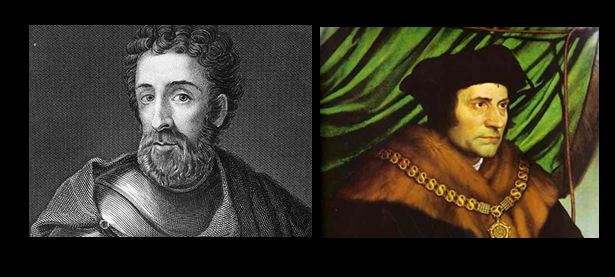
William Wallace and Sir Thomas More; the heads of whom ended up being displayed on London Bridge
Countless heads were plonked above the entrance to London Bridge over the years.
In 1598 for example, one German visitor noted that there were over 30 on display; a truly gruesome gaggle.
Similarly, in 1616, Dutch engraver, Claes Jansz Visscher, created his stunning panorama of London; a beautiful and historically priceless etching which provides us with a view of London, prior to the Great Fire of 1666.
Sketching his masterpiece from a perch close to London Bridge, Claes was able to observe the open-air gallery of heads, and jotted them down accordingly:

The custom of exhibiting chopped off heads on London Bridge continued for 355 years; the last victims being aired in 1660.
*
Today, the gruesome ritual is commemorated via a simple, yet elegant sculpture; a towering spike which stands outside the modern office block known as ‘Number One, London Bridge.’

In a way, the grisly practice is also recalled- albeit unintentionally (or maybe subconsciously…)- by the soon-to-be completed ‘Shard Tower‘; a spike-shaped 1,012 ft. tall skyscraper which stands a short distance from the present day London Bridge, and will be Western Europe’s tallest building when it finally opens…

An Eccentric Restaurateur
This is the entrance to Langan’s Brasserie; one of those London restaurants which has acquired something of a cult status:

Situated just off of Piccadilly on Stratton Street, Langan’s was opened in October 1976 by Peter Langan; a charismatic entrepreneur from Ireland.
Peter’s new venture was in partnership with none other than the actor, Sir Michael Caine (a figure who, as regular readers will know, has cropped up in a number of my recent blog posts- Sir Michael is clearly one of London’s most influential sons!)
Peter Langan was a genius businessman; flamboyant and controversial.
One of his more bizarre stunts was to crawl across the restaurant’s floor, biting the ankles of his customers. He was also famed for putting out a fire in the eatery’s kitchen- with a bottle of vintage champagne.
In a particularly notorious episode, a customer discovered a cockroach and subsequently presented his find to the restaurant’s owner. Peter Langan responded by eating the offending creepy-crawly! (This was of course, many years before the bug-munching antics of ITV’s I’m a Celebrity, Get Me Out of Here!)
*
Sitting in the heart of Mayfair, Peter Langan made sure that his restaurant was becoming of its plush location.
The walls of the restaurant are decked out with some fine examples of 20th century art- including works by David Hockney, Lucien Freud and Francis Bacon. Peter had acquired many of his valuable paintings at his previous establishment; Odin’s (still open, on Devonshire Street), where he maintained a policy of accepting artwork in lieu of cash.
To this day, Langan’s upholds a policy of encouraging new art; maintaining a wall by the bar upon which up and coming artists can display their work (even ‘wacky’ children’s entertainer Timmy Mallet– a surprisingly good artist- has exhibited his canvases there!)
*
Peter Langan liked to play as hard as he worked, and was a shockingly heavy drinker. So bad was his alcoholism, that he could often be spotted during service… fast asleep beneath one of the brasserie’s tables.
Perhaps inevitably, it was this out of control boozing which led to Peter’s death in December 1988.
After a huge, drunken argument with his wife (in which she threatened to leave him), he set fire to his house and perished in the subsequent blaze.
He was 47 years old.

Peter Langan, 1984 (photo owned by the National Portrait Gallery)
Although Peter Langan died almost 25 years ago, and Sir Michael Caine sold his share of the business in 2003, Langan’s Brasserie is still going strong today.







 View from the Mirror