Waterloo Reggae
This is Clive; one of London’s true characters.
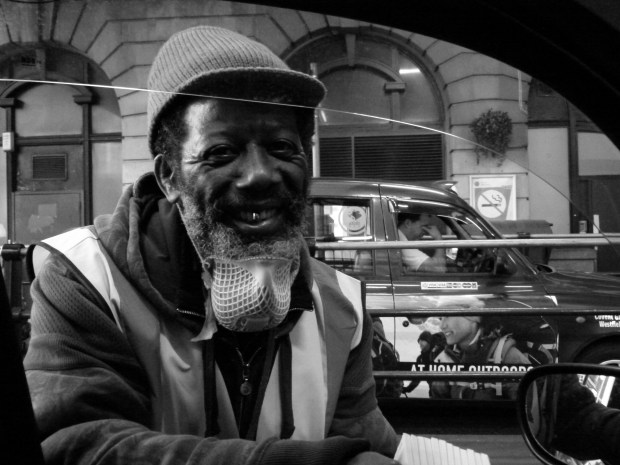
Photo of Clive Natural, taken at Waterloo Station from the seat of my taxi
Clive’s full name is Clive Nugent, but he prefers to call himself Clive Natural; a reference to his outlook and approach to life.
Any London Cabbie who works during the daytime will be familiar with Clive. You can often find him at either Paddington or Waterloo Station, where he runs a business providing useful items such as receipt books and cab-stickers.
If Clive’s around, you’ll see him as you pull up beside the station’s taxi rank to pick up or drop off a passenger. He’ll be there; casually pacing up and down the long lines of cabs, wearing his bright yellow high-visibility jacket, receipt books in hand, chatting and joking away with the taxi drivers.
You’d be surprised just how many receipts us cabbie’s dish out in the course of a day’s work, so it’s always vital that they are kept to hand. Clive’s receipt pads are the cheapest in town; three blocks for a mere £1.20. I keep trying to tell him that he’s practically giving them away, but his response is always the same- the cabbies would “cry” if he were to put the prices up, especially in these financially difficult times!
The environment in which Clive works each day is hectic, noisy and grimy.
At Paddington and Waterloo, the taxi ranks and drop-off points are very close to the railway platforms and, as Clive plies his trade, he is surrounded by rumbling taxi engines, belching diesel trains and thousands of people, swarming in and out of the main line terminals in a never-ending stream.
The noise created by these elements is deafening; a constant, background roar, frequently punctuated by the loud, but melodic ‘ding-dinngg-dinngg-dinnnggg’ of the station tannoy, booming out echoing security notices and information on train departures, delays and arrivals.
Because of the fumes generated by trains, cabs and buses, Clive often wears a mask over his nose and face in order to protect his lungs from the polluting onslaught (he removed the mask for the above photo, but you can see it hanging around his beard).
The harsh, smoky atmosphere; characterized by iron and concrete, in which Clive spends his working day, is a far-cry from his native Jamaica. Originally from Trench Town, Clive moved to the UK in 1971.
Today, with his friendly nature and good humour, he certainly brings a touch of Caribbean sunshine to the cab ranks- I can safely say I’ve never seen Clive looking miserable!
*
I first met Clive at Paddington Station, not long after beginning my career as a cabbie. In urgent need of some receipts, I gladly purchased a few books off of him.
The receipts are designed by Clive himself and, later that day, I noticed a tiny web-address printed in the bottom right hand corner of each one.
Typing the address into my browser, I was directed to Clive’s site- whereupon I discovered a well-kept secret: that he is, in fact, a gifted musician.
When I next saw Clive, I asked him about his musical profession, and why he was selling receipts and stickers rather than pursuing his talent. He laughed, and replied;
“Well, a man’s got to eat!”
*
Clive Natural’s career as musician is an impressive one which stretches back many years.
As mentioned earlier, Clive is originally from Trench Town; a part of Jamaica which is notoriously tough, but has also provided a fertile ground from which some of the greatest names in Reggae have sprung: Peter Tosh, ‘Toots and the Maytals’ and of course, the legendary Bob Marley all have their roots in Trench Town.
Being a relatively compact community, Clive knew Bob personally as a young man, along with members of his backing group, ‘The Wailers’ (if you get Clive talking on the subject, he’s able to give you a detailed account of each Wailer and where their lives eventually took them).
Shortly after first arriving in the UK in the early 70s, Clive joined a band called ‘Nyabingi’ and, in 1977, the group supported the late, great Barry White at the ‘Rainbow Theatre’; a once legendary music venue on Seven Sisters Road, near Finsbury Park in North London.
When I first asked Clive about the musical side of his life, he revealed that, as well as his taxi bits and pieces, he also had a few copies of his albums tucked away in his work bag. I purchased two; ‘Shine the Light’, which he recorded in the early 1980s, and his latest project, ‘Set It.’

For ‘Set It’, Clive was able to gain a well-earned break, travelling back to Jamaica, where the album was recorded at a Kingston based studio. Further work on the album was carried out back in London; on Coldharbour Lane in the heart of Brixton.
Although I purchased ‘Set It’ some months ago, it is only recently that Clive has been able to start fully getting it out to the public; he hopes to have the album for sale on both ‘E-Music’ and ‘I-Tunes’ very soon.
The album contains some great reggae, and I was especially taken in by the second track; ‘TrenchTown’; a clever (although sad) song, in which Clive sings about the neighbourhood in which he spent his childhood, before it succumbed to violence and instability. The twist in the song is that it’s a loose, reggae-based version of Petula Clarke’s 1964 hit, ‘Downtown’.
If you want a flavour of Clive Natural’s music, you can treat your ears to some examples of his earlier work here, on his website (click on the ‘samples’ section).
You can also hear the great man talking about his latest album in the following, short clip:
http://www.youtube.com/watch?v=BrHDsc0bRJY
Thanks for brightening up the ranks, Clive!

Cabbie’s Curios; the London Eye capsules
The ‘London Eye’, although a relatively recent edition to the capital (it opened in 1999, just in time for the Millennium), is now one of London’s most celebrated Landmarks.
A spin on the London Eye takes around 30 minutes; the spectators enjoying their journey from any one of the specially designed viewing capsules.
In all, there are 32 of these capsules…
That’s one for each London Borough!
In case you were wondering; a list of all of London’s Boroughs can be found here.

Cabbie’s Curios: The Unfinished Motorway…
First opened in 1959, the M1 is one of Britain’s major motorways. Almost 200 miles long, it links London to the city of Leeds in West Yorkshire.
The London terminal of the M1 is at ‘Staples Corner’ (named after ‘Staples Mattress Factory‘, which stood at the major junction from 1926 until 1986).
The start of the M1 is also beside ‘Brent Cross Shopping Centre’; the UK’s first major indoor shopping mall, which opened in 1976.
If leaving the M1 at Junction 1, you’ll notice that the motorway splits apart, forcing exiting traffic into a slip road. Drivers concentrating on the road ahead will easily miss the fact that the slip road runs alongside a short-stretch of derelict, weed-strewn concrete.

This abandoned length of tarmac is a ‘ghost road’; a section which was built but never used; construction quickly being stopped. The short piece of road actually marks the direction of the route which the M1 was originally intended to take…
In the 1960s and 1970s, the authorities envisioned all manner of motorways and ring-roads, ploughing right through our cities with scant regard for the surrounding environment, architecture or residents.
The primary goal of these enlightened planners was to carry the broad stretch of hulking, M1 motorway all the way into Central London; ploughing through neighbourhoods, and soaring above rooftops via monstrous flyovers.
The original M1 route would have roared through Cricklewood, thundered past Kilburn and Maida Vale and torn down through St John’s Wood. If the planners had their way,the M1 motorway would have terminated just north of Marble Arch; in the vicinity of the tranquil Montague Square (which, no doubt, would have been ripped apart and buried beneath copious amounts of stark concrete).
Thankfully, the authorities saw sense, and the scheme was never fully realised. The M1 now terminates in the suburbs, approximately 6 miles from Marble Arch.
Having said that, the M1 is my main route into London and, on my grumpier days, I sometimes wish that there was a quick, concrete strip to speed myself and my taxi into the direct centre of town! Oh well, no matter what its length, I’m sure it would have been choked with traffic!







 View from the Mirror