Cabbie’s Curios: London’s Earliest Photograph
Can you imagine just how many photographs of London have been taken over the years, both by professional snappers and casual clickers?
If it were at all possible to produce such a figure, I’m sure it would be even higher than the number currently associated with the level of debt held by Greece (about 340 Billion Euros at the moment; give or take a cent!)
I sometimes find myself wondering how many of those London photos I’ve accidentally appeared in? How many albums, created by tourists from all over the world, contain unintentional pics of myself, my family and friends?
Every single time I venture into London; both for cabbing and leisure, it’s inevitable that I’ll be caught in the background of some picture or other, so prevalent are cameras in our highly photogenic capital.
When I’m out working, this number increases, as the London Taxi is a tourist attraction in its own right. Not a day goes by when I don’t spot at least one tourist pointing a camera in my direction and, on some occasions, I’m even asked to pose! Gosh, it’s like being a celebrity sometimes!
Bearing such things in mind, I find the following image almost impossible to comprehend…
I give you, London’s earliest surviving photograph:

This picture was taken in 1839.
To put that into some context, Queen Victoria had only been on the throne for two years, and Charles Dickens’ early novel, ‘Oliver Twist‘ was fresh off the press, having being published only a year before.
Frederic Chopin and Giuseppe Verdi were actively composing music, and JMW Turner was the talk of London’s art scene.
The photograph is essentially a tourist snap, captured by Frenchman, ‘M de St Croix‘, who’d travelled to London in order to demonstrate the new-fangled science of photography, which was being pioneered back home by his fellow countryman, Louis Daguerre.
The scene depicts a statue of King Charles I on horseback, which was sculpted in 1633 by another French fellow called Hubert Le Seur (after the King was executed in 1649, this statue was buried and hidden by John Rivet; a metal worker and secret Royalist. Upon the Restoration of the monarchy, he dug it up and presented it to a grateful King Charles II).
If you wish to see the statue today, it’s very easy to find- just head for Trafalgar Square, where you’ll find it looking pretty much the same, gazing down towards Whitehall, and proudly perched in front of Nelson’s column (which hadn’t even been built when this pioneering photograph was taken!)
Today, the location is called ‘King Charles Island‘, and this long-surviving statue, now besieged by roaring circles of traffic, marks the official centre of London, from which all distances to the British Capital are measured.
*
Funnily enough, I took my very first photograph of London a few feet away from King Charles Island. It was quite a few years after M de St Croix’s shot though… I snapped this one back in September 1986!

London Can Take It
The current state of international finance has indeed created tough times.
Whilst training to be a London Cabbie, I was under the impression that the build up to Christmas (i.e November and December), would be one of the most lucrative periods of the year.
Alas, November so far has been dire.
Although not one to discuss finance, I must say that the previous week has been disastrous, and I’ve only just about managed to scrape enough to cover my costs; the profit I’ve made being barely enough to cover the price of a fish and chip supper.
To make matters worse, my local garage increased their fuel prices today… and, whenever that occurs, I have to take a pay-cut.
*
Despite living in economically harsh times, I constantly keep trying to remind myself that things go in cycles; economies dip and peak, recessions occur and ‘boom-times‘ present themselves with a fiscal bang.
As we British say; one must “keep a stiff upper lip.” Dark days may lie ahead, but a light beams at the end of the proverbial tunnel.
Bearing this in mind, and after a particularly soul-destroying Friday, I was reminded of an old film from the 1940s entitled, ‘London Can Take It’; a documentary made during the height of the London Blitz, in which Nazi bombers subjected the British Capital, and other UK cities, to an endless campaign of ferocious, night-time bombing.
This was when Londoners really did have it tough; a terrifying era which makes my current financial woes seem like chicken-feed in comparison.
I’ll let the following video; made in 1940 and narrated by the American journalist, Quentin Reynolds, speak for itself.
All that I will say is that is that it makes my current problems appear trivial… and that the resilience on display, in the face of such a disgusting fascism, only serves to make me love my City with an even greater passion… (note the scene towards the very end; a cabbie in a particularly vintage taxi, providing an Air-Raid Warden with a light for his smoke!)
Waterloo Sunset
Of all the bridges which span London’s infamous River Thames, my favourite, without a shadow of a doubt, is Waterloo Bridge.
Over the years, there have been two of these beauties.
The first was masterminded by John Rennie; a Scotsman and genius architect, famed for his work on docks and river crossings.
The original Waterloo Bridge was opened on the 18th June 1817, the ceremony being preformed by the Prince Regent; son of King George III.
King George was a monarch who suffered from serious bouts of mental illness- a tragic affliction which his son took great advantage of.
Whilst his father was ill, the Prince Regent perused his own form of madness, gambling away his dad’s cash on high-stake card games and grandiose construction schemes… crazy stuff, although his delusional building ambitions did eventually result in the creation of Regent’s Street, Regent’s Park and the Brighton Pavillion!
In 1899, the celebrated French Impressionist artist, Claude Monet came to London. Setting up camp in the luxury Savoy Hotel, Monet painted a number of London scenes including several of the nearby Waterloo Bridge:
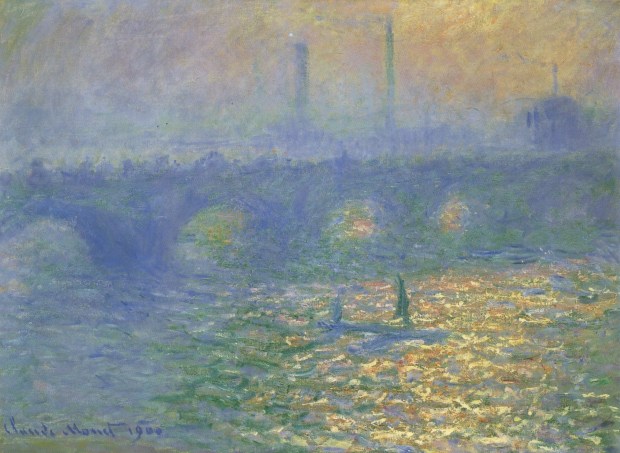
Waterloo Bridge, Sunlight Effect. One of a series by Claude Monet, painted between 1899-1901
By 1923, the piers which supported the old bridge were beginning to sink and, in 1936, the crossing had to be demolished (albeit to much protest).
*
The current Waterloo Bridge was designed by Sir Giles Gilbert Scott and, being built during the early 1940s, when World War Two was raging and most of the male workforce were conscripted into the armed forces, construction was primarily carried out by female labour gangs… hence the crossing being nicknamed “The Ladies’ Bridge” (and a truly superb job they did too).
In my humble opinion, the view from Waterloo Bridge is the best in London, and I always get a tingle when I drive across it.
Being situated over a bend in the River Thames, the panorama allows a broad, sweeping view of both the financial City and Royal Westminster.
The historical elegance of St Paul’s Cathedral and the Houses of Parliament are gorgeously presented from Waterloo Bridge, as are the more recent additions of the London Eye and soaring skyscrapers.
Whenever I drive over Waterloo Bridge (and not a working-day goes by when I don’t), I frequently think of the 1967 song, ‘Waterloo Sunset’ by ‘The Kinks’; a beautiful (although melancholy) tune, which perfectly sums up the allure of this breathtaking Thames crossing (and, of course, contains the wonderful line; “taxi lights shine so bright”….)







 View from the Mirror